
To verify a Christian senior care ministry’s nonprofit status is to answer a basic stewardship question: is this organization legally and structurally accountable in the ways it claims to be? For Christian donors supporting elder care, the stakes are not merely administrative. Vulnerable seniors can be exploited through opaque billing, misleading fundraising, or unstable operations that fail when care is needed most.
Nonprofit status is not a guarantee of faithfulness, competence, or even honesty. But it is a threshold test. It establishes a public record, a regulatory framework, and a set of required disclosures that allow donors to exercise prudence without cynicism. Scripture commends generosity, and it also commends discernment. “Let the wise listen and add to their learning” (Proverbs 1:5). Verifying status is one concrete way to do so.
Start with the IRS determination and classification
The cleanest starting point is whether the ministry is recognized by the Internal Revenue Service as tax-exempt. In the United States, most donor-supported ministries that are not churches will be organized under section 501(c)(3). Some Christian senior care organizations also operate as affiliates of a church or denomination, or as integrated auxiliaries, which affects what appears in public databases. The point is not to force every ministry into the same mold, but to confirm that its stated structure matches reality.
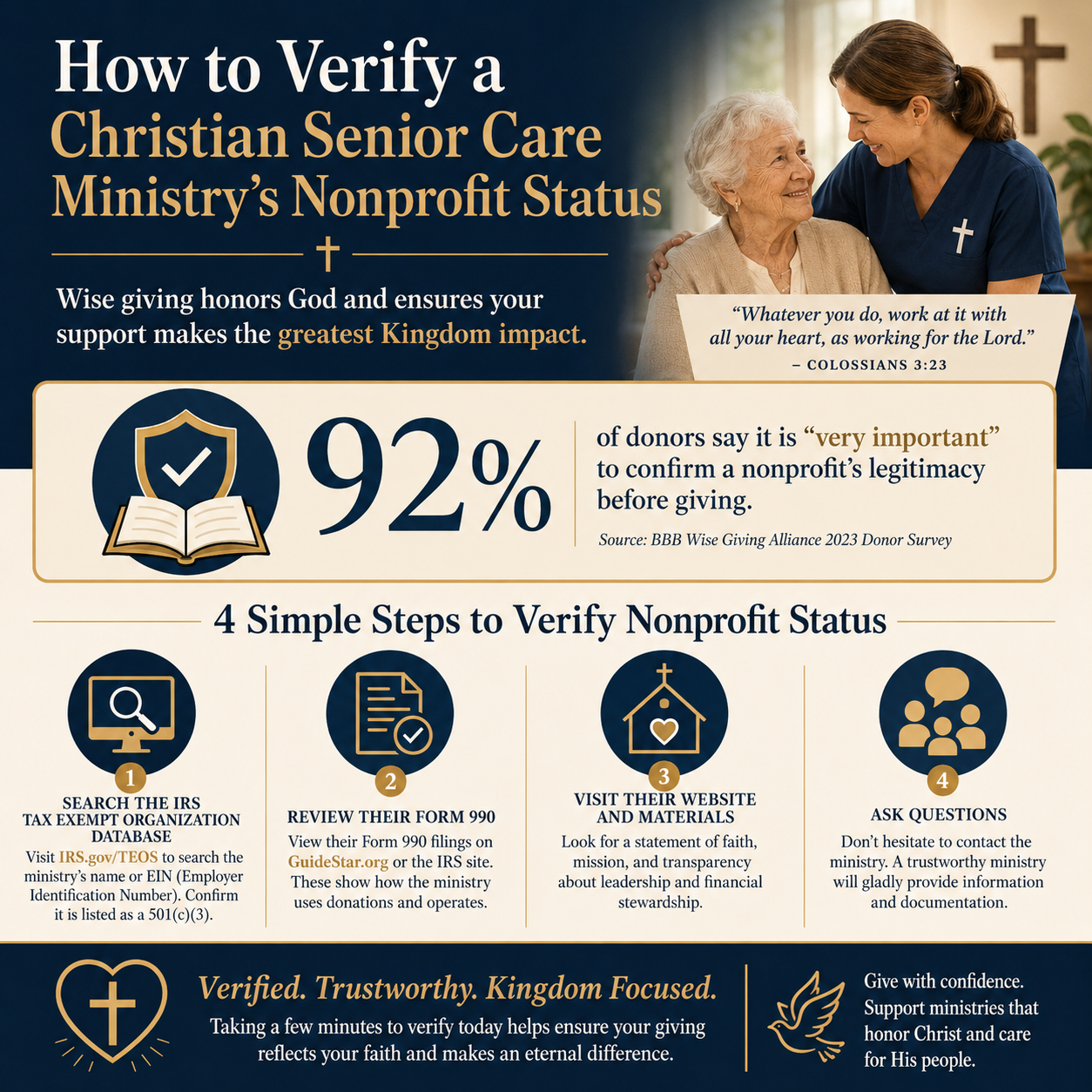
Use the IRS Tax Exempt Organization Search
The IRS provides the Tax Exempt Organization Search (TEOS), which allows donors to confirm whether an entity is eligible to receive tax-deductible contributions and to review certain filings. Start by searching the legal name and location. If the ministry has a common “doing business as” name, ask for the legal name used for IRS purposes and the Employer Identification Number.
Primary checkpoint: does the listing show the organization as eligible to receive tax-deductible charitable contributions? If the ministry says it is a 501(c)(3) but is not listed, that is a reason to pause and ask questions, not a reason to assume wrongdoing. There are legitimate edge cases, especially for church-related entities. But ambiguity should be resolved before giving.
IRS TEOS: https://www.irs.gov/charities-non-profits/tax-exempt-organization-search
Confirm the organization type and what it implies
When an entity is listed, verify the classification (typically 501(c)(3)) and pay attention to whether it is a public charity or a private foundation. Most ministries seeking broad donor support operate as public charities. Private foundation status is not disqualifying, but it carries different regulatory expectations and often reflects a different funding model.
Also note revocation status. The IRS revokes exemption for organizations that fail to file required annual returns (Form 990-series) for three consecutive years. A ministry can be reinstated, but donors should treat any revocation and reinstatement history as a prompt for deeper review of governance and administrative discipline.

Read the Form 990 with care and with humility
If the organization is required to file a Form 990 (or 990-EZ), the filing is one of the most practical tools donors have. It is also frequently misused. A 990 is a compliance document, not a ministry report. It can reveal serious issues, but it can also be misunderstood by readers who assume that every number communicates impact.
Find the 990 from reliable repositories
Many ministries link to their 990s on their own websites. That is helpful, but donors should also check independent repositories such as GuideStar (Candid) or ProPublica’s Nonprofit Explorer, which publish IRS-sourced filings. This reduces the risk of reviewing an outdated, incomplete, or selectively presented document.
Candid GuideStar: https://www.guidestar.org/
ProPublica Nonprofit Explorer: https://projects.propublica.org/nonprofits/
Focus on governance, related parties, and financial signals
For senior care ministries, several parts of the 990 deserve special attention. First, governance: does the organization list independent voting board members, and does it document key policies such as conflict of interest and whistleblower protections? Second, related-party transactions: are there payments to board members, officers, or their businesses? These are not automatically improper, but they require disclosure and careful oversight.
Third, program description and revenue model: senior care can involve residential facilities, home-based services, care coordination, counseling, chaplaincy, and benevolence. The 990 should make the basic model intelligible. If the ministry’s public messaging emphasizes benevolence while the 990 indicates that most revenue is fee-for-service or facility income, that mismatch should be clarified. Christian donors can support a fee-based model, but truthfulness about the model is part of integrity.
Cross-check state registration and corporate records
Federal tax exemption is only part of the accountability picture. Most states maintain public records for charitable organizations and business entities. These records can confirm whether the nonprofit is in good standing, whether it is registered to solicit donations, and whether there have been enforcement actions.
Verify charitable solicitation registration where required
Many states require charities to register before soliciting donations from residents of that state. Requirements vary, and some religious organizations are exempt in certain jurisdictions. Still, Christian ministries that solicit broadly—especially online—should be able to explain how they approach multi-state compliance.
Use the National Association of State Charity Officials (NASCO) to find your state charity regulator. NASCO directory: https://www.nasconet.org/
Check the secretary of state business entity database
Separately, check the organization’s corporate status through the secretary of state (or equivalent) in the state where it is incorporated. Look for “active” or “in good standing” status, and confirm the registered agent and address. Frequent changes in address or a pattern of administrative dissolution and reinstatement is not proof of malfeasance, but it does suggest instability that donors should weigh carefully, especially in ministries serving seniors who cannot easily absorb disruption.
When donors are deciding between several ministries, the broader context of accountability matters. Many of the questions we see in our verification work are addressed within Accountability and Transparency in Christian Senior Care Ministries, because nonprofit status is foundational but not sufficient.
Ask whether the ministry is a church, an affiliate, or a service provider
Christian senior care ministries sit at the intersection of congregational care, social services, and sometimes health care. Donors can be misled when they assume every organization should have the same public filings, or when ministries use “church” language to avoid legitimate scrutiny. Christians genuinely disagree about how much public disclosure should be expected from church-connected work. But donors can still ask structured questions that honor religious liberty while insisting on honesty.
Church-related entities may not file 990s
Churches and certain affiliated entities are generally not required to file Form 990. That can be appropriate, but it means donors must look for other verifiable indicators of accountability: audited financials, independent board oversight, clear conflict-of-interest practices, and transparent reporting on restricted gifts.
If an organization claims it is “under a church umbrella,” ask for specifics. Which church? What legal relationship exists? Is the ministry a separate corporation, a department, or a related entity? Donors should be able to see documentation—such as corporate records, a letter from the church, or governance documents—that clarifies the relationship.
Senior care may involve regulated services and contractual complexity
Some Christian ministries provide direct care through licensed facilities or home health operations; others offer spiritual care, visitation, caregiver respite, transportation, or financial assistance. The closer the organization is to regulated healthcare or residential services, the more complex the compliance environment becomes. Donors should not assume that “nonprofit” means “low risk.” They should expect leaders to be candid about licensure, quality assurance, and how the ministry handles complaints and critical incidents.
At Most Trusted, our evaluations against The Most Trusted Standard pay attention to these boundary lines, because donors deserve clarity about what a ministry is and what it is not. A vague identity often correlates with weak governance, even when intentions are sincere.
Use a disciplined donor checklist before you give
Verification is not suspicion; it is stewardship. The goal is to reduce avoidable uncertainty and to direct generosity toward ministries that can sustain faithful care. Senior care is long obedience in the same direction, and donors should favor organizations that demonstrate the same long-term seriousness in governance and financial integrity.
A short checklist for nonprofit status verification
- Confirm the legal name and EIN, then verify eligibility in IRS TEOS.
- Locate the most recent Form 990 or 990-EZ in an independent repository, if filing is required.
- Review governance disclosures, related-party transactions, and clarity of revenue model.
- Check state charity registration requirements and the organization’s registration status where applicable.
- Verify corporate good standing through the state’s business entity database.
Know what nonprofit status does not prove
A verified 501(c)(3) status does not prove that a ministry is theologically sound, that its care is clinically appropriate, or that it treats seniors with dignity. It does not guarantee that the board is independent, that fundraising is restrained, or that restricted gifts are handled faithfully. It simply establishes that the organization exists in a public regulatory framework.
The harder question is whether the ministry’s operations are consistent with Christian truthfulness and love of neighbor. For donors who want that broader lens, Christian Senior Care Ministries addresses the wider terrain: spiritual formation, stewardship, care ethics, and organizational credibility.
FAQs for How to verify a Christian senior care ministry’s nonprofit status
What if the ministry says it is a nonprofit but we cannot find it in IRS TEOS?
Do not give until the discrepancy is resolved. Ask for the legal name and EIN, and request documentation of tax-exempt status, such as the IRS determination letter. If the organization is church-related, ask for a clear explanation of the legal relationship and what accountability mechanisms substitute for a public 990. Some entities are legitimately difficult to locate because of naming differences or recent formation, but donors should not be asked to fund ambiguity.
Is it a red flag if a Christian senior care ministry does not publish a Form 990?
It depends on whether the ministry is required to file. If it is a public charity that files a 990, unwillingness to share it is a credibility problem because the document is already public through the IRS. If it is a church or an exempt church-affiliated entity, it may not file a 990; in that case, donors should expect alternative transparency such as audited statements, a clear governance structure, and documented policies that protect against conflicts of interest and misuse of restricted gifts.
A status check is the beginning of wise generosity
Christian donors give not only to meet needs, but to honor Christ in the way resources are stewarded. Verifying nonprofit status is a modest act of diligence with outsized consequences: it filters out preventable risk, clarifies what kind of organization you are supporting, and creates space for deeper questions about faithfulness, competence, and care. The ministries most worthy of trust tend to welcome that diligence, because they understand that transparency is not an enemy of ministry; it is a form of integrity.



