

Reading Christian senior care ministry financial reports is one of the most concrete ways donors can practice stewardship without cynicism. The numbers will never tell the whole story of faithfulness, but they can tell the truth about whether a ministry is positioned to keep caring for older adults with dignity.
Scripture treats money as a discipleship matter, not merely an administrative one. Jesus’ repeated teaching about wealth and trust forces a question behind every audited statement: is this ministry handling resources in a way that reflects the character of God, protects vulnerable people, and sustains the work over time?
Start with the documents that carry real accountability
Audit, reviewed statements, and what each one can and cannot say
Not every ministry will have the same level of financial reporting, and that difference matters. An independent audit is the strongest common signal in nonprofit finance because it requires an outside firm to test internal controls and verify that statements are materially accurate under established standards. A review is less intensive; a compilation is largely formatting without assurance.
What this means in practice is that donors should ask: does the organization provide audited financial statements, and are they current? A clean opinion does not guarantee wisdom or holiness, but it does reduce the risk that basic categories are being misrepresented.
Form 990 and why it is useful even when it is imperfect
If the ministry is a U.S. 501(c)(3) public charity, its IRS Form 990 can be a valuable cross-check because it forces consistent disclosure about revenue, expenses, governance, and certain transactions. Churches are generally exempt from filing; church-affiliated senior care ministries may or may not file depending on legal structure.
When a 990 is available, confirm that the narrative the ministry tells matches what it reports to the IRS. Donors can access many filings through the IRS tax-exempt organization search, which is an official federal source: IRS.

Read the revenue story before you evaluate the spending story
How ministries are funded shapes both resilience and risk
Senior care ministries often operate with a complex revenue mix: resident fees, Medicare and Medicaid reimbursements, philanthropic gifts, endowment income, and grants. Each stream has different volatility and different ethical pressures. A ministry heavily dependent on government reimbursement may face policy-driven margin compression; a ministry heavily dependent on donations may face fundraising pressure that can distort messaging or program design.
On the financial statements, start with the statement of activities and ask whether revenue sources are diversified enough to carry the ministry through cycles. Concentration can be appropriate, but it should be visible, acknowledged, and managed rather than ignored.
Restricted gifts and why the fine print matters
Many senior care ministries receive restricted gifts for capital projects, benevolence funds, chaplaincy, or specific campuses. Restricted revenue is not inherently better; it is a promise the ministry must keep. Strong reporting explains how restricted funds are tracked and released for their intended purpose.
Donors should be alert to a common misunderstanding: a large increase in contributions can coincide with cash strain if gifts are restricted to buildings while operating costs rise. Financial statements that clearly separate restricted and unrestricted activity help donors see whether generosity is supporting both expansion and daily care.
Evaluate expense categories with moral realism, not simplistic ratios
Why overhead ratios cannot carry the weight donors place on them
Christian donors often want a single percentage that proves efficiency. The sector has had to reckon with how misleading that instinct can be. Charity Navigator, Candid, and the BBB Wise Giving Alliance jointly warned against treating overhead as the primary measure of nonprofit performance, noting that underinvestment in administration can undermine results and accountability: Charity Navigator.
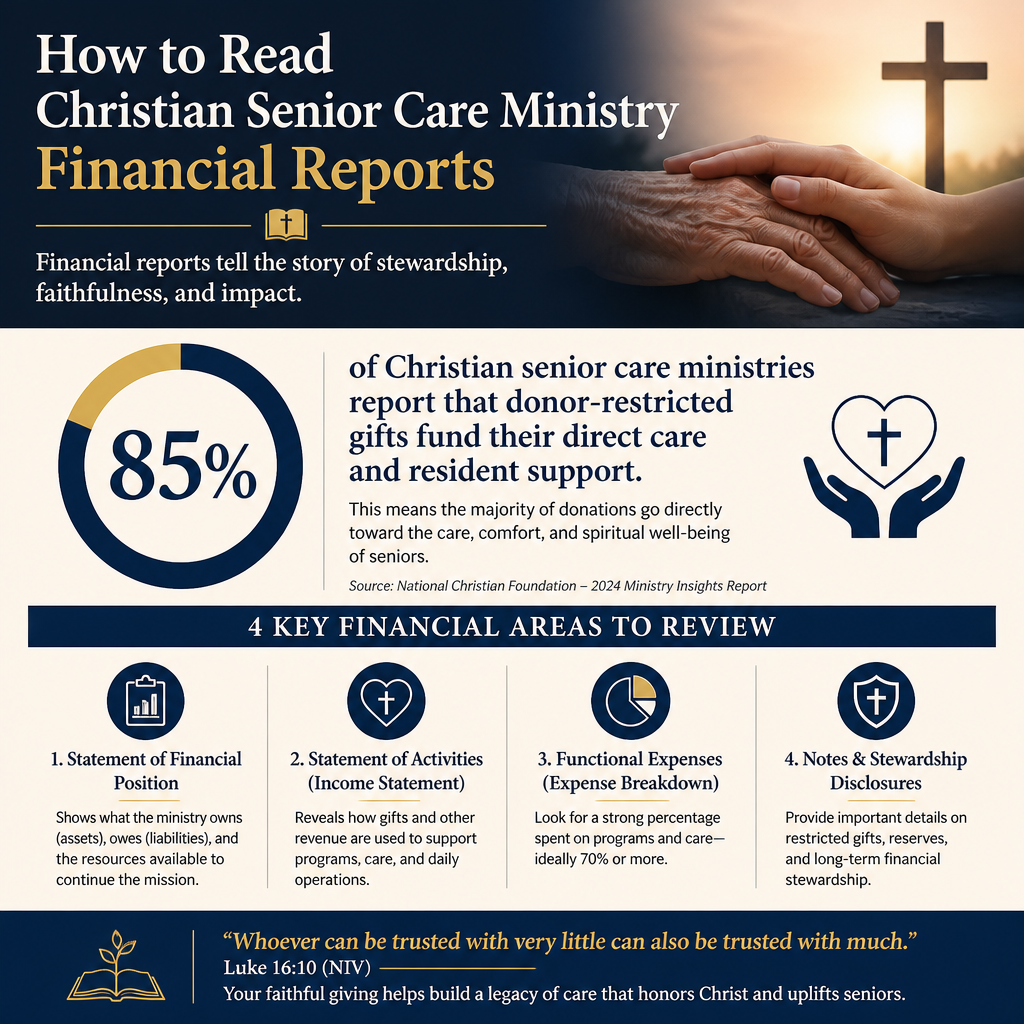
Senior care is also structurally different from many ministries. Skilled nursing, assisted living, memory care, facilities maintenance, clinical compliance, and staffing are expensive. A ministry can have “high overhead” because it refuses to cut corners in safety, background checks, infection control, or financial controls. Those are not distractions from mission; they are part of faithful care.
What to look for instead of a single score
We recommend reading expenses with three questions in view: Does spending align with stated priorities? Is the cost structure sustainable? Are there signs of chronic underinvestment that could harm residents or staff? A few concrete indicators often help more than a single ratio:
- Whether fundraising expense rises sharply without a corresponding rise in stable net revenue
- Whether administrative expense is implausibly low for a regulated care environment
- Whether occupancy or payer mix changes are visibly addressed in management discussion
- Whether debt service is crowding out staffing and care quality investments
- Whether related-party transactions are disclosed clearly and explained
Expense analysis is where donors most need maturity. A ministry can spend “efficiently” and still be unsafe, or spend “inefficiently” while building the systems that protect residents and maintain integrity. The question is whether spending decisions are accountable, transparent, and oriented toward long-term faithfulness.
Balance sheet questions that reveal whether care is sustainable
Liquidity, reserves, and the ethics of financial fragility
Senior care ministries are responsible for people who cannot easily absorb disruption. That makes liquidity and reserves an ethical concern, not merely a financial preference. On the balance sheet, look for cash and cash equivalents, current assets versus current liabilities, and any notes about going-concern uncertainty.
The field has had to reckon with a tension: donors often want gifts to go directly to care, yet a ministry with no reserves can be forced into emergency decisions that harm residents and staff. The “starvation cycle,” described by Ann Goggins Gregory and Don Howard, explains how chronic underfunding of necessary infrastructure can reduce effectiveness over time: Stanford Social Innovation Review.
Debt, capital projects, and whether expansion is disciplined
Buildings are unavoidable in senior care, and capital projects can be an act of love when they improve safety and dignity. Debt can also become a spiritual and operational burden when it outpaces the ministry’s capacity to staff, maintain, and fill beds responsibly. Notes to the financial statements should disclose covenant requirements, interest rate risk, and maturity schedules.
Donors should ask whether expansion is being pursued with sober assumptions about staffing availability, reimbursement rates, and local demand. Confidence is not the same as optimism. Strong boards insist that capital plans are matched to realistic operating projections and clear accountability.
Governance and disclosure signals that separate transparency from marketing
Board oversight is visible if you know where to look
Financial reports are also governance documents. Audited statements often include disclosures about internal controls and significant estimates. Form 990s, when available, list key employees and sometimes reveal whether the organization documents board meetings, manages conflicts of interest, and has a whistleblower policy.
Across our verification work at Most Trusted, the ministries that meet The Most Trusted Standard tend to treat governance as a form of protection for the people they serve. They disclose not only successes but also constraints: staffing shortages, reimbursement pressures, and the real costs of providing excellent care.
Transparency that respects donors and residents
Christian donors rightly reject ministries that turn older adults into fundraising imagery. Transparency is not the same as exposure. Faithful disclosure protects resident dignity while still providing donors with verifiable information: audited financials, clear program descriptions, measurable outcomes where appropriate, and candid explanation of risks.
For donors comparing organizations, it can help to orient financial reading within a broader accountability context. Within Accountability and Transparency in Christian Senior Care Ministries, we track the kinds of disclosures that consistently correlate with integrity. For a wider view of the field, Christian Senior Care Ministries provides the ministry context donors often need to interpret financial choices fairly.
FAQs for How to read Christian senior care ministry financial reports
Should a Christian senior care ministry always have an audit?
Not always, but donors should treat the presence or absence of an audit as meaningful information. Larger ministries, ministries with complex revenue streams, or ministries operating regulated care environments generally have stronger reasons to pursue an annual independent audit. If a ministry does not have one, donors can ask whether it has reviewed statements, what internal controls exist, and whether there is a timeline toward fuller external assurance.
Is a low fundraising and administration percentage a sign of faithfulness?
Not by itself. Senior care requires compliance, staffing systems, clinical oversight, facilities maintenance, and financial controls that do not fit neatly into donor-preferred categories. A ministry can be underinvesting in the very functions that prevent harm. Donors should look for disciplined spending, clear disclosure, and governance that demonstrates serious oversight rather than relying on a single ratio.
A donor’s aim is not suspicion but tested trust
Financial reports cannot measure love, but they can reveal whether a ministry’s stewardship makes love sustainable. When donors learn to read the audit, the revenue mix, the cost structure, and the balance sheet with moral realism, they are better positioned to support Christian senior care that honors the image of God in older adults and remains worthy of the church’s trust.



