

Faith and stewardship in Christian senior care is not primarily a question of sentiment. It is a question of discipleship expressed through money, governance, and long-term responsibility to people whose needs rarely resolve quickly. For Christian donors, senior care is one of the clearest places where biblical mercy meets the modern realities of medical complexity, family strain, and the financial pressures that can quietly degrade dignity.
Scripture is unambiguous about God’s concern for those made vulnerable by age and poverty. The fifth commandment frames honor as a covenant obligation, not a preference (Exodus 20:12). The prophets condemn societies that push the weak to the margins. And Jesus ties faithfulness to concrete care for the sick and the overlooked (Matthew 25:36). Yet faithful giving still requires judgment. Not every ministry that uses Christian language practices Christian stewardship, and not every sincere program is structured to sustain safe, competent care.
The biblical logic of senior care stewardship is covenantal
Christian senior care sits within a moral horizon larger than “meeting needs.” The Bible describes God as one who keeps covenant across generations, and it calls God’s people to reflect that permanence in how we honor parents, widows, and the frail. The heart of stewardship is not merely distributing resources; it is ordering resources toward covenant faithfulness—truthful, durable care that does not depend on novelty or crisis fundraising.
Honor is more than affection
“Honor your father and your mother” is frequently reduced to sentiment, but in Scripture honor has weight: it shapes time, money, and social responsibility. Paul’s instruction regarding widows assumes structured provision and careful discernment within the church (1 Timothy 5:3–16). That passage is not a fundraising appeal. It is a governance document, insisting that care be both compassionate and wisely administered.
For donors, this matters because senior care is often expensive, prolonged, and operationally demanding. A ministry may genuinely love seniors and still fail to provide safe staffing, transparent finances, or appropriate oversight. Faithful giving is not only generosity; it is vigilance directed by love.
Mercy has standards
Christian mercy is never indifferent to truth. When the vulnerable are involved, good intentions are morally insufficient. Senior care programs must attend to safety, competence, and accountability because the people served often cannot easily advocate for themselves. The biblical tradition treats the defense of the vulnerable as a test of righteousness, not a secondary concern (Proverbs 31:8–9).
What this means in practice is that donors should expect ministries to articulate clear care models, demonstrate compliance with appropriate legal and clinical norms, and show measurable commitment to dignity. In senior care, mercy is inseparable from the disciplines that keep people safe.

Christian donors face real tensions in senior care giving
Senior care is not a simple giving category. It includes residential communities, home-based services, chaplaincy, dementia programming, caregiver support, and benevolence funds. Some ministries operate primarily as providers; others function as bridge organizations, coordinating volunteers, transportation, or church partnerships. Each model creates distinct risks and distinct opportunities for Christian stewardship.
The cost pressures are structural, not merely managerial
The financial pressures on senior care are not speculative. Nursing facilities, home health, and assisted living services face staffing shortages and rising labor costs across the broader sector. Donors should understand that even well-run organizations can be squeezed by conditions they do not control. The question is how leadership responds: do they cut corners where residents will feel it, or do they make disciplined trade-offs and communicate them plainly?
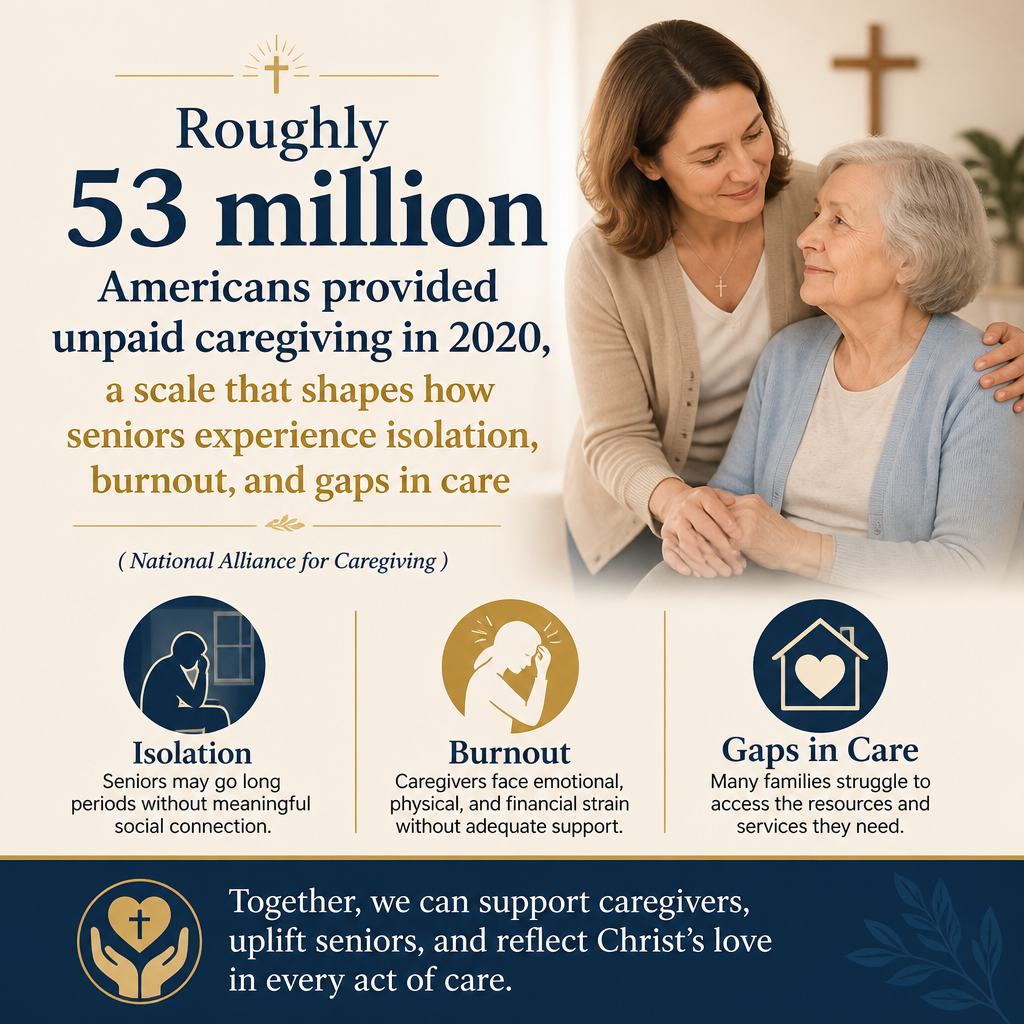
Even apart from institutional care, family caregiving is a major social reality. Roughly 53 million Americans provided unpaid caregiving in 2020, a scale that shapes how seniors experience isolation, burnout, and gaps in care (National Alliance for Caregiving). Christian senior care ministries frequently serve not only seniors, but also exhausted adult children and spouses. Donor strategies that ignore caregivers often miss where the most preventable harm occurs.
Christians genuinely disagree about models of care
Some donors prioritize explicitly Christian residential communities with onsite chaplaincy and worship. Others prioritize aging-in-place supports that keep seniors in their homes and churches. Both instincts can be faithful. Institutional settings can provide safety and social connection that a family cannot manage alone. Home-based support can preserve local community ties and reduce dislocation. The dispute is rarely about whether seniors matter; it is about which settings best preserve dignity, spiritual care, and safety when capacity declines.
Wise donors resist simplistic assumptions. “Home is always best” can ignore dementia, falls risk, and caregiver collapse. “Facility care is always safer” can overlook isolation, inadequate staffing, or spiritual thinness. The more mature approach is to ask what a particular ministry actually provides, how it safeguards residents, and how it supports families through transitions.
Spiritual care can be diluted by medicalization, and medical care can be diluted by spiritualization
Senior care ministries can drift in two directions. Some drift into medicalized professionalism that treats spiritual formation as a polite add-on. Others drift into devotional intensity that underestimates clinical realities. Christian donors should expect ministries to reject both errors. The Christian tradition affirms the unity of the person: body and soul, agency and dependence, present suffering and eternal hope.
For donors evaluating ministries, the key question is integration. Do leaders treat spiritual care as essential, accountable work—chaplaincy with training, oversight, and respectful practices? And do they treat clinical care as a moral responsibility—staffing, incident reporting, and compliance managed with transparency rather than defensiveness?
What trustworthy senior care ministries tend to demonstrate
Across our verification work at Most Trusted, the ministries that meet The Most Trusted Standard tend to show a consistent pattern: they make hard realities legible to donors. They do not hide complexity behind inspirational language. They explain where the money goes, who is accountable for outcomes, and how the ministry’s Christian commitments shape policy decisions when trade-offs are painful.
Faith foundation that governs practice
A faithful statement of belief is not the same as a faithful operational culture. In senior care, the “faith foundation” is most credible when it appears in concrete norms: dignity in routines, patience in behavioral care, truthfulness in family communication, and refusal to treat residents as revenue units. Donors should look for evidence that theological commitments shape decisions about staffing ratios, end-of-life practices, pastoral care, and financial hardship policies.
The harder question is how a ministry handles residents who cannot “participate” in obvious ways—those with advanced dementia, severe disability, or limited speech. A Christian model of care does not assign spiritual value based on productivity. It treats the image of God as undiminished by dependence.
Financial integrity appropriate to high-liability work
Senior care is often high-liability, regulated, and capital-intensive. That does not mean every ministry must resemble a hospital, but it does mean basic financial disciplines are non-negotiable. Donors should expect timely audited financials where appropriate, clear policies for related-party transactions, and transparent explanations of how benevolence funds are administered.
We also encourage donors to resist simplistic overhead assumptions. The broader nonprofit field has repeatedly warned against equating low administrative expense with effectiveness. Charity Navigator, Candid (formerly GuideStar), and the BBB Wise Giving Alliance jointly argued that overhead ratios are a poor proxy for impact and can pressure organizations to underinvest in governance and systems (Charity Navigator). In senior care, underinvestment in “administration” can mean underinvestment in compliance, training, and safety—costs that protect residents.
Governance and leadership that can absorb moral and operational pressure
Boards in senior care ministries must do more than affirm mission. They must oversee risk, ensure accountability for clinical quality where applicable, and protect against conflicts of interest. Donors should expect clear leadership structures, documented board independence, and a willingness to disclose material incidents with appropriate privacy protections.
A common failure mode in values-driven care is the concentration of authority in a charismatic founder without adequate checks. Another is a board that confuses loyalty with oversight. Mature ministries build governance that can survive leadership transitions and financial stress without compromising residents.
Transparency and effectiveness that respects the people served
Christian donors often ask for “impact,” but senior care impact is not always a dramatic narrative arc. Faithful effectiveness may look like reduced isolation, fewer preventable hospitalizations, consistent pastoral presence, caregiver stabilization, or dignified hospice transitions. Ministries should be able to describe what they measure, why those measures matter, and what they have learned when results disappoint.
Transparency also includes speaking honestly about limits. If a ministry cannot safely serve advanced dementia, it should say so. If it has a waitlist, it should explain the process. If it relies on government reimbursement, it should clarify how that affects operations. Trust is built when a ministry provides donors with intelligible reality rather than curated reassurance.
Donors who want a wider view of this field often begin with Christian Senior Care Ministries and then evaluate specific organizations with attention to both theological fidelity and operational competence.
How donors can practice faith and stewardship with clarity
Faithful giving to Christian senior care begins with a basic recognition: seniors are not a “cause.” They are neighbors, often bearing layers of loss—health, mobility, spouse, independence, and sometimes church connection. The goal is not to purchase a feeling of compassion, but to underwrite faithful presence, skilled care, and truthful administration over years.
We recommend donors adopt a set of disciplined questions. What is the ministry’s care model, and what populations does it serve well? What safeguards protect residents or clients who cannot self-advocate? What financial practices prevent mission drift under cost pressure? What governance structures can confront failure without concealment? And how is spiritual care provided in a way that is both explicitly Christian and genuinely respectful?
Senior care giving also benefits from a long view. Recurring support, designated benevolence funds with clear policies, and partnerships that strengthen local church involvement often stabilize ministries more than episodic gifts tied to emergencies. Many donors also find it fruitful to combine financial support with prayer that is specific: for peace at the end of life, for protection from loneliness, for wisdom for caregivers, and for integrity among leaders whose decisions affect fragile lives.
Faith and stewardship in Christian senior care is ultimately a decision to honor the image of God where dependence is greatest and visibility is least. When donors insist on ministries that are both theologically grounded and operationally accountable, they help make that honor tangible—through safer care, clearer governance, and mercy that can be trusted.



