
Red flags are not a substitute for due diligence, but they are often the earliest warning signs of a Christian nonprofit in trouble. Because Christian donors are usually giving out of worship, trust, and shared theological commitments, the cost of misplaced confidence is not only financial; it can damage a church’s witness, harm vulnerable beneficiaries, and harden donors toward future generosity.
Scripture treats money and leadership as spiritual tests, not merely technical concerns. Jesus warned that some would perform religious works publicly while remaining unknown to him (Matthew 7:21–23). Paul required that overseers be “above reproach” and “not a lover of money” (1 Timothy 3:1–3). Those standards do not guarantee flawless organizations, but they do clarify what faithful Christian governance is meant to protect.
What follows is a set of patterns our team has seen across nonprofit accountability work: not “gotcha” indicators, but recurring signals that warrant scrutiny. Some red flags point to immaturity rather than malice. Others suggest structural dysfunction that does not resolve with more fundraising or better messaging. Wise donors do not panic at every imperfection, but neither do they subsidize avoidable harm.
When the ministry story becomes more important than the truth
Christian nonprofits must communicate their work, and good storytelling can honor God’s grace and donors’ participation. The trouble begins when the story becomes immune to verification. When a ministry’s public claims outrun what it can document, donors are being asked to fund a narrative rather than a mission.
Claims that cannot be audited
A common warning sign is impact language with no meaningful definition: “thousands saved,” “cities transformed,” “revival breaking out,” “families restored.” Some of those outcomes may be spiritually real and difficult to quantify. Even so, credibility grows when ministries explain how they know what they claim: what they count, what they do not count, and what evidence is available for independent review.
Donors should watch for ministries that resist basic accountability questions by spiritualizing them. “We cannot measure the Holy Spirit” can be true in a narrow sense, but it can also function as a shield against any inquiry. Scripture does not commend that posture. Paul regularly appealed to observable fruit and transparent conduct among the churches (2 Corinthians 8:20–21).
Photos, testimonials, and emotional urgency doing the work of evidence
Another indicator is a heavy reliance on emotionally charged media without operational clarity. Images of vulnerable children, dramatic conversion stories, or crisis language can be legitimate, but they can also become a substitute for showing budgets, program models, and outcomes. Christian donors should not be manipulated into acting against prudence. The New Testament assumes that Christian love is not gullible; it is “abounding… with knowledge and all discernment” (Philippians 1:9).
Unfalsifiable claims of persecution
Some ministries face genuine opposition for faithfulness. Others deploy persecution rhetoric to discredit questions that would be normal in any accountable organization: “We are under attack because we are effective.” Donors can respect the reality of spiritual conflict while still requiring the ministry to answer for governance, finances, and safety. In the apostolic pattern, leaders did not equate scrutiny with hostility; they welcomed what protected the church.

Financial signals that indicate fragility or misplaced priorities
A Christian nonprofit can be doctrinally sincere and still become financially unstable. Trouble often shows up not as one dramatic scandal but as a series of smaller compromises: unclear restricted funds, undisciplined fundraising practices, or board inattention to financial controls. Because donors are stewards, not owners, financial clarity is not “business thinking”; it is part of moral responsibility.
Delayed or incomplete financial disclosure
When a U.S. nonprofit delays publishing Form 990s, provides only partial statements, or declines to share audited financials when it is large enough to warrant them, donors should slow down. Not every ministry can afford an audit in its early stages, and some organizations operate in sensitive contexts. But secrecy is rarely the best long-term strategy. Healthy ministries distinguish between legitimate security needs and simple unwillingness to be examined.
As a baseline, donors can expect most established U.S. nonprofits to make their annual filings available through the IRS or major nonprofit data platforms. The IRS provides access to tax-exempt organization data and filings, which donors can consult directly through the IRS Tax Exempt Organization Search.
Overdependence on a single revenue stream
Financial fragility often appears when a ministry depends on a single donor, a single church network, or one recurring event for most of its revenue. Donors do not always see this risk, because the ministry may look vibrant while cash is flowing. But when one source changes, the organization can spiral into abrupt layoffs, rushed fundraising, or cutting corners in program quality.
This is not an argument against major donors or signature events. It is an argument for governance that plans for volatility and refuses to build a mission on financial assumptions that have not been tested over time.
Fundraising practices that crowd out integrity
Christian donors should be wary when urgent appeals become constant, when every communication is framed as an emergency, or when giving is tied to exaggerated promises. These patterns can indicate a lack of reserves, poor planning, or a culture that treats donors as a pipeline rather than partners in stewardship.
It is also worth recognizing a common donor misconception: that a low “overhead” ratio is the primary sign of a faithful ministry. The nonprofit field has widely criticized simplistic overhead scoring because it can pressure organizations to underinvest in governance, staff development, and evaluation. Charity Navigator, Candid (formerly GuideStar), and BBB Wise Giving Alliance jointly argued against using overhead alone as a measure of performance in their “Overhead Myth” statement, which remains a useful corrective for donors seeking better questions to ask: The Overhead Myth.
Governance and leadership patterns that rarely end well
In Christian ministry, charisma is often mistaken for calling, and platform is often mistaken for accountability. Yet Scripture’s leadership requirements are primarily about character and credibility over time. The warning signs of organizational trouble frequently show up in governance before they show up in finances.
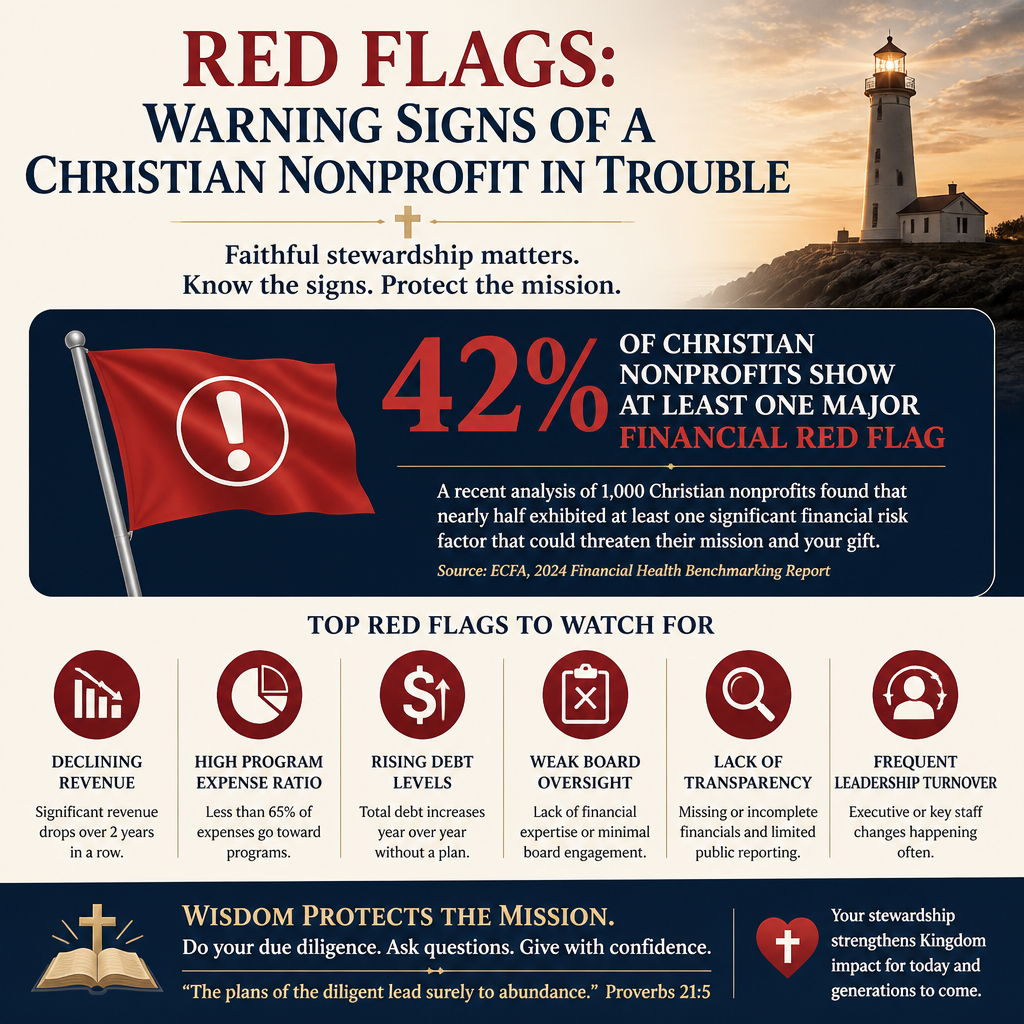
A board that is ceremonial rather than governing
A healthy board is not a group of admirers; it is a fiduciary body that guards mission, doctrine, and integrity. Warning signs include boards made up of family members, employees, or close friends with no meaningful independence; board minutes that are perfunctory; and a culture in which the leader cannot be questioned.
This is especially concerning when the ministry’s founder controls board appointments, sets compensation without independent review, and acts as the final authority on financial decisions. Even excellent leaders need constraint. In Christian terms, accountability is a form of love because it protects both the mission and the leader from temptation.
Spiritual authority used to silence questions
Some ministries slide into a subtle but real form of spiritual coercion: questioning a decision is treated as questioning God; raising concerns is described as “division.” This is not the New Testament model. The early church debated, weighed evidence, and listened to dissenting voices (Acts 15). A ministry culture that cannot tolerate scrutiny is a ministry culture that will eventually hide something, even if it begins with small things.
Leadership instability or a lack of succession planning
Frequent turnover among key staff, repeated interim arrangements, or unexplained departures can indicate internal disorder. Donors are not entitled to private personnel details, but patterns matter. In addition, ministries that revolve entirely around one leader often do not survive that leader’s illness, moral failure, or retirement. A responsible board plans for continuity because the mission belongs to God, not to one gifted individual.
Program and theological integrity under pressure
Some ministries fail not through scandal but through drift. Donor expectations, platform incentives, or the pressure to “scale” can gradually reshape a mission until it becomes indistinct from secular philanthropy—or, just as dangerously, religious branding attached to practices that harm people. Christian donors should care about outcomes and methods, not only intentions.
Mission drift disguised as growth
Growth is not inherently faithfulness. A ministry may add programs, expand to new regions, or broaden its messaging in ways that obscure its original purpose and competence. Donors should ask whether expansion is supported by qualified leadership, appropriate safeguards, and demonstrated effectiveness, or whether it is a response to fundraising opportunities.
Harmful models defended by good intentions
The Christian sector has had to reckon with “when helping hurts”—the reality that aid can entrench dependency, distort local economies, or displace local leadership when it is designed around donor needs rather than community realities. Steve Corbett and Brian Fikkert’s framework has shaped much of this conversation, pressing ministries to rethink paternalism and to prioritize local agency and long-term flourishing: When Helping Hurts.
For donors, a red flag is a ministry that refuses to engage these critiques or treats them as secular hostility to compassion. Mature ministries acknowledge the complexity, learn from research and local partners, and adapt with humility.
Doctrinal vagueness that functions as brand protection
Christians genuinely disagree about secondary matters, and wise ministries avoid unnecessary fights. But doctrinal silence can also be strategic: a way to maximize donor appeal while minimizing accountability to a church tradition or a clear statement of faith. Donors should not require ministries to mirror their exact theological distinctives, but they should expect clarity on the gospel, Scripture, and the ministry’s relationship to the local church.
When a ministry’s theology is always implied and never stated, or when its public posture shifts depending on the audience, donors are left funding an organization whose convictions cannot be evaluated.
How prudent donors investigate without cynicism
Christian donors can pursue discernment without slipping into suspicion. The goal is not to “catch” ministries, but to identify those that demonstrate the kind of integrity that can bear the weight of donor trust. The practical challenge is that many warning signs are not individually decisive; they become persuasive in combination.
Questions worth asking before you give
- Governance: Who is on the board, and how independent are they? How are conflicts of interest handled? Is executive compensation reviewed and documented?
- Financial integrity: Are recent Form 990s accessible? Are financial statements reviewed or audited when scale warrants it? Does the ministry explain how restricted gifts are tracked and honored?
- Transparency: Does the organization provide clear program descriptions, budgets at a meaningful level, and candid reporting that includes challenges, not only wins?
- Effectiveness and safety: What safeguards protect beneficiaries—especially children and other vulnerable people? How is staff vetted and trained? Are there written policies for incident reporting and response?
- Theological grounding: Is the ministry’s statement of faith public and substantive? Is there evidence of accountability to a church body, elders, or a recognized theological authority?
These questions are not obstacles to generosity. They are a way of honoring both the donor’s stewardship and the dignity of the people the ministry serves.
What donors should do when red flags appear
First, distinguish between missing information and concerning information. Some ministries simply have not communicated well. Others have made choices that deserve serious concern. A responsible organization should be able to answer good-faith questions with clarity, even if it cannot disclose every operational detail.
Second, look for a posture of repentance and correction where mistakes have occurred. Christian nonprofits are not immune to failure. The question is whether leaders tell the truth, accept oversight, and make durable changes. In the language of stewardship, a ministry’s response to correction is often more revealing than the initial problem.
Third, consider the cumulative pattern. A single late report, a leadership transition, or a temporary funding gap may be explainable. A persistent combination of secrecy, board weakness, exaggerated claims, and frantic fundraising is rarely a temporary season.
How The Most Trusted Standard clarifies the evaluation
At Most Trusted, we evaluate ministries against The Most Trusted Standard, a 15-criteria framework that examines faith commitments, financial integrity, governance practices, and operational transparency. The value of a defined standard is not that it eliminates judgment; it disciplines judgment. It forces hard questions to be asked consistently across organizations, including questions that sympathetic donors may otherwise avoid.
Donors often tell us that their greatest frustration is not a lack of ministries to support, but a lack of verifiable clarity. A standard grounded in both Christian moral reasoning and nonprofit best practice helps donors compare ministries on more than charisma, brand strength, or emotional appeal.
One of the clearest patterns in our work is that healthy ministries do not fear scrutiny. They may disagree about metrics or strategy, but they can explain their choices, document their practices, and submit to oversight without treating accountability as an attack.
FAQs for Red Flags: Warning Signs of a Christian Nonprofit in Trouble
Is it unbiblical to question a ministry’s finances or leadership?
No. Scripture repeatedly commends transparent handling of funds and accountable leadership. Paul described precautions taken so that “no one should blame us” in the administration of gifts, aiming to do what is right “not only in the Lord’s sight but also in the sight of man” (2 Corinthians 8:20–21). Donor questions, when asked respectfully, can be an expression of stewardship and love for the church’s witness.
What if a ministry says it cannot share details because of security risks?
Security constraints can be real, especially in sensitive international contexts. Even then, a ministry can usually provide some form of verifiable accountability: independent board oversight, third-party financial review, clear policies, and aggregated reporting that protects identities. The red flag is not discretion; it is using discretion as a blanket exemption from governance and financial integrity.
Are charismatic founders always a warning sign?
No. Many faithful ministries were built by unusually gifted founders. The concern is when a founder’s platform becomes a substitute for accountable structures: an independent board, documented policies, financial controls, and a credible plan for succession. Christian leadership is meant to be tested by character, not protected by reputation.
How should donors respond when a ministry has a public scandal?
Donors should avoid both reflexive dismissal and reflexive defense. The questions are concrete: What happened? What safeguards failed? What independent investigation or oversight exists? What restitution and corrective action are being taken? In Christian terms, repentance is not merely a statement; it is a turning that produces visible fruit, including structural changes that reduce the likelihood of recurrence.
Discernment that protects generosity
Christian donors are not called to suspicion, but we are called to wisdom. Red flags are not a way to withdraw from the work of mercy; they are a way to ensure that mercy is not commandeered by confusion, fear, or uncontrolled ambition.
When donors insist on clear theology, accountable leadership, and transparent stewardship, they are not importing secular expectations into sacred work. They are echoing biblical priorities: truthfulness, integrity, and a love that does not use the vulnerable as props. Ministries that welcome that kind of scrutiny are usually the ones best positioned to endure, to correct course when needed, and to serve faithfully over the long haul.



