
What questions donors should ask Christian relief ministry leaders is not a matter of suspicion; it is a matter of stewardship. Christian relief and development work sits at the intersection of urgent human suffering, complex systems, and the church’s public witness, which means good intentions are not a sufficient safeguard.
Scripture gives both mandate and measure. We are commanded to “do good to everyone” (Galatians 6:10), and also warned that leaders and ministries will be judged by their fruit, their teaching, and their conduct (Matthew 7:15–20). Mature giving therefore asks leadership questions that are concrete, verifiable, and proportionate to the influence and resources entrusted to a ministry.
1. Ask what the ministry believes and how that belief governs decisions
Relief work can drift toward a generic humanitarianism that is ethically sincere but theologically thin. Christian donors are not merely funding outcomes; we are participating in a witness. The first questions should clarify whether the ministry’s faith is a public label or an operating conviction that shapes hiring, partnerships, and program design.
What does the ministry mean by Christian
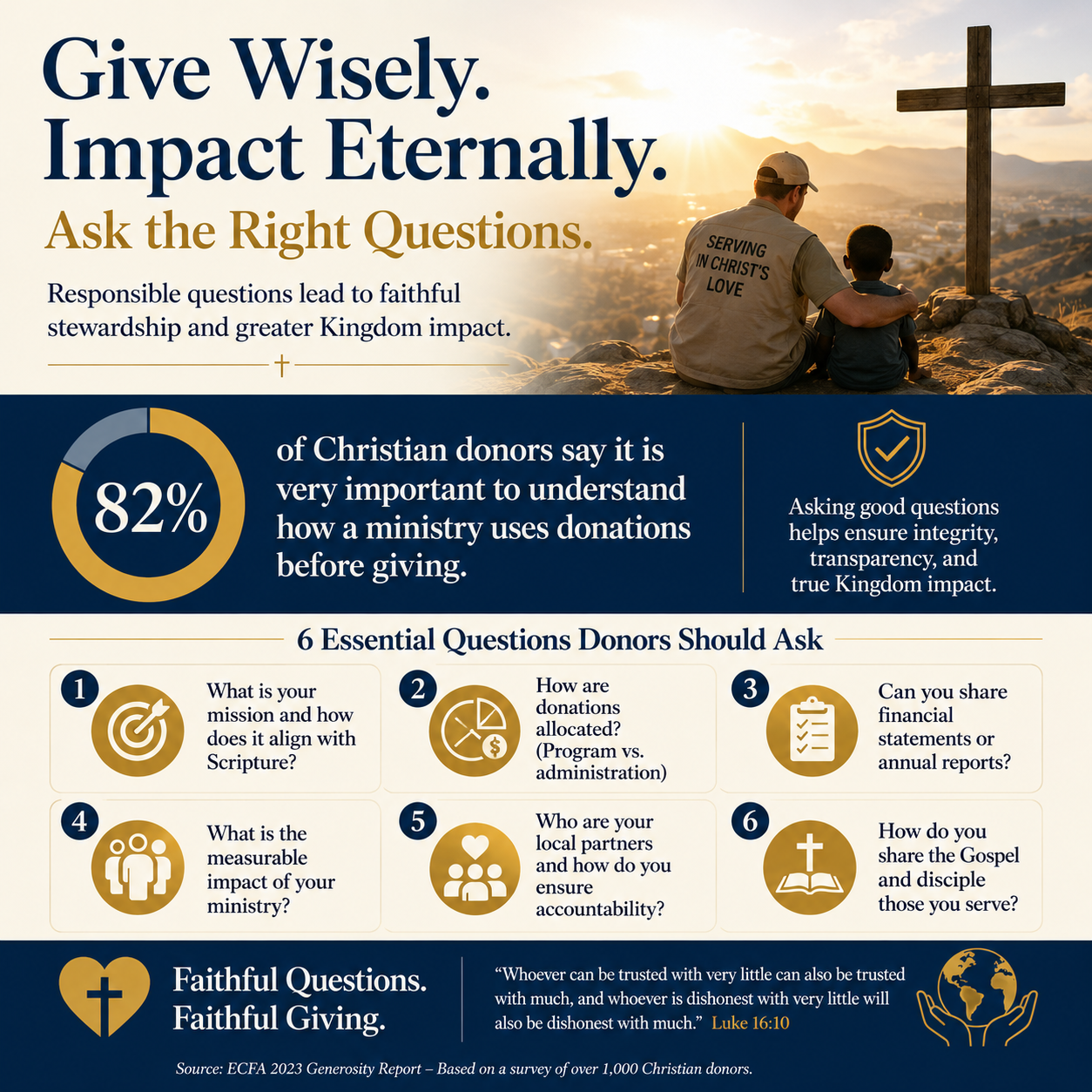
Ask leaders to describe their statement of faith and where it has practical authority. Does it govern board oversight? Does it shape field partnerships? Does it inform how they speak about dignity, justice, and hope in communities that may not share Christian belief?
Leaders who are clear here rarely rely on slogans. They can name the theological commitments they will not compromise, and the prudential decisions where faithful Christians can disagree.
How do they avoid coercion and still remain faithful
Christian relief ministries often face a genuine tension: offering help without strings attached, while also refusing to treat the gospel as irrelevant to human flourishing. Ask how they prevent manipulation in vulnerable settings and how they separate access to aid from participation in spiritual activities. A credible answer will include written policies, training expectations, and accountability mechanisms, not simply a stated intention.
It also helps to ask how the ministry understands “integral mission” or “holistic ministry” if those terms appear in their materials. Clarity is a strength, not a threat, when donors are supporting work done in the name of Christ.

2. Ask how leaders define success and what evidence they can show
Relief and development are not the same discipline. Relief is urgent and time-bound; development is relational and long-term. The questions donors ask should test whether leaders understand that difference and whether their metrics match the type of work they claim to do.
What outcomes matter most and why
Ask leaders to name the outcomes they prioritize: reduced mortality, restored livelihoods, strengthened local institutions, church-based community care, trauma recovery, or something else. Then ask why those outcomes are the right ones for the context. Serious leaders can explain trade-offs: speed versus sustainability, breadth versus depth, and immediate need versus long-term capacity.
At Most Trusted, our verification work evaluates ministries against The Most Trusted Standard, including criteria tied to transparency and effectiveness. The ministries that meet those expectations tend to describe success in ways that are specific enough to test and humble enough to revise.
Whether they measure harm as well as benefit
The development field has had to reckon with the fact that well-funded interventions can unintentionally weaken local markets, undermine local leadership, or create dependency. Ask what “do no harm” means operationally for them. Do they evaluate unintended consequences? Do they have feedback channels for community members, including complaints mechanisms?
A useful touchstone is the When Helping Hurts framework, articulated by Steve Corbett and Brian Fikkert, which has shaped many evangelical approaches to poverty alleviation by warning against paternalism and emphasizing asset-based, local ownership. Reference: Moody Publishers.
3. Ask who holds power and what accountability looks like in practice
Donors often focus on programs and budgets while neglecting governance. Yet Scripture repeatedly treats leadership character and accountability as central (1 Peter 5:2–3; James 3:1). In international relief work, where distance can hide dysfunction, governance questions are not secondary.
How the board is composed and how it exercises oversight
Ask how many board members are independent, how often they meet, and whether they review executive compensation, audits, and key risk areas. Ask whether the board receives regular reporting on safeguarding, fraud prevention, and field security.
It is reasonable to ask whether the organization has written conflict-of-interest policies and whether board members and senior leaders disclose potential conflicts annually. Strong ministries welcome these questions because they know governance protects mission as much as it protects reputation.
How leaders handle failure and correction
Every serious ministry has setbacks: a program that does not achieve results, a partner that proves unreliable, a crisis that exposes weak controls. Ask leaders to describe a significant failure from recent years and what they changed afterward. If leaders cannot name any meaningful correction, donors should wonder whether problems are being surfaced and addressed.
For donors who want broader context on the field’s unique pressures, see Christian Relief and Development Ministries.
4. Ask what financial integrity means beyond a low overhead ratio
Faithful donors want funds handled with integrity, but simplistic heuristics can backfire. Many donors were trained to treat “low overhead” as the primary indicator of virtue. The nonprofit sector has publicly corrected that assumption for good reason: underinvestment in finance, HR, safeguarding, and monitoring can increase risk and reduce effectiveness.
Whether financial reporting is timely, clear, and complete
Ask whether the ministry has an annual independent audit and whether it makes audited financial statements available. Ask how they categorize and allocate expenses and whether those allocations are reviewed for consistency. If the ministry fundraises with restricted gifts for specific projects, ask how restrictions are tracked and honored.
In the United States, donors can also review a nonprofit’s Form 990, which provides governance and financial disclosures. Reference: Internal Revenue Service.
How leaders resist donor-driven distortion
International relief is particularly vulnerable to “what photographs well” becoming “what gets funded.” Ask how leaders protect program decisions from donor pressure that could compromise dignity or local ownership. Ask whether they pay attention to what communities say they need, not only what donors want to sponsor.
We recommend one short set of questions donors can keep at hand when reviewing a ministry’s financial posture and fundraising claims:
- Do you publish audited financials, and can donors access them without requesting permission?
- How do you handle restricted gifts if the original plan becomes unwise or impossible?
- What internal controls reduce fraud risk in field contexts where cash and inventory move quickly?
- How do you set executive compensation, and what independent review is involved?
- What reserves policy guides your approach to stability during crises and funding swings?
For a deeper donor-oriented approach to these questions in this sector, see How to Give Wisely to Christian Relief and Development Ministries.
5. Ask how the ministry treats people who can be harmed by good intentions
Relief ministry leaders carry responsibility not only for beneficiaries but also for staff, volunteers, and local partners. A ministry can be doctrinally orthodox and financially clean while still mishandling power, disregarding safeguarding, or ignoring local leadership. Donors should ask questions that honor the image of God in those most vulnerable to institutional failure.
Safeguarding and abuse prevention
Ask whether the ministry has safeguarding policies, background check standards where applicable, and training expectations for staff and volunteers. Ask whether there is a clear, accessible reporting mechanism for abuse or exploitation and whether reports are handled by qualified, independent personnel when senior leaders could be implicated.
This is not abstract. The humanitarian sector has documented widespread risks of sexual exploitation and abuse in crisis settings, which is why credible ministries treat safeguarding as core to mission. For sector-wide expectations and definitions, see guidance from the United Nations Office for the Coordination of Humanitarian Affairs. Reference: OCHA.
Local ownership and partnership integrity
Ask who controls the program: a Western headquarters, a national office, local churches, or community organizations. Ask how partners are selected, how capacity is strengthened, and how credit is shared publicly. Donors should be cautious when a ministry’s messaging consistently centers external heroes rather than local agency and leadership.
Christian donors should also ask whether partnerships respect the local church without instrumentalizing it. The church is not merely a distribution channel; it is a community with spiritual responsibilities and long-term presence after international attention fades.
FAQs for What questions donors should ask Christian relief ministry leaders
Should donors avoid ministries that share the gospel alongside relief work?
Not necessarily. Christian donors often support ministries precisely because they refuse to separate compassion from Christian witness. The question is whether the ministry offers aid without coercion and maintains clear safeguards so that services are never conditioned on religious participation. Leaders should be able to explain policies that protect dignity and consent, especially in crisis settings where vulnerability is acute.
What documents should donors ask for before giving significant support?
For substantial gifts, donors can reasonably request audited financial statements, the most recent Form 990 if applicable, a current annual report with program results, safeguarding policies, and basic governance information such as board composition and conflict-of-interest practices. When a ministry cannot provide basic documentation in a timely way, the issue is often not secrecy but weak internal discipline, which becomes a material risk in complex field work.
Stewardship requires questions that honor both urgency and truth
Christian relief and development ministries operate where needs are real and time is often short. The most faithful donors do not respond to that urgency by suspending discernment; they respond by asking leaders the kind of questions that protect the vulnerable, strengthen credible work, and preserve the church’s witness. When ministries welcome those questions and can answer with clarity and evidence, generosity becomes not merely compassionate, but trustworthy.



