
What accreditation Christian relief ministries should have is a stewardship question before it is a branding question. For Christian donors who want their giving to honor Christ and strengthen the vulnerable rather than inadvertently burden them, “accreditation” is best treated as one piece of a wider pattern of verifiable integrity.
The harder reality is that the relief and development field does not operate with a single, universally binding accreditation regime. Some signals are meaningful, some are weak, and some are simply mismatched to the kind of work a ministry actually does. Wise giving requires distinguishing between (1) formal regulatory compliance, (2) voluntary third-party standards, and (3) the ministry’s demonstrated capacity to deliver faithful, competent service over time.
Accreditation is not the same as legal compliance
Before evaluating accreditations, donors should separate “accredited” from “lawfully accountable.” In the United States, a legitimate charity must generally be recognized as tax-exempt under section 501(c)(3) and must file annual disclosures if it meets the IRS filing thresholds. This is not accreditation, but it is a basic public accountability mechanism.
Start with basic nonprofit legitimacy
Verifying 501(c)(3) status and basic filings is elementary due diligence. The IRS provides a public Tax Exempt Organization Search that donors can use to confirm status and view key information.IRS Tax Exempt Organization Search
For ministries working internationally, legal compliance also includes the ability to operate in-country lawfully, manage cross-border funds appropriately, and adhere to banking and anti-terror finance requirements. These matters rarely appear on a website, but a serious ministry will have board oversight and documented controls because the stakes are high for beneficiaries and for the witness of the church.
Understand what accreditation can and cannot do
Accreditations are voluntary signals that a ministry has subjected itself to outside scrutiny against a defined standard. That can help donors, but it cannot replace discernment about theology, governance, or effectiveness. Relief work is complex: a ministry can be financially clean and still do harm through poor program design; it can have a sincere faith confession and still lack safeguards for children; it can be accredited for fundraising ethics and still be careless with local partnerships.

Financial accountability accreditations that carry weight
Christian donors often feel a responsible tension: we want to give generously, and we want to give carefully. Financial accountability accreditations do not guarantee faithfulness or impact, but they do provide evidence that a ministry is willing to be measured and corrected in objective ways.
ECFA as a Christian-specific standard
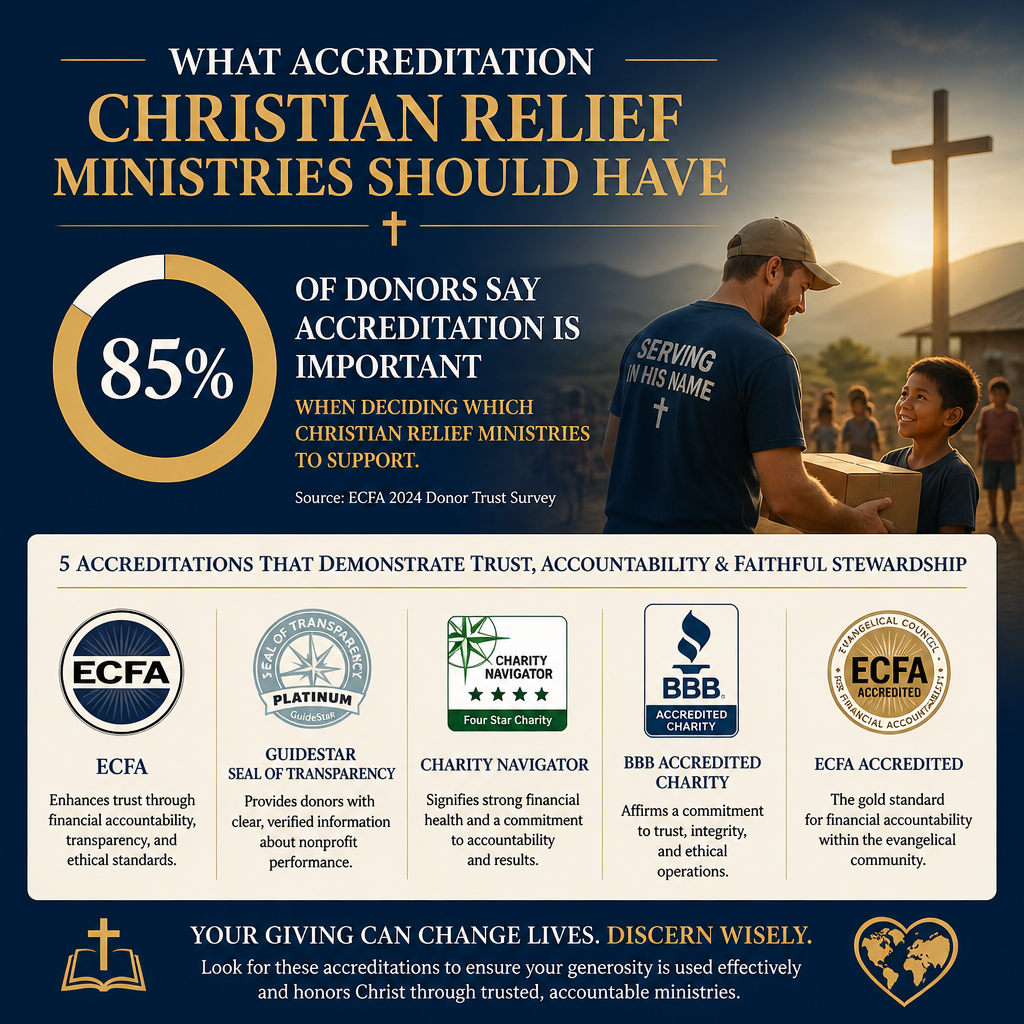
The Evangelical Council for Financial Accountability is the best-known Christian accreditation body for financial stewardship, governance, and transparency. ECFA membership indicates that the organization has committed to meet defined standards and to submit to an external review process.Evangelical Council for Financial Accountability
Not every exemplary ministry will be an ECFA member, and not every ECFA member will be exemplary in every domain. Membership should be treated as meaningful, but not final. The value lies in the fact that standards exist, reviews occur, and the organization has accepted a measure of outside accountability in a faith-adjacent context.
BBB Wise Giving Alliance for donor expectations
The BBB Wise Giving Alliance is not a Christian body, but it has longstanding charity standards around governance, effectiveness reporting, finances, and fundraising communications. For ministries that solicit broadly from the public, this kind of external review can be an important check on fundraising practices and disclosure habits.BBB Wise Giving Alliance
Christian donors should also remember that “low overhead” is not the same as “high integrity.” The philanthropic sector itself has pushed back against simplistic overhead fixation. The “Overhead Myth” letter, signed by leaders from GuideStar, Charity Navigator, and BBB Wise Giving Alliance, argued that minimizing administrative costs can incentivize underinvestment in the very systems that protect beneficiaries and improve outcomes.Stanford Social Innovation Review on the Overhead Myth
Program quality accreditations are narrower but often more demanding
Relief and development is not only a financial exercise; it is a technical discipline. The church’s compassion must be paired with competence because harm can be sincere. This is where “accreditation” can become more specific: child protection standards, humanitarian codes of conduct, and sectoral benchmarks that are closer to program reality than generalized charity ratings.
Humanitarian standards and sector codes
The Sphere Handbook is among the most influential frameworks in humanitarian response, describing minimum standards in areas like water, sanitation, shelter, and health services. Sphere is not accreditation in the formal sense, but it is a recognized benchmark. A ministry that cites Sphere and can explain how its programs align to such standards is usually signaling seriousness about technical quality and accountability to affected populations.Sphere Association
Similarly, the Core Humanitarian Standard (CHS) outlines commitments for quality and accountability in humanitarian action. Some organizations pursue CHS verification through recognized bodies, while others use the CHS as an internal framework. Donors can ask ministries to describe how they receive and respond to beneficiary feedback, manage complaints, and prevent exploitation and abuse, which are central concerns in CHS-aligned practice.Core Humanitarian Standard
Child safeguarding and protection expectations
Where ministries serve children, accreditation-like signals around safeguarding may matter more than almost anything else. There is no single universal credential that replaces scrutiny, but donors can reasonably require evidence of policies, training, reporting pathways, background checks appropriate to the context, and independent oversight. The field has learned that good intentions are not a safeguarding system.
Christians genuinely disagree about the best delivery models in some areas of development, but there is little principled disagreement that the vulnerable must be protected from abuse and from exploitative fundraising narratives. A mature ministry will be able to show not merely a policy document, but the machinery of implementation.
Accreditation should be weighed alongside theology, governance, and transparency
Because accreditation is partial, donors should test it against a wider set of questions. At Most Trusted, our verification work evaluates ministries against The Most Trusted Standard, a 15-criteria framework across Faith Foundation, Financial Integrity, Governance and Leadership, and Transparency and Effectiveness. The aim is not to replace the church’s discernment, but to offer donors evidence they can interrogate.
What trustworthy ministries consistently make visible
The ministries that meet rigorous expectations tend to disclose more than the minimum because they understand that trust is earned. They publish audited financial statements when feasible, name board members, explain conflict-of-interest policies, describe program logic in plain language, and report results with appropriate humility about limits. They also avoid using spiritual language as a substitute for accountability, because Scripture does not treat accountability as secular; it treats it as moral.
What this means in practice is that accreditation should not end the conversation. It should open a deeper one: Who governs this ministry? How are decisions made? How does leadership invite correction? Does the ministry’s theology of the imago Dei shape communications about those it serves, or are beneficiaries reduced to props for fundraising?
A focused set of donor checks
The following questions are not exhaustive, but they are the kind of concrete checks that prevent accreditation from becoming a shortcut:
- Identity: Can the ministry clearly articulate its Christian commitments and how those commitments shape programming and partnerships?
- Oversight: Is there an engaged, independent board with documented governance practices and conflict-of-interest discipline?
- Financial transparency: Are audited statements available when appropriate, and are key disclosures easy to find?
- Safeguarding: Are child and vulnerable-adult protection standards implemented with training, reporting, and external accountability?
- Effectiveness: Does the ministry report outcomes credibly, naming both results and limits without inflated claims?
Donors who want to understand the broader landscape of relief work, including how Christian ministries differ in model and risk profile, should situate accreditation questions within the wider context of Christian Relief and Development Ministries.
How to interpret common scenarios donors encounter
Most donor decisions are made under constraints: limited time, limited access, and emotionally compelling needs. In that context, donors often face recurring scenarios where “accreditation” is used as reassurance. These scenarios merit a more disciplined reading.
When a ministry has no accreditation
A lack of formal accreditation is not an automatic disqualifier. Some effective ministries are small, locally rooted, or constrained by the cost of participating in formal review processes. The appropriate response is not to assume the worst; it is to ask for substitute evidence: governance documents, recent financials, independent references, safeguarding policies, and proof of lawful operations.
When the ministry serves in high-risk contexts, the absence of accreditation raises the need for stronger internal controls and clearer transparency, not less. Donors are not being uncharitable by asking for documentation. They are honoring the biblical requirement that those entrusted with resources be found faithful (1 Corinthians 4:2).
When a ministry has accreditation but weak transparency
This is the scenario that most often confuses donors. Accreditation can become a badge displayed on a website while key information remains opaque. In our view, that disconnect should prompt careful questions. A ministry confident in its accountability usually does not hide basic facts about leadership, finances, or program outcomes.
Christians should also recognize that relief and development outcomes are hard to measure, and simplistic metrics can mislead. Still, opacity is not the same as humility. A ministry can speak carefully about impact while still disclosing the kinds of evidence serious donors need.
Donors who want a disciplined approach to due diligence should also consult How to Give Wisely to Christian Relief and Development Ministries, where we address common decision points and the kinds of documentation that tend to separate mature organizations from well-intentioned but underbuilt efforts.
FAQs for What accreditation Christian relief ministries should have
Is ECFA membership required for a Christian relief ministry to be trustworthy?
No. ECFA membership is a meaningful positive signal because it reflects voluntary submission to defined standards and external review, but it is not a sacrament of trustworthiness. Some excellent ministries are not members, often due to size, structure, or strategic priorities. The more decisive question is whether the ministry can provide verifiable evidence of strong governance, financial integrity, safeguarding, and transparent reporting consistent with Christian stewardship.
Should donors rely on Charity Navigator or similar ratings as accreditation?
General charity ratings can be useful as one input, particularly for checking basic financial and governance signals, but they are not accreditation and they rarely assess faith commitments, child protection maturity, or program quality in the ways relief work requires. Donors should treat them as a starting point and then seek deeper evidence, especially for ministries operating internationally or working with vulnerable children.
A disciplined view of accreditation serves Christian love
Accreditation can help donors give with confidence, but it is never the whole picture. The ministries most worthy of trust are not those that collect badges, but those that welcome scrutiny, tell the truth about their work, protect the vulnerable with concrete safeguards, and demonstrate stewardship consistent with the gospel they proclaim. When donors evaluate accreditation within a wider framework of verifiable integrity, generosity becomes not only heartfelt, but responsible.



