
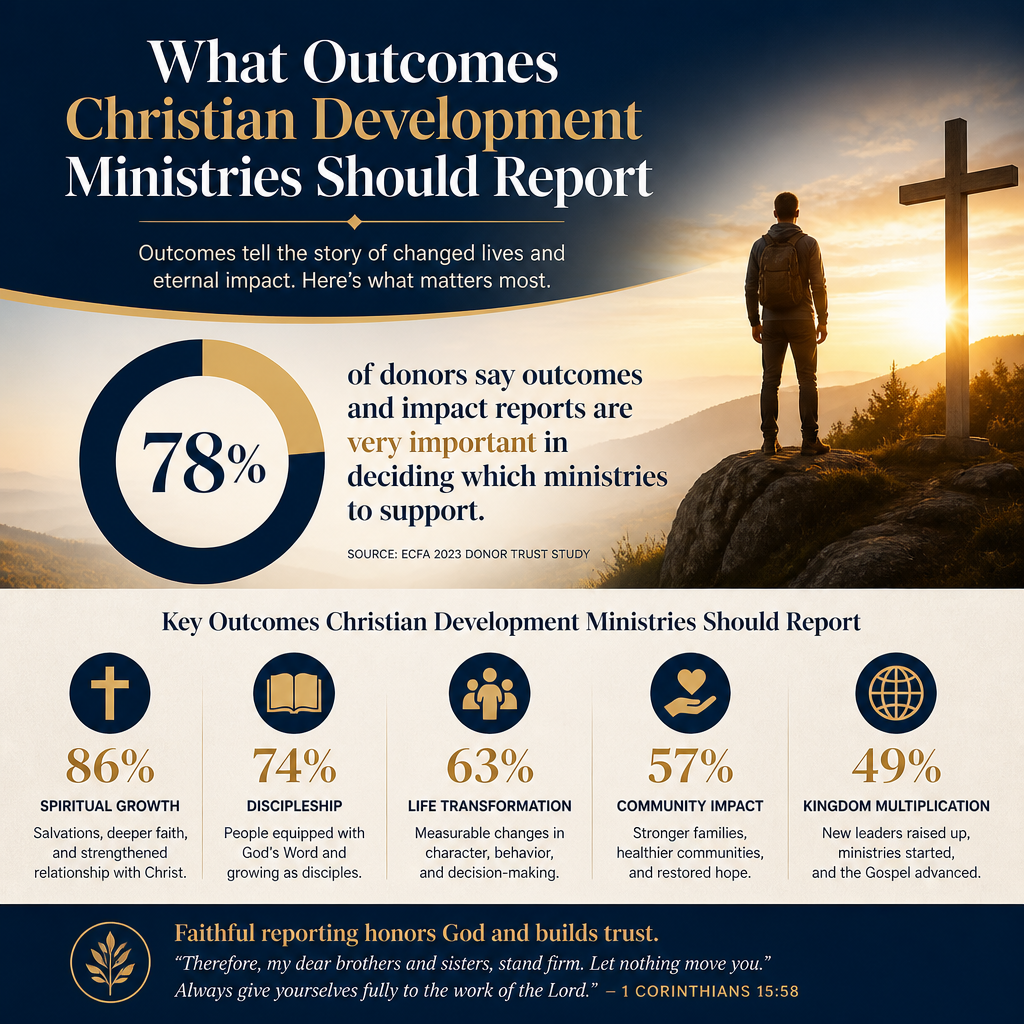
What outcomes Christian development ministries should report is not a technical question; it is a stewardship question. Donors are not purchasing inspiration. They are entrusting resources that belong to God, given for the love of neighbor and the witness of the church.
Development work also resists simple measurement. Scripture’s commands are clear—seek justice, love mercy, care for the poor—yet the path from a gift to a durable change in a household or community can be long, indirect, and contested. Mature reporting does not pretend otherwise. It names what is measurable, what is proximate, what is uncertain, and what is learned along the way.
Start with outcomes that respect people as image bearers
Report change in well being, not only activity
Ministry newsletters often emphasize activity: wells drilled, trainings held, loans disbursed, Bibles distributed. Activities matter, but they are not outcomes. Outcomes describe what changed in a person’s life or a community’s conditions because the activity occurred. A ministry serving agricultural livelihoods, for example, should not stop at “farmers trained.” It should report whether yields improved, whether income stabilized across seasons, and whether food insecurity declined.
Christian donors tend to be generous toward urgent need, but many have also seen the limits of short-term “help” that does not strengthen local agency. The best development reporting insists on dignity: households are not projects; they are neighbors. That means outcomes should be framed in human terms—safety, health, learning, work, belonging—rather than as institutional throughput.
Include harm prevention as an outcome category
Christian compassion can unintentionally undermine what it intends to build: local markets distorted by free goods, dependency created through repeated distributions, leadership bypassed when outsiders control decisions. The When Helping Hurts framework, articulated by Steve Corbett and Brian Fikkert, has helped the church name these dynamics and recover a more respectful posture toward the materially poor.
Accordingly, ministries should report outcomes that demonstrate they are not only doing good but also avoiding avoidable harm. Safeguarding incidents, complaint resolution timelines, community feedback participation, and evidence of local decision-making authority are not peripheral details. They are part of whether love of neighbor is being practiced with wisdom.

Report outcomes across a credible chain of change
Distinguish outputs, short-term outcomes, and long-term outcomes
Christian development donors often ask for “impact,” but impact must be traced through a chain of change that is honest about time horizons. A ministry can responsibly report three layers:
- Outputs: what was delivered (services, goods, training sessions, visits).
- Short-term outcomes: what changed soon after (knowledge gained, behaviors adopted, access improved).
- Long-term outcomes: what endured (income resilience, reduced disease burden, school completion, reduced violence).
When reporting collapses these layers, donors are pushed toward either cynicism (“none of this is real”) or naïveté (“every activity is transformation”). Neither serves faithful stewardship.
Use benchmarks that connect to widely accepted development indicators
Good reporting is specific enough to be tested. For example, if a ministry addresses child health, it can align with recognized indicators such as stunting, wasting, immunization coverage, or skilled birth attendance, while still describing the pastoral and discipleship realities that shape trust and uptake.
One reason donors value independent verification is that ministries can be tempted—often unintentionally—to select the most flattering metrics. At Most Trusted, our work against The Most Trusted Standard examines whether a ministry’s reporting matches a plausible theory of change and whether the measures used illuminate reality rather than curate a narrative.
Report outcomes that show depth, not only scale
Household resilience is often the most honest north star
Development is not only about lifting annual income; it is about resilience under pressure: drought, price shocks, sickness, conflict, and displacement. Ministries should report whether households are better able to withstand predictable crises without selling productive assets, withdrawing children from school, or taking on predatory debt.
Where food security is a central claim, ministries should describe their measurement approach rather than merely stating success. Many reputable actors use established tools such as the Food Insecurity Experience Scale or similar household-level measures. The key is not a particular instrument, but disciplined consistency and transparency about limitations.
Spiritual care should be reported with integrity, not inflated certainty
Christian donors rightly care about gospel witness. Yet spiritual fruit is not a commodity, and spiritual measurement can become manipulative if it is driven by fundraising pressure. Ministries should report spiritual outcomes in ways that honor conscience and avoid coercion: participation in voluntary Bible study, access to pastoral care, and testimonies presented as testimony—not as a guaranteed product of aid.
Christians genuinely disagree about how tightly evangelism and humanitarian assistance should be integrated in any given context, particularly where vulnerability is acute. The ministry that reports with maturity does not hide that complexity. It documents its posture, its safeguards, and its accountability to local church leadership.
Report outcomes that donors can verify, not only admire
Make evaluation methods intelligible
Donors do not need a graduate seminar in monitoring and evaluation, but they do need enough clarity to assess credibility. Ministries should state whether outcomes come from administrative records, household surveys, third-party evaluations, or qualitative research, and should explain sampling and frequency in plain language.
Where causal claims are strong—“this program reduced malnutrition” rather than “we served malnourished children”—the evidence should be correspondingly strong. Randomized controlled trials are not always feasible or ethical, but careful quasi-experimental designs, independent assessments, and transparent comparison to baselines are often possible.
Report cost alongside outcomes without weaponizing overhead
Christian donors frequently ask, “How much goes to programs?” That question is understandable, but it is incomplete. The sector has had to reckon with the “overhead myth,” articulated in a joint letter by GuideStar, Charity Navigator, and the BBB Wise Giving Alliance, which cautioned donors against using overhead ratios as a proxy for impact GuideStar.
Ministries should therefore report cost in a way that actually informs stewardship: cost per participant served, cost per outcome achieved where possible, and explanations for administrative capacity that protects beneficiaries (safeguarding, audit, compliance, staff training). Cheap can be irresponsible, and expensive can be wasteful; donors need the context to judge which is which.
Donors who want to assess a ministry’s broader reliability can situate outcome reporting within a wider picture of leadership, finances, and transparency. That is part of why we maintain resources on Christian Relief and Development Ministries for readers who are weighing multiple organizations and models.
Report outcomes that fit the realities of Christian development work
Local partnership outcomes deserve explicit reporting
Many Christian development ministries work through local churches, community-based organizations, or national NGOs. Donors should expect reporting that names what “partnership” means in practice: who controls funds, who makes program decisions, who owns data, and how conflicts are resolved. Outcomes should include partner capacity and durability, not as a self-congratulating add-on but as a central driver of sustainable change.
When a ministry claims to “empower local leaders,” donors should see evidence: local boards with real authority, locally led staff structures, and transition plans that prevent permanent dependency on foreign funding.
Reporting should address the limits of attribution
Development outcomes are shaped by weather, governance, conflict dynamics, market shifts, and family structures. Responsible ministries resist simplistic credit-taking. They speak in terms of contribution rather than sole causation when the evidence warrants it, and they report what did not work alongside what did.
This is particularly relevant in fragile contexts. For instance, displacement and conflict can reverse years of progress. Ministries that report only success stories may be protecting fundraising rather than telling the truth. The donor who wants to give with open eyes should seek ministries that tell the truth about setbacks and still demonstrate faithful, competent adaptation. Many donors also want to understand these dynamics by program type; our research on How Christian Development Ministries Create Long-Term Change addresses common models and their measurement challenges.
FAQs for What outcomes Christian development ministries should report
Should Christian development ministries report both spiritual and material outcomes?
Where a ministry’s mission includes spiritual care, reporting should reflect that reality, but with restraint and integrity. We recommend reporting spiritual activities and voluntary participation clearly, describing discipleship pathways, and documenting safeguards against coercion. Claims about conversion or spiritual transformation should be presented with theological humility and methodological clarity, not as fundraising proof.
What is the minimum outcome reporting a donor should expect before giving?
At minimum, donors should expect a ministry to report (1) who is served and how they are selected, (2) baseline need and what “success” means, (3) a small set of outcome measures tracked consistently over time, (4) the method used to collect the data, and (5) evidence of learning, including what did not work. Where these are absent, the ministry may still be well-intentioned, but the donor is being asked to give without the transparency Scripture commends in stewardship.
What faithful outcome reporting makes possible
Christian donors are not called to cynicism, but neither are they called to fund stories without evidence. The ministries most worthy of trust report outcomes that honor dignity, trace a credible chain of change, and tell the truth about cost, limits, and learning. That kind of reporting strengthens the church’s witness, protects vulnerable neighbors, and allows generosity to be guided by wisdom rather than by sentiment.



