
Deciding when to give to Christian relief ministries for emergencies is not only a question of compassion; it is a question of timing, trust, and spiritual stewardship under pressure. Emergencies compress decision-making. They also magnify the consequences of weak information, rushed assumptions, and misplaced confidence.
Scripture does not treat mercy as optional. The Samaritan did not postpone care until conditions were ideal (Luke 10:33–35). Yet Scripture also commends discernment: “Let all things be done decently and in order” (1 Corinthians 14:40). Emergency giving sits at that intersection—urgent love, disciplined judgment, and a refusal to confuse immediacy with effectiveness.
Give before the emergency if you want to give well during it
The strongest emergency response is usually funded before the crisis makes the news. Ministries that respond effectively in the first 72 hours do not assemble relationships, permissions, and logistics on the fly; they pre-position capacity. For donors, that means the most strategic “emergency gift” is often a year-round commitment to a ministry that can surge when needed.
Across our verification work at Most Trusted, we observe that ministries meeting The Most Trusted Standard typically show evidence of readiness that is unglamorous but measurable: stable governance, practiced financial controls, partnerships with local churches, and clear decision rights for crisis spending. These features rarely trend on social media. They are also what keeps emergency money from becoming emergency waste.
What readiness looks like in Christian relief
Readiness is not merely a warehouse of supplies. It is the capacity to assess, coordinate, and serve without displacing local leadership. A ministry may be ready for hurricanes but not for conflict displacement. Another may be strong in water and sanitation but weak in child protection. The donor’s task is to fund readiness that matches the kinds of crises that ministry is equipped to address.
Why pre-commitment reduces moral risk
After a disaster, donors face a predictable temptation: give to the loudest appeal rather than the most trustworthy operator. Pre-committing to a vetted relief ministry reduces that risk. It also reflects a Christian understanding of steadfastness—consistent faithfulness rather than reactive generosity.
Give immediately when life-saving windows are short
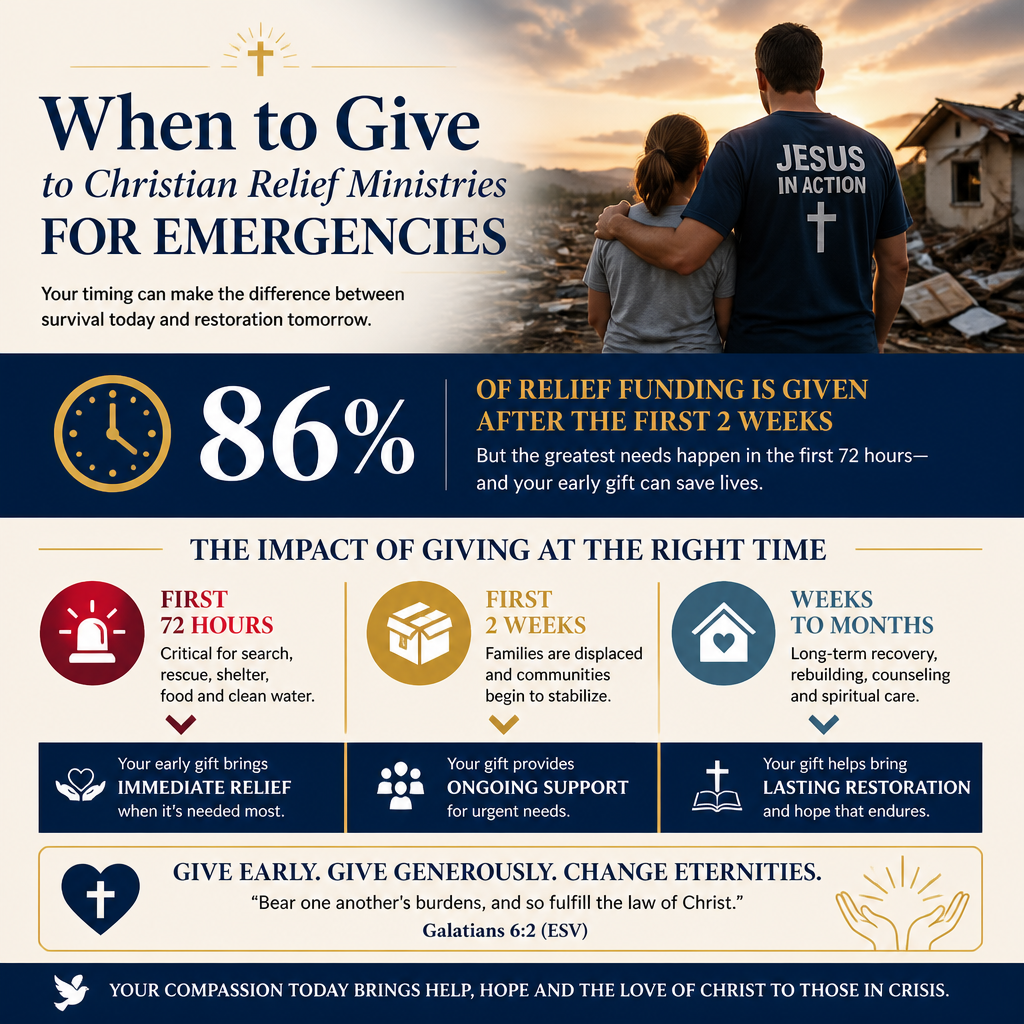
Some needs do not wait. In the earliest phase of a sudden-onset disaster, the goal is stabilization: search and rescue, emergency medical care, temporary shelter, safe water, and rapid protection for children and vulnerable adults. In that period, speed matters because the conditions are still moving—aftershocks, flooding, disease risk, interrupted power, and the breakdown of ordinary safeguards.
The hard question is not whether to give quickly, but whether the ministry can actually move quickly without losing accountability. The ministries that can do both tend to have a clear chain of authority, documented procurement practices, and the ability to work through existing local partnerships rather than inventing them under crisis stress.
What this means for donors in the first days
In the first one to two weeks, we recommend prioritizing ministries with established emergency operations and a documented record of response in similar contexts. If a ministry is newly formed, unusually vague about its plan, or disproportionately focused on branding its presence at the scene, a prudent donor can wait without failing the call to mercy.
A sober word about emotionally targeted appeals
Emergency fundraising often relies on vivid images and urgent copy because the need is real. But the same emotional intensity can be used to bypass due diligence. The Christian tradition has never treated tears as a substitute for truth. Discernment is not cynicism; it is love that refuses to be manipulated.
Wait to give when the crisis is complex and the harm risk is high
Not every emergency is best served by immediate outside spending. Some crises require careful assessment to avoid unintended harm: complex conflict zones, human trafficking risk after displacement, or public health emergencies where untrained volunteers can worsen transmission. In those settings, delay is sometimes the responsible expression of care.
The relief and development field has had to reckon with the ways outside help can unintentionally weaken local capacity. The When Helping Hurts framework, articulated by Steve Corbett and Brian Fikkert, has reshaped how many Christian ministries think about dependency, dignity, and the difference between relief, rehabilitation, and development. Donors do not need to master the full literature, but we should learn the basic lesson: the fastest gift is not always the best gift.
Signals that a donor should slow down
Some warning signs are straightforward. If an appeal centers on sending short-term volunteers into a newly destabilized region, donors should ask hard questions about security, safeguarding, and local church leadership. If a ministry cannot explain how it coordinates with legitimate local authorities and credible partners, the risk of duplication and disruption rises.
How to give faithfully while waiting
Waiting does not require doing nothing. It may mean giving to a trusted ministry’s general disaster fund rather than a narrowly defined promise. It may mean supporting local churches and Christian agencies already in-country. It may mean funding communications and assessment work that leads to better targeted interventions.
Use verifiable indicators when the public attention moves faster than truth
Emergency giving exposes a recurring donor dilemma: the people most eager to make claims are not always the people most equipped to keep them. Credible ministries can show evidence—policies, audited financials, governance discipline, and clear reporting on outputs and outcomes. The point is not to demand perfection in a chaotic environment. It is to insist on the kinds of accountability that keep good intentions from becoming collateral damage.
One useful corrective is the “Overhead Myth” letter signed by Charity Navigator, Candid, and the BBB Wise Giving Alliance, which argues that simplistic overhead ratios can mislead donors and push nonprofits toward underinvestment in capacity and controls. See the joint statement at Candid. In emergencies, underinvestment in capacity can translate directly into weak procurement, poor safeguarding, and unreliable reporting.
A short due diligence checklist for emergency gifts
- Clear description of what the ministry will do in the first 30 days, and what it will not do
- Evidence of local partnerships, including churches and reputable implementing organizations
- Basic financial accountability: audited statements, board oversight, and restricted-fund practices
- Safeguarding policies for children and vulnerable adults, including training and reporting pathways
- A plan for reporting results after the crisis headlines fade
Where Most Trusted fits in a donor’s process
Most Trusted exists because donors should not have to choose between urgency and confidence. We evaluate Christian nonprofits against The Most Trusted Standard, a 15-criteria framework spanning faith foundation, financial integrity, governance and leadership, and transparency and effectiveness. In emergency contexts, those criteria function as guardrails: they do not remove the pain of a crisis, but they reduce the odds that a donor’s gift will be squandered or misdirected.
Donors who want to compare ministries within Christian Relief and Development Ministries often find that clarity about operating model is as important as doctrinal alignment. A ministry may be theologically sound and still structurally unprepared for disaster operations. Serious donors hold both together.
Give for the long recovery when the cameras leave
Some of the most faithful emergency giving happens after the public’s attention shifts. Families move from shelters to temporary housing. Schools reopen with shortages. Livelihoods take years to rebuild. Trauma does not keep a news cycle. The church’s calling to “bear one another’s burdens” (Galatians 6:2) includes the burdens that persist after the immediate danger passes.
Research on disaster philanthropy has consistently shown that giving spikes early and declines sharply even as needs remain. The Center for Disaster Philanthropy regularly counsels donors to support mid- and long-term recovery, not only immediate relief; see Center for Disaster Philanthropy. Christian donors are particularly well-positioned to fund this phase because local churches often become the most durable institutions in a community’s rebuilding.
What long recovery funding can accomplish
Long recovery gifts can fund home repair, livelihood restoration, counseling and pastoral care, legal aid for documentation, and resilience measures that reduce losses in the next disaster. This is also the season when careful reporting becomes possible. A mature ministry can show what was delivered, what partnerships were formed, what failed, and what was learned.
How to match the gift to the season
Some donors prefer to give immediately and move on; others prefer to wait and fund recovery. Both can be faithful. The key is to match the season to the ministry’s competencies and to keep giving aligned with reality rather than sentiment. Donors exploring approaches within Giving Strategies for Christian Relief and Development often find that a two-part commitment—early relief plus later recovery—is both practical and spiritually coherent.
FAQs for When to give to Christian relief ministries for emergencies
Should we give to a specific disaster fund or to general relief capacity?
If a ministry has proven disaster operations and a credible plan for the specific crisis, a designated disaster fund can speed impact. When information is limited or the situation is volatile, general relief capacity can be the wiser gift because it allows leaders on the ground to adapt without violating donor intent. Either approach can be responsible if the ministry communicates clearly how funds will be used and reported.
How can we tell whether an emergency appeal is trustworthy without becoming cynical?
Trustworthiness is usually visible in ordinary documents: audited financials, board governance, clear safeguarding policies, and consistent reporting across good years and hard years. Cynicism assumes bad faith; discernment asks for evidence. In emergencies, we recommend prioritizing ministries that can explain their operating model, their local partnerships, and their accountability practices in plain language.
Giving that honors urgency and truth
Emergency giving is one of the clearest tests of Christian stewardship because it asks us to act under moral pressure with limited information. We serve our neighbors best when we pair compassion with verifiable accountability, funding ministries prepared to act quickly and to stay faithfully for the long recovery. The goal is not to eliminate risk; it is to give in a way that reflects both the mercy and the wisdom Scripture commends.



