

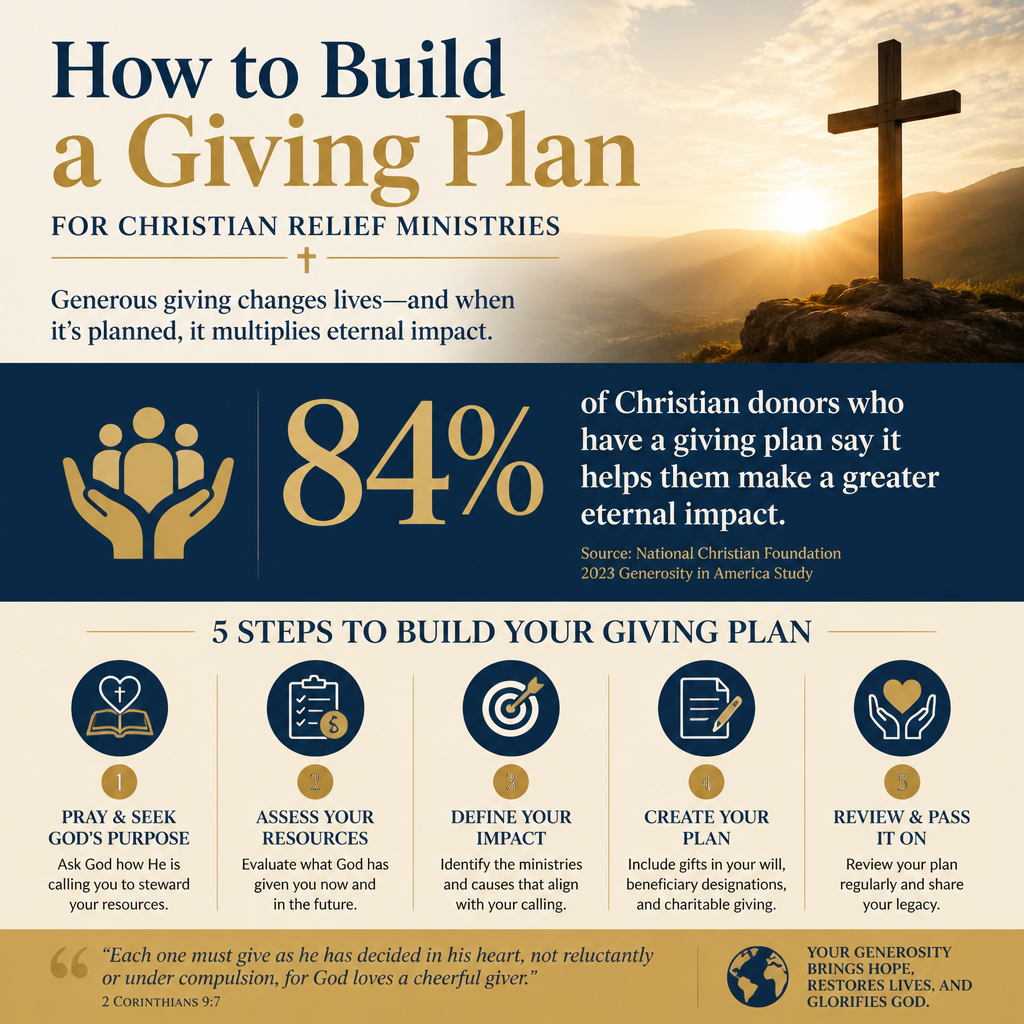
How to build a giving plan for Christian relief ministries is ultimately a question of discipleship before it is a question of budgeting. Christian relief and development sits close to the heart of God’s concern for the poor, the displaced, and the vulnerable, and it also sits in a field where urgency can tempt donors into unexamined decisions.
Many donors feel the strain of competing goods: local needs and global crises, evangelism and material aid, emergency response and long-term development. The Christian calling is not to avoid those tensions, but to order them under Scripture, and then to give with clarity, humility, and verifiable confidence.
Start with a theology of mercy that can withstand urgency
Relief ministries usually meet us at moments when images are searing and time feels short. A giving plan does not reduce compassion; it protects it from being commandeered by the loudest appeal. The Old and New Testaments consistently bind worship to justice and mercy: “Whoever is generous to the poor lends to the Lord” (Prov. 19:17), and James refuses to separate faith from concrete care (Jas. 2:14–17).
What this means in practice is that a donor’s first work is to decide, before the next crisis, what kinds of suffering we are called to address and how we will remain faithful when information is incomplete.
Distinguish relief, rehabilitation, and development
One of the most helpful disciplines is to name what kind of work a ministry is doing. “Relief” is immediate, life-preserving intervention when a community cannot cope. “Rehabilitation” restores what has been damaged. “Development” strengthens long-term capacity and opportunity. Donors often fund “relief” because it feels morally urgent, even when the work on the ground is actually rehabilitation or development, which requires different expectations and different measures of effectiveness.
The When Helping Hurts framework, articulated by Steve Corbett and Brian Fikkert, has reshaped how many Christian organizations think about these distinctions, especially the ways outside assistance can inadvertently weaken local initiative or reinforce dependency if the wrong tool is used for the situation.
Name the moral limits of what donors can know
Christians genuinely disagree about some practical questions in aid: the best balance between direct service and systems change, when cash assistance is preferable to in-kind goods, how to quantify spiritual fruit alongside material outcomes. A giving plan does not pretend those debates are settled. It sets standards for what we will fund, what we will not, and what evidence we require to remain responsible before God and neighbor.

Set priorities by purpose, not by headlines
A serious plan answers the “why” and “where” questions before it answers the “how much.” Most donors have more opportunities than capacity. Without chosen priorities, giving becomes reactive, and reactive giving often drifts toward emotionally compelling narratives rather than toward faithful stewardship.
Clarify your burden and your boundaries
Some donors are called toward acute emergencies: war, famine, sudden displacement. Others have a long-term burden for maternal health, clean water, agricultural resilience, disability inclusion, or refugee integration. Neither is inherently superior. The key is coherence: do the causes you fund belong to an intelligible Christian vision of neighbor love, and are you supporting approaches that respect human dignity and local agency?
For donors who want to keep their priorities tethered to a wider view of the field, we maintain an editorial overview of Christian Relief and Development Ministries as a way to understand common program models and recurring risk areas.
Allocate for both crisis response and slow work
Many donors intend to give to long-term development, then find their entire budget absorbed by the next disaster cycle. A plan can formalize a division: a reserve for immediate crises, and a committed baseline for the slower work of resilience. The humanitarian system regularly faces funding gaps; for example, the UN Office for the Coordination of Humanitarian Affairs reports large shortfalls between humanitarian requirements and funding received in its Global Humanitarian Overview materials, which shapes what relief agencies can actually deliver UN OCHA.
The harder question is how we remain committed after the cameras leave. Relief without rehabilitation can leave communities stabilized but not restored; development without attention to shocks can be undone in a week. A disciplined allocation is one of the few tools donors have to counter the volatility of public attention.
Choose ministries with evidence, not impressions
Christian donors often inherit an unspoken rule: trust the story, trust the brand, trust the personality. Yet Scripture commends tested character and accountable stewardship (1 Tim. 3:1–13; 2 Cor. 8:20–21). Wise giving requires more than goodwill; it requires verification.
Use The Most Trusted Standard as a due diligence baseline
At Most Trusted, we evaluate Christian nonprofits against The Most Trusted Standard, a 15-criteria framework spanning Faith Foundation, Financial Integrity, Governance and Leadership, and Transparency and Effectiveness. This is not a substitute for prayerful discernment, but it is a disciplined way to ask the questions donors often mean to ask and then postpone.
Across our verification work, the ministries that perform well tend to share several traits: clear doctrinal commitments without manipulative spiritual claims, governance that is meaningfully independent, financial statements that can be read without guessing, and impact reporting that is neither triumphalist nor evasive.
Avoid simplistic proxies such as overhead ratios
Many donors were taught to evaluate a ministry primarily by its “overhead.” The field has had to reckon with how misleading that can be. In a widely cited open letter, Charity Navigator, Candid (formerly GuideStar), and the BBB Wise Giving Alliance warned donors against using overhead ratios as the decisive measure of effectiveness, urging attention to results, transparency, and governance Charity Navigator.
Administrative capacity can be a sign of health rather than waste: fraud controls, safeguarding policies, staff training, and monitoring all cost money. The question is not whether an organization spends on infrastructure, but whether that spending is governed well, disclosed clearly, and tied to real service outcomes.
- Identity and doctrine: Does the ministry state its faith commitments plainly and avoid spiritual coercion?
- Financial clarity: Are audited financials, Form 990s, and key policies accessible and intelligible?
- Governance: Is there an engaged board with independence, term limits, and conflict-of-interest discipline?
- Safeguarding: Are child protection and vulnerable-adult policies specific, public, and enforced?
- Program credibility: Does reporting include outputs and outcomes, and acknowledge limitations?
Decide how you will measure faithfulness and effectiveness
Christian relief ministries are not laboratories, and the people they serve are not data points. Still, donors owe more than good intentions. Love of neighbor includes responsibility to learn whether our giving is actually helping. The challenge is to measure what can be measured without reducing people to metrics.
Ask for outcomes that fit the program model
In disaster response, credible measures may include time to deliver assistance, percentage of aid reaching targeted households, or restoration of basic services. In livelihoods or agriculture, donors can look for sustained income changes, food security indicators, or adoption of practices over time. In clean water, metrics often include functionality rates of water points after one to three years, not merely installations.
What we should be cautious about is demanding the wrong kind of certainty. Some outcomes will be delayed, some are confounded by conflict or weather, and some require mixed methods. Mature ministries will articulate these constraints openly rather than offering perfect numbers.
Hold space for spiritual integrity without commodifying conversion
Christian donors rightly want ministries to be Christian, not merely adjacent to Christian sentiment. Yet it is possible to make spiritual fruit a fundraising metric in ways that pressure staff, distort reporting, or instrumentalize suffering communities. We recommend asking how a ministry integrates gospel witness with service: partnership with local churches, pastoral care that respects consent, and discipleship that is not contingent on receiving aid.
Theological seriousness does not require sensationalism. In many contexts, especially among displaced people and religious minorities, discretion and humility are part of faithful witness.
Build the plan as a disciplined rhythm of giving
A giving plan is not only a set of preferences; it is a calendar and a practice. Donors who sustain joy in giving usually make fewer impulsive decisions because they have already decided how much they will give, when, and to whom, leaving room for genuine emergencies without letting emergencies become the whole story.
Establish your annual amount and your review cadence
Some households begin with a percentage of income; others begin with a fixed annual amount that grows over time. Either approach can be faithful if it is intentional and sacrificial rather than accidental. The practical discipline is to define a review cadence: an annual review of your core ministries, a mid-year check on performance and news, and a separate process for unplanned crisis gifts.
For donors who prefer to work within an established set of decision norms, our coverage of Giving Strategies for Christian Relief and Development is designed to keep tactical choices connected to governance, evidence, and theological commitments.
Use a two-tier portfolio for stability and responsiveness
Many experienced donors keep two tiers. The first tier is a small number of “core partners” funded consistently for three to five years, allowing ministries to plan and deepen work. The second tier is a flexible allocation for crisis response or pilot initiatives. This pattern lowers the odds that we will chase novelty and raises the odds that we will fund outcomes that require time.
Where possible, donors can also consider non-cash assets, donor-advised funds, and matching opportunities through an employer or family foundation. The underlying principle remains the same: giving should be deliberate enough to be accountable and flexible enough to be merciful.
FAQs for How to build a giving plan for Christian relief ministries
How many relief ministries should we support at one time?
We generally recommend concentrating most giving in a small number of trusted ministries you can evaluate well, then reserving a smaller portion for responsive crisis giving. Concentration strengthens accountability: it is easier to understand a ministry’s governance, safeguarding, and program model when you are not trying to track twenty organizations at once.
Should we prioritize local church giving over global relief giving?
Many Christian donors treat local church giving as a baseline commitment because the local church is a primary context for worship, formation, and accountable community. Beyond that baseline, global relief giving can be a direct expression of the church’s call to love the stranger and care for the poor. The faithful answer is often not either-or, but a coherent both-and shaped by vocation, capacity, and the needs God puts before us.
A plan that honors both compassion and accountability
Christian relief giving should not be governed by sentimentality or cynicism. A mature giving plan makes room for urgent mercy while insisting on the disciplines that protect the vulnerable: clear theology, evidence of integrity, accountable leadership, and truthful reporting. The aim is not to remove risk from Christian generosity, but to ensure our risk is borne for love of neighbor rather than for lack of diligence.



