
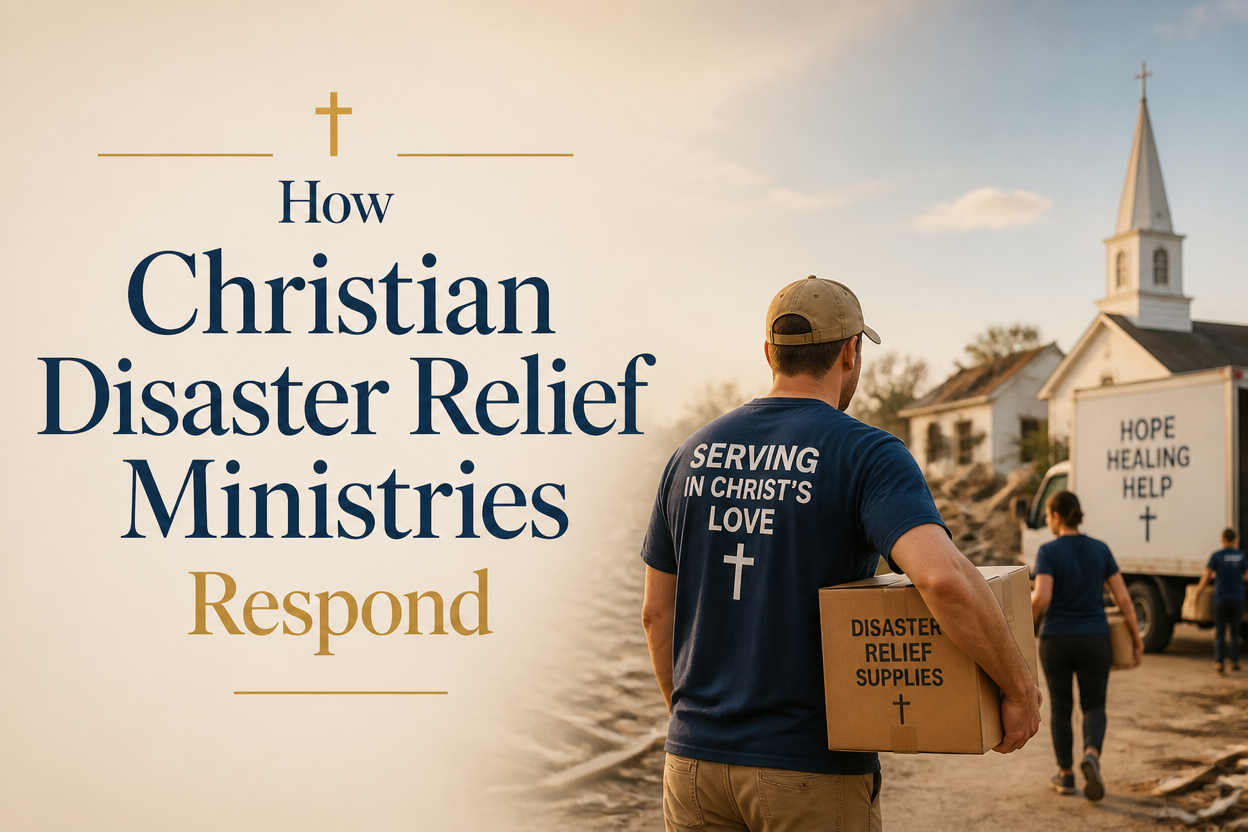
How Christian disaster relief ministries respond is often the clearest public test of their theology of neighbor-love, their operational maturity, and their accountability to the church. Donors are right to feel the moral weight of these moments: when families lose homes, when congregations lose buildings, when a region’s fragile infrastructure collapses, giving becomes an act of stewardship under pressure.
Disaster response is also a field where good intentions can magnify harm. Cash can undercut local markets. Shipments can overwhelm airports and ports. Volunteers can displace local labor or burden traumatized communities. The ministries that serve well tend to pair urgency with restraint, and compassion with discipline—because love of neighbor includes refusing to make a crisis worse.
Immediate response is not improvised, even when it feels urgent
In the first hours after a hurricane, earthquake, or wildfire, the public sees activity—trucks, tarps, meals, chainsaws, mobile clinics—and assumes speed is mostly a matter of willpower. Mature disaster relief is different. It is built before the storm: relationships with local churches, standing agreements with vendors, trained volunteer systems, and logistics that can flex without breaking.
The federal system in the United States also shapes what happens on the ground. Many large-scale responses operate inside a framework coordinated by government emergency management, where nonprofits, churches, and agencies are expected to collaborate rather than compete. When a disaster is large enough for a federal disaster declaration, FEMA can coordinate resources across jurisdictions, which affects where relief groups can stage, how donations flow, and what gaps remain for the church to fill. FEMA publicly outlines the disaster declaration process and its implications for assistance and coordination at FEMA.
Triage is an ethical practice, not a bureaucratic delay
Early decisions have moral consequences. Where do teams deploy first: hardest-hit neighborhoods, the most visible sites, the places where partners already exist, or the places least likely to be served by other actors? Christian ministries routinely face a tension between speed and discernment. The best organizations triage with humility—seeking accurate situational awareness, listening to local leaders, and resisting the temptation to perform competence for donors.
In practice, triage often looks like rapid assessments, mapping unmet needs, and aligning with local churches that can validate what is actually happening street by street. That is slower than broadcasting a dramatic call for help, but it is typically faster than correcting a misdeployment.
Local churches are not an add-on to effective response
Outside observers sometimes treat churches as distribution points or volunteer pools. Scripture treats the church as a living body with responsibilities toward its own members and outward toward neighbors. When disaster strikes, local congregations often become the most durable institutions left standing—spiritually, relationally, and sometimes physically.
Ministries that respond well do not merely “use” churches. They honor them as partners, learn their neighborhood knowledge, and submit to the reality that local pastors will still be present after the national spotlight moves on.
Material aid is only one form of early relief
Food, water, shelter, and debris removal matter, but immediate response also includes less visible work: trauma-informed spiritual care, reunification support, translation, and helping families complete complex assistance paperwork. Christians genuinely disagree about how explicitly evangelistic disaster work should be in the first days of a crisis. The strongest approaches tend to be both clear and careful: unashamed of the gospel, and scrupulously respectful of those who are suffering and disoriented.
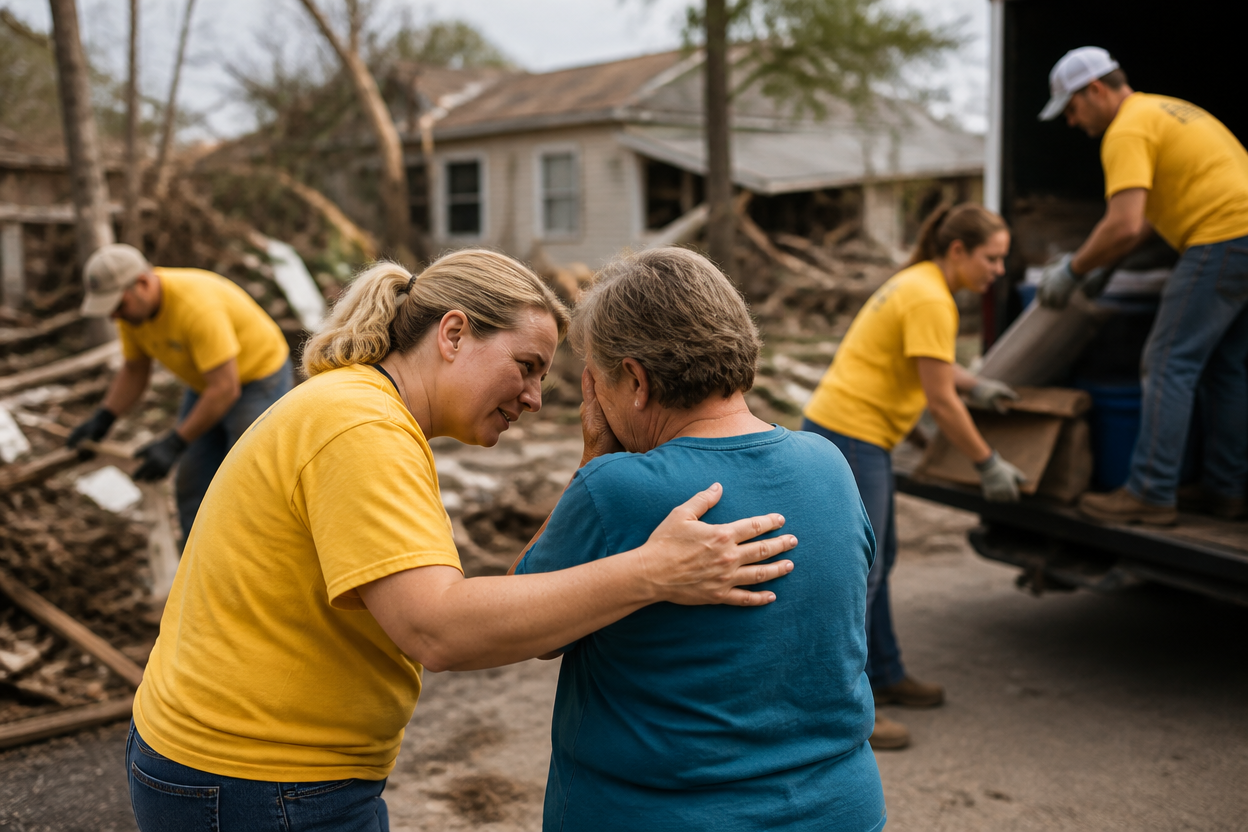
Wise giving avoids the donations that cause harm
Donors often ask what is “most needed,” and the honest answer is usually not the most emotionally satisfying. Disasters create a mismatch between what donors want to send and what communities can responsibly receive. The humanitarian sector has had to learn this repeatedly, to the point that many emergency managers actively discourage unsolicited goods.
For example, after major disasters, unsolicited clothing and household items can clog supply chains and consume volunteer time that should be used for life-safety tasks. The American Red Cross has long emphasized that cash donations are typically the most flexible and effective form of support in disasters because they allow responders to purchase what is needed locally and quickly; their guidance is summarized at American Red Cross.
Cash is not a lack of compassion
Some donors prefer tangible goods because it feels personal. Yet cash, given to a trustworthy ministry with verified controls, is often more personal in effect because it can be converted into what families actually need. It can also help stabilize local commerce rather than replacing it. When a ministry purchases supplies locally where feasible, it supports businesses and workers who are themselves recovering.
That said, cash is only wise when the receiving organization has financial integrity and clear allocation practices. Donors are justified in asking how restricted and unrestricted funds are handled, how expenses are tracked by project, and what safeguards exist against fraud in chaotic environments.
Volunteers help most when they are trained, timed, and submitted
Volunteer energy is one of the church’s great strengths, but untrained or poorly coordinated volunteers can become a burden. Effective ministries deploy teams with clear roles, adequate supervision, appropriate insurance coverage, and safety protocols that treat local residents with dignity. They also time deployments carefully: the first wave may require professional responders and local crews, while later phases open meaningful space for volunteer rebuilding teams.
Donors who want to “go” can ask hard questions that reflect love of neighbor: Who requested volunteers? What training is required? What is the plan for housing, transport, and local coordination? What safeguards prevent harm to children and other vulnerable people?
Guardrails reflect theology, not merely risk management
Christian relief can be tempted toward urgency that eclipses prudence: “Any help is good help.” Scripture pushes in another direction. Zeal without knowledge can be destructive, and Christian love includes discipline, accountability, and deference to those who bear local responsibility. Ministries that refuse harmful donations, set volunteer requirements, and coordinate with civic systems are not being cold; they are practicing ordered mercy.
Effective ministries coordinate without surrendering their Christian identity
Disaster zones are crowded with actors: government agencies, large secular NGOs, local nonprofits, businesses, and a wide range of faith-based groups. Coordination can feel like compromise to some donors, especially when partnerships include organizations with different theological commitments. But refusing coordination often means duplicating services in some areas while leaving other needs uncovered.
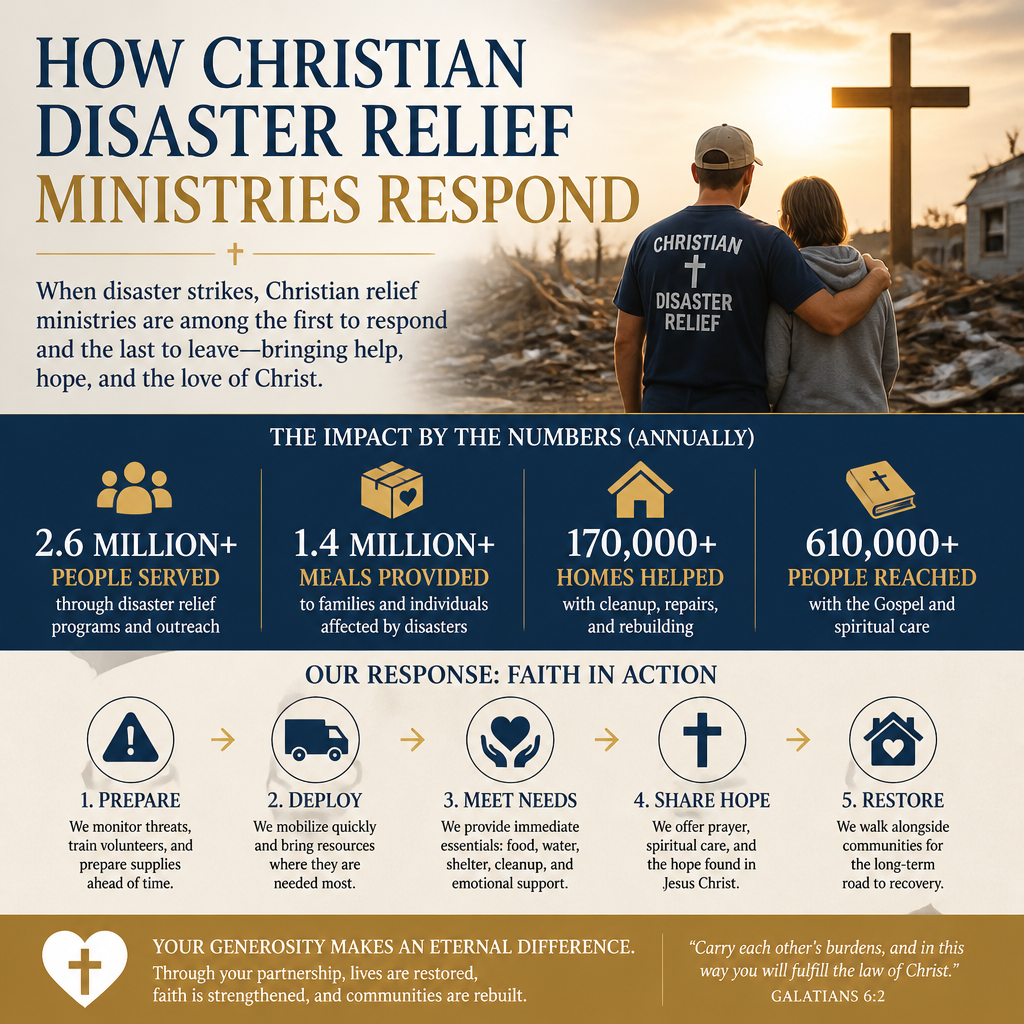
What this means in practice is that donors should expect serious Christian disaster relief ministries to be both cooperative and clear. Cooperative: willing to align with shared standards for safety, data, and distribution. Clear: transparent about their mission, accountable to Christian leadership, and unwilling to manipulate suffering for fundraising or ideological signaling.
Coordination protects the vulnerable and the credibility of the church
In the aftermath of disaster, vulnerable people face elevated risks: exploitation, trafficking, fraud, and abuse. Coordination and documented processes—identity verification, case management, referral pathways, and safeguarding policies—are not bureaucratic burdens; they are protective measures. When the church is perceived as careless with vulnerable people, the damage is spiritual as well as practical.
In our verification work at Most Trusted, we find that ministries that can demonstrate safeguarding policies, partner due diligence, and incident reporting maturity are better positioned to serve under crisis conditions. A donor does not need to be an investigator, but a donor should expect evidence that these systems exist.
Local leadership is not simply a cultural preference
A persistent temptation in disaster response is the outsider narrative: the powerful rescuer arrives to fix the broken place. Christian theology cuts against this. God’s people are called to bear one another’s burdens, not to replace one another’s agency. Local churches and community leaders often have the best grasp of family networks, informal economies, and historical tensions that can make certain interventions combustible.
Strong ministries therefore invest in local partners before disaster hits, and they honor local decision-making during response. This does not eliminate missteps, but it reduces the kind of preventable harm that comes from ignorance.
Transparency must withstand the speed of crisis fundraising
Disasters accelerate giving, and they also accelerate marketing. Some appeals are faithful and restrained; others lean on unverified numbers, emotional imagery, or vague claims about “helping thousands” without operational detail. Sophisticated Christian donors have reason to resist this. If a ministry cannot explain what it is doing, where it is working, and how funds are governed, urgency becomes a substitute for accountability.
When donors want a broader frame for evaluating relief and development organizations beyond the crisis moment, we encourage engagement with Christian Relief and Development Ministries as a category where long-term credibility can be assessed with sobriety rather than adrenaline.
Relief that endures shifts from response to recovery and then to restoration
Most disasters follow a recognizable arc: rescue and immediate relief, then stabilization, then long recovery. Donor attention typically declines long before recovery is complete. This is one reason reputable ministries plan from the beginning for a handoff from emergency distribution to case management, rebuilding, livelihoods support, and pastoral care that can persist.
In the United States, the long tail of recovery can be measured in years, not weeks. The National Institute of Standards and Technology has documented how community resilience and recovery depend on housing, infrastructure, social systems, and governance capacity—not merely short-term aid—through its Community Resilience planning resources at NIST.
When ministries shift to recovery work
The decision to pivot from relief to recovery is not only operational; it is ethical. As basic needs stabilize, the most urgent gaps often become less visible: mold remediation, legal documentation, mental health, domestic violence risk, lost income, and disrupted schooling. Faithful ministries adjust without abandoning the people who no longer generate compelling photographs.
Recovery also increases the need for discipline in project management. Rebuilding homes requires permitting, inspection, contractor oversight, volunteer supervision, and clear criteria for beneficiary selection. Donors should expect a credible ministry to be able to explain how it selects households, how it avoids favoritism, and how it handles conflicts.
What kinds of gifts are genuinely useful in the recovery phase
As the work becomes complex, certain kinds of support become disproportionately valuable: flexible funding, skilled labor, vetted local contractors, and capacity for case management. Donors who prefer designated gifts can ask whether designation will slow the organization’s ability to meet changing needs. The strongest ministries can articulate the trade-off plainly rather than using designation language as a fundraising tactic.
Non-cash gifts can still matter when they are requested, appropriate, and logistically feasible. Yet the guiding question remains whether the gift strengthens local recovery or diverts attention from it.
Measuring effectiveness without reducing mercy to metrics
Christians can become uneasy when ministries speak about outcomes, as though compassion must justify itself in spreadsheets. But the opposite error is equally serious: refusing to measure anything, and thereby asking donors to finance sentiment rather than service. Mature ministries pursue both mercy and clarity: they track outputs (meals served, homes repaired) and, where feasible, outcomes (households stabilized, time to safe housing), while acknowledging what cannot be quantified.
Across our evaluation work using The Most Trusted Standard, we find that the healthiest organizations are transparent about what they know, what they do not know, and what they are doing to learn. They do not confuse reporting with righteousness, but they also do not treat accountability as optional.
Giving with confidence when the need is urgent
Christian disaster relief ministries respond well when they combine readiness, coordinated action, and the moral seriousness to refuse harmful forms of help. Donors serve the church and the suffering best when they look for ministries that can explain their operational plan, demonstrate financial and governance controls under pressure, and honor local churches as enduring partners.
The work is demanding, and the trade-offs are real. Yet when disaster response is governed by love that is ordered—truthful, accountable, and committed for the long recovery—Christian giving becomes a credible witness to the mercy of Christ in a world that cannot repair itself.



