

Giving strategies for Christian relief and development are never only about efficiency. They are moral choices made under limited knowledge: whose suffering we will notice, what risks we will tolerate, and how we will honor the dignity of people we will likely never meet. Scripture binds the church to works of mercy, but it also binds us to truthfulness, humility, and justice in how we carry them out.
Christian donors often feel the pressure of urgency: disaster headlines, compelling stories, and real needs that cannot be postponed. The harder question is how to give in a way that strengthens rather than replaces local responsibility, that meets immediate need without creating long-term dependency, and that treats the church’s resources as stewardship rather than sentiment. What follows is a set of giving practices we see among mature donors and among ministries that consistently meet high standards of integrity.
Begin with stewardship before urgency
Relief and development giving is most faithful when it is planned before the crisis, not improvised in the moment. Emergency appeals are often legitimate, but they can also reward ministries with the best marketing rather than the best operations. A giving plan anchored in stewardship reduces reactive generosity and makes room for discernment.
Let Scripture set the categories
Matthew 25’s works of mercy are concrete: food, clothing, welcome, care, presence. The New Testament also commends ordered generosity. Paul’s instruction to set aside a gift “on the first day of every week” (1 Corinthians 16:2) assumes intentionality, not impulse. Planned giving does not dampen compassion; it disciplines it so that compassion can endure.
For many donors, a useful first step is distinguishing relief from development. Relief is short-term, urgent action to preserve life and stabilize a situation after a shock. Development is patient work that restores productive capacity, social trust, and local institutions. Confusing the two can harm communities. Development practices applied during acute emergencies can be too slow. Relief practices applied indefinitely can keep families from regaining agency.
Build a portfolio that matches the real world
Most Christian households give to multiple commitments: local church, missionaries, and mercy ministries. Within relief and development, we recommend thinking in three lanes: (1) a small reserve for sudden disasters, (2) stable support for long-term development work, and (3) targeted giving aligned with a particular burden (refugees, maternal health, Bible translation integrated with community development, and similar callings). This approach avoids treating every crisis as a referendum on your entire giving plan.
Americans tend to overestimate how much they give, which makes planning harder. The Bureau of Labor Statistics tracks charitable contributions as part of the Consumer Expenditure Survey; it provides a sobering external reference point for what households actually give and how uneven giving patterns can be across income levels. Bureau of Labor Statistics
Use verification as a guardrail, not a substitute for judgment
Christian donors do not need to become auditors, but we do need defensible confidence that a ministry is who it claims to be and does what it says it does. That is the space where independent verification serves the church. Most Trusted evaluates ministries against The Most Trusted Standard, a 15-criteria framework across Faith Foundation, Financial Integrity, Governance and Leadership, and Transparency and Effectiveness. The point is not to outsource conscience. The point is to ensure basic claims are corroborated and that common failure points—unclear governance, weak financial controls, or unverifiable outcomes—are not hidden behind sincere language.

Give in ways that strengthen local responsibility
Christian development has matured substantially in the last two decades because the field has had to reckon with unintended harm. Good intentions can erode local markets, undermine legitimate local leaders, or create dependency cycles. Wise donors ask not only, “Did we do something?” but, “Did our help make it harder or easier for families and churches to flourish with their own agency?”
Prefer models shaped by When Helping Hurts
The When Helping Hurts framework, articulated by Steve Corbett and Brian Fikkert, pressed Christian donors and ministries to distinguish relief, rehabilitation, and development, and to treat poverty as fundamentally relational and spiritual as well as material. Those categories are now standard in many credible development organizations because they name a real danger: treating the poor as projects rather than neighbors. When Helping Hurts
Practically, donors can ask questions that reveal whether a ministry has internalized this discipline: Who sets project priorities? How are local churches and community leaders involved? What happens when outside funding decreases? Does the ministry have a strategy for local ownership, not only local participation?
Honor subsidiarity and the dignity of the local church
Christians genuinely disagree about the exact boundaries of Western involvement in majority-world development. Yet most serious practitioners converge on a principle: decisions should be made as close as possible to the people affected by them. That is not merely a development best practice; it reflects a Christian view of the neighbor as a moral agent, not a passive recipient.
We also recommend a cautious posture toward programs that bypass local churches entirely while still using Christian language for fundraising. There are situations where local churches are weak, compromised, or endangered, and direct partnership is not possible. But as a norm, a “Christian” development ministry should be able to explain its ecclesial relationships without evasion.
Avoid simplistic overhead arguments
Donors often ask for a single number—“What percent goes to programs?”—as if it can carry the moral weight of stewardship. The field has repeatedly warned against this reduction. In 2013, Charity Navigator, GuideStar (now Candid), and the BBB Wise Giving Alliance publicly argued that “overhead ratios” can mislead donors and push nonprofits to underinvest in systems that prevent fraud, measure impact, and retain competent staff. Charity Navigator
What this means in practice is not that overhead is irrelevant, but that it must be interpreted. A ministry with unusually low administrative costs may be under-accounting, under-reporting, or under-investing. A ministry with higher costs may be building the internal controls and monitoring that protect beneficiaries and donors. Mature giving strategies ask for explanations, not slogans.
Choose gift structures that match ministry realities
How a donor gives often matters as much as where a donor gives. The structure of a gift can create stability for a ministry, or it can introduce volatility and perverse incentives. Relief and development organizations face long planning horizons, complex compliance environments, and intense scrutiny during crises. Donors can either add friction or reduce it.
Why monthly giving changes what ministries can responsibly do
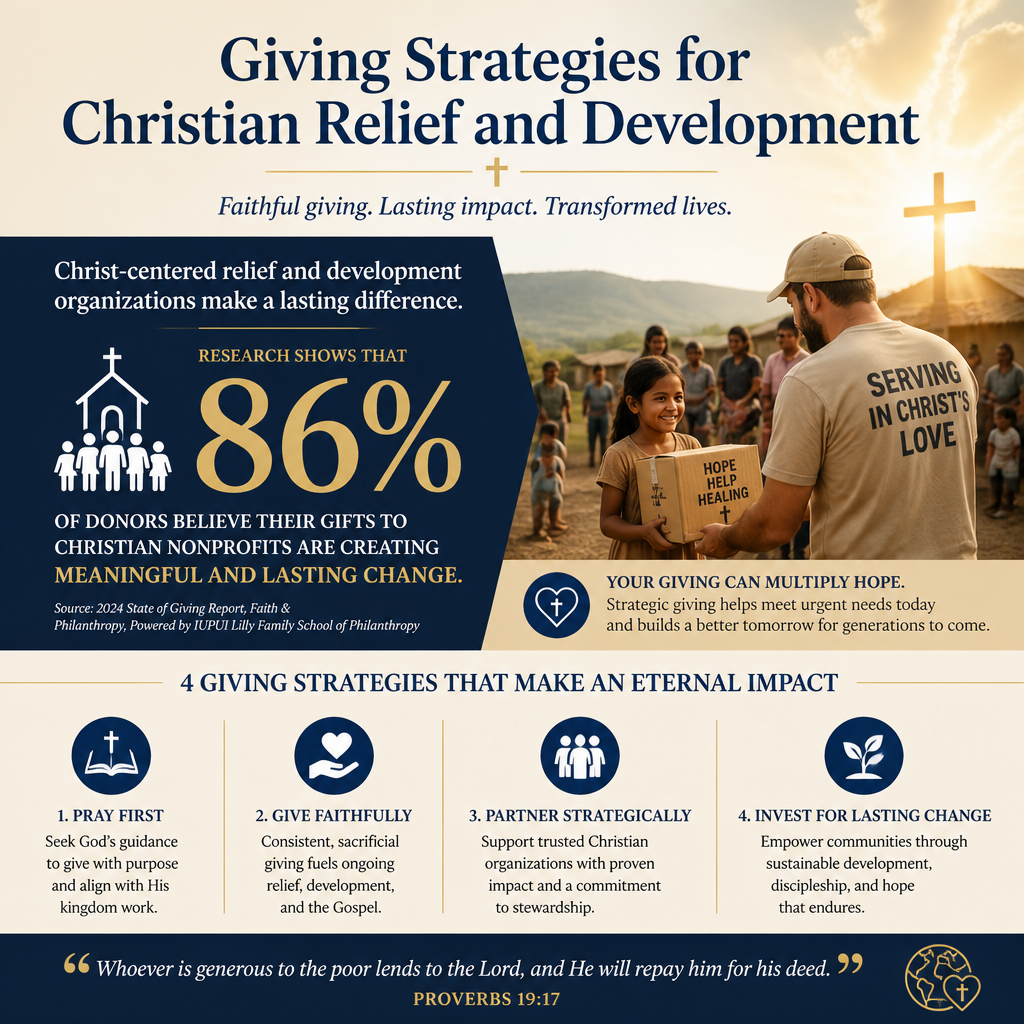
Monthly giving is not merely convenient; it is a form of partnership that aligns with responsible operations. Predictable cash flow allows ministries to retain trained staff, pre-position supplies where appropriate, and avoid panic fundraising that can pressure teams to overstate need. For development work in particular—agriculture training, water and sanitation systems, community health worker networks—continuity is a moral issue because abandoned projects can leave communities worse off than before.
Monthly giving should not be blind giving. We recommend periodic review: confirm that reporting remains consistent, that leadership and governance have not changed in troubling ways, and that public claims match verifiable evidence. Across our verification work, the ministries that meet The Most Trusted Standard tend to treat recurring donors as stakeholders who deserve clarity, not merely as funding sources.
When to designate gifts and when not to
Designated gifts can be appropriate when the need is specific and time-bound—an earthquake response, a targeted nutrition intervention, a particular cohort of displaced families. But designations can also weaken effectiveness if they constrain a ministry’s ability to allocate funds where the situation actually changes. Disaster response often shifts from search and rescue to shelter, then to sanitation, then to livelihood restoration. A rigid designation can force spending that is no longer wise.
We recommend asking ministries how they handle designations: Do they maintain separate accounting? What happens if the project is overfunded or becomes infeasible? Do they have a written policy for reallocating restricted gifts with donor consent? A credible ministry can answer these questions clearly and in writing.
Emergency giving should be fast, but not naïve
In acute disasters, speed matters. Yet the first organization to reach an inbox is not necessarily the first organization to deliver aid responsibly. Some donors keep an emergency shortlist: a small set of ministries they have already vetted for governance, financial controls, and on-the-ground capacity. This preserves responsiveness without rewarding opportunism.
Emergency appeals also create risk for exaggeration, duplication, or mission drift. Donors can insist on clarity about what is being funded: cash assistance, in-kind goods, medical care, logistics, or local partner grants. A serious ministry can articulate both the immediate response and the handoff to longer-term recovery.
Insist on verifiable integrity and truthful reporting
Christian donors often assume that shared confession guarantees shared practices. It does not. The church’s charitable work is done by fallen people inside complex institutions. That reality does not license cynicism; it requires prudence. Verification is one way the church can honor its own moral claims.
What good receipts and acknowledgments should include
Tax compliance is not the heart of Christian giving, but it is a basic sign of organizational maturity. In the United States, donors typically need a written acknowledgment for a single contribution of $250 or more to claim a deduction, and the acknowledgment must state whether goods or services were provided in exchange for the gift. The IRS explains these substantiation requirements and the logic behind them. Internal Revenue Service
We recommend viewing receipts as part of transparency: prompt issuance, clear language, and consistent donor records. Sloppy acknowledgment practices can signal broader weaknesses in financial administration.
Governance is not optional for Christian ministries
Many ministry failures begin with governance: boards that function as friends of the founder rather than fiduciaries, conflicts of interest left unmanaged, decision-making concentrated without accountability, or a lack of documented policies. Donors should not be embarrassed to ask about board composition, independence, and oversight practices. These are not secular distractions; they are ways of honoring the biblical concern for impartiality and faithful stewardship.
This is one reason Most Trusted’s work is framed around The Most Trusted Standard rather than around sentiment or brand reputation. Governance and financial integrity are often invisible until a crisis makes them undeniable. Responsible donors look for evidence before the crisis.
Effectiveness should be described truthfully, not triumphantly
Relief and development outcomes are difficult to measure with precision. Some changes can be counted—households receiving cash transfers, wells rehabilitated, clinics supplied. Other changes are more complex—social cohesion, resilience, spiritual formation. Christians genuinely disagree about what counts as “success,” especially when ministries combine evangelism with development. Serious reporting names limits and trade-offs rather than implying certainty.
We recommend favoring ministries that can define their intended outcomes, report progress consistently over time, and show how they learn from failure. Transparency about what did not work is one of the most reliable markers of honesty we see.
Give with confidence shaped by truth
Christian relief and development giving is one of the clearest places where love of neighbor and love of truth must remain joined. The church is commanded to act, but also to act wisely, resisting vanity, paternalism, and the temptation to purchase emotional relief through charitable spending. A mature strategy is not complicated for its own sake; it is disciplined for the sake of the people our gifts touch.
For donors who want to go deeper in discerning ministries within Christian Relief and Development Ministries, we recommend starting with verifiable basics: a clear faith foundation, accountable governance, transparent finances, and honest reporting on effectiveness. Compassion remains the motive. Evidence protects that compassion from being recruited into harm.



