
When Christian medical ministries need funding most, the need is rarely visible in a single headline or a single line item. It concentrates in predictable pressure points: before clinics open, when supply chains fracture, when disasters bring sudden patient surges, and when the slow, faithful work of discipleship-based care must be sustained after the cameras leave.
Christian donors often feel the tension acutely. We want our giving to meet urgent suffering, and we also want it to strengthen long-term care that is competent, ethically grounded, and locally rooted. The harder question is not whether medical mercy matters—Scripture is unambiguous about visiting the sick (Matthew 25:36)—but how to recognize the funding moments when a ministry’s faithfulness is most at risk and when donor support most directly protects patients.
The first funding crisis is before the first patient arrives
Many medical ministries are most vulnerable financially at the point when their mission becomes operational. Capital projects and clinical readiness costs arrive long before sustainable revenue does. It is easy for donors to underappreciate this phase because it is less emotionally compelling than stories of healed patients, yet it often determines whether competent care will exist at all.
Start-up costs are not overhead in disguise
Licensing, facility build-out, cold-chain storage for vaccines, sterilization capacity, diagnostic equipment, and clinical protocols are patient-safety issues. They are also expensive. Even ministries that will eventually operate with diversified funding (patient fees, insurance reimbursement where applicable, grants, and philanthropy) can experience a dangerous gap between vision and viability.
Donors sometimes respond by demanding that every dollar go “to the field,” understood narrowly as direct patient services. The field has had to reckon with how that instinct can be counterproductive. Charity evaluators themselves have argued for years that simplistic overhead ratios do not reliably measure effectiveness, as reflected in the Overhead Myth letter by charity evaluation leaders such as Charity Navigator, GuideStar, and the BBB Wise Giving Alliance https://www.charitynavigator.org/.
What careful donors can underwrite at this stage
Across our verification work at Most Trusted, we observe that the ministries best positioned to provide durable care treat early-stage funding as a matter of governance and stewardship, not mere fundraising. They plan for depreciation, equipment maintenance, and training pipelines. They also put clear controls around restricted gifts so that enthusiasm does not override clinical prudence.
For donors deciding where to begin, a useful frame is whether the ministry can show readiness milestones that are specific and auditable: a documented staffing plan, signed clinical partnerships, board oversight of risk, and a credible path to ongoing operating revenue. The broader landscape of vetted work in Christian Medical Ministries helps donors compare ministries that serve similar populations but are at different maturity levels.

Supply chains and staffing are where medical mercy becomes fragile
Christian medical ministries depend on supplies and skilled people. When either becomes unstable, clinics can remain open in name while care quality quietly deteriorates. Donors who want to protect patients should understand when procurement and workforce become the bottleneck.
Essential medicines are a recurring, not occasional, vulnerability
In many contexts, ministries procure medications through a mix of local purchase, donated inventory, and international shipment. Each channel has ethical and clinical risks: expired medications, inconsistent formulations, customs delays, and the temptation to treat drug availability as providence rather than as a controllable system. Ministries that offer surgery face additional risk around anesthesia supplies, oxygen, blood safety, and sterile technique.
We also note a common donor misunderstanding: that medical supplies are a one-time need. A clinic treating chronic illness, maternal health, and pediatric infections is running a perpetual logistics operation. When a ministry loses a major donor or encounters a shipment disruption, the immediate victims are not abstract. They are patients who are told to return later, complications that become emergencies, and clinicians forced into rationing decisions.
Workforce stability is as spiritual as it is operational
Staffing is not simply a human resources function; it is part of discipleship and neighbor-love. Retaining competent nurses, clinicians, pharmacists, and administrators requires fair pay, continuous training, and a culture that resists both burnout and messianic leadership patterns. The global health workforce shortage is well documented; the World Health Organization describes significant shortfalls in health workers in many regions https://www.who.int/.
The tension for donors is real. Paying competitive wages can feel less “ministry-like” than funding a specific outreach event. But if the ministry cannot keep qualified staff, it cannot keep patients safe, and it will eventually lose the trust of the community it aims to serve.
Disasters create a funding surge, then a funding vacuum
When earthquakes, floods, conflicts, or epidemics erupt, giving often spikes. The Christian impulse to respond quickly is a strength. Yet disaster environments also create a distinct temptation: to fund only the visible moment and not the long tail of recovery and rehabilitation.
The first 72 hours are not the whole crisis
Emergency triage, trauma care, water purification, and mobile clinics matter. But long-term needs often involve infection control, maternal care continuity, mental health support, rehabilitation, and rebuilding referral pathways. Ministries that remain after the initial surge face a different set of costs: staff fatigue, equipment repair, security, and ongoing procurement when local markets are disrupted.
What this means in practice is that the ministries doing the most faithful work may experience the steepest funding drop precisely when they are most embedded and most accountable. Those are often the ministries that also maintain stronger clinical documentation and more sober communications, which can paradoxically reduce short-term fundraising appeal.
How donors can support disaster response without rewarding dysfunction
Christian donors can insist on a response model that honors both urgency and order. The field has learned, sometimes painfully, that unmanaged volunteer deployments and unsupervised medical work can cause harm. Funding should favor ministries that coordinate with local health authorities, use licensed clinicians in their scope of practice, and maintain patient safeguards even under pressure.
- Fund replenishment plans for essential medicines and consumables, not only initial shipments.
- Support local staff retention and hazard pay when conditions become dangerous.
- Ask for after-action reporting that names failures as well as successes.
- Prioritize ministries that strengthen local facilities rather than duplicating them.
- Give to flexible operating support when governance is strong and reporting is credible.
Chronic disease and primary care are underfunded because they are unglamorous
Acute interventions often photograph well. Primary care rarely does. Yet in many communities, the greatest burden is not a dramatic emergency but a daily accumulation: uncontrolled hypertension, diabetes complications, untreated infections, maternal anemia, depression, and preventable disability.
The quiet cost of continuity
Continuity requires medical records, follow-up systems, reliable medication access, and patient education that respects local context. It also requires a theological patience that resists treating each visit as an isolated act of charity. Christian medical ministries that are faithful to long-term care are often building trust one appointment at a time, and they need donors who understand that stability is part of mercy.
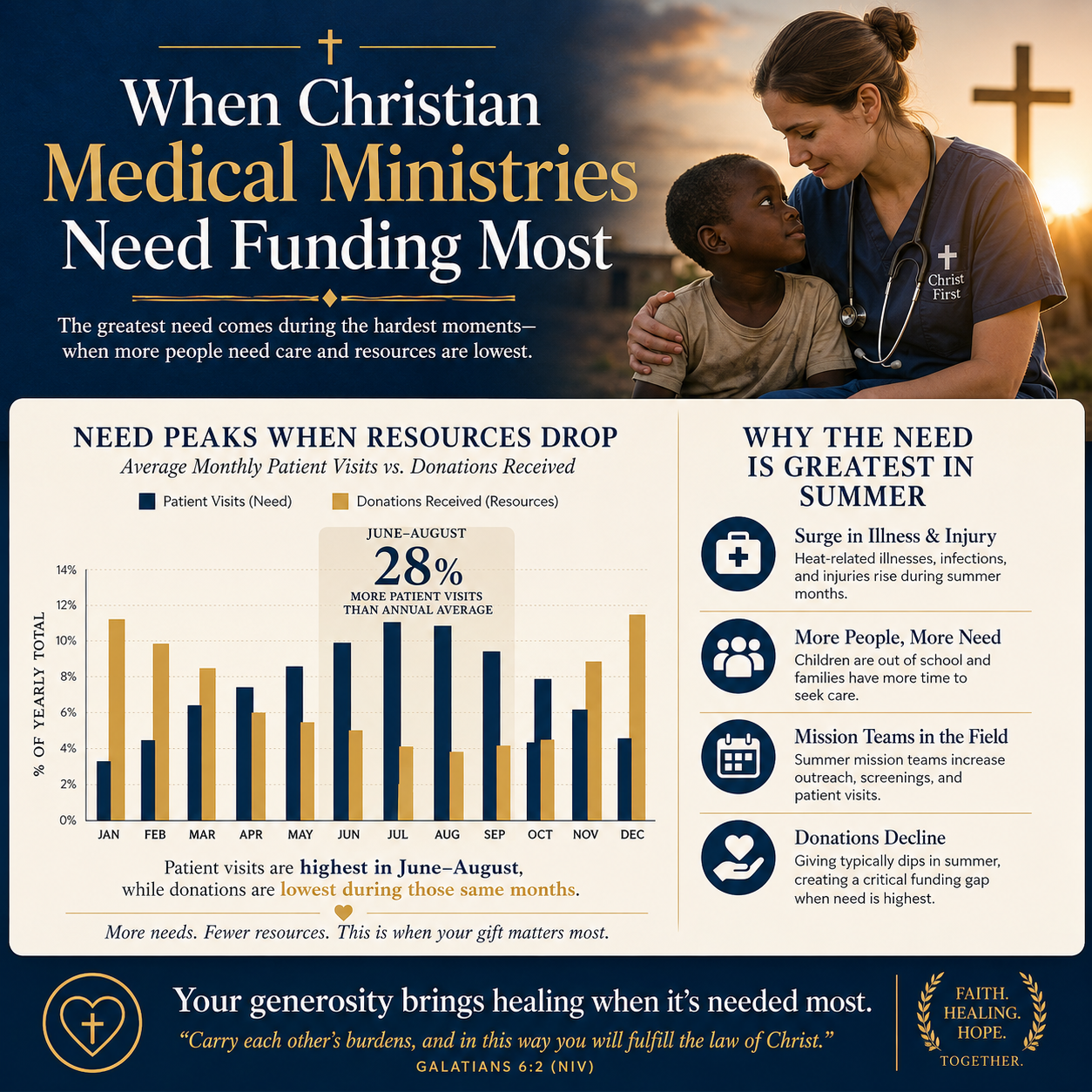
In the United States, many Christian clinics serving uninsured or underinsured patients are also exposed to policy and reimbursement shifts. National data underscores the scale of the uninsured population; the U.S. Census Bureau regularly reports on health insurance coverage https://www.census.gov/. When local economies tighten, patient need rises at the same time that giving can soften—a pressure that can push clinics toward reactive fundraising rather than measured clinical expansion.
What verifiable effectiveness looks like in long-term care
Christians genuinely disagree about what outcomes should matter most: numerical patient counts, spiritual conversations, community health indicators, or leadership development of local believers in medicine. Mature donors can hold more than one good goal at once, provided the ministry is clear about its aims and honest about its limits.
Within How to Give to Christian Medical Ministries, we emphasize the donor discipline of asking for evidence that matches the ministry’s stated mission. A primary-care ministry should be able to describe follow-up rates, medication adherence strategies, referral networks, and safeguards against dependency dynamics, consistent with insights widely discussed in the When Helping Hurts framework articulated by Corbett and Fikkert https://moodypublishers.com/.
Spiritual integrity pressures funding in ways donors rarely see
Christian medical ministries do not only manage clinical risk; they manage spiritual risk. When funding is scarce, the temptation is to promise more than can be delivered, soften theological commitments to broaden appeal, or substitute publicity for accountability. The moments when integrity is most costly are often the moments when funding is most needed.
Restricted giving can distort mission if governance is weak
Restricted gifts can be a gift to a ministry, but they can also become a quiet form of donor control. A clinic may accept funding for a new program while lacking staff capacity to run it safely. A hospital may add services to satisfy a funding opportunity while neglecting the less visible work of infection control or staff formation.
The ministries that meet The Most Trusted Standard tend to treat donor intent as serious stewardship without letting donor preference become de facto management. They can articulate what they will not do, even if it costs money, because their board and executive leadership understand that faithfulness is not only doctrinal; it is operational.
Transparency is not a marketing posture
Medical ministry environments are prone to compelling storytelling. Donors should not be cynical about that; stories are part of Christian testimony. But donors should also insist on transparency that can withstand scrutiny: audited or reviewed financials when appropriate to scale, clear governance, documented safeguarding policies, and measured reporting about outcomes.
Most Trusted exists to serve that posture of stewardship. Our verification work evaluates ministries against The Most Trusted Standard, a 15-criteria framework spanning Faith Foundation, Financial Integrity, Governance and Leadership, and Transparency and Effectiveness. When a medical ministry is asking for funds during a difficult season, donors are right to ask whether the ministry’s internal disciplines are strong enough to carry the weight of the gift.
FAQs for When Christian medical ministries need funding most
Is it better to give to emergency relief or to ongoing clinic operations?
The better question is which ministry can demonstrate competence and accountability for the type of work it is doing. Emergency medicine requires rapid logistics, clinical governance under pressure, and coordination with local systems. Ongoing clinic operations require continuity systems, staff retention, and long-term financial planning. Many donors support both by giving a portion to disaster response and a portion to operating stability, provided the ministry can document safeguards, reporting, and a credible plan for sustainability.
What should donors ask before funding medical equipment purchases?
Donors should ask who will maintain the equipment, how consumables will be sourced, how staff will be trained, and whether the equipment fits the ministry’s clinical scope and local referral pathways. It is also prudent to ask whether the gift will create ongoing costs that the ministry cannot cover. A responsible ministry can answer these questions plainly and will treat them as part of patient safety rather than as donor hesitation.
Funding most often matters where faithfulness is hardest
Christian medical ministries need funding most at the points where care becomes vulnerable: before the first clinic day, when staffing and supply chains strain, after disasters when attention fades, during the unglamorous years of chronic care, and when integrity requires saying no to money that would distort the mission. Donors who give with discernment protect more than budgets; they protect patients, communities, and the credibility of Christian witness in places where suffering is not theoretical.



