

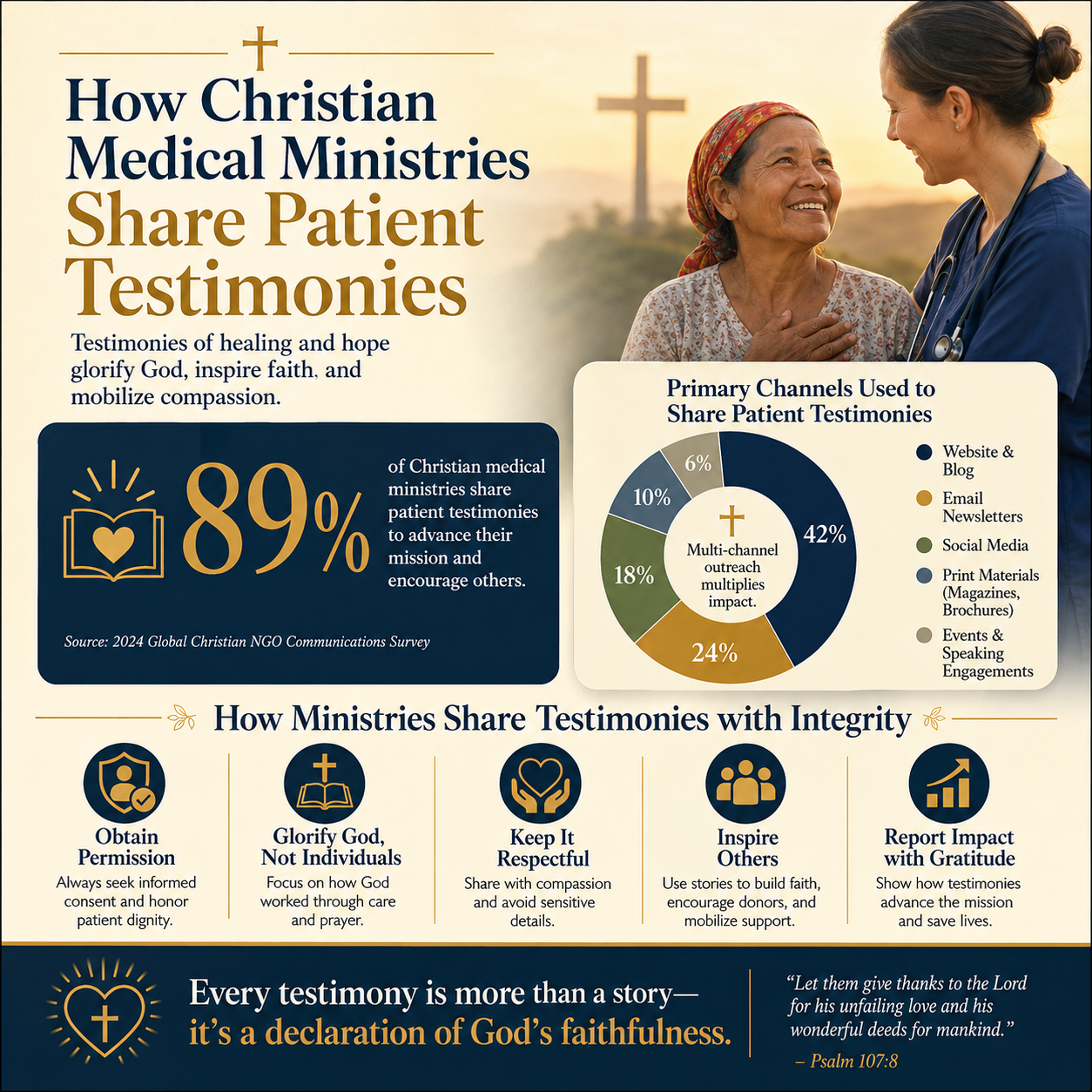
How Christian medical ministries share patient testimonies is not a marketing question first; it is a discipleship question with legal, pastoral, and stewardship dimensions. Testimonies can honor God’s mercy, strengthen the faith of supporters, and bear witness to Christ’s compassion for the sick. They can also expose vulnerable patients to harm, turn suffering into content, or imply guarantees that faithful giving produces predictable outcomes.
For Christian donors, the stakes are twofold. We want to know whether a ministry’s stories are true and representative, and we want to know whether the people in those stories were treated as neighbors rather than as means. Scripture commends public witness to God’s works (Psalm 107:2) and also warns against partiality and exploitation (James 2:1–7). A mature testimony practice must hold both truths at once.
Testimony is witness, not an asset
Theological purpose and moral limits
In the New Testament, testimony is fundamentally witness: “you will be my witnesses” (Acts 1:8). Christian medical ministries often serve at the intersection of bodily suffering and spiritual questions, where patients and families are seeking meaning, relief, and dignity. A well-handled testimony can illuminate the ministry’s calling: caring for the sick, restoring sight, treating infection, counseling a frightened mother, or walking with a family through chronic illness.
But Christian tradition has never treated another person’s pain as raw material. The Good Samaritan does not narrate the wounded man’s story for effect; he binds wounds, pays costs, and protects dignity (Luke 10:25–37). Testimonies that are built around shock, voyeurism, or implied superiority are not merely distasteful. They contradict the very mercy they claim to describe.
Why donors should care about narrative integrity
Donors are not neutral consumers of stories. We become complicit in the incentives we fund. If a ministry repeatedly selects only the most dramatic cases, exaggerates medical outcomes, or frames patients as helpless props for donor heroism, donors are being trained in a distorted moral imagination.
Across our verification work at Most Trusted, we observe that ministries that meet The Most Trusted Standard tend to treat stories as evidence that must be handled with care, not as emotional currency. They build internal safeguards that keep testimony aligned with truth, patient dignity, and the ministry’s stated mission.

Consent is necessary but not sufficient
Informed consent in a ministry context
Many ministries correctly emphasize written consent. Yet donors should understand that consent can be compromised without anyone intending manipulation. A patient may agree to be photographed or interviewed because they feel grateful, because a staff member is asking, or because they assume participation is expected to receive follow-up care. Ethical storytelling requires more than a signature; it requires conditions in which a “no” is safe.
In clinical settings, the power imbalance is real. The U.S. Department of Health and Human Services describes health information privacy protections and patient rights in ways that underscore why disclosure must be carefully governed, even when intentions are good U.S. Department of Health and Human Services HIPAA. Many Christian medical ministries operate outside U.S. jurisdictions, but the underlying principle remains: medical details are intrinsically sensitive, and ministries should assume heightened duties of care.
Special protections for children and high-risk patients
Children, survivors of abuse, patients with stigmatized conditions, and families in crisis can be harmed by exposure even if they appear willing in the moment. Donors should look for a bias toward protection: blurred faces when needed, anonymized details, and a refusal to share identifying information that could invite retaliation, stigma, or financial predation.
Christians genuinely disagree about how public a testimony should be to maximize witness and encourage generosity. The more reliable ministries are the ones that are explicit about their limits and can articulate why they sometimes choose not to publish a powerful story.

Accuracy and representativeness are stewardship issues
Medical claims require disciplined language
Christian medical ministries often work in complex clinical environments: limited diagnostics, inconsistent follow-up, and shifting security or supply conditions. Testimony language should reflect those realities. “Healed” may describe a patient’s lived experience, but “cured” is a medical claim. “Life-saving” may be true, but it can also be a vague superlative used to justify fundraising. Disciplined ministries train staff to distinguish between spiritual gratitude, clinical assessment, and fundraising narrative.
Donors should be wary of claims that imply certainty where the context cannot support it. This is not cynicism; it is reverence for truth. Scripture’s prohibition against false witness applies to fundraising too (Exodus 20:16). When stories are polished beyond recognition, they cease to be testimonies and become tools.
Representative storytelling and the temptation of extremes
Most Christian medical work is not dramatic. It is wound care, prenatal monitoring, infection control, diabetes counseling, cataract surgery, and steady presence. If every story is extraordinary, donors should ask whether the ministry is selecting for spectacle rather than representative impact.
The field has had to reckon with the way donor attention can unintentionally reward the most emotionally gripping narratives. This is one reason we encourage donors to read testimonies alongside audited financials, program reporting, and governance disclosures. For donors seeking a broader view of the ministry landscape, our coverage of Christian Medical Ministries situates patient stories within the practical realities of delivering care.
Transparency must be matched with restraint
When anonymity is the most honest form of transparency
Some donors interpret anonymity as suspicious. In medical ministry, it can be an ethical necessity. A ministry can be transparent about what it does without disclosing who received care, where they live, or what condition they carry. In some contexts, details about religious conversion, sexual violence, HIV status, infertility, or mental illness are life-altering if publicized.
Restraint is not secrecy when it is governed by a coherent policy. A credible ministry can explain what it will never publish, how consent is gathered, who approves stories, and how long content remains in circulation. A policy that anticipates social media sharing, downstream reposting, and long-term digital permanence is a mark of seriousness.
What donors should look for in a ministry’s testimony policy
Donors cannot audit every story. We can, however, assess whether a ministry has the structures that make ethical storytelling likely. As you evaluate a medical ministry’s communications, we recommend looking for:
- Clear consent practices that emphasize voluntariness and the right to withdraw
- Written guidelines on sharing medical details, including limits on diagnosis and prognosis claims
- Additional protections for children and other high-risk patients
- Internal review by leadership or a designated ethics or clinical lead before publication
- Evidence that stories are supported by program reporting, not replacing it
In our work applying The Most Trusted Standard, these practices tend to correlate with stronger governance and a healthier understanding of accountability. They also protect donors from being emotionally manipulated into funding a narrative rather than a mission.
Testimonies should serve discipleship, not just fundraising
Donor formation and the long arc of mercy
Christian donors often carry a quiet burden: the fear of giving to something that is untrue, inflated, or ethically compromised. That burden is not merely financial. It is spiritual. A ministry that shares patient testimonies responsibly helps form donors in patience, realism, and hope—virtues needed for sustained mercy.
Testimonies that acknowledge limits can be more credible than stories that promise triumph. Chronic illness persists. Trauma healing can take years. Surgeries can have complications. A ministry that tells the truth about those realities is not undermining faith; it is refusing to confuse faith with denial.
How this connects to care delivery and accountability
Stories are only one window into whether care is delivered well. Donors should also ask about clinical oversight, referral pathways, follow-up, pharmaceutical integrity, safeguarding practices, and local partnership. The best storytelling cannot compensate for weak governance, and strong governance should shape storytelling.
For donors who want to understand testimony practices in the broader context of medical care delivery, our analysis of How Christian Medical Ministries Deliver Care addresses the operational realities that ethical communications should reflect rather than conceal.
FAQs for How Christian medical ministries share patient testimonies
Should Christian medical ministries share photos of patients receiving care?
Sometimes, but only under conditions that protect dignity and voluntariness. Photos taken during treatment can easily cross into intrusion, especially when patients are in pain, partially clothed, or unable to meaningfully decline. Donors should prefer ministries that use clinically appropriate settings, avoid humiliating angles, limit identifying details, and can describe a consent process that does not pressure patients to participate.
How can donors evaluate whether testimonies are credible without violating privacy?
Donors can look for corroboration at the level of systems rather than identities: audited financial statements, clear program reporting, governance transparency, clinical oversight, and written safeguarding and communications policies. Credible ministries do not ask donors to accept extraordinary claims on the strength of a story alone; they provide reporting that makes the story plausible within documented operations.
Trustworthy witness requires disciplined mercy
Christian medical ministries will continue to share patient testimonies because Scripture commends witness to God’s mercy and because donors deserve to see what their giving makes possible. The question is whether that witness is governed by truth, consent, and dignity, or by the incentives of attention.
When ministries tell stories with restraint, accuracy, and reverence for the patient as an image-bearer, testimonies become what they were meant to be: not the conversion of suffering into fundraising, but a sober record of mercy in the presence of God.



