

How to give to Christian medical ministries is not primarily a question of tactics. It is a question of stewardship under God, where compassion for the sick is joined to disciplined discernment about how care is delivered, who benefits, and what long-term fruit a gift produces. Christians have never had the luxury of treating healing work as optional; Jesus’ ministry repeatedly joined proclamation of the Kingdom with mercy to bodies as well as souls (Matthew 4:23), and the early church became known for costly care in times of plague and abandonment.
Yet modern medical work is structurally complex. It blends medicine, public health, logistics, spiritual care, regulation, and sometimes international supply chains. Mature giving begins by honoring the sanctity of suffering people without romanticizing the work or assuming every well-branded clinic, hospital ship, or crisis fund is equally wise, accountable, or effective.
Begin with the mission reality and the moral stakes
Christian medical ministries operate across a wide spectrum: community health centers, mobile clinics, global surgery programs, maternal and child health, mental health counseling, disability care, addiction recovery, medical debt relief, hospice, disaster response, and training for national clinicians. The donor’s first responsibility is to understand which kind of work is being funded, because the ethical questions differ. A trauma surgery program faces different risks and costs than a medication access program, and both differ from a short-term medical trip model.
Theological seriousness also requires clarity about what Christian medical care is for. Christians genuinely disagree about how to describe the relationship between evangelism and compassionate service, but Scripture does not permit a false choice. We are commanded to do good to all, especially to the household of faith (Galatians 6:10), and to love our neighbor as ourselves (Luke 10:27). The question is not whether to care, but whether the ministry’s model of care protects dignity, avoids harm, and reflects truthful witness.
Different models carry different risks
Some of the most common failure modes in medical missions are not malicious. They are structural. Donated pharmaceuticals can arrive close to expiration, misaligned with national formularies, or without cold-chain integrity. Short-term teams can unintentionally displace local clinicians or create dependency if follow-up care is absent. Hospitals and clinics can drift into “fee-for-service” economics that price out the poor unless there is a disciplined subsidy model. Christian compassion does not remove these risks; it raises the obligation to face them.
Ask what “success” means in a medical ministry
Because medical care deals with outcomes that can be measured, it is tempting to treat impact as a simple count: patients seen, surgeries performed, prescriptions dispensed. Those counts matter, but they can hide essential questions: Was the diagnosis accurate? Was the care appropriate to the context? Were referral pathways in place? Did the ministry strengthen local capacity? Did it protect vulnerable patients from coercion, exploitation, or spiritual manipulation?
Resist simplistic overhead judgments
Medical work is expensive by nature. Clinical staff, compliance, malpractice coverage, pharmacy controls, and quality systems are real costs. Donors should resist the instinct to demand unrealistically low administrative expense as a proxy for faithfulness. The modern nonprofit sector has had to correct this category error; the “Overhead Myth” letter signed by major charity evaluators argued that overhead ratios alone are a poor measure of performance and can even incentivize underinvestment in systems that protect beneficiaries (BBB Wise Giving Alliance).

Give in ways that match how clinical ministries actually function
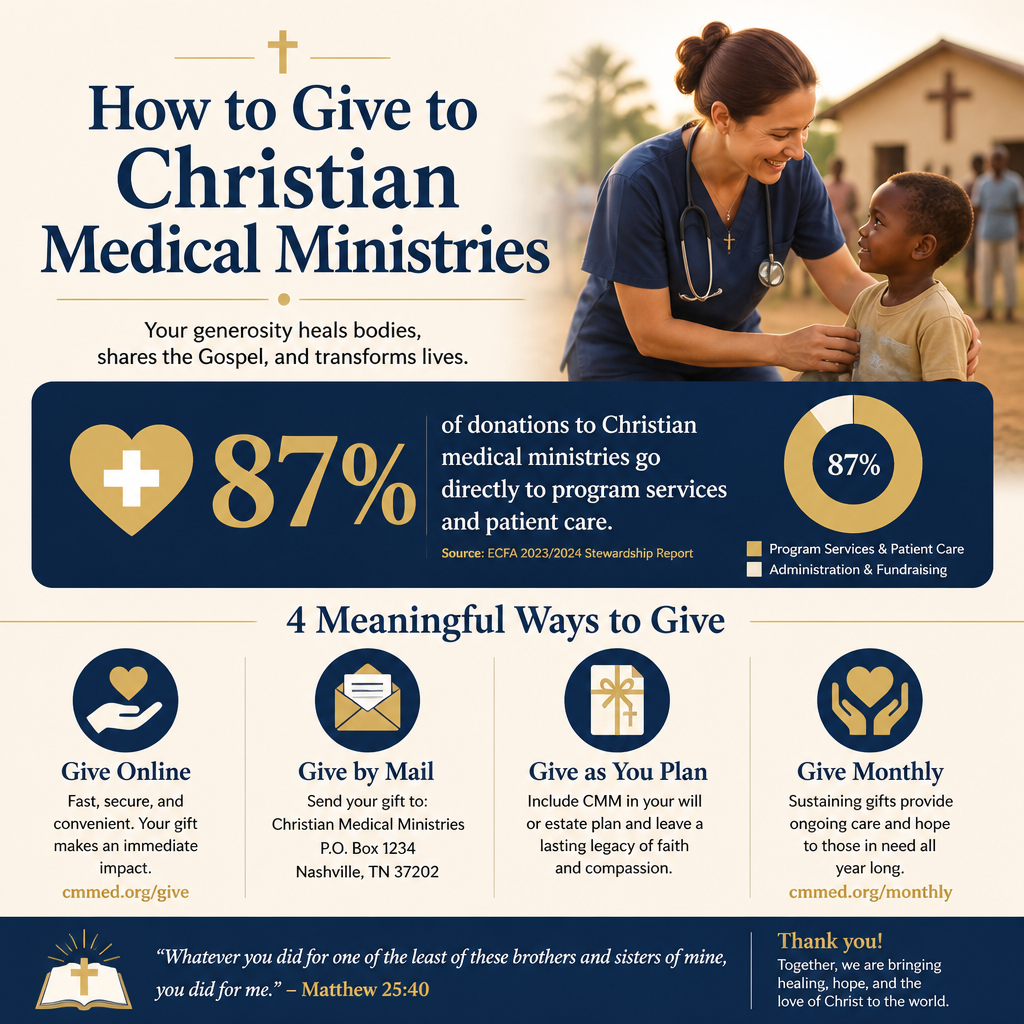
Once a donor understands the kind of medical work being supported, the next question is the form of giving. Effective Christian medical ministries typically require a blend of predictable operating support, designated funds for restricted clinical initiatives, and occasional surges for emergencies. Donors can serve these ministries well by matching their giving methods to real cost structures rather than to marketing calendars.
Online giving can be wise when it is verifiable
Online donation pages have made generosity frictionless, but they have also made impersonation and low-accountability fundraising easier. Before giving online, donors should verify the legal identity of the ministry (name, location, EIN if U.S.-based), confirm that the payment page is secure, and look for plain-language explanations of how gifts are used. For U.S. donors, the IRS provides a searchable tool to confirm whether an organization is eligible to receive tax-deductible charitable contributions (Internal Revenue Service).
Online giving is often the best channel for smaller recurring gifts and for donors who want clean records for year-end receipting. It can also be an appropriate channel for rapid disaster response, but donors should be more discerning, not less, when urgency rises. Crisis conditions increase both legitimate need and opportunistic fundraising.
Monthly giving supports staffing, continuity, and patient follow-up
In medical care, continuity is not a luxury. A clinic that can retain nurses and community health workers, maintain a reliable pharmacy, and follow up with patients over time often produces better outcomes than a clinic that is forced into constant retrenchment. Monthly giving is one of the most practically meaningful ways donors can serve this stability. It also reduces the ministry’s fundraising volatility, which can become a hidden tax on leadership attention.
At the same time, donors should not assume that recurring gifts are always the best option. Some programs have seasonal expenditure cycles (for example, vaccine campaigns or mobile clinic rotations). The more sophisticated approach is alignment: give recurrently when the program’s work is ongoing, and give in larger periodic tranches when the program’s costs are episodic.
Stock gifts and other non-cash assets can increase net impact
For donors with appreciated securities, giving stock can be a highly efficient way to fund Christian medical work, particularly for larger gifts. In many cases, donors may avoid capital gains tax while receiving the charitable deduction, increasing the net amount available for mission. The IRS describes the tax treatment of charitable contributions of property, including securities (Internal Revenue Service). This is not a substitute for professional counsel, but it is often a prudent option for donors seeking to maximize generosity without reducing capacity to give.
Designated gifts require more discernment, not less
Many donors understandably prefer designated gifts: “for surgeries,” “for medicines,” “for the children’s ward,” “for disaster response.” Sometimes designation is appropriate and even necessary, especially when funding a defined initiative or when a donor’s conviction is specific. But designation can also introduce distortions if it overrides clinical priorities or leaves essential but less visible needs unfunded.
Understand restriction levels and their consequences
Designations range from soft preference (a donor’s stated intent that still allows leadership discretion) to legally restricted funds that must be used only for a specific purpose. Legally restricted funds can protect integrity, but they can also create waste if the stated purpose becomes impractical. For medical ministries, over-restriction can mean stocked medicines without clinicians, equipment without maintenance, or a funded procedure program without the diagnostics and follow-up required for patient safety.
A constructive practice is to fund a program area rather than a single line item: “maternal health services” rather than “ultrasound machines,” or “community clinic operations” rather than “bandages.” This respects donor intent while preserving clinical judgment and the flexibility necessary for responsible care.
Ask how the ministry decides when needs are greatest
Donors often ask when Christian medical ministries need funding most. The answer varies by model, but the pattern is consistent: the most urgent needs are frequently the least marketable. These include retaining qualified staff, maintaining compliance and safety systems, replacing worn equipment, and funding follow-up care for chronic conditions. Disaster spikes can require surge funding, but long-term health outcomes are often built in ordinary months when leaders can plan, train, and strengthen local systems.
Insist on safeguards for patient dignity and spiritual integrity
Medical vulnerability creates moral responsibility. A Christian ministry should be able to explain how it avoids coercion in spiritual conversations, protects patient confidentiality, and ensures informed consent. This is where donors should be unembarrassed to ask questions. The image of God in the patient makes patient protection a spiritual obligation, not a compliance checkbox.
Verify the ministry with standards that match the stakes
Because medical ministries can attract strong donor emotion, they are also a setting where disciplined verification matters. At Most Trusted, we exist to help donors give with confidence by evaluating Christian nonprofits against The Most Trusted Standard, a 15-criteria framework that examines faith foundation, financial integrity, governance and leadership, and transparency and effectiveness. The aim is not suspicion; it is moral seriousness about stewardship.
Look for governance that can withstand pressure
Medical work creates pressure: urgent need, complex logistics, and public scrutiny when outcomes are painful. Donors should look for a governing board that is real, independent, and engaged; clear conflict-of-interest practices; and leadership accountability that does not depend on charisma. Ministries that are built around a single personality can grow quickly, but they are often fragile under ethical strain.
Financial integrity should be legible to donors
Transparent ministries do not merely publish numbers; they make the numbers understandable. Donors should look for audited financial statements when appropriate, clear explanations of restricted versus unrestricted funds, and credible reporting on major programs. For U.S. donors, Form 990 is one useful tool for understanding an organization’s finances and governance disclosures, and it is accessible through the IRS (Internal Revenue Service).
Donors should also recognize that medical supply donations can complicate reporting. In-kind gifts may be essential, but they can also inflate revenue figures and obscure the underlying cash requirements of the work. A trustworthy ministry will explain how in-kind valuation is handled and what portion of its clinical work depends on reliable cash support.
Effectiveness reporting should match the ministry’s clinical claims
Ministries should not be expected to publish private patient data, but they should be able to describe outcomes responsibly: follow-up rates, referral systems, quality assurance processes, training outcomes, or community health indicators appropriate to their context. The most credible ministries do not claim they “solved” a region’s health problems. They present measurable progress, acknowledge constraints, and show how they coordinate with local health authorities and churches.
For donors who want to situate a specific ministry within the broader landscape, our editorial coverage of Christian Medical Ministries highlights recurring models, common risk factors, and the verification signals that tend to predict long-term faithfulness.
Giving that heals should be both compassionate and accountable
Christian donors are not called to choose between tenderhearted mercy and sober evaluation. Scripture holds them together. Love of neighbor moves us toward the sick; stewardship requires that our gifts do what we claim they do, without harming those we intend to serve. The most faithful giving to Christian medical ministries is often quiet: predictable support for competent local care, flexible funding aligned to real clinical needs, and verification practices that honor both donors and patients.
When donors give with this kind of moral clarity, they participate in a work that is recognizably Christian: not merely humanitarianism, and not merely branding, but mercy rooted in truth, offered in the name of Christ, and structured with the accountability that vulnerable people deserve.



