
Board governance matters in Christian legal services because legal work concentrates power: the power to interpret facts, to select cases, to speak publicly, and to place a ministry’s name alongside vulnerable people at decisive moments. A healthy board does not merely “support the staff.” It guards mission integrity, ensures lawful and ethical practice, and keeps a ministry accountable to the people it serves and to the donors who fund it.
Christian donors often assume governance is an internal concern, secondary to direct client outcomes. In legal services, that assumption fails quickly. Weak governance can produce conflicts of interest, drift from a ministry’s statement of faith, mishandled restricted gifts, or public advocacy that does not reflect the ministry’s stated commitments. The cost is not only reputational. It can be spiritual harm, legal exposure, and the loss of credible witness.
Governance is a theological responsibility before it is a legal one
Stewardship and accountability are not optional virtues
Scripture frames leadership as stewardship under God, not ownership. Elders are charged to shepherd “not domineering over those in your charge, but being examples” (1 Peter 5:3). While a nonprofit board is not a church eldership, the moral logic is similar: authority is real, and God cares how it is exercised. Donors who fund Christian legal ministries are not purchasing services; they are entrusting resources to leaders who will answer to God for the use of those resources.
What this means in practice is that a board should be able to articulate the ministry’s mission in theological terms and apply that mission in hard cases. Legal services generates hard cases by design: situations where rights, safety, family stability, immigration status, religious liberty, and state power collide. A ministry with a robust board can name the moral trade-offs honestly and set boundaries before crisis forces them.
“Doing justice” includes the way an organization governs itself
Micah 6:8 is frequently cited in justice-focused work, but its triad is inseparable: do justice, love kindness, walk humbly with God. Humility is not sentimental; it takes institutional form. A board that welcomes independent audits, enforces conflict-of-interest policies, and invites external review embodies a kind of organizational humility. A board that resists scrutiny or treats donors as mere revenue streams is not merely “inefficient.” It is spiritually disordered.
Across our verification work at Most Trusted, ministries that consistently meet The Most Trusted Standard tend to treat governance as part of discipleship: an arena where truthfulness, restraint, and accountability are practiced under pressure. That posture is especially important in legal services, where the cultural temperature is high and incentives to overstate impact can be strong.

Christian legal services concentrates risk in predictable places
Conflicts of interest and client harm are not theoretical
Legal ministries regularly engage judges, government agencies, donors with strong views, and sometimes high-profile cases that attract media. Without strong governance, a ministry can slide into conflicts of interest: board members steering cases toward personal priorities, major donors shaping case selection, or staff operating without meaningful oversight. The board’s job is to ensure the ministry’s stated purpose, not any individual’s preference, governs decisions.
Client vulnerability intensifies the stakes. Many clients in Christian legal services are facing eviction, domestic violence, deportation, incarceration, or the loss of child custody. When representation is mishandled or boundaries blur, the consequences are concrete. The field is candid about capacity limits; demand for civil legal aid far exceeds supply. The Legal Services Corporation has reported that low-income Americans receive inadequate or no legal help for most substantial civil legal problems, a reality summarized in its “justice gap” research (Legal Services Corporation). That gap makes triage unavoidable, and triage makes governance unavoidable.
Public advocacy can outpace donor understanding
Christians genuinely disagree about how legal advocacy should intersect with public policy. Some ministries focus narrowly on direct representation; others pursue impact litigation or policy advocacy. Either approach can be faithful, but donors deserve clarity. A board should ensure that the ministry’s advocacy posture is consistent with its mission, transparent to supporters, and accountable to real metrics beyond media attention.
A frequent failure mode is “mission acceleration” without governance capacity: rapid growth, bigger cases, more press, and a widening gap between stated commitments and operational reality. Strong boards slow certain decisions down on purpose. That restraint protects clients and protects the ministry’s credibility.
What donors should expect from a well-governed legal ministry
Clear roles between board and staff
Governance is not micromanagement. Competent boards distinguish between oversight and operations: they set mission, approve strategy, ensure financial integrity, hire and evaluate the chief executive, and monitor risk. They do not attempt to practice law through committees. In legal services, that distinction is especially important, since improper board interference in legal judgments can create ethical and liability complications.
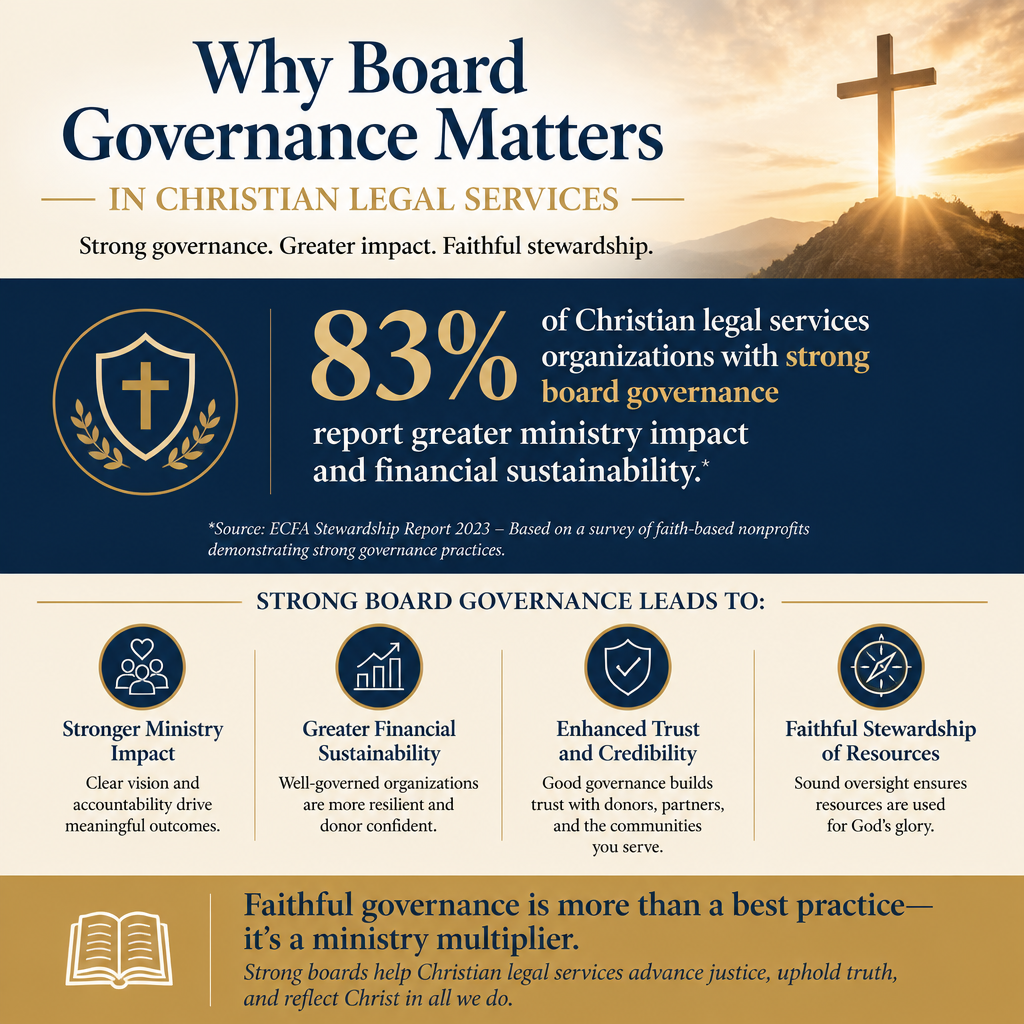
At the same time, boards must be informed enough to oversee a complex practice area. A board composed entirely of friends of the founder, or entirely of lawyers with no financial or pastoral competence, tends to have blind spots. A mature ministry builds a board with complementary strengths: legal ethics, finance, program evaluation, trauma-informed service, and theological clarity.
Policies that are more than paperwork
Policies do not guarantee integrity, but their absence reliably signals immaturity. Donors should expect a credible Christian legal ministry to maintain and enforce, at minimum, the following governance basics:
- A written conflict-of-interest policy with annual disclosures
- A whistleblower policy and a credible reporting pathway
- Documented board minutes and board approval for key decisions
- Clear gift acceptance and restricted-gift policies
- A process for evaluating the chief executive with documented goals
These are not “corporate” concerns imported into ministry. They are concrete ways of telling the truth, refusing favoritism, and protecting the weak. They also make a ministry more resilient when leadership transitions, a common moment for mission drift or financial instability.
How governance shapes financial integrity and donor trust
Restricted gifts and case funding require disciplined oversight
Christian legal services often attracts donors who want to fund specific kinds of cases: asylum work, adoption and foster care advocacy, religious liberty, or anti-trafficking litigation. Those interests can be legitimate, but they create pressure points. A board should ensure restricted gifts are tracked accurately and used as promised. If a ministry cannot fulfill a restriction, it should seek donor permission to redirect funds or return them. Donors should not have to discover in hindsight that designated funds were treated as general revenue.
Strong oversight also matters because legal ministries frequently operate with a mix of charitable giving, program fees, grants, and sometimes court-awarded attorney’s fees. Those revenue streams can be ethical and appropriate, but they can also distort incentives if not governed carefully. The board should understand how funding sources shape program choices and ensure the ministry’s posture remains service-oriented rather than revenue-driven.
Transparency is the discipline that keeps zeal from becoming presumption
Donors are right to ask for evidence of financial responsibility. A baseline expectation is that a ministry files an accurate Form 990 and makes it accessible. The Internal Revenue Service provides public access to nonprofit filings through its tax-exempt organization search resources (IRS). Form 990 is not a complete picture of faithfulness, but it is a meaningful window into governance: independent board members, related-party transactions, and how a ministry describes its mission.
The harder question is how a ministry communicates impact without exaggeration. Legal outcomes can be slow, uncertain, and sometimes confidential. Good governance ensures public reporting remains truthful: celebrating real wins without implying guarantees, and acknowledging limits without cynicism. This is one reason our team at Most Trusted treats transparency as a spiritual and practical discipline, not merely a marketing virtue.
Using The Most Trusted Standard to evaluate governance without cynicism
Verification should strengthen ministry, not replace discernment
Christian donors often feel caught between two errors: naïve trust and corrosive suspicion. Board governance provides a more excellent way. It gives donors objective, reviewable signals of maturity while preserving space for prayerful discernment about mission fit and theological alignment.
Most Trusted exists to help donors give with confidence by evaluating ministries against The Most Trusted Standard, a 15-criteria framework covering faith foundation, financial integrity, governance and leadership, and transparency and effectiveness. When we evaluate a Christian legal services ministry, we pay close attention to whether the board is functioning as an actual governing body or merely lending names to stationery.
Donors exploring this field can benefit from a broader view of the landscape of Christian Legal Services Ministries, especially because governance expectations may differ between a small local legal clinic, a national policy organization, and a ministry embedded within a church or denomination.
Questions that surface governance strength without demanding insider access
Governance cannot be reduced to a checklist, but donors can ask concrete questions that reveal whether oversight is real. These are not adversarial questions; they are stewardship questions:
Who sits on the board, and are a majority independent of paid staff and close family relationships? How does the board evaluate the chief executive, and what happens if performance or conduct concerns arise? What is the ministry’s conflict-of-interest process, and can leadership describe it without improvising? How does the organization decide which cases it will and will not take? What does the ministry disclose publicly about finances, decision-making, and results?
For donors who want a fuller framework for due diligence, the category How to Give Wisely to Christian Legal Services provides context for evaluating ministries with seriousness and charity rather than impulse.
FAQs for Why board governance matters in Christian legal services
Is a ministry less spiritual if it emphasizes governance and compliance?
No. Governance is one of the ways a ministry embodies truthfulness, accountability, and care for the vulnerable. In legal services, compliance failures can directly harm clients and compromise witness. Spiritual zeal that refuses accountability is not a biblical ideal; it is a predictable path to scandal and broken trust.
What if a Christian legal ministry has a faithful founder but a weak board?
Faithful founders can carry a ministry for a season, but governance weakness usually becomes a crisis during growth, controversy, or leadership transition. Donors can respond proportionally: fund in ways that do not increase restricted-gift complexity, ask whether board development is underway, and consider supporting ministries that can demonstrate mature oversight. The goal is not to punish young organizations but to avoid financing predictable failures.
A board is the ministry’s long obedience in the same direction
Christian legal services is often exercised in contested spaces where public pressure is intense and the need is urgent. A strong board does not guarantee perfect decisions, but it does make repentance possible, correction timely, and mission drift less likely. For donors, governance is not a peripheral administrative detail. It is one of the clearest indicators that a ministry can be trusted to practice justice with humility, to tell the truth about its work, and to steward gifts in a way that honors Christ.



