

Vetting a Christian legal ministry’s mission is an act of stewardship before it is an act of philanthropy. Because law is both powerful and contested, a mission that is vaguely worded or rhetorically inflated can drift into politicized activism, donor-driven priorities, or even sincere but misdirected efforts that neglect the weightier matters of justice, mercy, and faithfulness.
Christian donors are not only funding services; they are endorsing a moral vision of neighbor-love expressed through legal advocacy, counseling, and representation. Scripture’s vision of justice is not a partisan slogan. It is God’s settled commitment to righteousness in public life, including honest weights and measures, protection for the vulnerable, and impartial judgment (Prov. 31:8–9). A ministry’s mission statement should be strong enough to guide decisions under pressure and specific enough to be evaluated.
1. Test whether the mission is biblically anchored and institutionally specific
A mission that can be affirmed by almost any organization is not a mission; it is a sentiment. Christian legal ministries operate in high-stakes environments—courtrooms, immigration systems, child welfare proceedings, religious liberty disputes, and criminal defense. General language about “making a difference” offers no meaningful constraint when cases become complex or controversial.
Look for biblical commitments that shape practice
A serious mission will show how Scripture governs the ministry’s understanding of the person, truth, and justice. Micah 6:8 is often quoted, but the more revealing question is how a ministry handles the tensions Scripture requires us to hold together: truth and mercy, advocacy and honesty, zeal and restraint, courage and humility. Ministries that speak about justice without the fear of the Lord can drift into moralism; ministries that speak about evangelism without justice can reduce legal help to a transaction.
What this means in practice is that the mission should name the ministry’s theological center of gravity. Does it confess Christ plainly? Does it frame legal work as service to neighbor and public witness, not merely as cultural influence? Ministries with mature missions tend to articulate both the dignity of those served and the moral limits of advocacy, including a refusal to manipulate facts or demonize opponents.
Require real-world specificity about who is served and how
Mission clarity usually shows up in three concrete places: (1) the population served, (2) the legal domain, and (3) the kind of assistance offered. “Providing legal help to those in need” could describe a hotline, a referral network, a clinic with volunteer attorneys, or full-scope litigation. Donors should be able to understand the ministry’s intended outcomes without reading a press release.
For broader context on what different kinds of ministries do—and what responsible donor expectations look like across the field—Most Trusted maintains a reference point for Christian Legal Services Ministries.

2. Confirm the mission aligns with a coherent theory of justice and neighbor-love
Legal work is never merely technical. It carries an implicit account of what justice is for, what people are owed, and what outcomes are worth pursuing. Christians genuinely disagree about tactics in public life, but donors should not support a legal ministry whose mission is functionally undefined or whose strategy contradicts its professed theology.
Distinguish relief, empowerment, and structural change
Many legal ministries combine more than one approach: emergency relief (eviction defense, asylum support), long-term empowerment (expungement clinics, record correction, debt counseling), and policy or impact litigation. Each can be faithful. Each also demands different competencies and carries different risks.
A mission that promises “systemic transformation” may be overstating what a nonprofit can responsibly claim. At the same time, a mission that only offers “compassion” without naming measurable legal problems may understate the seriousness of the work. Mature missions locate their calling realistically: they speak with moral seriousness but not institutional grandiosity.
Watch for mission drift driven by attention and outrage
Legal ministries can be pulled off-course by news cycles, donor passions, or platform incentives. A mission that is overly dependent on external enemies tends to become reactive. Donors should ask: if the cultural temperature changes, would this mission remain coherent? If the same ministry faced a case where its own constituency was wronged and where its constituency was at fault, would its stated commitments allow it to act consistently?
One useful diagnostic is whether the mission includes commitments that constrain the ministry when doing so is costly: integrity in testimony, respect for the rule of law, truthfulness in communications, and willingness to serve those who cannot repay or amplify the ministry’s brand.
3. Examine whether the mission is operationalizable and accountable
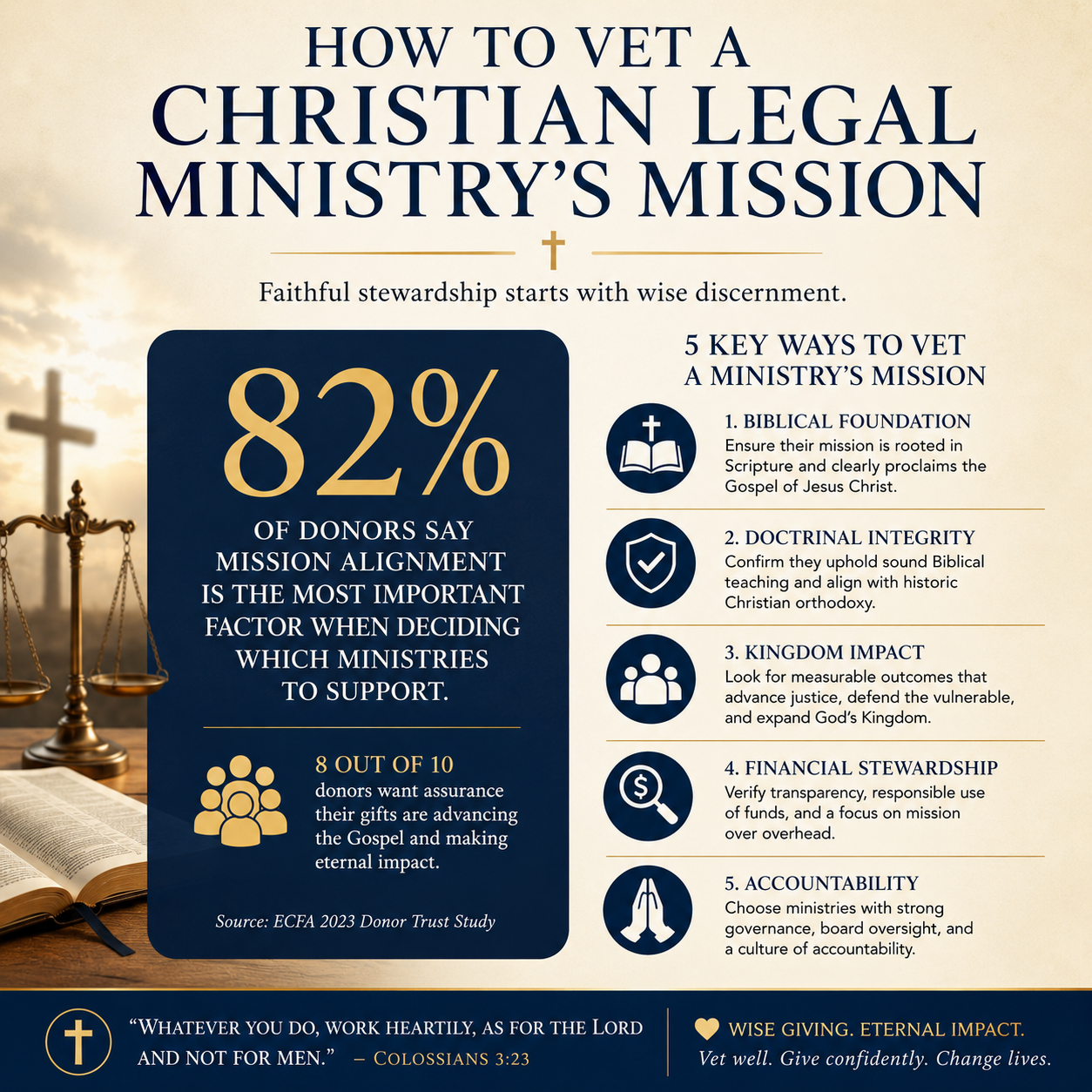
A Christian mission is not validated by aspiration alone. It must be capable of guiding budgets, staffing, program design, and evaluation. When a ministry’s mission cannot be translated into decisions—what cases to take, what services to prioritize, what outcomes matter—it becomes difficult to hold the ministry accountable.
Ask what the mission implies about case selection and client care
Case selection is where many legal ministries reveal their real mission. Do they exist primarily to serve clients with urgent needs, or primarily to win precedent-setting cases? Do they provide holistic support—translation, trauma-informed care, pastoral partnership—or do they treat clients as instruments for a cause? These are not accusations; they are categories that should be disclosed honestly.
The donor’s interest is not to micromanage litigation strategy but to verify alignment: the mission should make clear whether client service or broader advocacy is primary, how conflicts are handled, and what ethical commitments govern representation.
Look for measurable claims that can be verified without reducing ministry to numbers
Not everything that matters can be quantified, and donors should resist metrics that reward shallow volume. Still, legal ministries can report meaningful indicators: cases opened and closed, types of services provided, referral completion rates, client satisfaction practices, and follow-up processes. For impact litigation, credible reporting includes clear descriptions of objectives, legal posture, and outcomes—both wins and losses—rather than only celebratory storytelling.
Donors can ask for documents that tie mission to practice: program descriptions, annual reports, and publicly stated policies. When a ministry asks for trust while withholding basic information, that is a governance problem before it is a communications problem.
4. Vet the mission against financial integrity, governance, and public truthfulness
A mission can be doctrinally sound and still be operationally unreliable. Scripture’s warnings about money, partiality, and dishonest speech apply directly to nonprofit work. If a ministry’s mission is to pursue justice, its internal life must be shaped by truth.
Match mission ambition to financial realities
Legal work is expensive: licensed professionals, malpractice coverage, secure data systems, and time-intensive representation. Donors should be cautious of missions that imply expansive national impact while financial statements suggest chronic underfunding or dependence on a single revenue stream. Financial fragility can drive an organization toward sensational cases, exaggerated fundraising claims, or program commitments it cannot sustain.
At minimum, donors should review audited financials when available, IRS Form 990s where applicable, and clear descriptions of restricted versus unrestricted funding. The credibility of financial disclosure is not a superficial “overhead” debate. Major nonprofit evaluators have warned against using overhead ratios as a simplistic measure of effectiveness; the better question is whether spending patterns fit mission and whether reporting is candid. See the joint letter commonly known as “The Overhead Myth” from Charity Navigator, GuideStar, and the BBB Wise Giving Alliance.
Test governance for independence and theological seriousness
Legal ministries often have founder-driven energy. That can be a gift, but it also raises governance risks. A credible mission is strengthened when oversight is real: an independent board, documented conflict-of-interest policies, and leadership evaluation that is not performative. Donors should look for signs that the board protects the mission from both internal ambition and external pressure.
Across our verification work at Most Trusted, the organizations that meet The Most Trusted Standard tend to be explicit about who has authority to set strategic priorities, how ethical complaints are handled, and how leadership is held accountable. These are not bureaucratic details. They are the guardrails that keep a ministry’s mission from becoming a slogan.
5. Use disciplined questions that reveal what the mission will cost
The most clarifying mission questions are not abstract. They force trade-offs into the open. A ministry can state its mission in a paragraph and still avoid the costs of living it out. Donors should ask questions that expose whether the mission is durable under conflict, controversy, and pressure.
Questions that surface clarity, limits, and integrity
- Who is the “neighbor” you are structurally committed to serve? Name the client populations and the barriers that keep them from justice.
- What kinds of cases will you not take, and why? Responsible ministries can articulate ethical and strategic boundaries.
- How do you ensure truthfulness in advocacy? Ask about fact-checking, legal ethics training, and corrections when public statements are wrong.
- How do you measure faithfulness when outcomes are uncertain? Legal work often involves losses; integrity is revealed in how losses are reported.
- How do you protect clients from being used for fundraising? Ask about consent practices, privacy, and trauma-informed storytelling.
Recognize legitimate diversity within faithful missions
Some Christian legal ministries focus on direct representation for low-income clients. Others focus on religious liberty litigation, immigration, or anti-trafficking work. Donors should not assume that one domain is inherently more faithful than another. The question is whether the mission is truthful about its aim, whether its methods are ethically sound, and whether its posture reflects the character of Christ rather than the spirit of the age.
Donors seeking a broader framework for disciplined giving in this space may find it useful to situate mission questions alongside financial integrity, governance, and transparency expectations within How to Give Wisely to Christian Legal Services.
FAQs for How to vet a Christian legal ministry’s mission
What is a red flag that a Christian legal ministry’s mission is not trustworthy?
A consistent red flag is a mission that relies on vague moral language while avoiding concrete disclosures about who is served, what legal work is performed, and what constraints govern advocacy. Another is a mission that is driven primarily by opponents and outrage, which often leads to reactive case selection and overstated claims. Trustworthy missions can name their commitments and their limits without evasion.
Should donors avoid Christian legal ministries that engage in policy or litigation work?
Not necessarily. Policy work and litigation can be appropriate expressions of seeking justice, especially when pursued with humility, truthfulness, and a clear understanding of the ministry’s role. The donor’s responsibility is to verify alignment: whether the ministry’s mission is biblically grounded, ethically constrained, and transparently reported. The strongest organizations explain why they use these tools, what accountability governs them, and how they protect clients and the public from propaganda.
Mission clarity is the beginning of trustworthy partnership
A Christian legal ministry’s mission should be able to bear weight: scrutiny from courts, questions from donors, and the moral seriousness of representing people made in God’s image. When the mission is biblically anchored, operationally specific, and governed with integrity, donors can give with clearer conscience and steadier confidence. Most Trusted exists to strengthen that confidence by evaluating ministries against The Most Trusted Standard, so that generosity is guided by truth as well as compassion.



