
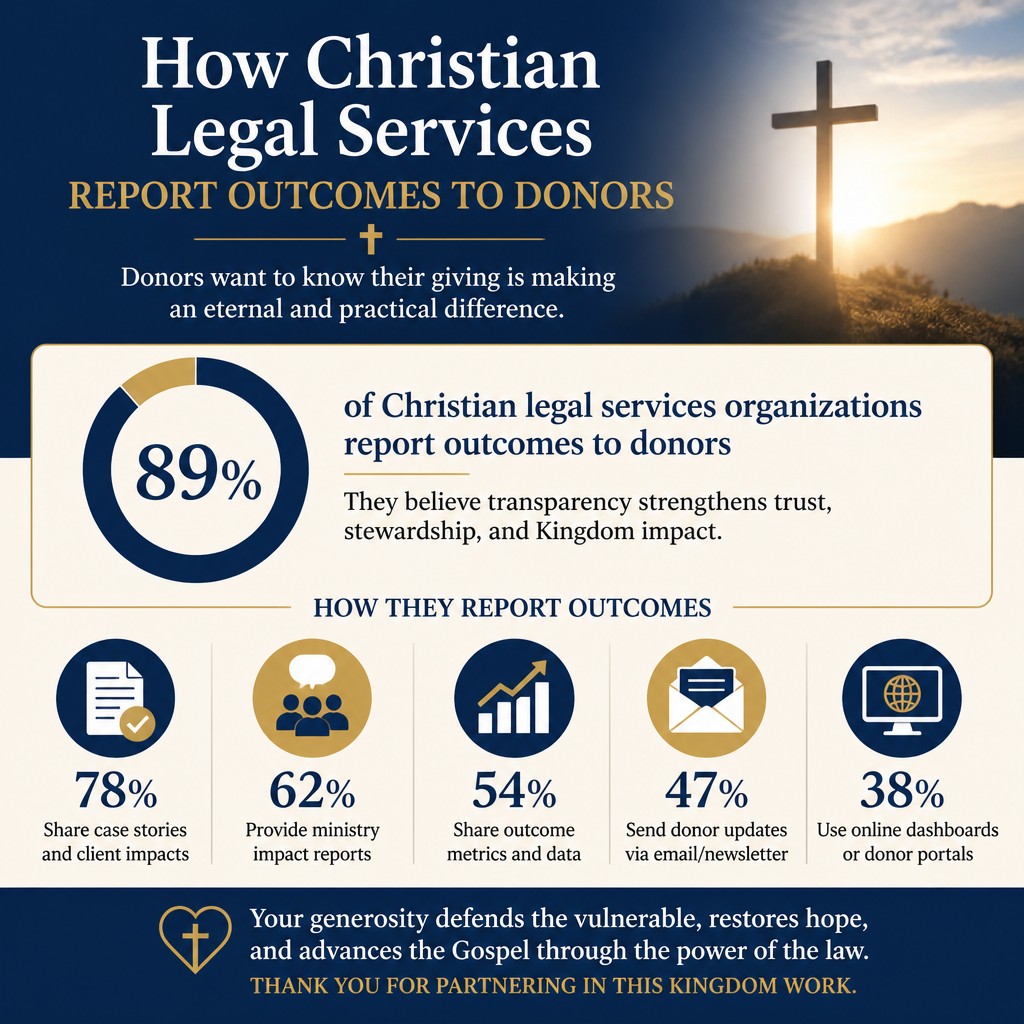
How Christian legal services report outcomes to donors is not a peripheral communications question. It is a test of whether a ministry is treating donors as partners in stewardship, and whether its work is ordered toward justice rather than publicity. Because legal aid can feel technical and slow, reporting is often where donor confidence is either strengthened through clarity or quietly eroded through vagueness.
Scripture does not allow Christian concern for justice to be sentimental. “Learn to do good; seek justice, correct oppression” (Isaiah 1:17) is a direct imperative, and ministries that serve in courts, detention centers, and immigration proceedings are operating in one of the most morally weighty arenas of public life. That weight calls for reporting that is truthful, careful about people, and candid about what can and cannot be measured.
Outcome reporting begins with a theology of justice and truth
Legal services ministries often do their best work when they refuse both cynicism and naivete. They see the limits of what a case result can prove about a person’s long-term stability, while still insisting that concrete legal outcomes matter. Donors do not need inflated claims; they need a ministry that speaks truthfully about what it attempted, what it achieved, and what remains unresolved.
Justice is a Christian obligation, not a marketing posture
Christian donors are right to ask whether a ministry is actually protecting the vulnerable or merely narrating compassion. Proverbs describes righteous leadership as knowing “the rights of the poor” (Proverbs 29:7). In legal services, “knowing” is literal: understanding due process, the contours of asylum law, the requirements of a protective order, the implications of a criminal record, and the lived reality of navigating these systems.
Reporting should reflect that seriousness. Ministries can and should explain what legal problem was addressed and why it matters for a neighbor’s safety or stability. A restraining order, a lawful work authorization, a cleared title, a sealed record, or lawful presence is not merely a “win.” It can change a family’s risk profile, access to employment, and vulnerability to exploitation.
Truthfulness protects both clients and donors
Legal services is an arena where exaggeration is especially damaging. It can endanger clients, compromise credibility with courts and partner agencies, and mislead donors who are trying to practice wise stewardship. The Christian tradition treats truthful speech as a moral matter, not an optional virtue. Outcome reporting should therefore avoid “miracle story” framing that implies certainty where there is none, particularly when a case is still pending or when long-term outcomes cannot be responsibly attributed to a single legal intervention.

What donors should expect ministries to measure and what they should not
Outcome reporting improves when ministries separate activity, outputs, outcomes, and long-term impact. Many donor communications collapse these categories, which creates confusion. Mature reporting acknowledges that some results are measurable now, some are probabilistic, and some are known only over time.
Core outcome categories that can be verified
Across our verification work at Most Trusted, the ministries that communicate well to donors tend to report outcomes in categories that map to real legal events. They can be substantiated through case management systems and documentation without disclosing private client details.
- Case resolution outcomes (for example, relief granted, charges dismissed, or an order issued)
- Process milestones (for example, filings submitted, hearings attended, continuances, appeals initiated)
- Client stabilization outcomes tied to legal status (for example, lawful work authorization obtained)
- Protection outcomes (for example, safety planning linked to protective orders, custody arrangements formalized)
- Systems outcomes where appropriate (for example, policy change or court practice improvement, with citations)
Donors generally do not need to know every motion filed, but they should be able to understand what the ministry counted, how it counted it, and why it matters.
What responsible reporting cannot promise
Some donor expectations are understandable but misaligned with the nature of legal work. A ministry cannot guarantee a particular verdict or immigration decision; ethical rules and the realities of adjudication do not allow that kind of certainty. Nor can a ministry responsibly attribute every long-term life change to legal representation alone. Housing stability, family unity, and spiritual renewal may be downstream effects, but they are influenced by many variables.
Christians genuinely disagree about how much emphasis ministries should place on “impact” language in complex social systems. What sophisticated donors can insist upon, however, is that ministries tell the truth about attribution: what was directly caused by legal action, what was plausibly contributed to, and what is simply hoped for.
Privacy and trauma require outcome reporting that is careful, not thin
Legal services reporting has an unavoidable tension: donors want concrete stories, but client confidentiality and safety often demand restraint. The solution is not to provide less information; it is to provide information in forms that protect people while still allowing donors to assess effectiveness.
Confidentiality is not a communications obstacle, it is part of ministry integrity
Because legal services ministries work with survivors of domestic violence, detained immigrants, the wrongfully accused, and families in crisis, client exposure can carry real risk. Even “anonymized” stories can become identifiable in a small community or a specific court docket. Ministries should therefore report outcomes using aggregated results, representative case types, and clear methodologies rather than leaning on vivid details that increase vulnerability.
Donors can take this as a positive signal: a ministry that refuses to trade client dignity for fundraising content is demonstrating governance and leadership maturity. When donors want to understand the broader landscape of this work, we recommend engaging resources like Christian Legal Services Ministries, where the field’s major models and safeguards can be compared without putting individuals at risk.
Trauma-informed storytelling still requires specificity
“Trauma-informed” should not become a reason for generalities that cannot be evaluated. Ministries can describe the legal problem, the intervention, and the result without naming locations, unique personal details, or court identifiers. They can also describe what did not work: a denied petition, an overburdened court calendar, a client who disengaged, or a systemic barrier that prevented relief. Candid reporting of losses often signals honesty and improves donor trust when it is paired with a clear explanation of what was learned.
What strong donor reporting looks like under The Most Trusted Standard
Most Trusted evaluates ministries against The Most Trusted Standard, a 15-criteria framework across faith foundation, financial integrity, governance and leadership, and transparency and effectiveness. For Christian legal services, “effectiveness” is not measured by theatrical wins; it is measured by documented service, lawful outcomes, ethical compliance, and credible learning over time.
Transparency that connects dollars to legal capacity
Legal services is labor-intensive. Donors are often deciding whether to fund staff attorneys, accredited representatives, paralegals, interpreters, training, or pro bono coordination. Reporting improves when ministries connect budget categories to service capacity in plain terms: how many open cases a staff attorney can reasonably carry, what supervision costs, why interpretation and expert affidavits matter, and how case management systems protect quality.
The best ministries also resist simplistic “overhead” narratives. The sector has repeatedly argued that overhead ratios alone are not a reliable indicator of performance; Charity Navigator, Candid GuideStar, and the BBB Wise Giving Alliance have publicly cautioned donors against using overhead as the primary measure of nonprofit quality in their Overhead Myth letter (Charity Navigator). For legal work, adequate administration can be the difference between ethical, supervised practice and preventable errors.
Effectiveness reporting that can be tested
When ministries meet a high standard, their reports allow a donor to ask informed questions and receive verifiable answers. That usually includes definitions for success, the time horizon being reported, and what data is excluded. For example, is a “case served” counted at intake, at filing, or at resolution? Are brief advice clinics counted separately from full representation? Are pro bono hours tracked independently? These details are not pedantry; they are the difference between clarity and impression management.
Legal services ministries also operate in an environment of high demand and limited capacity. The national justice gap has been documented for years, with the Legal Services Corporation reporting that low-income Americans receive inadequate or no legal help for the majority of their civil legal problems (Legal Services Corporation). A credible ministry will therefore report not only what was done, but how it triaged need, what it could not take, and what partnerships it relied on.
How donors can read legal outcomes without being misled
Donors often receive reports that list cases, decisions, and client stories, yet still struggle to evaluate whether the ministry is healthy. The harder question is whether outcomes are being presented in a way that reflects legal reality and Christian integrity rather than donor psychology.
Ask for denominators, not only numerators
“We won 120 cases” is less meaningful without context. Donors can ask: 120 out of how many? What kinds of cases were they? How many were full representation versus limited scope advice? What were the most common reasons for unfavorable outcomes? Ministries that report denominators are usually ministries that are managing for truth rather than applause.
It is also reasonable to ask for timelines. Immigration and asylum processes can take years; certain family law matters involve repeated hearings; expungement may require waiting periods. A ministry that reports only annual “wins” without acknowledging the multi-year arc of many cases may be unintentionally distorting the picture.
Look for evidence of ethical guardrails
Legal services is governed by professional standards. Donors should expect ministries to mention supervision structures, malpractice coverage where applicable, referral protocols, and policies that govern conflicts of interest. These safeguards rarely make for inspiring copy, but they are often where integrity is either preserved or compromised.
For donors comparing ministries by program type and use of funds, How Christian Legal Services Use Donations can provide a useful frame for evaluating whether reported outcomes align with the actual costs and constraints of responsible legal practice.
FAQs for How Christian legal services report outcomes to donors
Should Christian legal services ministries report a win rate?
Sometimes, with careful definitions. A “win rate” can be misleading if it mixes fundamentally different matters or ignores cases where the best outcome was harm reduction rather than a favorable ruling. If a ministry reports a win rate, donors should expect clear denominators, case-type breakdowns, and an explanation of what counts as success.
How can ministries share client stories without compromising safety?
They should prioritize aggregated outcomes and representative case summaries that remove identifying details, and they should obtain informed consent when any individual narrative is used. Strong reporting explains the legal issue, the intervention, and the result without unique personal markers that could expose a client in a court system or local community.
A faithful report tells the truth about both justice and limits
Christian legal services ministries serve neighbors whose lives can be altered by a hearing date, a filing deadline, or a judge’s discretion. Donors honor that reality when they insist on outcome reporting that is concrete, ethically restrained, and candid about uncertainty. The ministries most worthy of sustained support are typically those that can show their work: not only the compassion that motivates it, but the verifiable legal results, the safeguards that protect people, and the humility to name what remains unfinished.



