
How Christian legal services support pregnancy centers is no longer a theoretical question. It is a practical matter of whether local ministries can continue to offer compassionate care amid shifting regulations, high-conflict public scrutiny, and the real risk that a single complaint, investigation, or poorly drafted policy can derail years of faithful service.
For donors, the issue is stewardship as much as strategy. Pregnancy centers are often modest organizations with limited administrative capacity. Yet they operate where law, medicine, speech, employment, privacy, and public accommodations intersect. When a center lacks competent counsel, it is not only the organization that suffers; women and families lose access to material support, parenting education, ultrasounds where permitted, and ongoing community relationships that embody neighbor-love.
Why pregnancy centers face legal pressure disproportionate to their size
Regulatory complexity meets contested moral ground
Most pregnancy centers are not large institutions with in-house legal departments. They are frequently volunteer-heavy ministries that must still comply with an array of laws: nonprofit corporate requirements, employment rules, facility and medical regulations where clinical services are offered, fundraising and privacy rules, and local ordinances that can change quickly. Complexity alone would justify legal support; controversy increases the stakes.
Centers are also operating in a public environment where pro-life ministry is often assumed guilty by association. Donors should not romanticize this conflict, but neither should they ignore it. The New Testament consistently prepares the church for costly faithfulness (1 Peter 3:15–16), and modern administrative systems can make that cost arrive through paperwork, subpoenas, and investigations rather than overt persecution.
Risk is concentrated in moments of transition
Legal exposure rises when a center grows, adds clinical services, relocates, expands digitally, or shifts leadership. These are ordinary ministry developments, yet each creates decision points that affect compliance and credibility. A center that once offered only parenting classes may begin providing ultrasounds under medical oversight. A center that relied on informal volunteer practices may need documented training, HR policies, and incident reporting. The same ministry heart is present, but the legal environment has changed.
We also see risk spike when a center responds to public allegations. Even when claims are unfounded, a disorganized or legally naive response can create avoidable vulnerability. At that point, legal services are not an abstraction; they become a form of triage that protects the mission from preventable harm.

What Christian legal services actually do for pregnancy centers
They translate faith convictions into defensible policies
Pregnancy centers exist to bear witness to the dignity of life, the possibility of redemption, and the church’s responsibility to serve women with truth and compassion. But conviction must become written policy: what services are offered, what is not offered, how information is communicated, how referrals are handled, and how counseling is documented. Christian legal counsel helps a center articulate its identity clearly enough to withstand scrutiny without drifting into combative rhetoric that undermines ministry posture.
This is especially important for ministries that employ or host volunteers. A center’s statement of faith and conduct expectations must be coherent and consistently applied. If the center’s practices are misaligned with its documents, the problem is not merely legal. It is an integrity problem, and donors should care about that as a matter of Christian witness (2 Corinthians 8:20–21).
They reduce the probability that a crisis becomes fatal
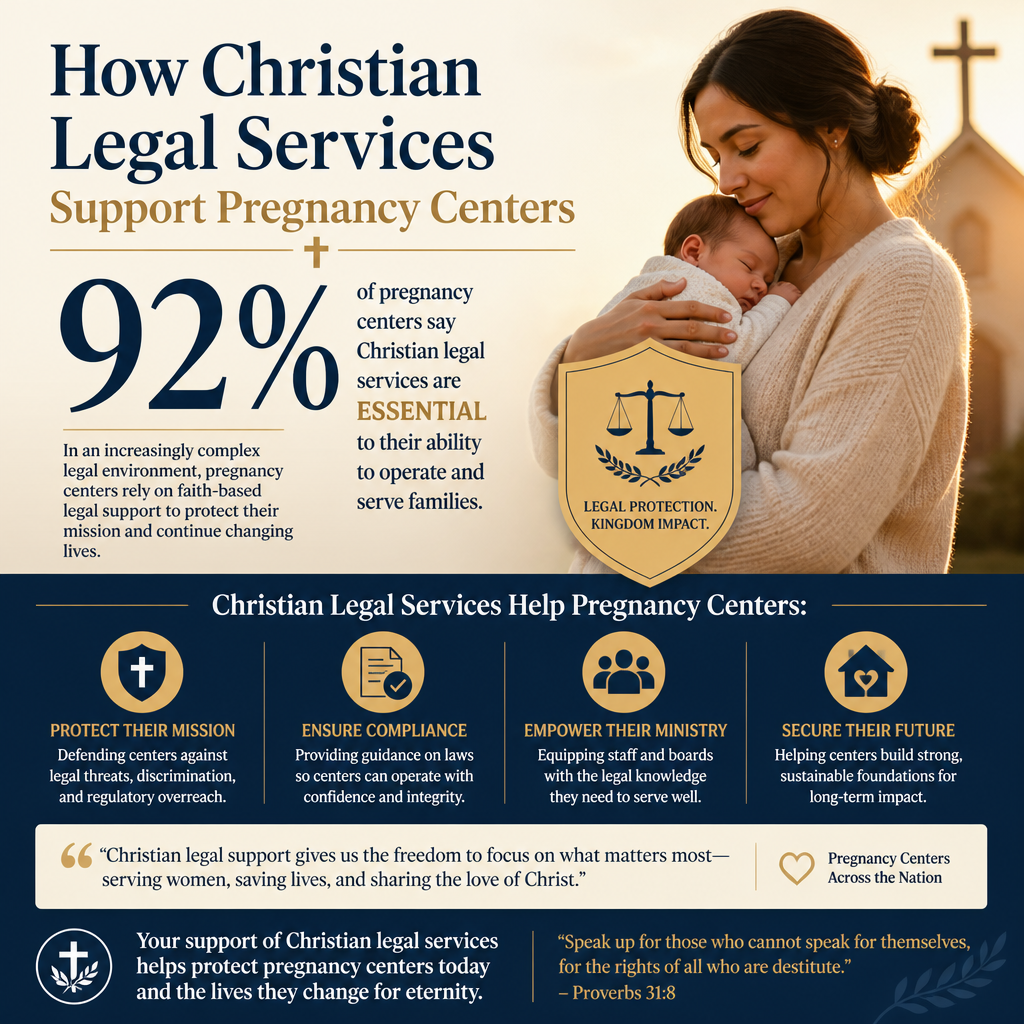
Many legal issues are survivable if addressed early: a demand letter, a hostile records request, a complaint to a regulator, a dispute with a landlord, or an employment conflict. Christian legal services support centers by creating a disciplined response plan: what to preserve, what to communicate, who speaks publicly, and when to escalate. That planning does not guarantee victory, but it often prevents unforced errors.
At their best, these attorneys function as long-term partners who understand the ministry’s theological commitments and help it operate with wise restraint. They are not merely litigators; they are counselors in the classical sense—helping leaders make decisions that are lawful, prudent, and faithful.

Key legal domains where pregnancy centers most need counsel
Medical and clinical compliance where applicable
Some centers provide medical services under licensed oversight; others do not. Donors should avoid simplistic assumptions that every center is a clinic. Where medical services exist, legal counsel often works alongside medical directors and compliance professionals to ensure proper scope of practice, documentation, consent forms, supervision, and referral language. When the boundaries are unclear, legal counsel helps draw them with precision, protecting both clients and the ministry.
Privacy and data security also matter. Centers routinely handle sensitive personal information: pregnancy status, relationship circumstances, and health-related concerns. Legal counsel assists with privacy policies, record retention, and vendor agreements for digital systems. This is an area where neglect can harm clients directly and create serious reputational consequences.
Speech and compelled messaging conflicts
Pregnancy centers can be pressured through local ordinances or state rules that aim to compel certain disclosures or restrict how services are described. Courts have recognized that some compelled speech requirements raise constitutional concerns. For example, the U.S. Supreme Court addressed compelled disclosures applied to pregnancy centers in NIFLA v. Becerra (2018) U.S. Supreme Court. Donors do not need to become constitutional scholars, but they should understand the practical implication: policy and signage are legal documents in effect, and small wording decisions can invite enforcement actions.
Christian legal services help centers communicate honestly and clearly—never misleading clients—while also resisting coercive requirements that force a ministry to contradict its convictions. That balance requires more than zeal; it requires careful language and a record of consistent practice.
Employment, volunteers, and religious liberty boundaries
Pregnancy centers typically depend on staff and volunteers who can serve with empathy, confidentiality, and alignment with the ministry’s purpose. Legal counsel helps draft employee handbooks, volunteer agreements, training standards, and incident procedures that reflect both professional care and Christian identity.
The legal framework around religious nonprofit employment has meaningful protections but also real limits. Wise counsel helps leaders avoid false confidence. When a center’s mission and conduct expectations are documented, consistently taught, and fairly applied, it strengthens both internal culture and external defensibility.
Fundraising, governance, and accountability to donors
Christian donors regularly ask whether a center is governed responsibly, whether restricted gifts are honored, and whether financial practices reflect integrity. Legal services support this by helping boards understand fiduciary duties, conflict-of-interest policies, document retention, and compliance with charitable solicitation rules. These are not merely technicalities. They are part of the “above reproach” standard Scripture commends for leaders and stewards (1 Timothy 3:2; Titus 1:7).
For donors looking for the broader landscape of legal ministries that serve in these contexts, our coverage of Christian Legal Services Ministries provides a useful frame for how different organizations approach defense, policy, and counsel in the public square.
How donors should evaluate legal partnerships without rewarding fear
Legal preparedness is not the same as culture-war posture
Some donors are understandably weary of fundraising that trades in outrage or perpetual emergency. That fatigue is not spiritual weakness; it is a reasonable response to communications that can become unmoored from truthfulness and hope. Legal realities are serious, but fear is a poor steward of Christian generosity.
The better question is whether legal support makes a pregnancy center more faithful to its calling: to offer care that is truthful, compassionate, and competent, and to maintain a public witness that does not collapse into hostility. Christian legal counsel should help a center speak with clarity and restraint, even when opponents are not restrained.
Indicators of a healthy legal relationship
Across our verification work at Most Trusted, we observe that the strongest pregnancy centers and their legal partners tend to share a practical commitment to integrity: documented practices, consistent training, and transparent communication with stakeholders. Donors can look for straightforward signs that legal support is serving mission rather than ego:
- Clear written policies that match what the center actually does day to day
- Board minutes and governance documents that show informed oversight
- Staff and volunteer training that includes confidentiality, mandated reporting where applicable, and client dignity
- Financial controls and restricted-gift practices that are documented and followed
- Public communications that are factual, measured, and consistent with the ministry’s stated purpose
When donors want a wider view of how Christian legal counsel engages family and life-related issues beyond a single ministry model, Christian Legal Services for Family and Life Issues is a helpful category to compare approaches and emphases.
Where verification and legal counsel meet for donor confidence
Legal strength cannot substitute for moral credibility
It is possible for an organization to be legally aggressive and spiritually shallow. It is also possible for a ministry to be warm-hearted and administratively negligent. Donors should resist both extremes. Pregnancy centers bear a particular burden: they serve women in vulnerable situations, often under time pressure, with complex relational dynamics. That setting demands more than goodwill. It demands systems that protect clients from coercion, ensure confidentiality, and foster genuine informed consent.
Legal services contribute to those protections, but they cannot create them by themselves. Culture, leadership, and accountability are decisive. That is why verification matters: it tests whether structures exist to support faithful service over time, not only whether a ministry can win a dispute.
What The Most Trusted Standard adds to a donor’s discernment
The Most Trusted Standard is designed to help donors give with confidence by evaluating ministries across faith commitments, financial integrity, governance and leadership, and transparency and effectiveness. Legal compliance fits naturally within that larger picture. A ministry may have capable attorneys and still fail at board oversight, financial controls, or truthful reporting. Conversely, a well-governed and transparent center is usually better positioned to receive and implement legal counsel effectively, because leadership already values documentation, accountability, and disciplined decision-making.
What this means in practice is that donors can ask better questions. Not only, “Does the ministry have counsel?” but also, “Does the board understand its responsibilities?” “Are policies implemented consistently?” “Is the ministry candid about what it does and does not provide?” These questions honor both prudence and charity.
FAQs for How Christian legal services support pregnancy centers
Do pregnancy centers need a lawyer even if they never expect to go to court?
Yes. Most legal support is preventative rather than adversarial: policies, consent forms, employment practices, governance documentation, facility agreements, and compliant fundraising. Litigation is the costly edge case; disciplined counsel helps reduce the likelihood that disputes escalate to that point.
Should donors prioritize funding legal defense or direct client services?
Wise stewardship often requires both. Direct services embody compassion in tangible ways, but legal preparedness can protect those services from interruption and can safeguard clients from harm caused by poor documentation or unclear boundaries. Donors should favor ministries that present legal funding as mission protection and integrity work, not as an excuse for alarmist messaging.
A faithful ministry requires both compassion and competent protection
Pregnancy centers serve in a space where moral conviction and legal constraint meet daily. Christian legal services support pregnancy centers by helping them operate truthfully, care for clients with dignity, and endure scrutiny without abandoning their theological commitments. For donors, the goal is not to fund conflict. It is to sustain ministries that can keep their doors open, their practices honorable, and their witness credible in the long work of love.



