
Why Christian lawyers take religious liberty cases is not primarily a story about politics. It is a story about vocation under God, the limits of state power, and the conditions required for the church to worship, serve, and speak with integrity.
For Christian donors, the question matters because religious liberty litigation is expensive, slow, and often controversial. It also sits close to the front lines of Christian institutional life: Christian schools, adoption and foster care providers, hospitals, campus ministries, churches, and small businesses owned by believers. When these cases are pursued wisely, they can protect space for ordinary faithfulness. When they are pursued poorly, they can harden public distrust and distort Christian witness.
Religious liberty is a theological concern before it is a legal strategy
Conscience is not a private preference
Christian legal advocates typically begin with a moral anthropology: the human person is made in the image of God, accountable to God, and therefore not ultimately owned by the state. The state has genuine authority—Scripture is clear about civil order (Romans 13:1–7)—but that authority is limited. When civil command collides with obedience to God, the Christian tradition has long insisted that “we must obey God rather than men” (Acts 5:29).
Religious liberty, in this sense, is not a request for special treatment. It is an attempt to preserve a basic social reality: plural societies remain stable when the state does not coerce ultimate allegiance. That conviction has deep roots in the American constitutional order, but Christian lawyers usually defend it as more than American heritage. They defend it as a recognition of how human beings are constituted before God.
The church requires public space to be the church
Christian ministry is not confined to a sanctuary. The Great Commission and the command to love neighbor have institutional expression: schools that form students, charities that serve the poor, and healthcare institutions that treat the sick. When legal pressure makes those institutions choose between fidelity and continued service, Christian lawyers often see litigation as a form of neighbor-love: protecting the ability to keep serving without abandoning core doctrine.
This is one reason donors pay attention to Christian Legal Services Ministries. These organizations tend to defend not only individuals, but also the ecosystem of Christian institutions that makes sustained mercy and discipleship possible.

Most cases are about concrete conflicts, not abstract principles
The legal questions usually arrive through ordinary institutions
Religious liberty disputes often surface as employment decisions, licensing conflicts, accreditation standards, zoning restrictions, or compelled speech issues. In many instances, Christian lawyers are not seeking to change the culture through courts; they are trying to prevent Christian ministries from being regulated into theological incoherence.
Consider the kinds of settings where conflicts commonly arise:
- Faith-based schools and colleges navigating nondiscrimination requirements while maintaining doctrinal standards
- Medical professionals and hospitals facing mandates that raise conscience concerns
- Churches and ministries encountering zoning and assembly restrictions
- Adoption and foster care providers facing licensure conditions that conflict with their understanding of marriage and family
- Employees disciplined for religious expression or Sabbath observance
These are not theoretical problems for the people involved. They are board-level and pastoral-level dilemmas: whether an institution can continue operating, whether staff can serve without violating conscience, and whether ministries can remain open to the public without surrendering their religious identity.
Religious liberty law is shaped by precedent and procedural realities
Donors sometimes assume these cases are chosen simply because they are “winnable” or media-friendly. In practice, case selection is constrained by jurisdiction, factual record, timing, and standing. A strong moral claim can still be a weak legal vehicle. Responsible Christian legal organizations weigh those trade-offs because a bad case can produce a bad precedent that harms the very communities they hope to protect.
The stakes are significant in the United States, where religious liberty doctrine continues to develop through Supreme Court and appellate decisions. For example, the Supreme Court has repeatedly addressed how the Free Exercise Clause applies when generally applicable laws burden religious practice, including in Employment Division v. Smith (1990), a foundational decision that still shapes the legal landscape Supreme Court of the United States.
Christian lawyers often see these cases as service to the vulnerable
Minorities need protections most when majorities are impatient
Religious liberty protections are tested when a community becomes unpopular or misunderstood. The Christian legal imagination is shaped by a biblical recognition that power can be used to suppress dissent, even when suppression is clothed in respectable language. The Hebrew midwives disobeyed Pharaoh’s command because they feared God (Exodus 1:17). Daniel continued to pray despite the king’s edict (Daniel 6:10). The early church endured legal and social pressure precisely because it would not render ultimate worship to Caesar.
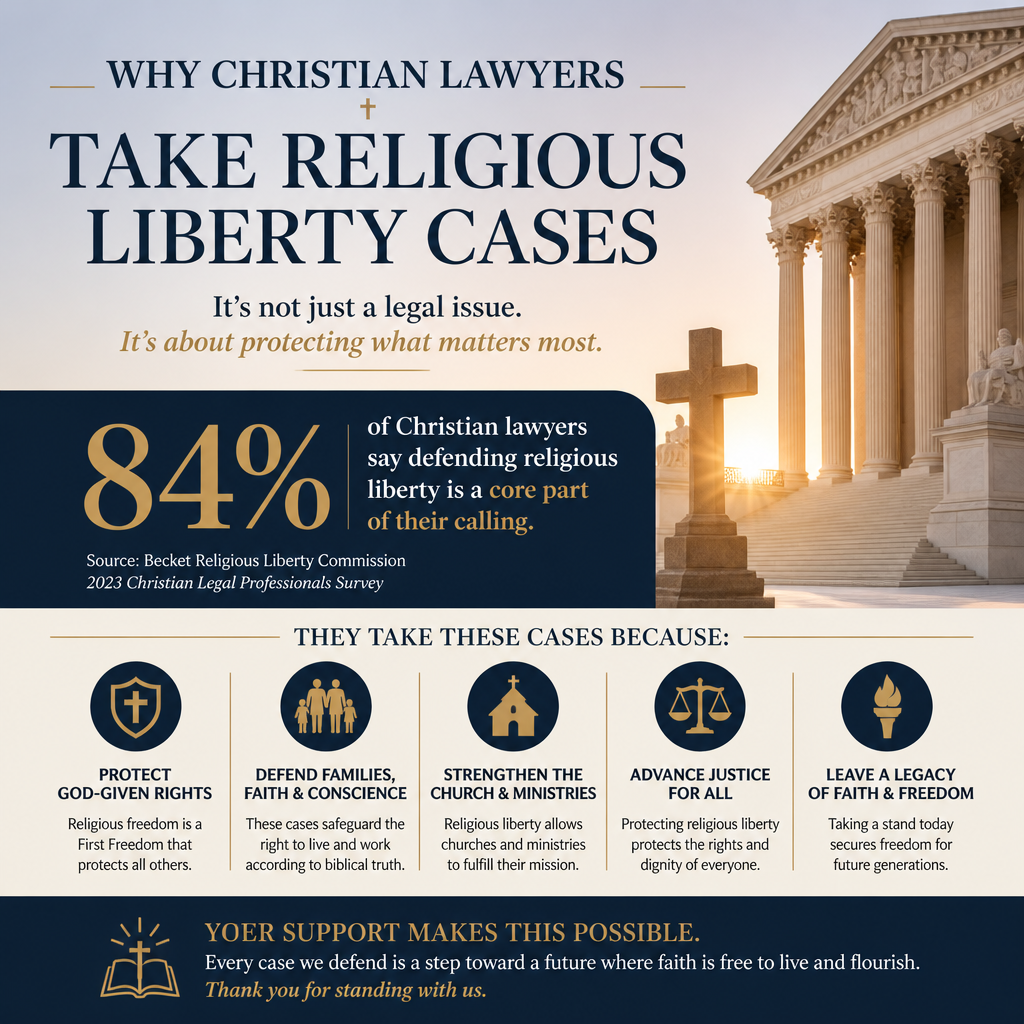
Modern cases can involve Christians as cultural majorities in some places and as contested minorities in others. Christians genuinely disagree about how to interpret that social location. Still, the basic principle remains: coercion of conscience is a moral harm. Christian lawyers often frame their work as shielding those without cultural power—religious minorities, immigrant churches, and small ministries—from regulations that would be trivial for large institutions but crushing for small ones.
Some of the most consequential work is quiet and local
Not every religious liberty case becomes national news. Many are mundane disputes about permits, building use, employment accommodations, or bureaucratic delays. These are the kinds of cases where Christian ministries can lose momentum, exhaust staff time, and divert funds away from direct service.
When donors support legal ministries, they are often supporting this quieter layer of protection: the ability of ministries to keep their doors open, retain staff, and serve communities without constant threat of regulatory whiplash. That is one reason we encourage donors to understand Christian Legal Services and Religious Liberty as a category of Christian public witness that is frequently preventive rather than performative.
There are real tensions Christians must name plainly
Religious liberty can be confused with grievance politics
The modern American context makes it easy for religious liberty advocacy to be interpreted as partisan maneuvering. Sometimes that critique is unfair; sometimes it exposes genuine temptations. Christian lawyers and the donors who fund their work have to reckon with the fact that litigation can be used to inflame rather than clarify, to humiliate opponents rather than pursue justice, or to elevate institutional survival above Christian witness.
The New Testament does not forbid legal recourse. Paul appealed to Roman legal protections when it served the mission and protected the church (Acts 22:25; 25:11). Yet Paul also warned believers against vindictiveness and urged patience under suffering (Romans 12:17–21). Mature religious liberty advocacy requires both convictions at once: the legitimacy of legal protection and the spiritual danger of self-justifying anger.
Not every claim labeled religious liberty is morally coherent
Courts can protect religious exercise without endorsing the truth of a religion’s claims. That procedural neutrality is a feature of liberal democracy, but it creates a moral challenge: Christian organizations can be tempted to treat “religious liberty” as a catchall defense for choices that deserve closer moral scrutiny.
Donors should expect Christian legal ministries to draw careful lines: to distinguish between protecting conscience and protecting institutional self-interest; between principled advocacy and opportunistic culture war. The best ministries articulate theological rationale, demonstrate restraint in case selection, and treat opponents with dignity even in adversarial proceedings.
For donors, the question is not only why they litigate but how they operate
Legal advocacy requires unusual transparency and governance
Religious liberty cases are often funded by major donors, planned over multiple years, and executed through complex legal strategies. That structure creates risks familiar to experienced Christian givers: mission drift, donor capture, weak board oversight, and communications that trade accuracy for fundraising urgency.
At Most Trusted, we exist because serious Christian donors want to give with confidence, not instinct. Our verification work evaluates ministries against The Most Trusted Standard, a 15-criteria framework that examines doctrinal clarity, financial integrity, governance practices, and evidence of operational transparency. For legal ministries in particular, donors benefit from clear answers to questions such as: How are cases selected? Who provides oversight? What safeguards prevent conflicts of interest? How does the ministry report outcomes without exaggeration?
What donors can reasonably look for before funding a legal case or legal ministry
Wise giving does not require donors to become attorneys. It does require discernment proportionate to the stakes. When a ministry’s work centers on high-conflict litigation, stronger guardrails are not optional; they are a form of stewardship.
In our review of the sector, the ministries most likely to retain trust over time tend to show several traits: first, they distinguish legal wins from cultural discipleship and do not confuse the two; second, they present opponents as image-bearers rather than caricatures; third, they publish clear financial reporting and do not treat legal strategy as a reason for opacity; and fourth, they demonstrate humility about what courts can and cannot accomplish in the long arc of Christian mission.
Even where legal victories are significant, courts cannot generate revival, repentance, or Christian unity. They can, at best, preserve room for the church to continue proclaiming the gospel and practicing costly love without being compelled to deny its Lord.
FAQs for Why Christian lawyers take religious liberty cases
Are religious liberty cases mainly about protecting Christian privilege?
They can be framed that way, and sometimes Christians contribute to that perception through careless rhetoric. At their best, religious liberty cases seek to protect conscience and institutional integrity for all faith communities, especially when state power pressures dissenting minorities. The moral question is not whether Christians are criticized; it is whether the state is coercing worship, speech, or conduct in ways that violate legitimate claims of conscience.
How can donors evaluate a Christian legal ministry without becoming partisan?
Donors can focus on verifiable markers of integrity rather than party alignment: doctrinal clarity, board oversight, financial transparency, responsible communications, and a demonstrated commitment to truthfulness even when it complicates fundraising. Ministries that can explain their case selection criteria, publish credible financial reports, and speak of opponents with restraint tend to be more trustworthy partners for Christian donors seeking faithful public witness.
A disciplined defense of liberty can serve the church and the neighbor
Why Christian lawyers take religious liberty cases comes down to a belief that coercion of conscience is a real harm and that the state’s authority is not ultimate. Litigation is an imperfect tool, and Christian donors should not romanticize it. Yet when pursued with theological seriousness, institutional accountability, and moral restraint, religious liberty advocacy can preserve the space in which churches and ministries continue to worship freely and serve publicly, for the good of their communities and the honor of Christ.



