
What evidence supports a religious liberty case is rarely a single document or a single moment. It is a disciplined record showing that a person or ministry held a sincere religious conviction, faced a concrete government burden, and sought reasonable relief without collapsing the rule of law into private preference.
For Christian donors, this question is not abstract. Religious liberty litigation shapes whether Christian schools can hire consistent with their beliefs, whether faith-based foster agencies can serve without surrendering convictions, and whether ministries can speak and act in public life with integrity. Yet the same cases also invite scrutiny: are we defending conscience, or demanding privilege? The difference often turns on evidence.
1. Clarify the legal claim and match evidence to the required elements
Religious liberty cases live or die on legal elements. A compelling narrative without element-by-element proof leaves a court with little to work with. The first evidentiary task is to identify what must be proven under the governing doctrine and statute.
Constitutional claims require tight proof of government action and burden
Under the First Amendment, evidence commonly must establish that the challenged policy is state action, that it burdens religious exercise or speech, and that the government’s justification fails the applicable scrutiny. Some claims turn on whether a policy is neutral and generally applicable; others on whether it is viewpoint discriminatory or coerces speech.
Because this doctrine is complex, effective legal ministries begin with precise issue framing. That discipline is one reason donors often support Christian Legal Services Ministries that pair pastoral seriousness with courtroom competence.
Statutory claims often turn on substantial burden and least restrictive means
Where a statute such as the Religious Freedom Restoration Act applies, evidence usually must show a “substantial burden” on religious exercise and then test whether the government is using the least restrictive means to achieve a compelling interest. In many cases, the government will argue that alternative options exist and the burden is minor; the plaintiff must be prepared to document why the proposed alternatives do not preserve religious integrity or are not realistically available.

2. Establish sincerity and religious character without overreaching
Courts are generally hesitant to adjudicate theology, but they do assess sincerity. The goal is not to prove that a belief is correct, but that it is genuinely held and religious in nature, and that the plaintiff is not manufacturing a claim for strategic advantage.
What sincerity evidence often looks like in practice
Sincerity is typically demonstrated through consistent statements and consistent behavior over time. For an individual, that might include long-standing church membership, prior statements about the belief, patterns of conduct, or an employment record showing a consistent religious practice. For a ministry, it often includes formal doctrinal statements, board-adopted faith commitments, and documented internal policies that predate the conflict.
Christians genuinely disagree about how much documentation should be necessary. Requiring extensive proof can feel like a subtle form of coercion, especially for believers whose traditions are less document-driven. Still, the reality of litigation is that unrecorded convictions are harder to defend. The ministries that are most resilient treat documentation as stewardship: not to impress a court, but to serve the truth.
Common mistakes that undermine credibility
Two patterns regularly weaken sincerity claims. The first is opportunism: a belief suddenly “discovered” when a regulation appears. The second is inconsistency: policies that contradict the alleged belief or show selective enforcement. If a Christian school claims a conviction about doctrinal fidelity but has historically ignored the issue until outside pressure arrives, the record will be vulnerable.
3. Document the burden with concrete facts, not general unease
Courts distinguish between offense and burden. Evidence must show a tangible cost imposed by the government: a penalty, exclusion, denial of access, forced speech, compelled participation, or loss of a license or contract. The record should make clear that the burden is not hypothetical.
Evidence that shows a real burden
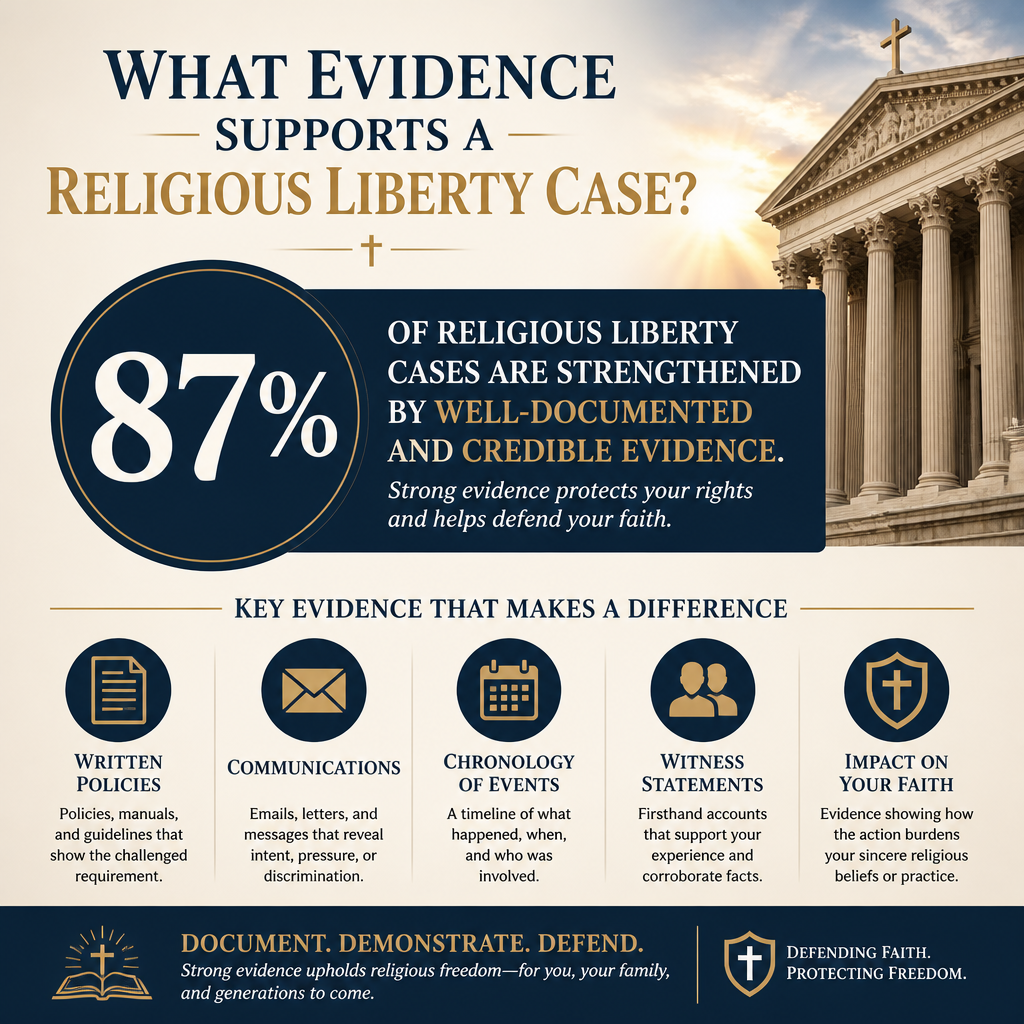
Strong records typically include the actual text of the regulation or policy; official notices, emails, and letters from agencies; meeting minutes; and affidavits describing what compliance would require. The burden should be tied to specific consequences: fines, shutdown orders, denial of accreditation, termination of a contract, or exclusion from a generally available program.
When cases arise from administrative decisions rather than dramatic raids, donors sometimes underestimate how much the “paper trail” matters. Administrative law is often won by the documents the agency generated, and by the careful preservation of what was said, when, and by whom.
Show the lack of workable alternatives
Governments often defend burdens by claiming that the plaintiff could simply choose another option. Evidence should address this directly: are the alternatives materially different, geographically inaccessible, financially impossible, or conscience-violating in their own way? Courts regularly test whether the plaintiff is asking for an exemption from a real constraint or simply seeking a more favorable arrangement.
- Copies of policies, contracts, or licensing standards at issue
- Written communications from officials describing required compliance
- Timelines showing the sequence of events and decision points
- Affidavits detailing practical effects on ministry operations
- Documentation of attempted accommodations and the government response
4. Prove differential treatment, inconsistency, or viable accommodation
Many religious liberty cases hinge on comparisons. If the government grants secular exceptions but denies religious ones, or if it treats one viewpoint more harshly than others, the evidentiary posture changes. Likewise, if an accommodation is feasible, plaintiffs should be prepared to show it with specificity.
Comparators and unequal application
A common evidentiary strategy is to identify similarly situated entities that receive exemptions or favorable treatment. This can include other contractors, other schools, other healthcare providers, or other speakers using public forums. The point is not that government may never draw distinctions, but that it must not single out religious exercise for special penalties.
Public records are often decisive here. Agency guidance, published waivers, and policy exceptions can demonstrate that the government’s asserted “no exceptions” stance is not true. In some cases, Freedom of Information Act requests are essential to uncover how standards were applied across comparable entities; federal FOIA is administered by the U.S. Department of Justice’s Office of Information Policy at justice.gov.
Feasibility evidence and least restrictive means
In many statutory cases, the central dispute becomes whether the government could achieve its interest with less intrusion on religious exercise. Evidence might include expert declarations on operational feasibility, cost analyses, documented examples from other jurisdictions, or proof that existing exemptions already achieve the government’s stated goal.
The harder question is that accommodation evidence can cut both ways. If an exemption would undermine core civil protections or create substantial third-party harms, courts will consider that. Serious religious liberty advocacy does not pretend those tensions do not exist; it names them and offers workable solutions that honor both conscience and neighbor-love.
5. For donors, evaluate the evidentiary posture and the ministry behind it
Donors are not called to become litigators, but donors are called to wise stewardship. Supporting religious liberty work includes supporting the integrity of the case-making itself: whether the claim is grounded, whether the record is responsibly assembled, and whether the ministry’s governance and communications sustain credibility over time.
Signals of a case built for truth, not merely for headlines
Across our verification work at Most Trusted, we observe that high-integrity legal ministries tend to invest early in documentation, internal policies, and board oversight. They avoid overstating facts, even when overstating might raise more funds. They also distinguish clearly between what a court has ruled and what advocates hope a court will rule.
That discipline is part of why donors benefit from evaluating ministries within Christian Legal Services and Religious Liberty through a consistent framework. At Most Trusted, our work is to help donors give with confidence by assessing ministries against The Most Trusted Standard, a 15-criteria framework spanning faith commitments, financial integrity, governance, and transparent reporting of results.
How to read public case materials responsibly
Many filings are public: complaints, motions for preliminary injunction, appellate briefs, and court opinions. A well-supported case will include exhibits that show the policy, the burden, the attempted accommodation, and the timeline. Supreme Court opinions and case materials are available through the Court’s official website at supremecourt.gov. For donors, the question is not whether a brief contains forceful language; it is whether the record is anchored to verifiable facts and legally relevant comparisons.
The field has had to reckon with the temptation to treat religious liberty as a perpetual emergency requiring perpetual escalation. Courts do not reward that posture. Neither should Christian philanthropy. A ministry’s long-term effectiveness is often visible in unglamorous habits: careful intake, conflict de-escalation when possible, and honest assessment of legal risk when litigation is necessary.
FAQs for What evidence supports a religious liberty case
Does a religious liberty case require proof that a belief is theologically correct?
No. Courts generally avoid deciding whether a belief is true in a theological sense. The evidentiary focus is usually on whether the belief is sincerely held and religious in nature, and whether government action imposes a legally cognizable burden on exercising that belief.
What should a ministry document before any conflict arises?
Ministries are best served by written doctrinal commitments, board-adopted policies tied to those commitments, consistent employment and service standards, and clear records of how policies are applied. When a dispute emerges, the most persuasive evidence is often the evidence that existed long before litigation was contemplated.
Religious liberty is defended with truth told carefully
Evidence supports a religious liberty case when it shows sincerity without theatrics, burden without exaggeration, and requested relief that is concrete and principled. For Christian donors, the aim is not to fund contention, but to preserve the space for faithful witness in public life. That work is strengthened when ministries build records that can bear the weight of scrutiny, because truth is not only proclaimed; it is demonstrated.



