
What a religious liberty case involves is rarely limited to a single disputed sentence in a statute or a single line in a constitution. It is usually a collision between real people, real institutions, and competing claims of authority: the state’s duty to govern for the common good, and the church’s duty to worship, teach, serve, and order its life under Christ. Mature Christian donors are often drawn to these cases because the stakes feel existential. Yet the legal questions are typically narrower than the cultural narratives built around them.
Religious liberty litigation also tests our discernment as givers. Some cases are necessary defenses of core Christian practice. Others are strategically unwise, factually weak, or pursued in ways that damage Christian witness. Across our verification work at Most Trusted, we see that the health of a legal ministry is not measured only by courtroom outcomes, but by theological clarity, governance discipline, financial integrity, and a truthful public account of what is at stake.
1. The dispute usually begins long before a lawsuit
Most cases start as a policy conflict, not a courtroom drama
A religious liberty case commonly begins with an ordinary administrative moment: a license renewal, a zoning hearing, a school policy update, an employment decision, a benefits rule, or a complaint filed with a state agency. The initial question is often practical: can a Christian institution continue its work under new terms, or will compliance require it to violate conscience?
When the dispute escalates, the earliest documents matter. Legal ministries gather facts, preserve communications, and clarify who has legal authority to act. They also attempt informal resolution, because litigation is costly and uncertain, and because Christians are called to pursue peace where possible (Romans 12:18). The harder question is what “peace” means when a policy would force a Christian organization to deny its stated doctrine or abandon its mission.
Religious liberty claims arise in distinct spheres
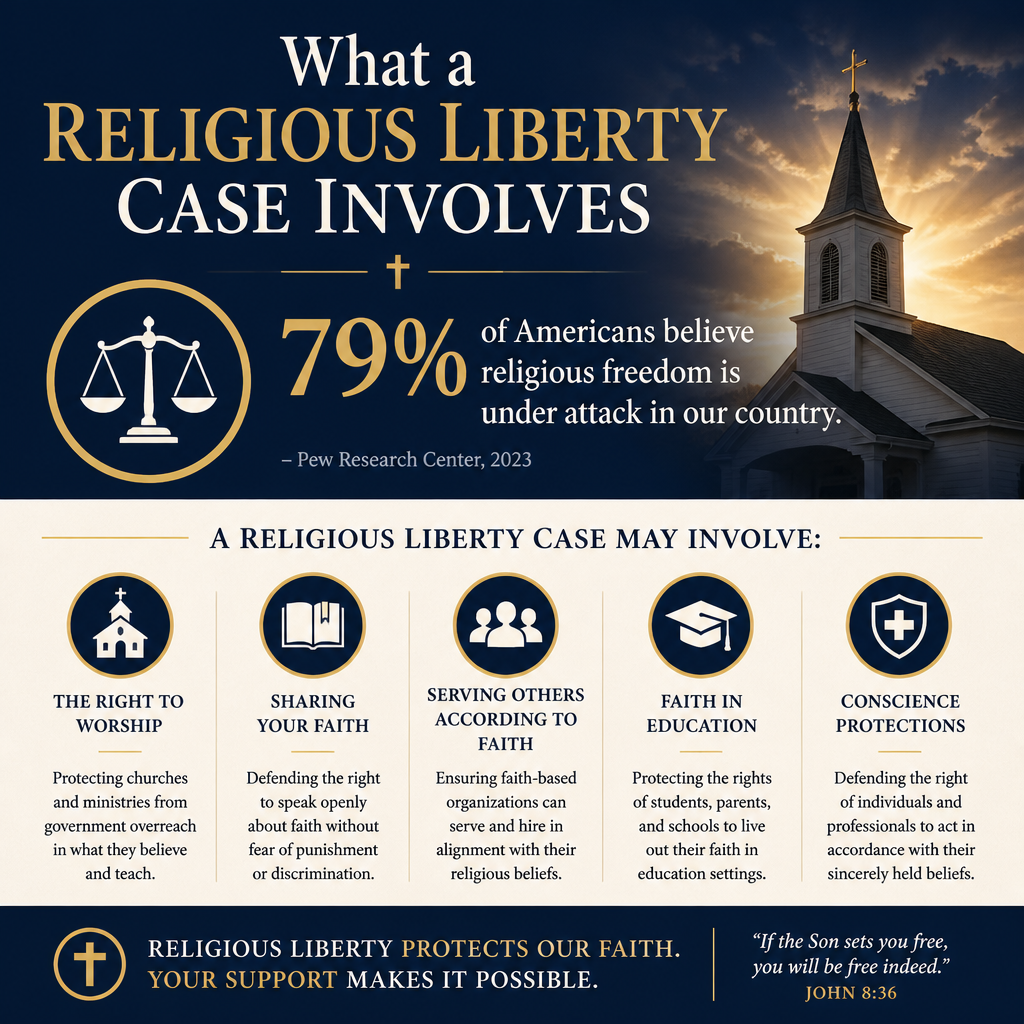
Not every conflict belongs in the same category. Religious liberty claims may involve:
- Church autonomy in internal governance and discipline
- Religious nonprofit operations such as hiring, housing, and counseling
- Religious schooling and student formation
- Healthcare and conscience protections
- Individual speech and religious exercise in public employment or public space
These spheres have different legal tests and different risks. A donor who treats every dispute as interchangeable will struggle to evaluate strategy, credibility, and likely outcomes. For readers seeking a broader view of the ministries that work in this space, we track the field under Christian Legal Services and Religious Liberty.

2. Courts ask specific legal questions, not broad cultural ones
The constitutional and statutory frame shapes everything
In the United States, religious liberty cases typically involve the Free Exercise Clause, the Establishment Clause, and a set of federal and state statutes that protect religious exercise in particular contexts. A claim might be constitutional, statutory, or both. The choice is strategic: some statutes provide clearer standards or stronger remedies than constitutional arguments do.
The federal Religious Freedom Restoration Act sets a prominent standard for federal government action. The Supreme Court has held that this federal law does not apply to the states, which is why state-level protections depend on state constitutions and state RFRAs where they exist. The legal landscape is therefore uneven across jurisdictions, and serious ministries do not promise uniform results in every state.
Not all burdens count the same in law
Courts often focus on whether a law is neutral and generally applicable, whether it targets religious practice, and whether the government has imposed a substantial burden on religious exercise. Those terms are technical, and their application can be contested even among Christian attorneys. What counts as “substantial” is not always intuitive. Some burdens are direct compulsion. Others are coercive through penalties, loss of licenses, or exclusion from public programs.
Even when a court agrees there is a substantial burden, the government may argue it has a compelling interest and that the policy is narrowly tailored. The donor-relevant implication is sobering: a case can involve a sincere and weighty conscience claim, yet still lose on legal grounds because a judge finds the governmental interest overriding in that context.
3. The facts and the plaintiff matter as much as the principle
Bad facts can make bad law
Religious liberty litigation lives and dies on fact patterns. Was a policy applied evenly or selectively? Were accommodations offered? Did the institution clearly articulate its beliefs and apply them consistently? Did it document decision-making responsibly? These questions are not public relations details. They are the material a court uses to decide whether the law was applied fairly and whether religious claims are credible.
Some disputes become headline cases because the moral stakes are significant, but headlines can obscure weaknesses. A donor should not assume that a case is “obviously winnable” because the underlying belief is orthodox. Courts do not rule on orthodoxy. They rule on legal standards and evidentiary records.
Institutional integrity is part of the witness
Religious liberty ministries sometimes represent churches and Christian nonprofits that are under real pressure, but they also sometimes represent individuals whose conduct is undisciplined or ambiguous. The public tends to conflate the client with the cause. A wise legal ministry, and a wise donor, therefore pays attention to the plaintiff’s credibility and the institution’s integrity.
This is one reason our team at Most Trusted emphasizes verification that goes beyond messaging. Ministries that meet The Most Trusted Standard tend to show consistency between stated doctrine and operational practice, clarity in governance oversight, and forthright disclosure about what a case can and cannot accomplish. Those traits protect donors from subsidizing legal theater instead of durable religious freedom work.
4. Remedies are often limited, and trade-offs are real
Winning can mean an injunction, not a cultural reversal
Donors often hope a religious liberty case will “settle the issue.” Courts rarely do. Even a clear win may only prevent enforcement of a policy against a particular plaintiff, in a particular jurisdiction, under a particular set of facts. It may be a temporary restraining order or preliminary injunction while the case proceeds. It may end in a settlement that avoids a binding precedent.
That limitation is not failure; it is how the judicial system functions. But it should shape donor expectations. Funding a case is often funding incremental protection, not immediate transformation.
Losses can set precedent that constrains the church
Christian donors should also weigh the risk of adverse precedent. A poorly chosen test case can narrow protections for others. Legal ministries therefore evaluate jurisdiction, judicial posture, factual record, and long-term implications. They also consider whether a case should be taken at all, or whether policy advocacy, negotiation, or institutional adjustments are wiser.
Christians genuinely disagree about some of these strategy decisions. Some prioritize maximal legal clarity. Others prioritize avoiding unnecessary conflict and protecting local ministries from reputational harm. These disagreements are not always about courage versus compromise. They are often about prudence and stewardship.
5. Donors should evaluate legal ministries with the same rigor as any other ministry
Legal work creates unique accountability pressures
Religious liberty work can be expensive, technically complex, and emotionally charged. That combination increases the risk of distorted incentives: overstating urgency to raise funds, selecting cases for publicity rather than principle, or avoiding honest disclosure about litigation risk. A donor who cares about faithful witness should not treat this category as exempt from due diligence.
Christians also have a theological reason to demand truthfulness. Scripture condemns false witness and commends integrity in speech (Exodus 20:16; Ephesians 4:25). A ministry’s fundraising claims about what a case “will do” should be sober, not inflated. A ministry’s description of opponents should avoid caricature, even when opponents act unjustly.
A donor-focused checklist for prudent support
When assessing a religious liberty legal ministry, we recommend looking for verifiable indicators such as:
- Clear theological commitments that explain what the ministry defends and what it will not defend
- Transparent case selection criteria and willingness to decline weak or unwise matters
- Governance oversight that limits conflicts of interest and reviews litigation strategy at an appropriate level
- Financial reporting that allows donors to see how litigation and program costs are allocated
- Public communications that are accurate about facts, legal standards, and likely remedies
For donors who want to understand the broader ecosystem of providers and approaches, we publish ongoing analysis under Christian Legal Services Ministries. Our purpose at Most Trusted is not to tell donors what to think politically, but to help them give with confidence by evaluating ministries against The Most Trusted Standard across faith foundation, financial integrity, governance and leadership, and transparency and effectiveness.
FAQs for What a religious liberty case involves
Do religious liberty cases only involve Christians?
No. In American law, religious liberty protections apply to people of many faiths and, in some contexts, to those with nonreligious conscience claims. Christians may welcome that breadth because it reflects a principle of limited government and freedom of worship. At the same time, Christian legal ministries often focus their limited capacity on cases involving churches, Christian nonprofits, and Christian individuals where doctrinal commitments and ministry operations are directly implicated.
Is donating to a religious liberty legal ministry the best way to protect religious freedom?
Not always. Litigation is one tool among others, including policy advocacy, institutional resilience, and local pastoral formation that prepares believers to live faithfully under pressure. Some moments require courtroom defense; others require patient negotiation or strategic adaptation that preserves conscience without provoking unnecessary conflict. Donors serve the church best when they support ministries that are honest about trade-offs, selective about cases, and accountable in governance and finances.
Religious liberty cases test both conscience and stewardship
What a religious liberty case involves is ultimately a contest over authority and obedience: who may compel what, and what faithfulness requires when the cost rises. For Christian donors, the question is not simply whether a claim sounds righteous, but whether the ministry pursuing it is truthful, prudent, and accountable. Supporting religious liberty work is a serious act of stewardship, and it deserves the same disciplined evaluation we would apply to any ministry claiming to serve Christ’s church in a contested public square.



