
How Christian legal services use injunctions often determines whether a case remains a private dispute or becomes a decisive moment for religious liberty and the church’s public witness. An injunction is not a final victory on the merits; it is a court order that temporarily stops an action or compels a duty while litigation continues. For donors, that distinction matters because injunction work sits at the intersection of urgency, prudence, and faithfulness.
The deeper question is not whether injunctions are “aggressive” tools. The question is whether a ministry uses them as a disciplined form of neighbor-love under law: protecting consciences, preventing irreparable harm, and telling the truth in public with integrity. Scripture recognizes that public justice is a legitimate arena of moral action—“Give justice to the weak and the fatherless; maintain the right of the afflicted and the destitute” (Psalm 82:3). Yet Christians genuinely disagree about how quickly to litigate, how broadly to seek relief, and how to weigh precedent against local pastoral realities. Mature legal ministries name those tensions rather than marketing certainty.
What an injunction is and why Christian ministries pursue it
Temporary relief when waiting would cause irreversible damage
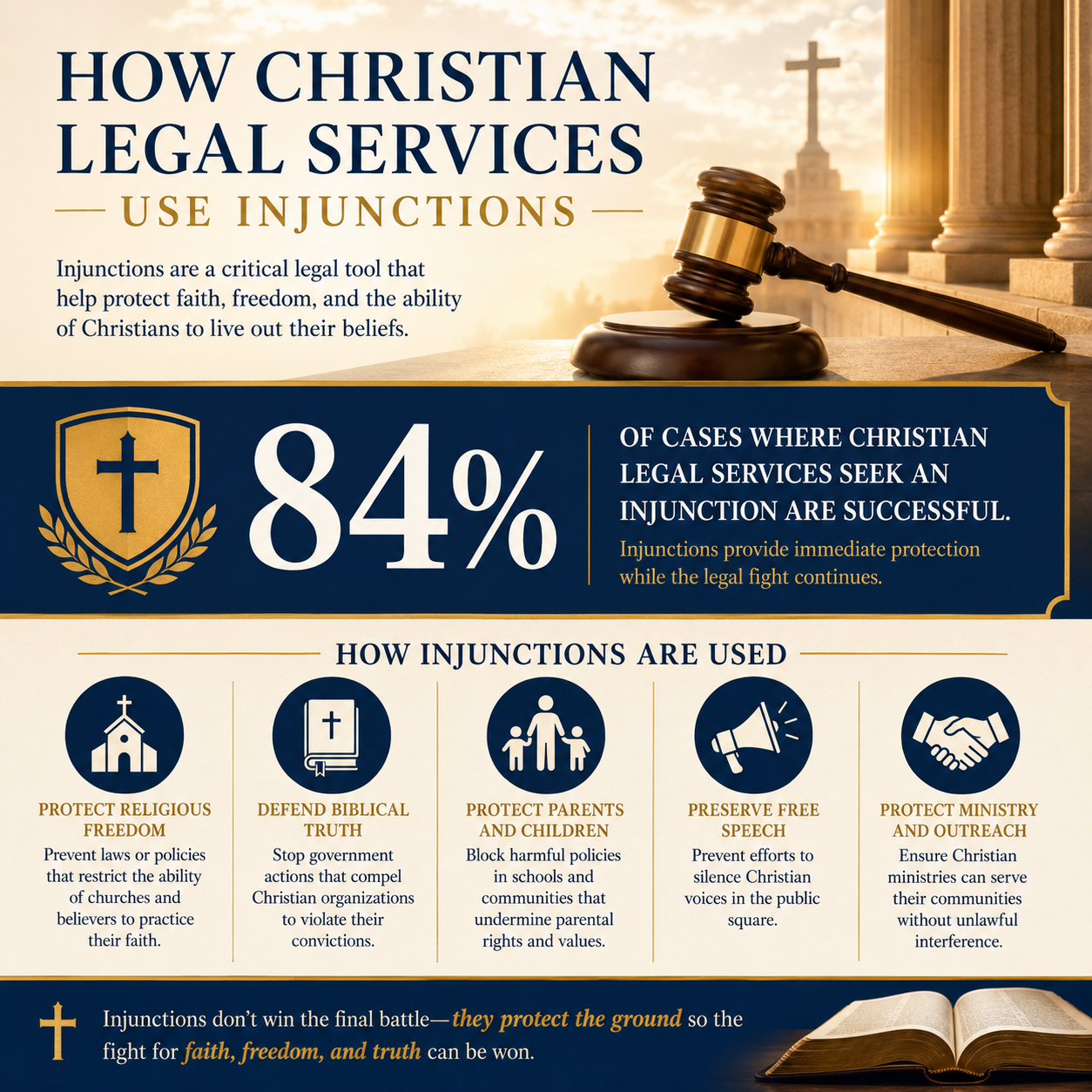
In U.S. civil litigation, injunctions generally fall into three categories: temporary restraining orders, preliminary injunctions, and permanent injunctions. The first two are the most common in urgent religious liberty cases because they aim to preserve the status quo while a court evaluates the underlying legal claims. Without such relief, the harm may be “irreparable”—a legal term that often includes burdens on constitutional rights, lost opportunities that cannot be restored, or coercive penalties that reshape conduct before a court can rule.
Christian legal services pursue injunctions when a client faces immediate pressure: a church threatened with closure under discriminatory enforcement, a Christian school facing compelled speech mandates, or a medical professional ordered to participate in procedures that violate conscience. What this means in practice is that injunctions can prevent a ministry’s mission from being damaged beyond repair before the case ever reaches trial.
The legal standard rewards clarity and credible evidence
Federal courts evaluate a preliminary injunction through a familiar framework: likelihood of success on the merits, likelihood of irreparable harm, the balance of equities, and the public interest. The Supreme Court summarized this approach in Winter v. Natural Resources Defense Council (2008), which remains widely cited in federal injunction practice. Supreme Court
For Christian donors, the practical implication is that injunction work punishes hype. Courts require declarations, documentation, and coherent legal theories under time pressure. Ministries that treat injunctions as fundraising theater tend to fare poorly; ministries that treat them as disciplined advocacy tend to build credibility with judges, regulators, and the broader public.

Injunctions and religious liberty cases where timing is the whole case
Protecting conscience before penalties force capitulation
Many religious liberty disputes are effectively decided by timing. If a church or business must comply immediately—at significant cost or moral compromise—then a later victory may arrive too late. A preliminary injunction can keep the doors open, prevent fines from compounding, and allow a court to hear the merits without a party being crushed in the interim.
Consider the logic underlying the Religious Freedom Restoration Act. Congress enacted RFRA in 1993 to require strict scrutiny when the federal government substantially burdens religious exercise. Congress.gov In practice, injunction motions are often the procedural vehicle for enforcing that protection in real time, especially when a new rule or enforcement action threatens to impose immediate burdens.
Protecting vulnerable neighbors when bureaucratic action moves faster than appeal
Some Christian legal services operate in immigration, human trafficking, domestic violence, or family law contexts. In those areas, a filing deadline, a deportation date, or a custody exchange can create irreversible consequences. Injunctive relief is not always available, but where it is, it can be the difference between safety and exposure.
Donors should also recognize the ethical complexity: injunctions can stop government action, but they can also delay policies that some Christians support for reasons of public order or contested moral reasoning. The mature posture is not to assume that every injunction requested by a “Christian” ministry is inherently righteous, but to ask whether the requested relief is narrowly tailored, factually grounded, and ordered toward the protection of legitimate rights and the common good.
How ministries decide when injunctions serve justice and when they do not
Narrow requests reflect theological and legal restraint
Injunctions are powerful precisely because they ask a court to act before full litigation. That power invites temptation: to request relief broader than necessary, to frame claims in absolutist language, or to turn complex disputes into culture-war symbols. Christian legal services best serve the church when they pursue restraint—seeking relief that addresses the specific harm without overreaching.
Across our verification work at Most Trusted, we observe that ministries most consistent with The Most Trusted Standard tend to pair courage with discipline: they define the client’s concrete harm, show the court why money damages cannot repair it, and limit the requested order to what is needed for protection. That approach is not only strategic; it aligns with a Christian moral instinct to avoid bearing false witness through overstatement (Exodus 20:16), including in legal pleadings.
Litigation is not discipleship, but it shapes public witness
Christians may rightly refuse to treat courts as saviors. Yet litigation still forms public perception of Christian faith. Injunction filings are often the first documents journalists and officials read. They carry an implicit message about truthfulness, seriousness, and the aims of the ministry.
This is where donor scrutiny belongs: not merely “Does the ministry win?” but “Does it speak accurately about facts and law, and does it treat opponents as image-bearers even while challenging their actions?” A ministry can be correct on the law and corrosive in tone; it can also be gracious in tone and careless with facts. Either failure harms credibility and, over time, can harm the very cause the ministry claims to serve.
What donor diligence should look for in injunction-driven legal work
Evidence of competence, not just urgency
Because injunctions move quickly, donors often see a flood of alerts, fundraising emails, and emergency appeals. Some are warranted. Others substitute urgency for substance. Donor diligence should reward ministries that provide verifiable clarity: what court, what legal claims, what relief is requested, and what is realistically at stake.
When donors research ministries in Christian Legal Services and Religious Liberty, we recommend asking for documentation that is already public in most cases: case numbers, filed pleadings, and judicial orders. A ministry that consistently avoids specifics may be protecting confidentiality in a narrow set of matters, but as a pattern it should raise questions.
A short checklist for evaluating injunction-centered fundraising
Injunction work often comes with strong rhetoric. The following questions help separate sober advocacy from performative crisis language:
- Does the ministry link to the actual court filings or provide the docket information?
- Does it describe the requested relief narrowly, or does it imply sweeping outcomes the court cannot grant?
- Does it acknowledge adverse facts and legal uncertainty, rather than promising inevitable victory?
- Does it explain how the case serves clients and communities, not only institutional power?
- Does it show how funds are used for litigation costs, client services, and compliance support?
These questions are not cynicism. They are stewardship. The New Testament repeatedly treats stewardship as a moral obligation, not a private preference (Luke 16:10–12). Donors should expect ministries to welcome that scrutiny.
How The Most Trusted Standard helps donors assess legal ministries using injunctions
Integrity is tested under time pressure
Injunction practice magnifies weaknesses that might be hidden in slower work. Under tight deadlines, governance quality shows. Financial controls show. Transparency habits show. And so does faith foundation: whether a ministry’s public voice remains truthful and measured when the stakes are high.
Most Trusted exists to help donors give with confidence by evaluating ministries against The Most Trusted Standard, a 15-criteria framework spanning faith commitments, financial integrity, governance and leadership, and transparency and effectiveness. In legal services, those categories translate into concrete signals: board oversight that understands litigation risk, clear policies for client confidentiality, audited financials where appropriate, and public reporting that distinguishes between legal strategy and verified outcomes.
Outcomes matter, but so do means
Christian donors often care about precedent, Supreme Court wins, and headline cases. Those can be legitimate measures of impact. But injunctions also affect ordinary people in ordinary courts—pastors negotiating zoning disputes, parents defending educational convictions, refugees seeking lawful protection, or pro bono clients facing life-altering deadlines. Faithfulness includes these quieter arenas.
When donors engage the broader landscape of Christian Legal Services Ministries, we encourage a balanced view of effectiveness. A ministry’s case selection, settlement posture, and client care can reflect Christian ethics as much as its courtroom victories. The church’s credibility is built not only on what we oppose, but on the justice we pursue and the truthfulness with which we pursue it.
FAQs for How Christian legal services use injunctions
Are injunctions only used in religious liberty lawsuits?
No. Injunctions are used across civil litigation, including business disputes, environmental cases, immigration matters, and family-related emergencies where courts have authority to preserve rights and prevent irreversible harm. Christian legal services use injunctions most visibly in religious liberty cases because constitutional harms can be difficult to remedy after the fact, but the tool itself is not limited to that category.
Should donors assume a request for an injunction means the ministry will win?
No. A preliminary injunction is an early-stage remedy governed by specific factors, and courts can deny relief even when a claim has merit. Donors should look for disciplined communication: accurate descriptions of what the court can do, clear evidence for the claimed harms, and transparency about uncertainty. Confidence should be grounded in verifiable facts, not in the emotional intensity of the appeal.
Why injunctions remain a test of Christian credibility in public life
Injunctions are a form of moral speech as well as legal procedure: they tell a court what is true, what is threatened, and what justice requires right now. Used well, they protect consciences and communities from harms that cannot be repaired later. Used poorly, they cheapen language, weaken public trust, and invite cynicism about Christian motives.
Donors have real agency here. By supporting ministries that combine legal competence with transparent reporting and theological seriousness, Christian giving can strengthen a public witness marked by truth and justice rather than anxiety and exaggeration.



