
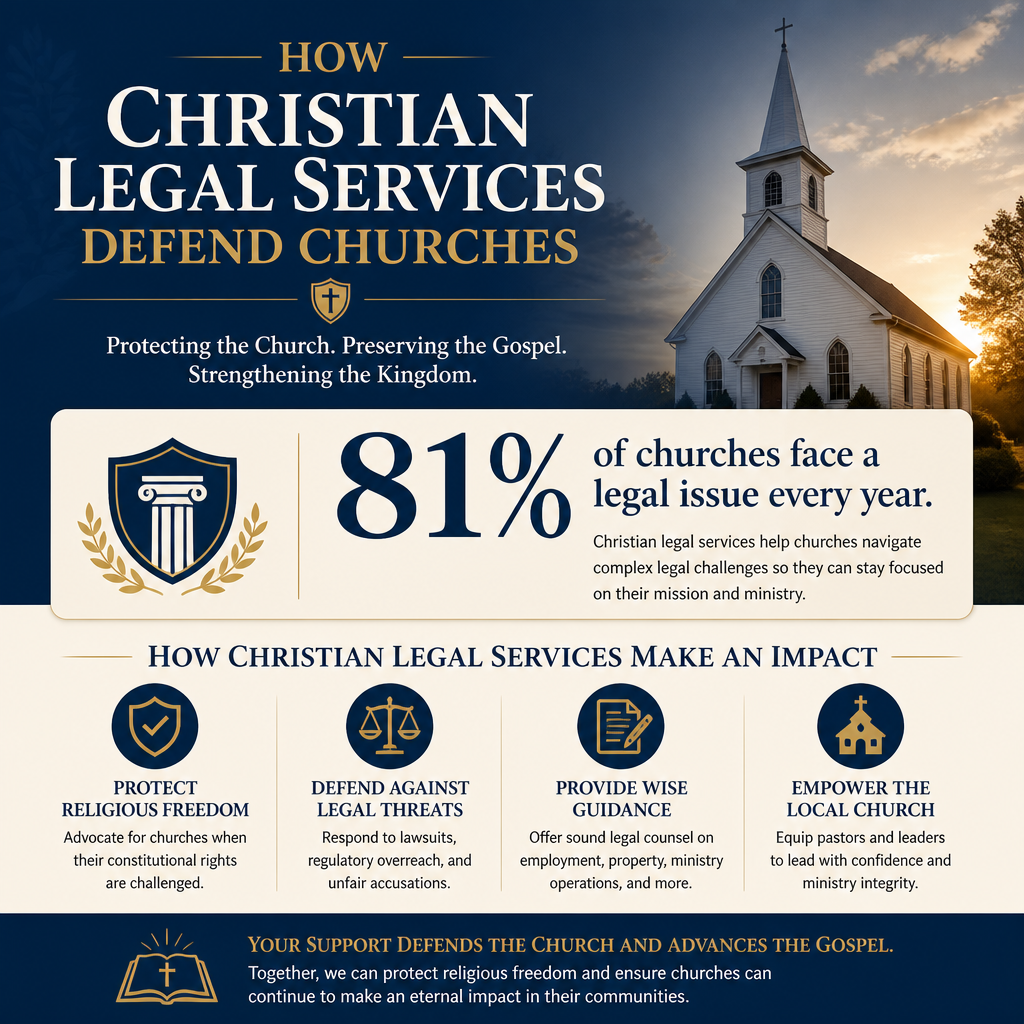
How Christian legal services defend churches is not primarily a culture-war question. It is a stewardship question for donors who understand that a congregation’s ability to preach, gather, disciple, and serve depends in part on whether it can operate faithfully under law without being coerced into compromise or crushed by preventable disputes.
Christians genuinely disagree about strategy in the public square, and there are places where legal advocacy can be done poorly: inflammatory fundraising, careless claims, or litigation pursued as a brand rather than a last resort. Yet the core need remains. Churches and Christian ministries occupy real legal terrain—employment, property, child safety, nonprofit compliance, licensing, zoning, speech, and religious liberty. When these matters are ignored, faithful ministry often becomes vulnerable not only to hostile pressure, but also to internal governance failures that harm people and weaken witness.
The church is not above the law and it is not without protection
Religious liberty is a means, not an end
The Christian tradition has never treated civil law as irrelevant. Scripture calls governing authorities “God’s servant for your good” (Romans 13:4), while also establishing clear limits when obedience to God is directly prohibited (Acts 5:29). What this means in practice is that churches must both respect the legitimate functions of law and insist, with humility and clarity, that the state is not the church.
American law reflects this distinction through constitutional protections. The First Amendment’s Free Exercise and Establishment Clauses do not make churches untouchable; they protect the church’s spiritual authority and ability to gather, teach, and order internal life without the state acting as a substitute shepherd.
The legal risks are ordinary, not theoretical
Many donor imaginations are captured by high-profile religious liberty cases. Yet much of what Christian legal services do is quieter: resolving a zoning dispute before it becomes a lawsuit, strengthening child-protection policies so a church does not learn governance through tragedy, or helping a ministry’s board align bylaws with actual practice.
The ministries we assess at Most Trusted often operate with lean teams and high volunteer dependence. That combination magnifies the cost of legal confusion. A single misstep with employment classification, building use, or insurance coverage can divert years of ministry energy into remediation.

Where churches most often need legal defense
Property and zoning are a consistent point of friction
Churches are embodied communities. They need places to worship, teach children, counsel, host funerals, and serve neighbors. Land-use decisions are rarely neutral; they are made through local politics, neighborhood pressures, and sometimes open animus. Federal law attempts to restrain this in religious land-use contexts through the Religious Land Use and Institutionalized Persons Act (RLUIPA), enforced by the U.S. Department of Justice’s Civil Rights Division https://www.justice.gov/crt.
Christian legal services often defend churches by helping them document discriminatory treatment, negotiate with municipalities, and, where necessary, pursue litigation that makes room not only for one congregation but also for future religious communities facing similar barriers.
Employment and governance disputes can wound a congregation
Employment conflict in a church is never merely a technical matter. It is discipleship in public. Yet legal boundaries matter: staff discipline, severance, and counseling practices frequently become contested when expectations are unclear. In some cases, a church’s failure is not that it was sued; it is that it never built basic governance practices that honor people made in God’s image.
Here, competent legal counsel functions as preventative care. A well-drafted handbook, a clear statement of faith connected to job roles, and properly documented board decisions are not bureaucratic excess. They are one way a church “provides for… its own” with integrity (1 Timothy 5:8) while protecting the mission entrusted to it.
What effective Christian legal services actually do
They combine legal competence with ecclesial wisdom
Not every attorney is equipped to counsel a church. Churches are not simply small businesses with religious messaging. They are spiritual bodies with real authority structures, sacramental commitments, and pastoral duties. Effective Christian legal services understand how doctrine, polity, and pastoral practice interact with the law.
For donors, this is a decisive distinction. Many legal mistakes in ministry come from importing secular templates without theological reflection. The outcome is often a mismatch: policies that are legally brittle, spiritually incoherent, and easily weaponized in conflict.
They emphasize prevention and peacemaking without naïveté
The Christian moral tradition prizes reconciliation, and Scripture is explicit about the dangers of contentiousness. Yet peacemaking is not appeasement. Legal services that serve the church well can pursue negotiated outcomes while also preparing for litigation when settlement would require surrendering core Christian teaching or leaving vulnerable people unprotected.
In our review work, the most credible legal ministries tend to describe litigation as an instrument of last resort and explain the criteria that govern that decision. They also disclose how they measure impact beyond case counts: policy clarity, training delivered, and risk reduced for local churches.
Discernment for donors funding legal defense
The moral hazard is real and should be named
Christians genuinely disagree about how much of the church’s public posture should be adversarial. Some legal organizations can drift into grievance-based fundraising that inflames anxiety and treats donors as an audience rather than as stewards. Donors should not ignore that temptation, especially in a digital attention economy that rewards outrage.
The better question is not whether a legal ministry is “bold,” but whether it is faithful. Faithful work tells the truth, refuses exaggeration, and is willing to accept slow, costly wins that protect the freedom to worship and preach without turning the church into a political machine.
Five indicators of credibility donors can verify
Donors can look for markers that are observable, not aspirational:
- Clear case-selection principles that limit litigation to materially significant issues.
- Competent governance: an engaged board, documented oversight, and conflict-of-interest discipline.
- Financial integrity consistent with recognized nonprofit disclosure norms and audited reporting when scale warrants it.
- Transparent communications that distinguish legal analysis from fundraising rhetoric.
- Training resources for churches that prevent harm: child safety, employment practices, bylaws, and religious accommodation.
These questions belong inside serious due diligence. They also align with why Most Trusted exists: to help donors evaluate ministries against The Most Trusted Standard, a 15-criteria framework spanning Faith Foundation, Financial Integrity, Governance and Leadership, and Transparency and Effectiveness. Legal defense ministries are not exempt from these disciplines; their public visibility makes them more accountable, not less.
How legal defense fits within a broader theology of witness
Legal protection preserves ordinary faithfulness
A mature theology of religious liberty does not treat freedom as an idol. It treats freedom as a condition that makes obedience possible in public. When a church can gather without arbitrary penalties, preach without compelled speech, and maintain its convictions in hiring and discipleship, it is not gaining privilege. It is retaining space to be the church.
This is why donors who care about long-term ministry health should see legal services as part of infrastructure. A church’s mercy ministries, evangelism, counseling, and discipleship all depend on a stable institutional platform. In many communities, that platform is tested through local disputes that never make national headlines.
Wise donors resist both panic and passivity
Some donors respond to legal threats with panic, assuming every disagreement is persecution. Others respond with passivity, assuming the courts are irrelevant to Christian mission. Neither posture reflects the balance of Christian prudence. The church can acknowledge real pressure without manufacturing it, and it can pursue lawful remedies without confusing those remedies with the Kingdom of God.
For donors exploring this space, it is often helpful to compare ministries in context—what kinds of cases they take, how they report outcomes, and whether their public communications sound like discipleship or like outrage commerce. Many donors begin their landscape review through Christian Legal Services Ministries, then evaluate particular organizations with the same care they would apply to any high-impact giving decision.
FAQs for How Christian legal services defend churches
Do Christian legal services only focus on high-profile Supreme Court cases?
No. High-profile cases exist, but much of the work is preventative and local: advising churches on governance, employment practices, child safety policies, and zoning or permitting disputes. Donors should ask what percentage of resources go to training and risk reduction versus litigation, and how the ministry reports outcomes with verifiable specificity.
How can donors evaluate a legal ministry without being lawyers?
Donors can assess governance, financial clarity, and truthfulness in communication. A credible ministry explains how it selects cases, shows disciplined board oversight, provides transparent financial reporting, and avoids exaggeration. Because legal work often carries public influence, donors may also consider whether the organization’s tone and strategy reflect Christian witness as well as legal competence. For broader context on religious liberty giving, many donors consult Christian Legal Services and Religious Liberty.
A donor’s role in protecting the church’s ordinary ministry
Churches do not ask for legal defense because they are eager for conflict. They ask because the ability to gather, teach, and serve requires legal clarity, competent governance, and at times firm resistance to coercion. Donors who fund Christian legal services are funding that protective work—ideally with sobriety, accountability, and a clear-eyed commitment to truth.
The most responsible giving in this area is neither reactive nor sentimental. It is deliberate support for ministries that pursue justice without sacrificing integrity, and that strengthen the church’s ability to remain faithful in public life.



