

Tax-smart giving to Christian legal services is not primarily about reducing a bill; it is about stewarding what God has entrusted so that more can be directed toward justice, mercy, and faithful witness. Legal ministries regularly meet people at points of crisis—eviction, domestic violence, immigration vulnerability, incarceration, threats to religious liberty, or a family collapsing under ordinary legal costs. Christian donors often want to respond quickly, but the most faithful generosity is both prompt and prudent.
What makes this category complex is that Christian legal work spans multiple models: direct legal aid for low-income neighbors, policy and appellate advocacy, prison reentry support, and community-based mediation. Those distinct approaches carry different financial patterns, different risk profiles, and different tax considerations for donors. Mature giving takes those differences seriously, without assuming that one model is automatically more “spiritual” than another.
Tax-smart giving begins with clarity about what you are supporting
Before selecting a tax strategy, donors need clarity about the ministry’s legal form and the nature of the work. In practical terms, the first question is whether the Christian legal service is a recognized 501(c)(3) public charity, a church or integrated auxiliary, or something else. Most donors assume “Christian ministry” automatically means “tax-deductible,” but that assumption sometimes fails in the legal space where policy activity, membership structures, or affiliated entities can complicate the picture.
Tax-deductible gifts are tied to the organization’s status, not the donor’s intent
For U.S. donors, gifts are generally deductible only when made to qualified organizations. The IRS maintains the Tax Exempt Organization Search tool that allows donors to confirm status and certain filing information for most nonprofits: IRS Tax Exempt Organization Search. Churches are not required to file Form 990, so they may not appear in the same way, which increases the importance of direct documentation and governance transparency.
Christian legal services sometimes operate through multiple entities: a 501(c)(3) ministry for charitable activities and a separate 501(c)(4) for certain advocacy work. Gifts to a 501(c)(4) are generally not deductible. The donor’s desire for “kingdom impact” does not change the tax treatment; the recipient entity does.
Not every payment is a charitable contribution
Another frequent confusion involves fees and benefit-received transactions. Paying for a ticketed banquet, purchasing a book, or receiving substantial goods and services generally limits the deductible portion of a payment. This is not a moral judgment; it is how charitable contribution rules distinguish a gift from a purchase. Strong ministries handle this with quiet precision, disclosing the fair market value of benefits and providing receipts that allow donors to keep clean records.
Christian donors should expect documentation that matches the ministry’s claims
Because Christian legal services often address contested areas of culture and law, donors should expect ministries to be especially disciplined about governance, transparency, and communications. Across our verification work at Most Trusted, the ministries that meet The Most Trusted Standard tend to treat financial documentation, donor receipts, and entity clarity as part of Christian witness rather than as an administrative burden. That posture does not guarantee faithfulness, but its absence is a meaningful warning sign.

Choosing the right asset and the right timing can materially increase impact
Tax-smart giving is frequently less about finding an exotic technique and more about giving the right kind of property at the right time. Many donors default to giving from a checking account, even when that is not the most efficient way to fund ministry. For Christian legal services that operate with significant ongoing case costs and staffing needs, predictable and efficient funding can be a form of practical love.
Cash giving is simple, but not always the most efficient
Cash remains the most straightforward gift type, and for many households it is the only responsible option. The complication is that U.S. taxpayers increasingly do not itemize deductions, which means a charitable deduction may not change the federal tax bill. The Tax Cuts and Jobs Act increased the standard deduction and contributed to this shift. The IRS publishes annual figures for the standard deduction and related rules: Internal Revenue Service. For donors who do itemize, cash gifts can remain highly effective, especially when combined with careful timing of gifts within a calendar year.
Donating appreciated stock can be one of the most powerful tools
For donors holding appreciated publicly traded securities, giving stock directly to a qualified charity can increase impact by avoiding capital gains tax and allowing a deduction for the fair market value, subject to applicable limits. This is a widely used approach among sophisticated Christian donors and family foundations precisely because it is both simple and principled: it converts unrealized gains into ministry support without unnecessary tax friction.
Because transfer procedures matter, donors should confirm whether the ministry can receive securities directly (via DTC instructions) or whether it uses a brokerage intermediary. Ministries that handle stock gifts well tend to provide clear written instructions, timely confirmation of receipt, and a receipt that reflects the date and number of shares (not a stated dollar value, which is typically the donor’s responsibility to determine).
Bunching, year-end discipline, and the spiritual danger of haste
Some donors “bunch” multiple years of charitable giving into a single year to exceed the standard deduction threshold, then give less in intervening years. This can be done directly or through a donor-advised fund. The strategy is legitimate, but it can quietly reshape the donor’s spiritual posture if it becomes a method for minimizing felt dependence on God and the church’s ordinary rhythms of generosity. Scripture commends planning, but it also warns against storing up security in ways that dull faith (Luke 12:15–21).
The harder question is whether a donor’s tax planning supports steadiness in generosity. Christian legal services often need stable support more than they need periodic windfalls. Many donors can pair a tax-efficient larger gift with a disciplined monthly commitment that sustains casework, staff retention, and client follow-through.
Donor-advised funds and planned gifts can support long obedience in generosity
Tax-smart giving is often at its best when it serves long-term faithfulness rather than short-term optimization. Two tools regularly used by serious Christian donors—donor-advised funds and planned gifts—can strengthen a ministry’s durability, but they also introduce questions of control, timing, and transparency that donors should not ignore.
Donor-advised funds can simplify giving, but they can also distance the donor
A donor-advised fund (DAF) allows a donor to make an irrevocable charitable contribution, receive an immediate tax deduction (if eligible), and then recommend grants over time. For donors with complex assets, major liquidity events, or a desire to consolidate records, DAFs are often an excellent fit. Fidelity Charitable publishes accessible guidance on how DAFs function and the mechanics donors commonly use: Fidelity Charitable.
At the same time, DAFs can create a psychological distance between the donor and the ministry’s lived reality. Christian legal services are not abstract projects; they represent people with names and court dates. Donors using DAFs should still pursue direct accountability: ask for outcomes, read annual reports, understand the ministry’s theological commitments, and confirm that governance protects integrity when cases attract controversy.
Charitable gift annuities and other planned gifts require special care in the legal-services context
Some Christian donors want to align their later-life financial stability with charitable intent. Charitable gift annuities (CGAs), charitable remainder trusts, and beneficiary designations can play a meaningful role in that planning. These instruments can be especially attractive when donors hold highly appreciated assets or desire a predictable income stream.
However, not every Christian legal ministry is positioned to administer complex planned gifts responsibly. A CGA is effectively a contractual obligation. Donors should confirm whether the ministry uses a reputable third-party administrator, maintains required reserves, and has board-level oversight for gift acceptance. Across our verification work, strong ministries tend to maintain written gift acceptance policies that address non-cash assets, conflicts of interest, and the ethical boundaries of donor influence.
Monthly giving is not a lesser form of generosity
Many donors treat recurring giving as a convenience feature. For Christian legal services, it is often a stability mechanism. Legal aid and advocacy work has uneven expense patterns—filing fees, expert costs, travel for hearings, and intensive case seasons. A consistent monthly base can reduce reactive fundraising and allow leaders to make staffing decisions that honor excellence and avoid burnout.
Monthly giving also fits a biblical theology of steady provision. God’s manna in the wilderness was daily, not annually, and it trained the people in trust and restraint (Exodus 16). Recurring generosity can shape the donor in similar ways when approached as worship rather than automation.
Verification and receipts are part of Christian integrity, not mere compliance
Christian donors are right to care about tax receipts and substantiation. Not because tax savings justify giving, but because clear records are part of ordered stewardship. The legal requirements for receipts are also a proxy for an organization’s internal discipline: ministries that handle documentation poorly often mishandle other forms of accountability as well.
What donation receipts should include
For cash gifts of $250 or more, donors generally need a contemporaneous written acknowledgment from the charity. The IRS outlines documentation requirements for charitable contributions and substantiation in its guidance on charitable deductions: IRS Charitable Contribution Deductions. Donors should expect receipts that include the organization’s name, the date and amount of cash contribution, a statement that no goods or services were provided (if applicable), or a good-faith estimate of the value of any goods or services received.
For non-cash gifts, ministries should acknowledge what was received without declaring a value, unless the gift is a quid pro quo transaction with a defined benefit. Donors bear responsibility for valuation and for additional forms such as appraisals in certain cases. Ministries that promise “we will value your gift for you” may be well-intentioned, but they can inadvertently create tax risk for donors.
Governance and transparency matter more in contested legal work
Christian legal services often operate in environments where opponents scrutinize finances, internal communications, and donor relationships. That makes governance quality non-negotiable. The Most Trusted Standard evaluates ministries across Faith Foundation, Financial Integrity, Governance and Leadership, and Transparency and Effectiveness. In our experience, donors are best served when these elements are visible: clear doctrinal commitments, independent board oversight, audited or reviewed financial statements appropriate to size, and public reporting that is neither evasive nor sensational.
Christians genuinely disagree about aspects of legal strategy and public engagement. Some donors prioritize direct legal aid for low-income clients; others prioritize precedent-setting litigation or policy defense. Verification does not remove that prudential disagreement, but it can clarify whether the ministry operates with integrity and whether its public claims match verifiable realities.
A sober approach to overhead, outcomes, and the temptation to simplistic metrics
Donors often ask for a single number that proves effectiveness. In legal services, simplistic metrics can mislead. A case count can reward shallow intake rather than durable help; a win-loss record can misrepresent complex settlements; policy outcomes can take years. Responsible ministries combine quantitative reporting with qualitative evidence—client stability, repeat harm prevented, durable legal status secured, and community trust rebuilt.
The same caution applies to overhead fixation. Serious legal work requires trained attorneys, secure systems, and careful compliance. Donors should resist demanding artificially low administrative costs that push ministries toward fragile operations. A more faithful question is whether spending patterns are transparent, governed well, and aligned with mission.
Giving that is both wise and worshipful
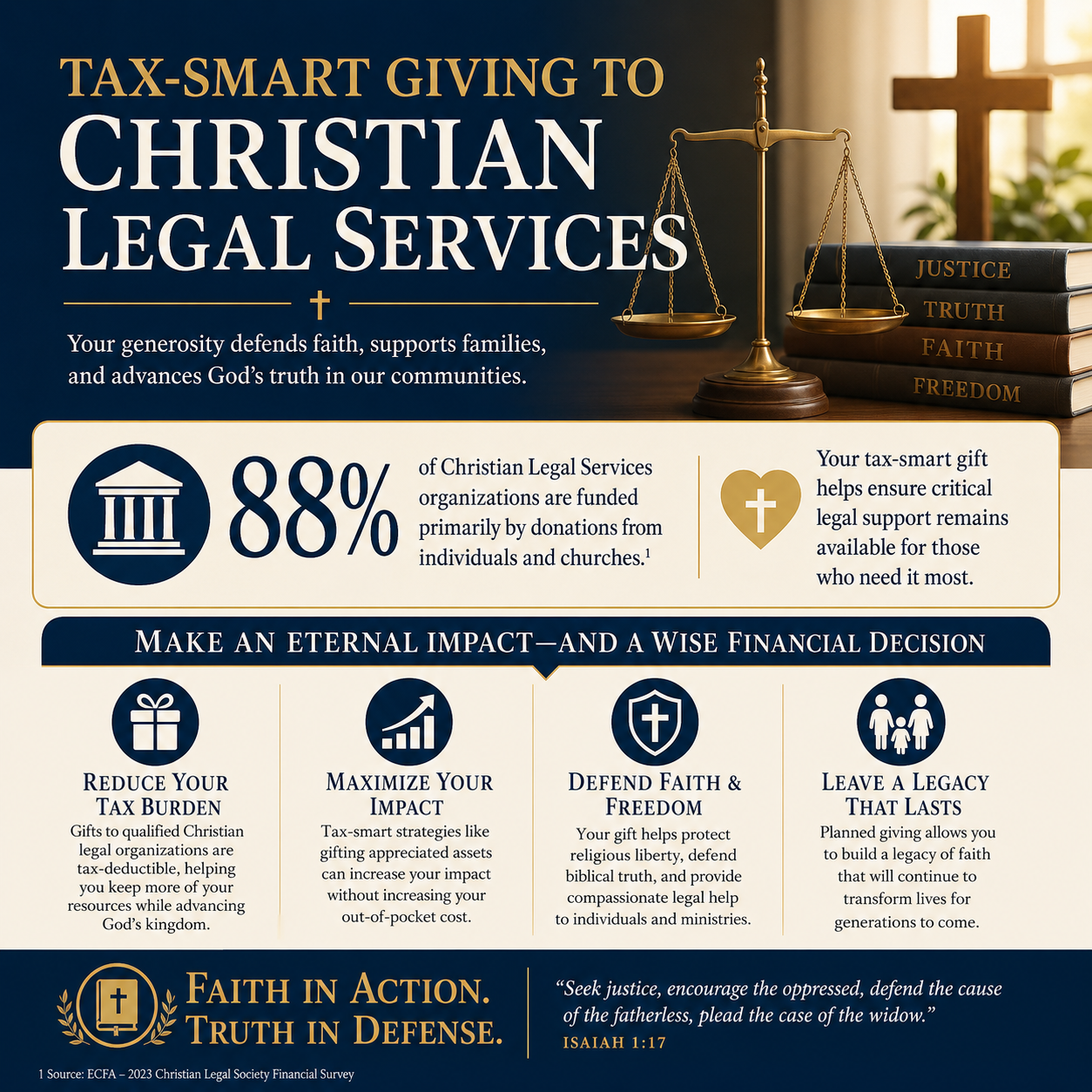
Tax-smart giving to Christian legal services is most faithful when it serves a larger aim: directing more resources toward ministries that practice justice with integrity and proclaim Christ without manipulation. Donors can make materially better decisions by confirming deductibility, giving appreciated assets when appropriate, using DAFs and planned gifts with discernment, and insisting on clear receipts and governance.
For donors seeking a broader view of this field and the distinct models within it, we encourage engagement with Christian Legal Services Ministries. Wise generosity does not eliminate complexity, but it refuses to be ruled by it, and it treats stewardship as part of discipleship.



