
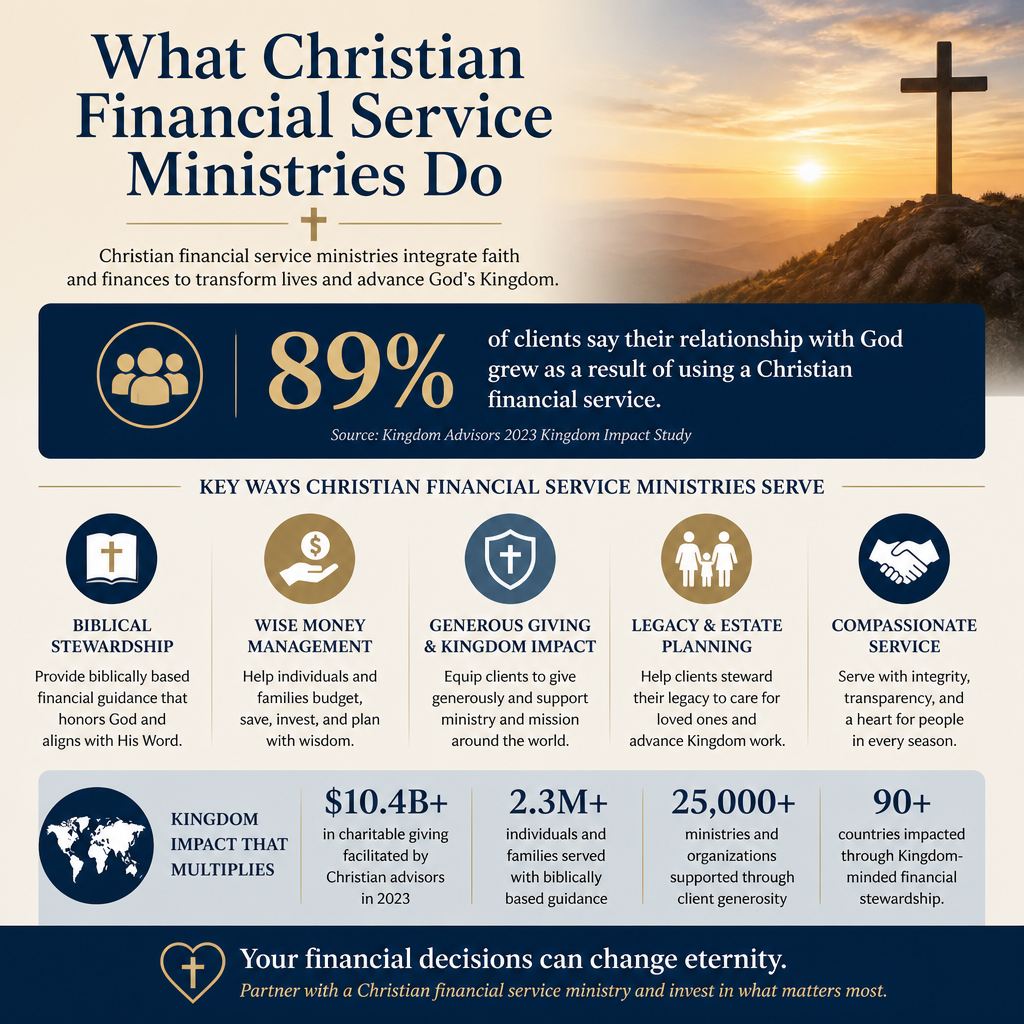
What Christian financial service ministries do is help believers handle money in ways that align with Scripture, protect households from predictable financial harm, and redirect resources toward the work of the Kingdom. They operate in the contested space where discipleship, personal responsibility, systemic injustice, and the modern financial system intersect. Donors who support these ministries are rarely funding “financial advice” in the abstract; they are funding formation, access, and accountability that ordinary families often cannot secure on their own.
Money is never a merely technical subject in the Bible. Jesus spoke frequently about wealth, anxiety, generosity, and hypocrisy because money functions as a spiritual diagnostic. “Where your treasure is, there your heart will be also” is not a metaphor about sentiment; it is an assessment about allegiance and practice. Christian financial service ministries exist because the church has learned that good intentions do not automatically produce wise stewardship, and that many believers need concrete tools, structures, and counsel to live faithfully within economic realities they did not choose.
Christian financial service ministries form stewardship, not just budgets
Many financial programs in the broader marketplace assume the goal is maximum consumption, prestige, or individual security. Christian financial service ministries begin with a different telos: stewardship under God, love of neighbor, and freedom from bondage. The work is often practical, but it is not neutral. It assumes that debt can become a form of slavery, that wealth can deceive, and that generosity is a disciplined habit rather than a spontaneous impulse.
They translate biblical principles into daily decisions
At their best, these ministries take biblical teaching about honesty, diligence, contentment, and generosity and convert it into practices a household can maintain. That includes setting realistic spending plans, building emergency reserves, repaying debt, giving consistently, and resisting predatory offers. The point is not moralism; it is formation. Financial habits shape imagination, marriage dynamics, and vocational decisions over time.
They address shame with truth and structure
Many Christian donors understand this pastoral reality: money problems carry shame. People hide in isolation until a crisis forces disclosure. A ministry that provides confidential coaching, peer-based groups, or church-embedded classes creates a pathway back into the light, where repentance can be specific and where change can be measured. In practice, this often looks like a curriculum, a trained coach, and a rhythm of accountability that normalizes slow, faithful progress rather than quick fixes.

They provide access to financial tools without compromising conscience
Christian financial service ministries vary in what they offer. Some focus on education and coaching; others provide financial products, lending, or advisory services. The unifying aim is to give believers access to tools that are competent and transparent, while guarding against practices that exploit vulnerability or contradict Christian ethics.
They help households avoid predatory and opaque financial products
In the United States, the Consumer Financial Protection Bureau has documented how payday loans can trap borrowers in cycles of reborrowing and high cost, especially when payments consume a large share of monthly income (Consumer Financial Protection Bureau). Christian ministries working in this space often develop small-dollar loan alternatives, emergency assistance paired with counseling, or partnerships with credit unions. The goal is not to remove consequences, but to interrupt exploitation and replace it with a path toward stability.
They offer guidance in areas where Christians seek moral clarity
Christians genuinely disagree about how far to press ethical screening in investments, how to weigh fiduciary duty against moral witness, and what counts as complicity in a complex economy. Some ministries provide biblically informed investment guidance, donor-advised fund administration, or charitable planning that reflects defined convictions. Others focus on ensuring transparency: fee structures, conflicts of interest, and accountability for advice given. The harder question is not whether values matter, but how to apply them with intellectual honesty when modern supply chains and capital markets are deeply entangled.
They strengthen the church by equipping people where stress concentrates
Financial stress is one of the most common accelerants of marital conflict, burnout, and pastoral crises. Ministries that bring financial coaching into congregational life can strengthen the church’s ability to shepherd people in ordinary discipleship, not only in emergencies.
They address the pastoral realities behind financial breakdown
Debt is often tied to more than math: medical bills, job loss, addiction, immigration status, family obligations, and regional housing costs. The field has had to reckon with a persistent tension: emphasizing personal responsibility without ignoring structural pressures that make certain households more vulnerable. Christian financial service ministries tend to be most credible when they name both realities directly, refusing both fatalism and simplistic blame.
They make generosity sustainable rather than episodic
Many donors have seen the pattern: a compelling need arrives, a household gives emotionally, and then retreats for months because the gift destabilized their budget. Stewardship formation aims for endurance. It teaches families to give in proportion, plan for predictable expenses, and practice hospitality without financial panic. This is one reason donors often support these ministries indirectly through their churches: mature generosity is a community good, and financial stability reduces downstream crisis needs.
They operate as specialized ministries with real risks and real accountability needs
Whenever a ministry touches money, it attracts both heightened expectations and heightened temptations. The sector has seen admirable integrity and painful scandals. For donors, the question is not whether financial service ministries can do good, but how to distinguish the trustworthy from the merely persuasive.
Common program models donors will encounter
- Church-based financial discipleship courses with trained facilitators
- One-on-one coaching, often tied to debt reduction and budgeting
- Small-dollar lending alternatives paired with counseling
- Matched savings programs and financial capability training
- Charitable planning support for givers, including complex gifts
Why governance and transparency matter more here than almost anywhere
These ministries often collect sensitive information, influence high-stakes decisions, and may handle funds directly. That creates clear donor due diligence questions: Who sets compensation? Are fees disclosed? Are there related-party transactions? Is advice tied to product sales? Are client outcomes measured without manipulating definitions? A mature donor should expect written policies, independent oversight, and understandable financial reporting.
This is one reason Many donors come to Most Trusted. As an independent verification service for Christian nonprofits, we evaluate ministries against The Most Trusted Standard, a 15-criteria framework covering faith commitments, financial integrity, governance, and public accountability. For donors who want a broader map of this ministry landscape, Christian Financial Service Ministries provides the most direct orientation to the field and the kinds of organizations operating within it.
They connect financial discipleship to measurable mission outcomes
Christian financial service ministries can drift into two equally unhelpful directions: spiritual language without measurable change, or measurable change without Christian distinctiveness. The most credible organizations refuse the false choice. They define outcomes that matter, measure them with restraint, and keep the work explicitly connected to the church’s moral vision.
What effectiveness can reasonably mean in this field
Outcomes might include debt reduction, improved savings behavior, reduced reliance on high-cost credit, or increased consistency in giving. But the best ministries also attend to less quantifiable changes: reduced anxiety, restored marital communication, and increased stability that makes ministry participation possible. Donors should ask for evidence that outcomes are tracked over time, not merely at graduation from a class.
Why donors should resist simplistic efficiency narratives
The charity sector has broadly recognized that overhead ratios are an unreliable proxy for effectiveness, a point reflected in the “Overhead Myth” letter endorsed by leading nonprofit evaluators (Charity Navigator). In financial service ministries, this matters in particular. Competent counseling, data protection, and compliance cost money. A ministry can be “lean” in a way that is irresponsible, especially when it deals with confidential information and complex financial guidance. The more serious donor question is whether spending aligns with mission and is governed with integrity.
Donors who want to explore how these programs fit within the wider set of ministry purposes and trade-offs will find useful context in The Mission and Impact of Christian Financial Service Ministries, where we examine how impact is credibly framed and responsibly assessed.
FAQs for What Christian financial service ministries do
Are Christian financial service ministries primarily charities or businesses?
They can be either, and sometimes they include both elements. Some operate as nonprofits offering education, coaching, and relief services; others provide financial products or advisory services under different regulatory structures. Donors should clarify what the organization is, how it is governed, whether any services generate fees, and how potential conflicts of interest are managed.
What should donors look for before supporting a financial service ministry?
Donors should look for clear theological commitments, transparent fee and compensation policies, strong board oversight, understandable financial statements, and evidence that programs produce durable outcomes. Because these ministries work close to households’ vulnerabilities, safeguards for confidentiality and ethical counseling are also essential. Verification against a coherent framework such as The Most Trusted Standard can reduce guesswork by focusing on governance, financial integrity, and public accountability.
Why this category of ministry matters for Christian donors
Christian financial service ministries do not replace the church’s teaching ministry; they operationalize it where anxiety, temptation, and long-term consequences converge. For donors, supporting this work is a way of funding steadiness: families that can remain in their homes, marriages that withstand strain, and givers who are freed to practice generosity without chaos. The most trustworthy organizations in this space treat money with the seriousness Scripture gives it, and they submit their practices to the kind of scrutiny that protects both households and the name of Christ.



