

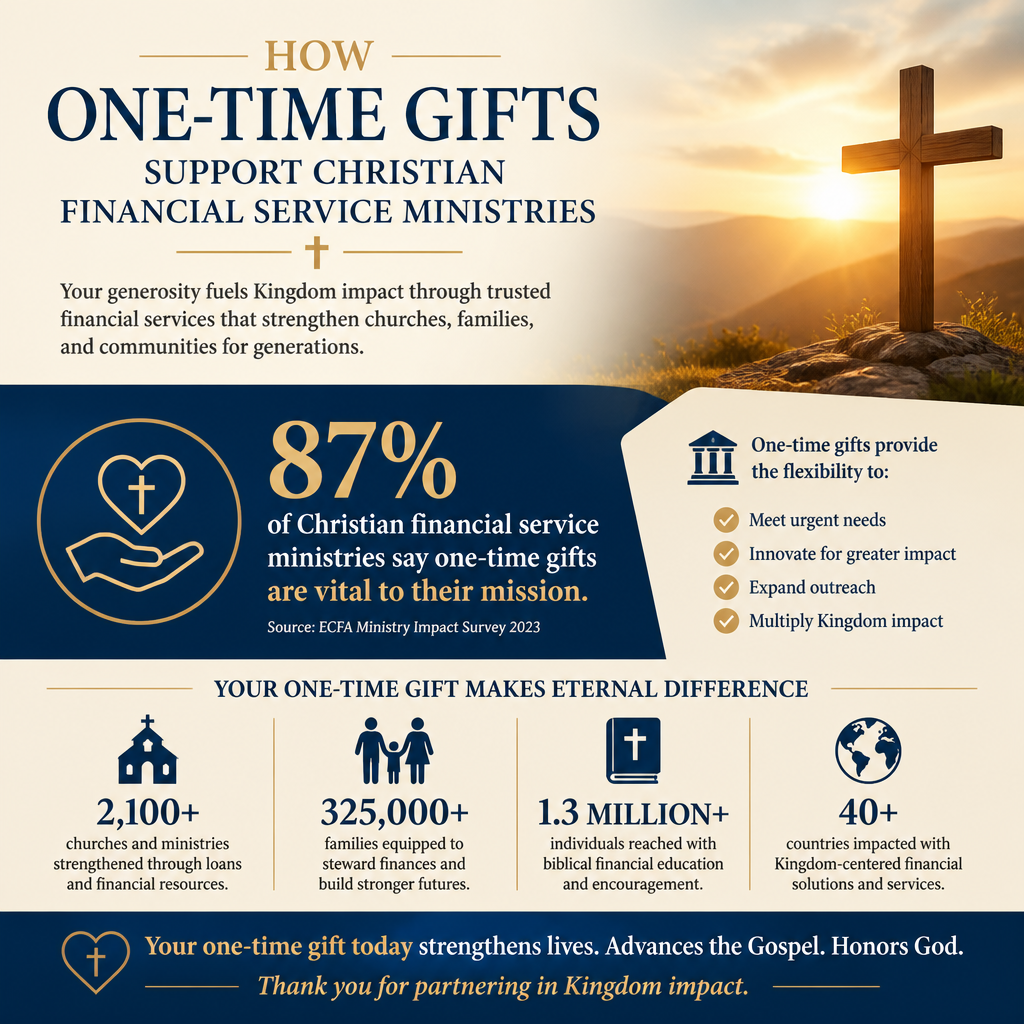
One-time gifts support Christian financial service ministries by supplying timely capital for mission-critical needs that cannot always wait for monthly revenue. Because these ministries often stand at the intersection of discipleship, financial counseling, and practical aid, a single well-directed gift can relieve immediate pressure while strengthening long-term capacity for biblical stewardship.
Christian donors rightly ask whether a one-time gift is merely a temporary patch or a meaningful instrument of ministry. Scripture holds both realities together: immediate mercy for real needs, and patient formation over time. When giving is discerned carefully, one-time generosity can serve as seed money for faithfulness rather than a substitute for sustainable planning.
Why one-time gifts matter in financial service ministries
Timing is often the ministry
Many Christian financial service ministries operate in moments of urgency: a family facing eviction, a borrower caught in a predatory loan cycle, a local church suddenly responsible for benevolence costs after a crisis. In settings like these, the difference between help that arrives today and help that arrives next month is not primarily administrative. It is pastoral. A one-time gift can underwrite the immediacy of mercy.
That urgency does not negate the call to wisdom. Christians genuinely disagree about where emergency assistance should end and where longer-term coaching and accountability should begin. The harder question is often not whether to help, but how to help without transferring responsibility away from the person God is calling to grow in faithfulness.
A one-time gift can strengthen the margin that prevents harm
Financial service ministries are vulnerable to a familiar tension: the needs are real, but poorly structured help can entrench dependency or subsidize unwise patterns. The When Helping Hurts framework, articulated by Steve Corbett and Brian Fikkert, has shaped the field by naming how assistance can unintentionally do spiritual and relational damage when it bypasses agency and mutuality.
One-time gifts can create the operational margin to do the work carefully. They can fund intake processes, case management, legal review, or the slower work of coaching that protects both the recipient and the ministry’s integrity.

Where one-time gifts typically go inside these ministries
Direct aid, targeted relief, and bridge funding
Christian financial service ministries span a range of models. Some provide direct relief (rent assistance, utilities, emergency food). Others focus on debt counseling, credit repair, workforce readiness, or small-dollar lending designed to replace payday products. Still others equip churches and Christian counselors to do financial discipleship at scale.
A one-time gift most often serves one of three functions: it fills a short-term gap, it seeds a discrete project, or it covers a surge in demand that exceeds normal cash flow. In the ministries we evaluate at Most Trusted, the most defensible use of one-time funding is usually tied to a clearly defined purpose with measurable outputs and a plan for what happens when the money is spent.
Capacity investments donors should not dismiss
Some donors hesitate when a one-time gift supports staff training, technology, audit costs, or evaluation work. Yet for financial service ministries, those investments are frequently mission-critical. A debt relief program that cannot document outcomes is not merely incomplete; it can become misleading. A lending program without strong underwriting and compliance processes can create harm. A counseling program without appropriate supervision can drift into advice that is pastoral in tone but financially unsound.
What this means in practice is that donors should evaluate “capacity” spending by its connection to faithful service, not by whether it feels inspiring. The “Overhead Myth” letter signed by Charity Navigator, BBB Wise Giving Alliance, and GuideStar cautioned donors against using overhead ratios as a primary measure of effectiveness, because the healthiest organizations often invest in the very infrastructure that enables outcomes and accountability Charity Navigator.
Discernment questions that make one-time giving wiser
Ask what the gift is solving and what it is not
One-time gifts are powerful precisely because they are limited. They are best suited to discrete needs: a funding gap, a time-bound initiative, a crisis response, or a capital purchase. They are a poor fit for permanent obligations such as ongoing salaries without a sustainability plan, or long-term programs with no identified renewal strategy.
For donors, the goal is not to eliminate every risk. The goal is to align a one-time gift with a ministry’s actual operating reality and theological intent: mercy for today, and growth toward responsibility tomorrow.
Practical questions we recommend
- What specific need will this one-time gift address, and what is the timeline?
- How does the ministry decide who receives help and under what conditions?
- What safeguards prevent assistance from becoming enabling?
- What outcomes will the ministry track, and what will it report back to donors?
- How will the ministry sustain the work after this one-time funding is spent?
These questions are not adversarial. They are stewardship. Jesus’ parable of the talents assumes accountability, not cynicism, and Christian donors should feel freedom to ask for clarity where money and pastoral responsibility meet.
How verification strengthens confidence in one-time gifts
Why these ministries require more than good intentions
Christian financial service ministries handle sensitive data, counsel vulnerable families, and sometimes manage restricted funds or lending capital. That combination raises legitimate concerns about governance, internal controls, privacy, and the spiritual posture of the work itself. A ministry can be sincere and still be structurally unprepared for the responsibility it has assumed.
Most Trusted exists because donors deserve more than marketing claims. We evaluate ministries against The Most Trusted Standard, a 15-criteria framework across Faith Foundation, Financial Integrity, Governance and Leadership, and Transparency and Effectiveness. One-time gifts are often deployed quickly; disciplined verification helps donors act decisively without acting blindly.
What we look for that matters for one-time giving
Across our verification work, we observe that the ministries most prepared to steward one-time gifts share several traits: clear restrictions and fund accounting when appropriate; documented decision rules for aid; credible, independent financial reporting; and leadership that can articulate the ministry’s theory of change in moral and practical terms. Donors can explore the broader landscape of Christian Financial Service Ministries with those stewardship questions in view.
Transparency is not a cosmetic virtue. In ministries that handle financial counsel and relief, transparency is an ethical obligation because opacity often hides either incompetence or manipulation. A one-time gift given into a transparent system does not guarantee fruit, but it meaningfully reduces the likelihood of preventable misuse.
Common tensions donors should name rather than ignore
Emergency relief and long-term formation
Financial distress is not always the result of personal irresponsibility. Medical bills, layoffs, disability, family breakdown, and systemic injustice are real. At the same time, Scripture’s call to generosity does not erase Scripture’s call to wisdom, diligence, and ordered love. The church must resist simplistic stories in both directions: narratives that blame the poor, and narratives that treat human beings as passive recipients rather than agents made in God’s image.
Many ministries attempt to hold these truths together by pairing aid with coaching, budgeting support, employment pathways, or community accountability. A one-time gift can fund the “bridge” that keeps a family stable long enough for that longer work to take root.
Donor restriction can help or hinder
Restricted gifts can protect a donor’s intent and guard against mission drift, especially in volatile economic moments. Yet excessive restriction can also immobilize a ministry, forcing leaders to chase donor preferences rather than respond to actual needs. Mature giving requires judgment about when restriction is an act of accountability and when it is an act of control.
Donors who want to think carefully about these choices within the broader practice of giving can review How to Give to Christian Financial Service Ministries as a context for aligning generosity, governance, and real-world outcomes.
FAQs for How one-time gifts support Christian financial service ministries
Is a one-time gift less helpful than monthly giving?
Not necessarily. Monthly giving supports predictable operations, but one-time gifts can address needs that are time-sensitive or project-specific, such as emergency assistance, a technology upgrade for secure client management, or a short-term surge in counseling demand. The more important distinction is whether the gift is matched to a clear purpose and a credible plan for stewardship.
How can we tell if a ministry will use a one-time gift responsibly?
We recommend looking for clear policies for aid distribution, transparent reporting, independent financial oversight, and leadership that can explain both the spiritual intent and the practical mechanics of the work. Verification against The Most Trusted Standard is one way to assess whether a ministry has the governance, financial integrity, and transparency needed to steward funds that may be spent quickly but carry lasting ethical weight.
One-time giving as disciplined mercy
One-time gifts support Christian financial service ministries when they are treated as purposeful acts of stewardship rather than emotional reactions to need. They can provide immediate relief, fund the slower work of financial discipleship, and strengthen the systems that protect vulnerable families from well-intended but careless help. For donors who want to give with confidence, the aim is not to eliminate risk, but to practice disciplined mercy grounded in truth, accountability, and love of neighbor.



