

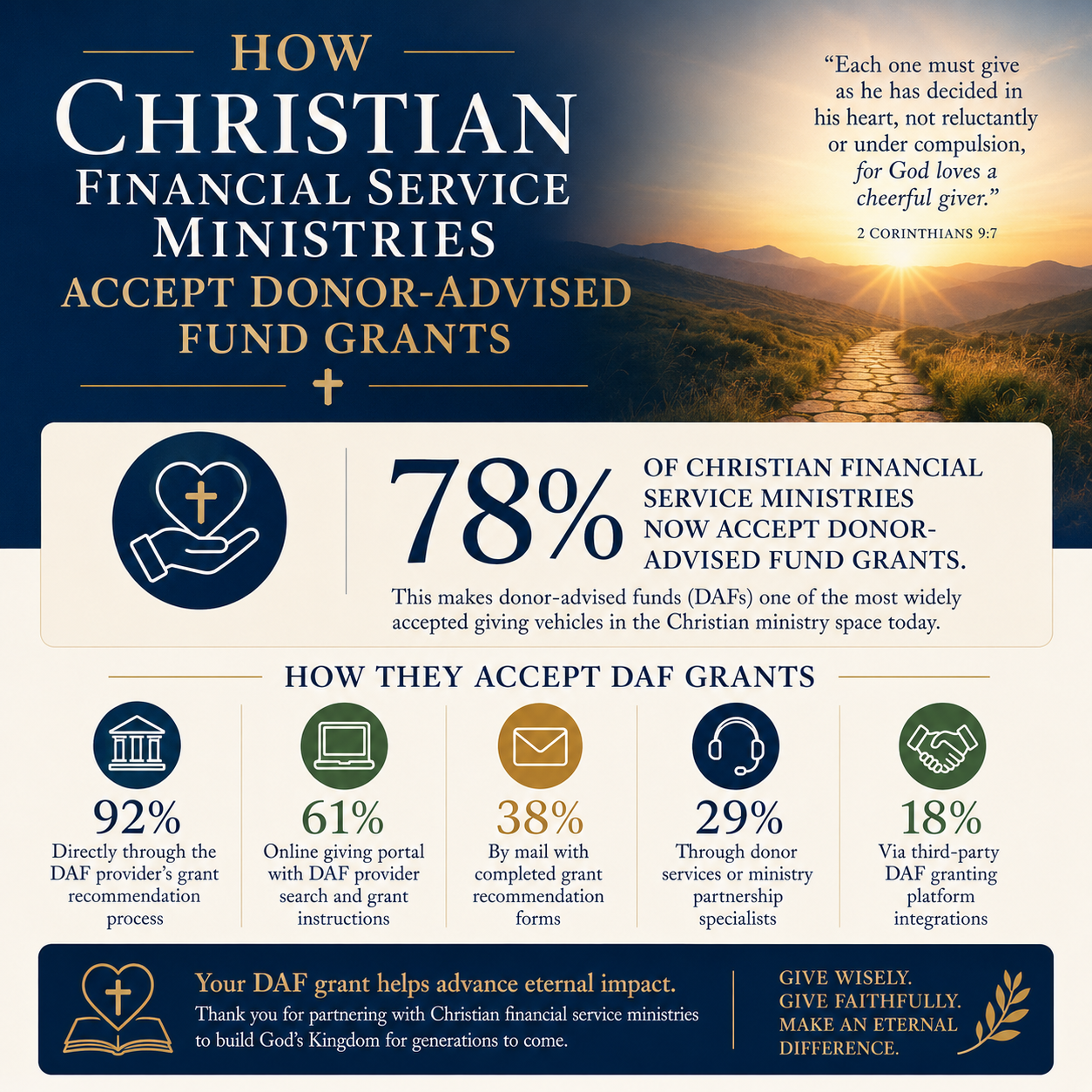
How Christian financial service ministries accept donor-advised fund grants is rarely a question of theology alone; it is a question of operations, compliance, and trust. Many donors assume a DAF grant is simply “another check,” but the constraints attached to DAF distributions can collide with how these ministries book revenue, communicate impact, and honor donor intent.
For Christian donors, the deeper concern is stewardship: not only whether funds reach the right place, but whether the ministry has the internal controls to receive restricted dollars without confusion, delay, or reputational risk. Scripture’s warnings about money are not abstract. “Moreover, it is required of stewards that they be found faithful” (1 Corinthians 4:2). Faithfulness includes competent administration.
Why donor advised fund grants are not the same as personal gifts
A DAF is a donor tool with its own legal boundaries
A donor-advised fund is typically housed at a sponsoring organization, often a public charity affiliated with a financial institution or a community foundation. Legally, the sponsor—not the donor—makes the grant. That distinction is why ministries often need specific intake steps: the grant arrives with the sponsor’s name on it, and the sponsor may require particular documentation before releasing funds.
Those boundaries matter for Christian financial service ministries because they sometimes operate with multiple program lines: member services, counseling, education, and charitable relief. A donor may hope to “support the mission broadly,” but the DAF sponsor may not permit grants that confer more than incidental benefits back to the donor or other private parties. The IRS’s general prohibition on using charitable funds for private benefit is foundational here (IRS: Charitable contribution deductions).
The most common friction points
Across our verification work at Most Trusted, the ministries that manage DAF grants well tend to do two things simultaneously: they communicate clearly to donors what a DAF can and cannot do, and they build a back-office process that prevents misclassification. The friction points are usually predictable:
- Grant purpose language that is too vague for the ministry to book correctly
- Grant purpose language that is too specific for the ministry to fulfill responsibly
- Requests for benefits or services that are not permissible with charitable dollars
- Timing gaps between a donor’s recommendation and the sponsor’s disbursement
- Missing information that prevents correct receipting and acknowledgment
None of these issues are scandalous by themselves. They become spiritually and operationally serious when the ministry lacks governance discipline and drifts into improvisation.

What Christian financial service ministries usually require to receive DAF grants
Basic administrative details that prevent avoidable delays
Most ministries will ask for a standard set of details to ensure the DAF sponsor can process the grant correctly. Donors should expect requests for the ministry’s legal name, mailing address, and tax ID, along with a note about where the grant should be applied (general operations, a named program, or a specific campaign). Many DAF sponsors also maintain their own database, which can contain outdated addresses or old entity names that create confusion.
Operationally, a competent ministry will also route DAF gifts through a development or finance team that can reconcile deposits, confirm restrictions, and record revenue in a way that aligns with audited financial statements. For donors assessing seriousness, this is not mere bureaucracy. It is part of what it means to “do what is right, not only in the Lord’s sight but also in the eyes of man” (2 Corinthians 8:21).
Restriction language that can be honored without distorting the mission
DAF donors often want to designate their giving for a particular outcome: debt relief, financial coaching scholarships, emergency assistance, or pastoral training. Designation is not wrong. Yet the harder question is whether the designation is realistic and whether the ministry has the program structure to honor it. Overly narrow restrictions can force unwise spending decisions or create pools of cash that sit idle while other needs go unmet.
Our team evaluates these questions through The Most Trusted Standard, which asks whether ministries have clear program descriptions, consistent financial reporting, and transparent policies for restricted gifts. A ministry that can explain how it handles restricted revenue is usually a ministry that can be trusted with it.
DAF compliance issues donors and ministries must take seriously
DAF grants cannot provide more than incidental benefits
Christian financial service ministries sometimes offer paid memberships, subscription services, or member-exclusive tools. These can be legitimate lines of work. But DAF grants generally should not be used to purchase goods or services for the donor, to pay personal expenses, or to satisfy a pledge. DAF sponsors often prohibit such uses because they risk private benefit or quid pro quo concerns. Donors should treat a DAF grant as charitable support for public benefit, not as a payment mechanism.
The policy environment around DAFs has also become more contested in recent years, with significant debate about payout expectations and transparency. For example, the National Philanthropic Trust’s annual reporting has helped document the scale and growth of DAF giving in the United States (National Philanthropic Trust). The field’s expansion has increased scrutiny, and ministries that handle DAF grants casually may find themselves unprepared for sponsor questions.
Restricted relief and hardship assistance requires clear guardrails
Some Christian financial service ministries operate benevolence-style programs: grants to families facing eviction, utility shutoffs, or other crises. These are works of mercy that align closely with the biblical concern for the poor. Yet they also demand tight controls: clear eligibility criteria, documentation standards, and a separation of duties so that compassion does not devolve into favoritism or quiet conflicts of interest.
When a DAF grant is directed toward hardship assistance, the ministry should be able to explain, in plain terms, how recipients are selected and how funds are safeguarded. Donors should not confuse “direct aid” with “informal aid.” The book of Proverbs praises generosity, and it also praises prudence.
What to look for before recommending a DAF grant
Evidence of financial integrity and governance maturity
DAF donors are often giving at levels where governance quality matters more, not less. Before recommending a grant, it is reasonable to look for audited financial statements, a current Form 990 (where applicable), an independent board with documented oversight, and a conflict-of-interest policy that is more than a template.
It is also reasonable to look for transparency that connects money to ministry outcomes. The better ministries do not treat reporting as marketing; they treat it as accountability. The IRS requires most tax-exempt organizations to make their Form 990 available for public inspection (IRS: Disclosure requirements for public charities). A ministry that is slow to disclose basic documents may still be doing good work, but the donor should not pretend the risk is imaginary.
Program clarity that matches the donor’s intent
Christian donors often want to support ministries whose work integrates biblical discipleship with practical financial wisdom. Yet “financial service ministry” can mean different things: debt management plans, budgeting education, microenterprise training, charitable relief, or institutional advising to churches and nonprofits. The donor’s first task is not to chase a brand name; it is to understand what the ministry actually does.
What this means in practice is that donors should read how the ministry describes its programs, where it operates, and how it measures effectiveness. This is also where Most Trusted’s verification work can serve donors: we assess ministries against The Most Trusted Standard so donors can distinguish between strong faith-aligned operations and well-phrased claims.
For a broader view of this field, see Christian Financial Service Ministries, where donors can orient themselves to the landscape and common ministry models.
How to coordinate the DAF sponsor, the donor, and the ministry
Align timelines and acknowledgment expectations
A frequent pastoral frustration for donors is the “silence gap”: the donor recommends a grant, the sponsor processes it on its own schedule, and the ministry cannot acknowledge it until the funds arrive and are matched to the correct designation. This is not always negligence; it is often a normal timing issue. Still, mature ministries manage it by telling donors what to expect and by acknowledging gifts promptly once received.
DAF donors should also understand that the ministry’s thank-you letter may be addressed to the sponsoring organization, or it may include limited donor details depending on what the sponsor transmits. If the donor wants a grant to be anonymous, that preference needs to be communicated through the sponsor’s process, not assumed.
Use clear grant purpose language and avoid prohibited requests
The simplest way to reduce confusion is to write grant recommendations in language the ministry can execute. “For general operating support” is often the most administratively clean option and frequently the most helpful, particularly for ministries that provide counseling, education, and relief in an integrated model. When donors do restrict gifts, the restriction should match a real fund or program the ministry already operates.
For donors who want to give with care and consistency across this category, How to Give to Christian Financial Service Ministries addresses common giving pathways and the trade-offs that accompany them.
FAQs for How Christian financial service ministries accept donor-advised fund grants
Can a donor advised fund grant pay for a ministry service that benefits the donor
In most cases, no. DAF grants are intended for charitable purposes and generally should not be used to purchase goods or services for the donor or to provide more than incidental benefits. If a Christian financial service ministry offers a paid membership, counseling package, or other direct service to the donor, donors should assume a DAF is not an appropriate payment tool unless the DAF sponsor explicitly confirms otherwise.
Should donors restrict a DAF grant to a specific program or give unrestricted
Both can be faithful stewardship, depending on the ministry and the donor’s intent. Unrestricted support typically gives a ministry the flexibility to fund core operations, staffing, and infrastructure that make programs durable. Restricted support can be appropriate when the program is clearly defined, actively operating, and the restriction will not distort priorities. The guiding question is whether the ministry has the capacity and governance discipline to honor the restriction without confusion or waste.
Stewardship that honors both mission and method
DAF giving can be an effective way for Christian donors to deploy significant resources with order and intentionality. For Christian financial service ministries, receiving DAF grants well is a test of administrative maturity as much as fundraising skill. Donors serve the Church best when they choose ministries that combine theological seriousness with financial integrity, and when they make grant recommendations that can be executed with clarity and accountability.



