

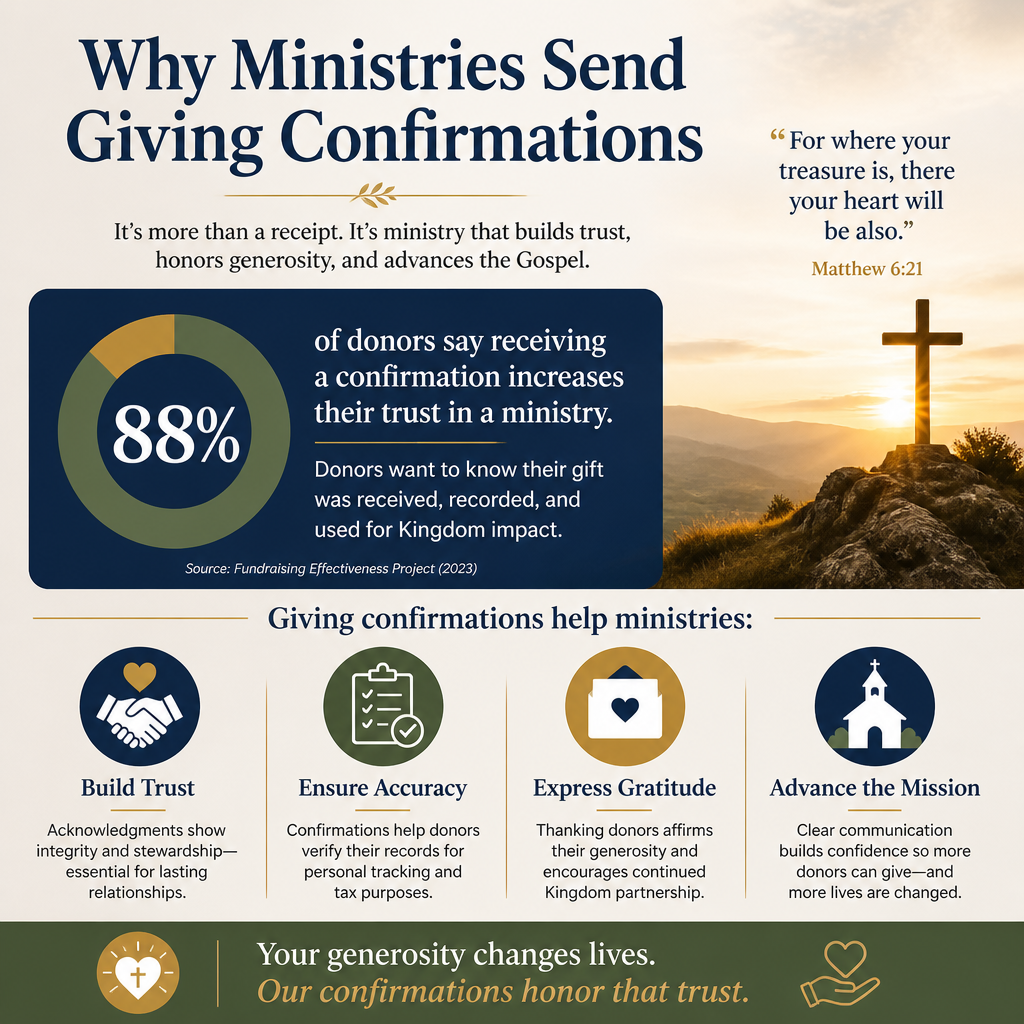
Why ministries send giving confirmations is ultimately a question about stewardship, truth-telling, and the covenant of trust between a donor and the work they support. A confirmation is more than a receipt; it is a ministry’s public record that a gift was received, accounted for, and treated with the seriousness Scripture assigns to handling resources offered to God.
Christian donors are not only funding outcomes. They are entrusting worshipful obedience—often sacrificial and sometimes costly—to an organization they cannot fully see. That asymmetry creates a moral obligation for ministries to communicate clearly and promptly about what was received and how it was recorded.
Giving confirmations are a stewardship practice before they are a tax document
Scripture treats financial handling as a moral matter
The New Testament speaks candidly about money because money reveals allegiance. Christian giving is an act of worship, and worship deserves integrity. When Paul organized a large relief offering, he took pains to ensure the handling of funds would be above reproach: “We take this course so that no one should blame us about this generous gift… for we aim at what is honorable not only in the Lord’s sight but also in the sight of man” (2 Corinthians 8:20–21). A giving confirmation is one small way a ministry demonstrates that same seriousness.
What this means in practice is that a confirmation belongs to the ethical duties of those who receive gifts, not merely to back-office administration. The donor is owed clarity: what was given, when it was received, how it was designated, and whether anything was received in return. Ambiguity is not neutral; it erodes trust.
A confirmation protects both donor and ministry from avoidable confusion
Even among careful donors, disputes and misunderstandings happen: a gift is made through a donor-advised fund, a recurring donation changes, a check is lost, a stock transfer posts later than expected, a designation is misstated, a name or address is outdated. Confirmations reduce the likelihood that these issues linger for months and then become difficult to reconcile.
Ministries that treat confirmations as optional often end up spending more time later correcting avoidable errors. Ministries that treat them as standard practice are signaling a deeper posture: we will be accountable for what we receive.

Confirmations are part of good financial controls and governance
They support clean books and disciplined processes
A confirmation is not a substitute for internal controls, but it is often connected to them. The act of generating a timely acknowledgment usually implies that a ministry has a functioning gift-entry process, that deposits and records are reconciled, and that donor data is handled with care. These disciplines matter because Christian ministry is not exempt from the ordinary temptations that accompany money: sloppiness, favoritism, and, in rarer cases, fraud.
Across our verification work at Most Trusted, we observe that ministries with consistent donor acknowledgments tend to have fewer downstream issues in financial reporting and fewer unresolved donor complaints. Donors may never see the internal accounting workflow, but they will feel the difference when basic communication is dependable.
Confirmations fit within a broader transparency expectation
Serious donors increasingly expect ministries to demonstrate financial integrity through more than warm storytelling. Publicly available audited financial statements, clear conflict-of-interest practices, and board oversight are not secular intrusions; they are ordinary means of honoring the trust God’s people place in an organization. A confirmation is a donor-facing extension of those commitments.
For donors evaluating ministries within Christian Financial Service Ministries, confirmations are a small but telling indicator of whether a ministry’s operational discipline matches its stated mission. They do not prove faithfulness on their own, but they do reveal whether an organization values accurate records and prompt communication.
Tax and regulatory requirements make confirmations necessary, but not sufficient
Some confirmations are required for donors to substantiate deductions
In the United States, donors who claim charitable deductions must retain appropriate documentation. For contributions of $250 or more, the IRS requires a contemporaneous written acknowledgment that includes whether any goods or services were provided in exchange for the gift and, if so, a good-faith estimate of their value. This is not a preference; it is a requirement of the tax code. Donors who cannot produce proper documentation can lose the deduction even when the gift itself is undisputed. See the IRS guidance on substantiation and written acknowledgments at IRS.gov.
The harder question is whether a ministry’s confirmation practice is shaped only by compliance or also by pastoral seriousness. Compliance can produce the minimum. Stewardship aims higher: it seeks to be honorable in the Lord’s sight and in the sight of others.
Quid pro quo language matters for Christian events and benefits
Many ministries invite donors to banquets, conferences, or benefit dinners. These can be legitimate, even fruitful, but they introduce a specific obligation: if a donor receives something of value (a meal, goods, a premium), the acknowledgment must address it. The requirement is not merely bureaucratic; it prevents confusion about what portion of a payment is a gift and what portion is a purchase.
Donors should not have to guess whether their “ticket” included a deductible gift portion, or whether a “recommended donation” was actually a fee. Clear confirmations serve honesty, and honesty is not negotiable for Christian institutions.
Confirmations are a form of donor care, not donor management
They honor the donor without centering the donor
Christian donors often carry quiet burdens in giving: competing needs within their church, compassion fatigue, concern about waste, and uncertainty about which claims are credible. A timely confirmation does not solve those burdens, but it reduces one avoidable strain. It tells the donor: your gift did not disappear into a void; it was received and recorded responsibly.
There is a tension here. Confirmations can be handled in a way that feels transactional, as if the ministry is primarily selling impact. But the right approach is neither manipulative nor cold. It is dignified communication: clear facts, gratitude that does not flatter, and language that reflects the spiritual nature of giving.
What strong confirmations usually include
Practices vary by ministry size and system, but strong confirmations tend to be consistent about a few elements:
- The legal name of the ministry and a way to contact them for corrections
- The date received and the amount, with the gift method noted when helpful
- The donor’s designation, if any, stated plainly
- A clear statement about whether goods or services were provided
- When relevant, the fair market value of any goods or services provided
When ministries omit these basics, donors are left to infer. In donor communication, inference is where misunderstandings multiply.
Confirmations also reveal a ministry’s posture toward truth and accountability
They should not be used to paper over unclear fundraising claims
Christian donors have learned that some fundraising language is elastic. Phrases like “your gift will” can imply a direct line from a particular donation to a specific outcome, even when funds are pooled. Pooling can be appropriate and often necessary, but the communication should be truthful about how designations work. Confirmations are one place where clarity can be reinforced rather than obscured.
Christians genuinely disagree about the right level of restriction donors should place on gifts, and ministries have legitimate operational reasons to avoid overly narrow designations. Still, the burden is on the ministry to communicate candidly. A confirmation should reflect what was actually promised and what was actually received, not a more inspiring version of either.
Verification frameworks help donors interpret signals
Donors who want to give with confidence need more than isolated signals. A confirmation is a good sign, but it is only one sign. At Most Trusted, we evaluate ministries against The Most Trusted Standard, a 15-criteria framework spanning faith commitments, financial integrity, governance, and transparency and effectiveness. In that broader context, confirmations matter because they touch multiple criteria at once: financial controls, disclosure habits, and respect for donors as partners rather than targets.
For donors paying attention to Donor Communication in Christian Financial Service Ministries, confirmations are often a reliable early indicator. Ministries that are disciplined and truthful in small communications are more likely to be disciplined and truthful when the questions become difficult.
FAQs for Why ministries send giving confirmations
Is a giving confirmation the same as a tax receipt?
Often it functions as one, but a confirmation is broader. For U.S. donors, certain written acknowledgments are required to substantiate deductions, especially for gifts of $250 or more, and they must state whether goods or services were provided. A ministry can meet that requirement and still communicate poorly; the Christian standard is not mere compliance but clear, honorable stewardship. The IRS requirements are summarized at IRS.gov.
What should we do if a confirmation is wrong or never arrives?
Request a correction promptly and in writing, and retain whatever documentation you do have (bank record, canceled check image, confirmation email from a payment processor, or DAF grant notice). A ministry with healthy administration should welcome the opportunity to correct errors without defensiveness. If the pattern persists—missed acknowledgments, repeated inaccuracies, or evasive answers—it is reasonable to treat that as a caution flag and to ask harder questions about financial controls and transparency.
Confirmations are small communications with large moral weight
Christian giving is not a private consumer transaction. It is a stewardship act offered before God and entrusted to human hands. Ministries send giving confirmations because donors need accurate records, regulators require clear acknowledgments, and faithful organizations should want to be above reproach in how they handle what has been given for the work of the Kingdom. When a ministry treats confirmations as a disciplined practice, it signals something deeper than administrative competence: a commitment to truth, accountability, and honor in the sight of God and neighbor.



