

Staying engaged with Christian financial service ministries year-round is a stewardship question before it is a communication strategy. These ministries sit close to a sensitive seam in Christian life: the use of money in a world where Mammon competes for loyalty, and where the vulnerable can be helped or harmed by financial decisions made far away.
Donors often disengage for understandable reasons. Some have been burned by vague reporting, unclear theology of stewardship, or appeals that feel more like pressure than pastoral seriousness. Others give faithfully but struggle to connect a balance sheet to the biblical aims of justice, mercy, and discipleship. Sustained engagement is possible, but it requires a clearer theology of money, better questions, and a disciplined rhythm of attention.
Anchor engagement in a theology of stewardship rather than in updates
Christian financial service ministries are not merely technical providers. At their best, they are institutions of formation that help Christians handle money as a tool for love of neighbor, not as an instrument of self-protection. Scripture’s warnings are not abstract: Jesus teaches that one cannot serve both God and money, and he ties financial practice to spiritual allegiance (Matthew 6:24).
Ask what the ministry believes money is for
Many ministries can describe their products, programs, or loan funds. Fewer can articulate a coherent theology of wealth, debt, risk, and provision that is faithful to Scripture and wise about modern complexity. Christians genuinely disagree about certain questions, including how to speak about debt, wealth creation, and the boundaries between charity and enterprise. The key is not uniformity; it is clarity and accountability.
What this means in practice is that donors should listen for doctrinal seriousness, not rhetorical flourish. Does the ministry treat generosity as discipleship, or as a transaction? Does it name moral hazards frankly, such as dependency, paternalism, or a prosperity-gospel drift that baptizes self-interest?
Recognize that formation requires time
Donors sometimes expect constant novelty: a new story, a new crisis, a new reason to stay emotionally engaged. Mature engagement is steadier. It looks more like a rule of life than a news cycle. Ministries serving in lending, debt relief, savings initiatives, microenterprise, or financial counseling often do slow work. The fruit can be profound, but it is rarely immediate.

Evaluate trustworthiness with verifiable signals, not sentiment
Because financial service ministries operate near sensitive data, financial pressure, and the possibility of conflicts of interest, donors should look for evidence that the ministry is governable and transparent. Sentiment is easy to manufacture; institutional integrity is harder.
Use an external standard when you can
Across our work at Most Trusted, we see a consistent pattern: the ministries that can document their decisions, controls, and outcomes tend to withstand leadership transitions and economic volatility more faithfully. Most Trusted evaluates ministries against The Most Trusted Standard, a 15-criteria framework across Faith Foundation, Financial Integrity, Governance and Leadership, and Transparency and Effectiveness. For donors who want year-round engagement, a standard provides a stable set of questions that remain relevant even when there is no crisis appeal.
In practice, this means returning to the same categories over time: board governance, audited financials, related-party transactions, clarity in restricted giving, and evidence that outcomes are more than testimonials. It also means tracking whether the ministry’s public communications match its filings and policies.
Know what healthy transparency can and cannot include
Financial service ministries often must protect client privacy. Donors should not demand identifiable details to feel convinced. The harder question is whether the ministry can demonstrate effectiveness while honoring confidentiality: clear program design, defined eligibility, documented underwriting or counseling protocols, complaint handling, and measurable outcomes reported in aggregate.
For a baseline of what responsible financial reporting looks like in the nonprofit sector, donors can consult the IRS guidance on nonprofit reporting and Form 990 expectations through the IRS Charities and Nonprofits site.
Choose a year-round rhythm that matches how ministries actually operate
Donor engagement often fails because it is built on adrenaline: an annual gala, a year-end push, a crisis campaign. Financial service ministries are better served by rhythms that track with their operational calendar, reporting cycles, and pastoral responsibilities.
Build engagement around decision points
Financial ministries make consequential decisions: underwriting standards, loan loss reserves, counseling curriculum, partnerships, and the boundaries of risk. Donors who care about faithful stewardship should align engagement with these decision points rather than waiting for marketing moments. Ask when the board reviews risk, when the annual audit is completed, when program outcomes are assessed, and when the ministry revises its policies for client protection.
The field has had to reckon with the reality that overhead ratios alone do not indicate health or impact. The widely cited “Overhead Myth” statement from major evaluators underscored that administrative spending can represent necessary investment in governance, systems, and compliance rather than waste; donors can read the joint letter through GuideStar’s parent organization at Candid.
Keep the relationship relational but not dependent
Some donors want intimate access to leaders; some ministries are tempted to grant it to secure support. Healthy engagement respects role boundaries. It is appropriate to ask leaders hard questions, to pray for them, and to stay informed. It is not appropriate to become a shadow board, to expect private veto power, or to make funding contingent on personal closeness.
- Schedule two fixed touchpoints each year tied to the audit and annual report.
- Ask one program-design question each quarter that probes client protection and spiritual care.
- Request a written update on risk management and governance practices, not only stories.
- Pray with specificity for staff burdens: confidentiality, burnout risk, and moral clarity under pressure.
- Revisit your giving restrictions annually to ensure they still serve the mission rather than your preferences.
Engage the ministry as a moral actor within the financial system
Christian financial service ministries do not operate in a vacuum. They sit inside an economy shaped by inequality, predatory products, and cultural assumptions about success. Year-round engagement requires attention to the ministry’s posture toward power, incentives, and the people it serves.
Ask how incentives are structured
The same tool can bless or harm depending on incentives. A loan fund can expand opportunity or entrench burden. A counseling program can dignify a family or subtly shame them. Donors should ask how staff and partners are rewarded: by volume, by repayment rates, by client well-being, by long-term stability, or by something else. A mature ministry can name the trade-offs plainly.
It is also reasonable to ask whether the ministry’s work aligns with what Christian development practitioners have learned about dignity and unintended harm. The When Helping Hurts framework, articulated by Steve Corbett and Brian Fikkert, has shaped much of the Christian conversation about poverty alleviation by arguing that poverty is often rooted in broken relationships, not merely lack of material goods. For an overview of their work, see When Helping Hurts.
Expect a serious approach to client dignity
Financial hardship is often accompanied by shame, fear, and relational fracture. Ministries that treat clients as projects will eventually drift from Christian ethics, even if their spreadsheets look clean. Donors should listen for practices that protect dignity: consent, privacy, culturally competent counseling, avoidance of manipulative testimony gathering, and a refusal to turn need into spectacle.
Christians can also disagree about the right balance between evangelism and service, especially in contexts where financial need creates vulnerability. The responsible stance is to ensure that any spiritual invitation is noncoercive, honest, and consistent with the character of Christ.
Make verification and communication reinforce each other
Many donors want better communication, but the deeper need is coherence between what a ministry says and what it can substantiate. When communication runs ahead of governance, trust erodes. When governance is strong but communication is thin, donors assume the worst or drift away.
Use the right questions for donor communication
Year-round engagement becomes sustainable when donors trade adrenaline for inquiry. Within Donor Communication in Christian Financial Service Ministries, we repeatedly see that the best donor relationships are built on disciplined transparency: clear outcomes, clear finances, clear theology, and clear accountability. Donors should ask for information that a responsible ministry can provide repeatedly and consistently.
Practical examples include: the ministry’s audited financial statements, a narrative explanation of major variances, a description of client safeguarding practices, and a report on outcomes that includes definitions and limits. The most credible ministries acknowledge where results are difficult to measure and where attribution is partial.
Let verification shape long-term giving decisions
Engagement should mature into discernment. If a ministry cannot answer basic governance questions, dismisses financial accountability as worldly, or treats donors as a revenue stream rather than as stewards seeking faithfulness, sustained support becomes harder to justify. If a ministry demonstrates humility, documentation, and consistent care for vulnerable clients, donors can give with confidence and patience.
For donors who want a wider frame for evaluating this sector, we maintain a central reference point at Christian Financial Service Ministries, where the question is not merely which causes move us, but which institutions can be trusted to steward resources in Christ’s name.
FAQs for How donors can stay engaged with Christian financial service ministries year-round
How can we stay engaged without expecting constant stories or crisis appeals?
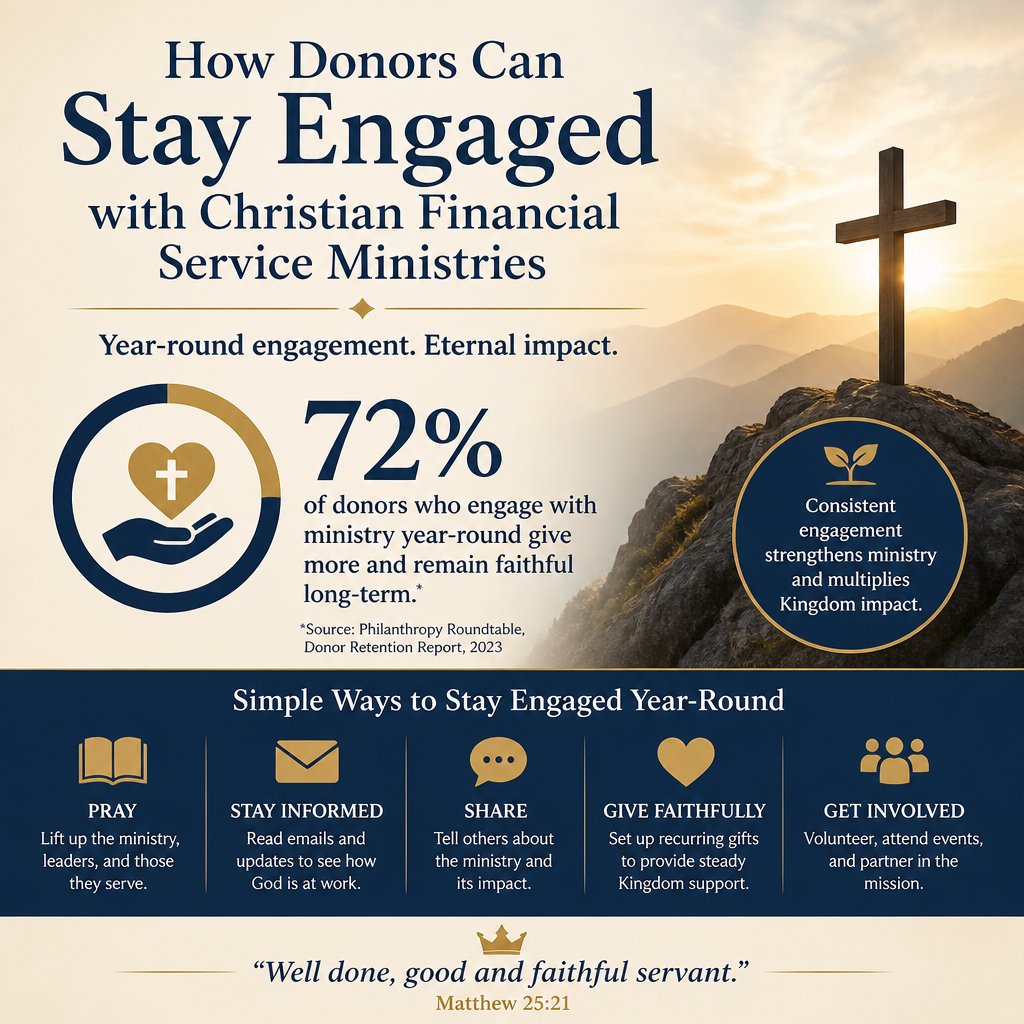
We recommend building engagement around verifiable cycles: the annual audit, the annual report, periodic outcome reporting, and defined governance reviews. Financial service ministries often do slow work, and a steady rhythm of inquiry honors that reality. Ask for consistent documentation, pray for leaders and clients with specificity, and let trust be shaped by transparency rather than novelty.
What should we do if a ministry says it cannot share details because of confidentiality?
Confidentiality is often legitimate, especially where financial hardship and personal data are involved. The appropriate response is not to demand identifiable stories, but to ask for aggregate outcomes, clear program definitions, written safeguarding and privacy policies, audited financials, and documented decision processes. A ministry can protect clients and still be accountable to donors.
A durable form of engagement
Year-round engagement with Christian financial service ministries is sustained when donors treat giving as discipleship rather than as episodic emotion. The goal is not constant visibility; it is faithful stewardship, exercised through serious questions, respect for client dignity, and trust built on verifiable evidence. Ministries that welcome that posture are often the ones most prepared to handle money in a way that serves the Kingdom rather than competing with it.



