
How Christian financial service ministries handle donor privacy is not an administrative footnote; it is a spiritual and fiduciary obligation. When a donor entrusts a ministry with personal information, that ministry is holding more than data. It is holding a piece of a person’s story—sometimes connected to hardship, debt, family strain, or a season of private repentance that should not become public knowledge.
Scripture frames this with moral clarity. Love “does not insist on its own way” (1 Corinthians 13:5), and that restraint has practical implications for how ministries collect, store, and use donor information. In our verification work at Most Trusted, we see donor privacy handled well when leaders treat it as a matter of stewardship and neighbor-love, not merely compliance or marketing efficiency.
Donor privacy is a stewardship issue before it is a legal issue
Why privacy is not merely a marketing preference
Many Christian donors give through financial service ministries because they want their generosity to be disciplined, accountable, and aligned with biblical priorities. Those same donors often expect discretion. Some give because they have received mercy and do not want recognition. Others give while navigating sensitive circumstances: a bankruptcy recovery, a special-needs adoption, a church conflict, a public-facing vocation, or a family member’s crisis. Privacy protects the giver from exposure, manipulation, and spiritual confusion about why they give.
Jesus’s warning about practicing righteousness “to be seen by others” (Matthew 6:1–4) is not an argument against gratitude or donor communication. It is a warning against turning giving into a mechanism for status. Ministries that honor donor privacy make it easier for donors to practice generosity without unnecessary social incentives.
The harder question is ownership of the relationship
Christian financial service ministries sometimes partner with churches, employers, or other nonprofits. A donor may give through a donor-advised structure, a giving platform, a workplace campaign, or a pooled fund. The practical question becomes: who owns the donor relationship and the donor data? The ministry, the partner, or the donor?
The ministries that treat privacy as stewardship tend to answer that question in a consistent direction: the donor is not a “lead,” and donor information is not a commodity. It is held in trust for the donor’s benefit and for the faithful delivery of receipts, statements, and necessary ministry updates.

What responsible privacy practices look like in Christian financial service ministries
Collection discipline and purpose limitation
Responsible privacy begins before any database is built. Mature ministries collect only what they need for clearly defined purposes: processing gifts, issuing tax documentation, preventing fraud, and communicating in ways the donor has requested. When ministries ask for additional information—birthdates, household details, employer data, or demographic profiles—they should be able to explain plainly why it is needed and what will happen if a donor declines.
Because many Christian donors are older and increasingly aware of identity theft risks, ministries should treat minimal collection as a protection, not a limitation. The Federal Trade Commission continues to warn consumers about identity theft and fraud patterns, and ministries should assume donors are rightly cautious about sharing sensitive information online Federal Trade Commission.
Security is not only technology
Data security includes encryption, access controls, and breach response plans. But in Christian ministries, the more common failure point is operational: too many staff accounts, shared logins, donor reports exported to spreadsheets, or sensitive notes kept in informal tools. Privacy collapses when convenience becomes the governing value.
Ministries handling financial transactions should also attend to recognized security standards and risk controls. Donors do not need technical jargon, but they do need evidence that leadership understands the stakes and invests accordingly. When security is treated as overhead to minimize, privacy becomes fragile.
How privacy intersects with donor communication and spiritual formation
The temptation to treat donors as an audience
Donor communication is necessary, and Christian donors often want it. They want to know that gifts were received, used as designated, and aligned with the ministry’s stated purpose. They also want to be drawn into meaningful prayer and informed participation. Yet the methods of modern fundraising can drift toward surveillance: tracking clicks, modeling donor “capacity,” and using personal detail to create psychological pressure.
Christians genuinely disagree about where the line should be drawn between thoughtful personalization and undue manipulation. The ethical standard is not whether the tactics “work.” It is whether they honor the donor as a neighbor and protect freedom of conscience. The most defensible posture is restraint: communicate clearly, avoid exploitative urgency, and decline to use private details in ways a donor would experience as coercive or intrusive.
What this means in practice for email, mail, and phone outreach
Most privacy harm is not dramatic. It is cumulative. It looks like an unexpected phone call after a one-time gift. It looks like a donor’s spouse receiving mail to a name they do not use. It looks like a ministry sharing a donor list with “trusted partners,” followed by a noticeable increase in solicitations. It looks like a well-intentioned staff member referencing a donor’s hardship in a way that feels exposed.
For donors evaluating ministries, it is helpful to ask whether communication practices flow from consent and clarity rather than assumption. For a deeper view of how this plays out across the sector, we have written more broadly about Donor Communication in Christian Financial Service Ministries.
Privacy, transparency, and the donor’s right to know
Transparency does not require disclosing donor identities
Some leaders implicitly contrast privacy and transparency, as though a ministry can only be accountable by exposing donor information. That is a category mistake. Transparency concerns governance, finances, program outcomes, and truthful communication. Donor privacy concerns the protection of personal data and personal stories. A ministry can be highly transparent about how funds are used without disclosing who gave.
The healthiest ministries separate these domains with care. They publish audited financial statements when appropriate, explain revenue sources honestly, and disclose related-party transactions and conflicts of interest, while guarding individual donor details. Donor confidence grows when transparency is comprehensive about the ministry and discreet about the donor.
What donors should expect to see in policies and disclosures
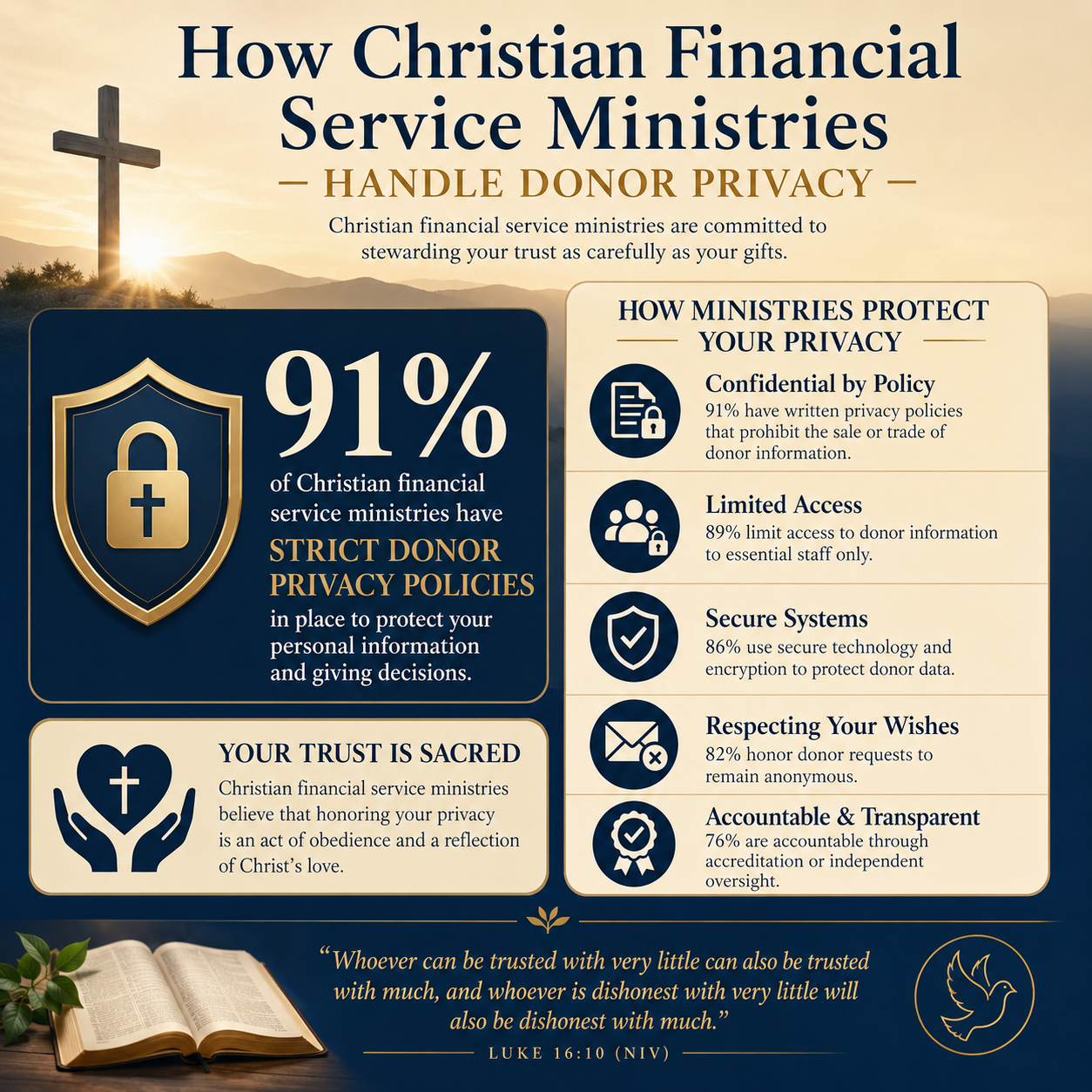
Many donors never read privacy policies, but the existence and clarity of those policies matters because they reveal the ministry’s posture. A responsible privacy posture is usually visible in a few specific commitments:
- Clear opt-in and opt-out controls for email, mail, and phone contact
- A straightforward statement on whether donor information is ever shared or sold
- Defined retention practices for donor records and sensitive notes
- Internal access restrictions, especially for giving history and personal details
- A documented breach response process and donor notification commitment
In the broader nonprofit field, donor trust has been tested by high-profile data misuse and increasingly sophisticated phishing. The FBI has repeatedly warned about business email compromise and related fraud schemes that often target finance workflows FBI Internet Crime Complaint Center. Ministries should assume that threat environment is real for them as well, even when their work is sacred.
How Most Trusted evaluates donor privacy in Christian financial service ministries
Privacy belongs with integrity, governance, and truthful communication
Most Trusted exists to help Christian donors give with confidence by evaluating ministries against The Most Trusted Standard, a 15-criteria framework spanning faith commitments, financial integrity, governance, and transparent reporting. Donor privacy is not an isolated item; it is interwoven with leadership maturity and operational discipline.
Across our verification work, we observe that ministries with strong privacy posture typically share several traits: their boards ask sober questions about risk; their finance and development teams coordinate rather than compete; and their communications emphasize consent and clarity over volume. Weak privacy posture often appears where governance is thin, vendor relationships are informal, and fundraising pressure is allowed to outrun controls.
Questions we recommend donors ask before giving
Christian donors do not need to become cybersecurity specialists to practice diligence. A few direct questions often reveal whether a ministry has done the basic work of stewardship:
Will you ever share or sell my information? Ministries should answer with precision, not vague assurances.
How can we control communication preferences? Opt-outs should be honored quickly and completely.
Who internally can access giving history and notes? “Only those who need it” should have a real definition.
What vendors process our gifts and data? Ministries should be able to name key providers and the general safeguards in place.
How will we be notified if there is a breach? Responsible ministries prepare for failure, not just success.
Donors who want to understand how verification relates to broader ministry health can review our coverage of Christian Financial Service Ministries.
FAQs for How Christian financial service ministries handle donor privacy
Is it acceptable for a ministry to share donor information with partner ministries or service providers?
It can be acceptable to share limited information with service providers who are necessary to process gifts, issue tax receipts, or operate core systems, provided the sharing is disclosed and governed by clear contractual safeguards. Sharing donor data with partner ministries for solicitation purposes is ethically and pastorally different; donors should expect explicit consent and a plain explanation of what data is shared, for what purpose, and how to stop it.
What should a donor do if a ministry keeps contacting them after they opt out?
First, request confirmation in writing that preferences have been updated across all channels, including any affiliated lists. If the ministry cannot or will not honor a reasonable opt-out, that is a meaningful signal about governance and internal controls. Donors may choose to redirect future giving to ministries that demonstrate clearer accountability and restraint in communication practices.
Privacy worthy of the gospel is careful, limited, and accountable
Christian financial service ministries do not serve donors well when they treat privacy as a checkbox or a branding statement. They serve donors well when they practice disciplined restraint: collecting only what is needed, protecting it with real controls, and communicating with consent and clarity. That posture is not merely prudent. It is a form of neighbor-love that keeps Christian generosity free, joyful, and protected from exploitation.



