
Why Christian financial service ministries use independent audits is ultimately a question of stewardship before God and credibility before donors. When a ministry handles gifts, donor-advised funds, investment-like instruments, or complex administrative services, the moral obligation is not only to be honest, but to be demonstrably careful with what belongs to the Lord.
Independent audits do not sanctify an organization, and they do not guarantee that every decision is wise. But they create a disciplined way to test whether financial statements are fairly presented, whether controls are functioning, and whether leadership is willing to be examined by qualified outsiders. For Christian donors who want to give with both faith and clarity, that posture matters.
Independent audits serve a biblical ethic of accountable stewardship
Stewardship requires more than good intentions
Scripture treats money as a spiritual matter with public implications. Jesus warned that “where your treasure is, there your heart will be also” (Matthew 6:21), and Paul insisted that Christian leaders should aim not only to be faithful, but to “take pains to do what is right, not only in the eyes of the Lord but also in the eyes of man” (2 Corinthians 8:21). That second phrase is not cynicism. It is a recognition that opaque money handling harms the witness of the church and exposes the vulnerable to preventable risk.
Christian financial service ministries often sit at a junction where generosity meets complexity: designated gifts, restricted funds, pass-through grantmaking, fee structures, reserve policies, and sometimes regulated relationships with banks or custodians. Even when no one is trying to deceive, complexity is where errors multiply. An independent audit is one of the strongest signals that a ministry has chosen verifiable accountability rather than relying on trust alone.
Accountability protects donors and beneficiaries
Donors are not merely “customers.” They are stewards seeking to honor God with resources entrusted to them. When financial reporting is weak, the first casualties are often unseen: delayed disbursements, unclear restrictions, inconsistent policies, or internal pressures to present results more favorably than reality. Independent audits do not prevent every failure, but they reduce the likelihood that ministries drift into unexamined practices that eventually damage both donors and the people the ministry exists to serve.
The point is not suspicion; it is prudence. “The simple believes everything, but the prudent gives thought to his steps” (Proverbs 14:15). In mature Christian philanthropy, prudence includes asking what mechanisms exist to surface problems early, when they can still be corrected.

What an independent audit does and does not guarantee
An audit is a defined professional opinion on financial statements
In most nonprofit contexts, an independent audit is performed under professional standards and results in an auditor’s opinion on whether the financial statements are presented fairly, in all material respects, in accordance with an applicable reporting framework. It is not a moral endorsement. It is not a ministry effectiveness report. It is a technical and disciplined examination designed to increase confidence in the numbers that shape decisions.
For ministries serving as financial intermediaries, the credibility of financial statements is not peripheral. It affects the ministry’s ability to manage liquidity, honor donor restrictions, and communicate honestly about what is available for mission versus what is restricted or reserved. Donors who care about faithful stewardship should want that clarity, not merely reassurance.
Audits have limits and wise donors should understand them
Christians genuinely disagree about how much assurance an audit provides. The field has also had to reckon with the reality that organizations can have audited statements and still experience fraud or significant governance failure. Auditors work with sampling and materiality thresholds, and they rely on information provided by management as part of their procedures.
What this means in practice is that an audit is best understood as one component in a wider accountability ecosystem: competent boards, conflict-of-interest discipline, transparent reporting to donors, and management willing to act on findings. Within Accountability and Transparency in Christian Financial Service Ministries, we treat the audit as necessary for many ministries, but rarely sufficient on its own.
Why audits matter especially for ministries that provide financial services
Complex cash flows increase both risk and scrutiny
Financial service ministries often process high volumes of transactions, manage donor restrictions, and maintain systems that resemble financial operations more than traditional program spending. The risk profile changes accordingly: reconciliation errors, segregation-of-duties weaknesses, vendor management problems, and restricted-fund misclassification can happen without malice, simply because the system is complicated and human beings are fallible.
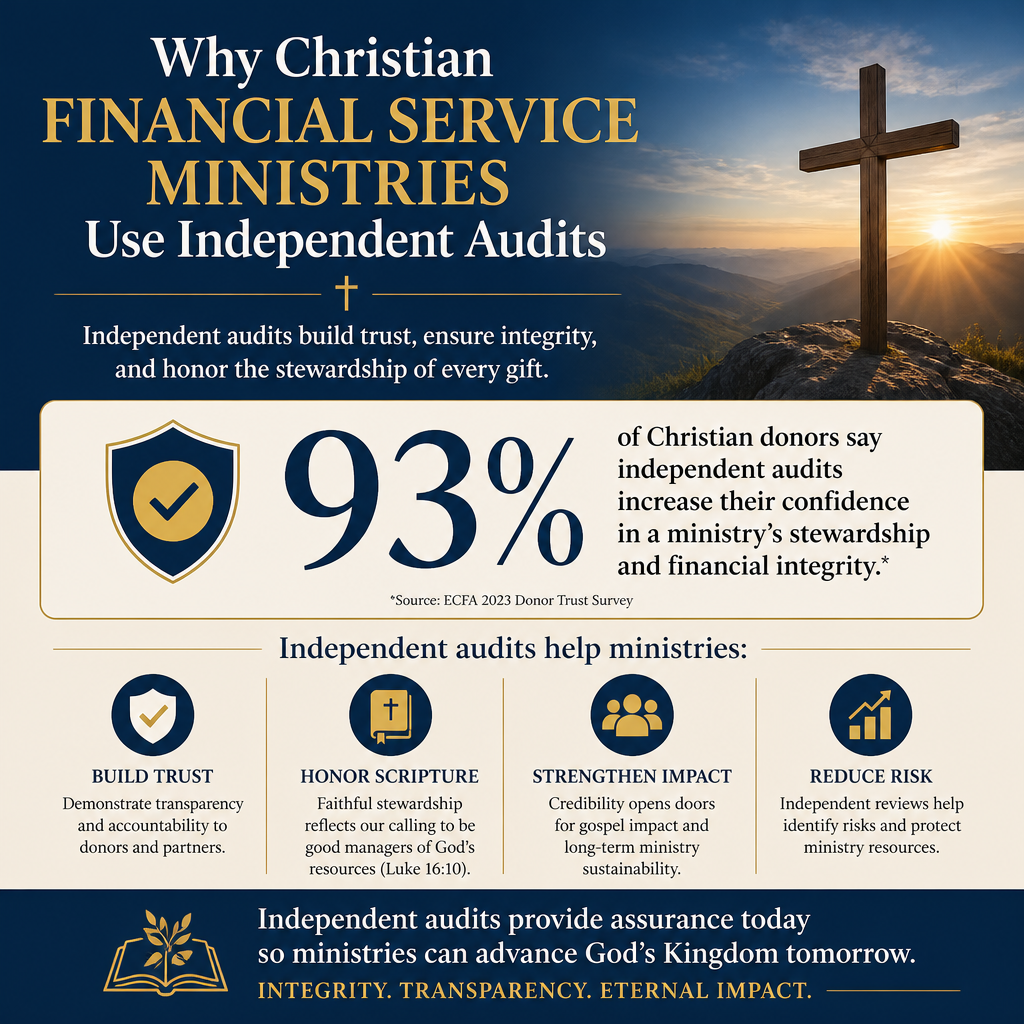
Independent audits provide structured testing in exactly these areas: how revenue is recognized, how cash is controlled, how funds are tracked, and whether liabilities and commitments are recorded appropriately. Donors should not apologize for asking whether those systems are in place, because Scripture does not treat carelessness with entrusted resources as a minor issue.
Donor confidence is shaped by transparency norms beyond the church
Many Christian donors give across a mixed landscape: local church, missions agencies, humanitarian organizations, schools, and Christian financial service ministries. They are also shaped, understandably, by broader nonprofit expectations around financial transparency and accountability. A common benchmark in U.S. philanthropy is the $750,000 annual federal expenditure threshold that triggers a Single Audit under the Uniform Guidance for organizations receiving federal awards eCFR. Not every ministry receives federal funds, and not every audit is a Single Audit. The larger point is that society recognizes a basic principle: when financial complexity and scale increase, independent review becomes more necessary, not less.
For ministries that want to remain above reproach, audits also help prevent a destructive cycle: questions arise, leadership becomes defensive, donors become anxious, giving declines, and the ministry’s internal pressure to present good news increases. Independent review interrupts that cycle by creating a routine expectation of scrutiny rather than a crisis-driven response.
How credible ministries treat the audit as a discipline, not a checkbox
They publish auditable information, not curated reassurance
Across our verification work at Most Trusted, we observe that ministries with strong financial integrity tend to treat the audit as the beginning of transparent communication, not the end. They make audited financial statements accessible, explain significant changes plainly, and distinguish between restricted and unrestricted funds in ways ordinary donors can understand without manipulating the narrative.
Wise donors often look for a pattern: not merely whether an audit exists, but whether leadership behaves as though the truth is welcome. When ministries minimize bad news, hide footnotes, or treat legitimate questions as disloyalty, they erode the trust they claim to protect.
They respond to findings with governance action
Auditors sometimes identify material weaknesses, significant deficiencies, or management letter comments related to internal controls. The presence of findings is not automatically disqualifying; in some cases, it reflects a ministry that has finally invited serious examination. The more important question is whether the board and executive leadership respond decisively.
Donors can reasonably ask for evidence of follow-through. In a mature organization, the audit committee or finance committee tracks remediation, sets deadlines, and requires clear documentation. This is one of the practical ways a board loves its neighbor: it reduces preventable harm and protects the ministry from avoidable scandal.
- Audited financial statements available without special request
- A named independent audit firm and a consistent audit cycle
- Clear explanation of restricted funds, reserves, and fee structures
- Board-level oversight of the audit process and findings
- Documented corrective actions when issues are identified
How audits relate to The Most Trusted Standard for donor confidence
Audits support financial integrity but they are not the full picture
Most Trusted evaluates ministries against The Most Trusted Standard, a 15-criteria framework that examines faith foundation, financial integrity, governance and leadership, and transparency and effectiveness. Independent audits fit naturally within financial integrity, but they also touch governance and transparency: who is accountable, what is disclosed, and how leadership demonstrates integrity under examination.
Donors sometimes ask whether audited financials can substitute for broader verification. They cannot. Audited statements tell a truth about financial reporting at a point in time; they do not evaluate theological coherence, board independence, executive accountability, or whether reported outcomes correspond to real impact. Mature discernment holds all of these together.
Healthy skepticism is compatible with Christian charity
Christians can fear that asking hard questions signals distrust. Yet Scripture repeatedly commends wise evaluation. Paul praises the Bereans because they examined what they were told (Acts 17:11). Financial discernment is not identical to doctrinal discernment, but the posture is similar: a willingness to test claims rather than absorb them uncritically.
This posture also resists a different temptation: reducing ministry faithfulness to a single financial ratio or overhead percentage. The broader nonprofit sector has argued persuasively that overhead alone is an inadequate measure of effectiveness, a point emphasized by the “Overhead Myth” letter signed by GuideStar, Charity Navigator, and BBB Wise Giving Alliance Candid GuideStar. Christian donors can affirm that insight while still insisting on audited reporting and strong controls. Depth of mission and strength of financial discipline should travel together.
Those who want a wider orientation to the field can start with Christian Financial Service Ministries, where we address the unique risks and responsibilities of ministries that handle financial services for the church.
FAQs for Why Christian financial service ministries use independent audits
Should we require an independent audit before giving to a Christian financial service ministry?
For larger ministries or any ministry handling complex financial services, we generally view an independent audit as a baseline expectation, not an optional enhancement. Smaller organizations may not yet be able to sustain the cost, but donors should then look for other strong forms of accountability: a qualified external review, transparent financial statements, and credible board oversight. The question is not perfection; it is whether the ministry has chosen verifiable discipline appropriate to its size and complexity.
If a ministry has audited financials, is it automatically trustworthy?
No. An audit increases confidence that financial statements are fairly presented, but it does not guarantee wise governance, ethical culture, or faithful use of funds. Donors should consider the audit alongside governance practices, transparency, conflict-of-interest controls, and the ministry’s willingness to answer substantive questions without defensiveness.
A credible audit culture strengthens both witness and stewardship
Christian financial service ministries use independent audits because ministries that handle the church’s resources must welcome scrutiny that matches their responsibility. Independent audits are a disciplined way to honor donors, protect beneficiaries, and demonstrate that leadership is willing to be examined rather than merely trusted. For donors seeking to give with confidence, the goal is not cynicism. It is careful stewardship shaped by truth.



