
Fraud prevention in Christian financial ministries is not a public-relations exercise; it is a test of stewardship before God and neighbor. When a ministry handles donor funds, loan payments, or benevolence distributions, the temptation to cut corners and the opportunity for misuse both increase, and Scripture treats that combination with sobriety.
The New Testament assumes that financial administration can either adorn the gospel or discredit it. Paul’s insistence on handling gifts “honorably… not only in the Lord’s sight but also in the sight of man” (2 Corinthians 8:21) sets a standard that is both spiritual and operational. Mature donors should expect ministries to build controls that make integrity normal rather than heroic.
Fraud thrives where spiritual language replaces verifiable controls
Why Christian contexts are not automatically safer
Christian donors often assume that shared belief reduces risk. It can, but it does not eliminate it. Spiritual authority can discourage questions, and relational trust can substitute for documentation. Those dynamics are not unique to Christian work, but they are intensified when donors feel that scrutiny signals cynicism.
Across our verification work at Most Trusted, we observe that the ministries most resilient to fraud are not those with the most emphatic mission language, but those that treat controls as an expression of discipleship. They expect humans to be human, including gifted leaders and faithful staff, and they design systems accordingly.
The harder problem is misuse that is not obviously criminal
Many failures are not a dramatic embezzlement. They are expense reimbursements that drift, conflicts of interest that are rationalized, restricted gifts that are “temporarily” redirected, or lending decisions made to protect relationships rather than honor underwriting standards. A donor’s concern is not merely whether a ministry can pass an audit, but whether it can sustain integrity when pressure rises.
This is one reason mature accountability conversations tend to move beyond overhead ratios. The widely cited “Overhead Myth” letter from GuideStar (now Candid), Charity Navigator, and the BBB Wise Giving Alliance argues that overhead alone is a poor measure of effectiveness and can incentivize underinvestment in systems that prevent waste and abuse Candid.

Segregation of duties and documented approvals are the first line of defense
Controls that make theft difficult
The most basic anti-fraud principle is simple: no single person should control an entire financial transaction from beginning to end. When the same individual can receive money, record it, reconcile the bank account, and approve disbursements, the ministry has created an opportunity structure for fraud.
Financial ministries that meet The Most Trusted Standard typically implement segregation of duties even when staffing is lean. That may require board involvement, outsourced bookkeeping, or rotating responsibilities, but the goal is consistent: reduce the number of places where “trust us” replaces “show us.”
What to look for in practice
Donors rarely need to interrogate a ministry’s internal controls line-by-line, but a mature donor can ask for evidence that core safeguards exist and are used. In well-governed organizations, these practices are not defensive; they are normal governance hygiene.
- Dual authorization for wire transfers and ACH payments
- Independent bank reconciliations reviewed and signed
- Documented expense and reimbursement policies with thresholds
- Timely deposit and recording controls for checks and online gifts
- Clear approval workflows for vendor selection and contracts
In donor-facing communication, ministries should be willing to describe these practices without disclosing sensitive details that would create new security risks. A refusal to discuss any controls at all, especially when paired with spiritualized language about “trust,” should prompt careful discernment.
Strong governance prevents conflicts of interest from becoming financial loss
Independent oversight is not optional
Fraud prevention in Christian financial ministries depends heavily on governance. A competent board that is independent of the chief executive is not antagonistic to leadership; it is a protective structure for the mission, the staff, and the donors. When boards function as friends of the founder rather than fiduciaries, conflicts of interest can become routine.
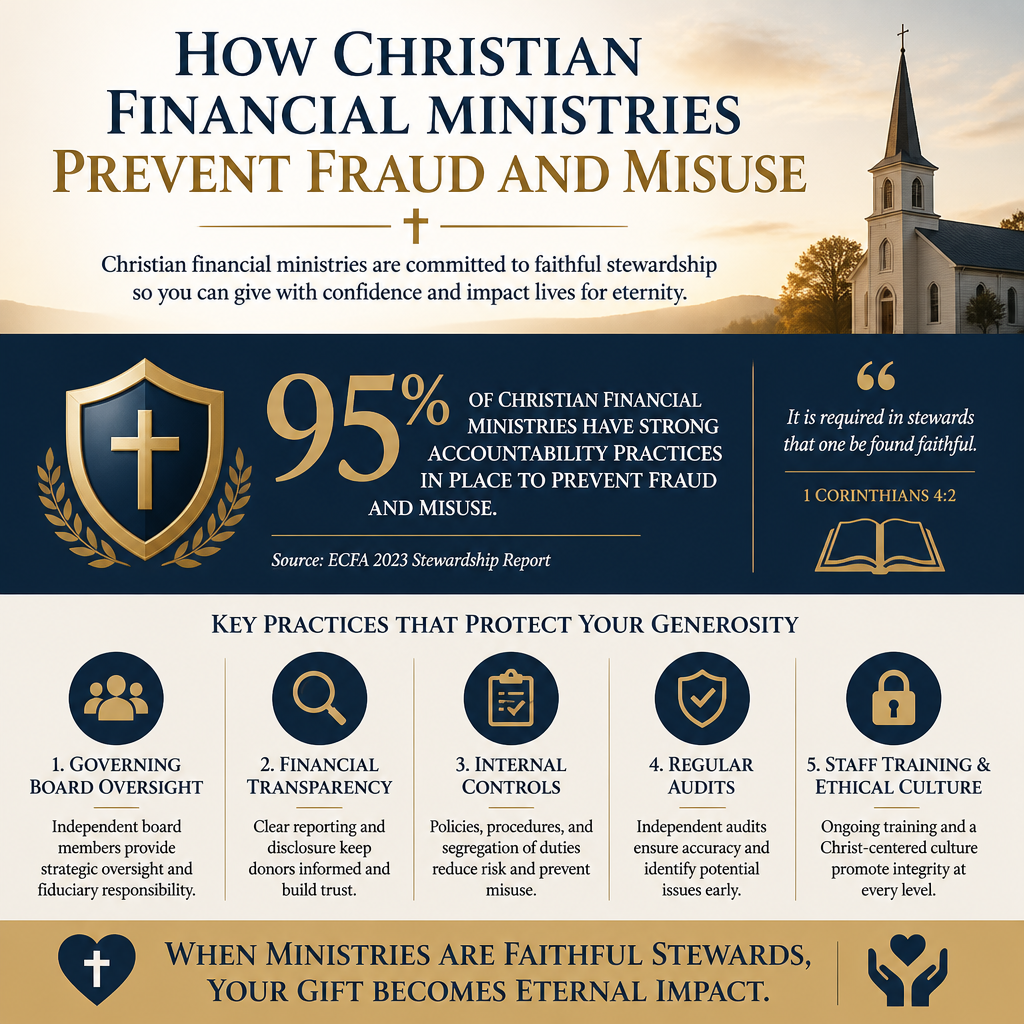
In our work, the healthiest boards understand that “above reproach” is not merely a personal qualification; it is an organizational posture. They ask for dashboards, read financial statements, and document decisions in minutes that demonstrate real oversight rather than ceremonial approval.
Conflict-of-interest policy and enforcement
A written conflict-of-interest policy matters, but enforcement is what keeps self-dealing from hiding in plain sight. Ministries should require annual disclosures from board and senior staff, and they should document how conflicts are managed: recusal from votes, competitive bidding, and fair-market validation when related-party transactions are unavoidable.
Christian donors sometimes worry that insisting on these practices implies suspicion. The better framing is that such safeguards honor the ministry’s witnesses in the community, protect employees from coercive expectations, and reduce the likelihood that future whistleblowers will be dismissed as disloyal.
For donors comparing ministry practices across a broader landscape of service models, we address governance expectations within Christian Financial Service Ministries as a category where fiduciary discipline is part of the ministry’s moral responsibility.
Audits, regulatory compliance, and complaint channels create external accountability
Independent audits and the limits of audits
An independent financial statement audit is one of the strongest signals that a ministry is willing to submit to outside scrutiny. Audits are not a guarantee that fraud cannot occur; they are designed to provide reasonable assurance that financial statements are free of material misstatement. But a consistent audit history, clean opinions, and evidence that management acts on findings substantially reduce donor risk.
When a ministry does not obtain an audit, it should be able to explain why in a way that is more than cost avoidance. Some smaller organizations use reviews or compilations instead, and donors should understand what those engagements do and do not test.
Financial ministries carry added regulatory expectations
Some Christian financial ministries handle lending, debt management, donor-advised structures, or other activities that trigger heightened legal and regulatory responsibilities. Donors should expect clear disclosure of how the ministry is structured, what entities are involved, and what consumer protections apply. Where a ministry interfaces with consumer finance, compliance failures can become both moral failures and material donor risks.
It is also prudent to ask whether the organization maintains a credible mechanism for complaints and whistleblowing, ideally with a pathway that does not run exclusively through the CEO. The Association of Certified Fraud Examiners has long reported that tips are the most common way occupational fraud is detected, outpacing audits and other methods Association of Certified Fraud Examiners.
Transparency to donors must be specific enough to test stewardship
Donor communication that withstands scrutiny
Christian donors are often told to “focus on impact,” but impact claims can be manipulated when financial reporting is vague. Meaningful transparency includes current financial statements, clear program descriptions, leadership compensation disclosures appropriate to the organization’s context, and policies that explain how restricted gifts are handled.
Donors can also evaluate whether a ministry’s disclosures match reality over time. Sudden shifts in reporting categories, recurring “one-time” crises, or persistent delays in releasing annual reports deserve attention. The goal is not to punish imperfect communication; it is to determine whether the ministry’s posture is candid and verifiable.
What The Most Trusted Standard is designed to clarify
Most Trusted exists because donors should not have to choose between naïve trust and corrosive suspicion. The Most Trusted Standard is a 15-criteria framework that examines faith commitments, financial integrity, governance, and public transparency in ways that are testable. It does not replace prayerful discernment, but it can strengthen it by grounding generosity in evidence rather than impressions.
For donors who want to go deeper on the specific expectations that distinguish healthy organizations from high-risk ones, our category work on Accountability and Transparency in Christian Financial Service Ministries frames what mature stewardship looks like in this space.
FAQs for How Christian financial ministries prevent fraud and misuse
Should donors require an audit before giving to a Christian financial ministry?
An audit is a strong safeguard, but the right expectation depends on size, complexity, and risk exposure. For ministries handling substantial volumes of funds, financial products, or multi-entity structures, an independent audit is often a baseline stewardship practice. For smaller ministries, donors can look for other credible forms of oversight, such as reviewed statements, independent board governance, and clear internal controls, while recognizing the limitations of lighter engagements.
What are the most common red flags that suggest a higher risk of misuse?
Patterns matter more than isolated imperfections. Common red flags include a founder-centric culture with little independent board oversight, refusal to share basic financial statements, unclear handling of restricted gifts, related-party transactions without disclosure, and inconsistent reporting year over year. Donors should also be cautious when spiritual authority is used to silence questions about money rather than to invite integrity.
Stewardship that can be examined is stewardship that can endure
Christian financial ministries serve the church best when their operations are built to withstand pressure, growth, and temptation. Donors should not be asked to suspend prudence in the name of faith. Giving that is both generous and discerning reflects the biblical conviction that money reveals allegiance, and that honorable administration protects the name of Christ in the public square.



