
How Christian financial service ministries ensure transparency is not a public-relations question. It is a discipleship question with financial consequences. When a ministry handles other people’s money—especially in products that resemble banking, lending, investing, or benevolence—opacity becomes both a spiritual hazard and a governance risk.
Christian donors are rarely asking for perfection. They are asking for candor: clear explanations of how funds move, who controls decisions, what is measured, and what is done when something fails. Scripture treats hiddenness around money as dangerous. “Whoever is dishonest in a very little is also dishonest in much” (Luke 16:10). Transparency is one of the ordinary, verifiable ways a ministry shows it intends to be faithful in “much.”
Transparency begins with definitional clarity about what the ministry is
Explain the product in plain language, then name the risks
Many Christian financial service ministries operate in categories that are unfamiliar to donors: debt relief services, microenterprise support, donor-advised giving platforms, financial coaching, Christian credit unions, investment vehicles aligned with biblical screens, or ministry-run “aid funds” that function like informal mutual assistance. Transparency starts by stating what the ministry actually does, what it does not do, and what risks a donor is indirectly underwriting.
Ministries that lead with mission language but cannot explain the underlying financial mechanics force supporters to trust vibes rather than evidence. Mature donors should expect clear definitions: whether a contribution is a tax-deductible gift, a fee for service, a deposit, a loan, or an investment. Each carries different donor rights, regulatory regimes, and conflict-of-interest risks.
Do not let spiritual language substitute for disclosure
Christians genuinely disagree about how much “market mechanism” belongs inside Christian ministry. Some donors welcome revenue-generating approaches if they expand access and reduce dependency; others worry that profit incentives distort mercy. What is not negotiable is disclosure. In 2 Corinthians 8:20–21, Paul describes taking pains to administer funds “honorably not only in the Lord’s sight but also in the sight of man.” That is not suspicion; it is accountability as an act of love.
For donors evaluating the broader landscape, we address the distinct models and risks within Christian Financial Service Ministries so supporters can ask the right first-order questions before they ever examine a line item.

Financial reporting is necessary, but not sufficient
Audits, tax forms, and the difference between compliance and clarity
Most donors know to look for an IRS Form 990 and an audited financial statement when an organization is large enough to justify one. Those documents matter. They show revenue sources, major expenses, related-party transactions, and governance disclosures. They also have limits. A 990 is a compliance document, not a donor-facing explanation of financial strategy.
Transparency in Christian financial service ministries requires both: compliance and interpretation. Donors should be able to see not only totals, but also the “why” behind the numbers: why reserves are held, why fee income exists, how defaults are treated, and how operational costs relate to real outcomes. The sector has broadly acknowledged that simplistic overhead ratios can mislead; the “Overhead Myth” letter signed by Charity Navigator, GuideStar, and BBB Wise Giving Alliance cautions donors against using overhead as the sole proxy for effectiveness (Charity Navigator).
What donors should look for in financial integrity disclosures
Across our verification work at Most Trusted, the ministries that meet The Most Trusted Standard tend to publish financial materials that a financially literate donor can interrogate. They make it possible to follow the money without having to guess.

- Audited financial statements or a clear explanation of why an audit is not yet appropriate for the ministry’s size
- Board-approved financial policies, especially around reserves, expense approvals, and related-party transactions
- Segment reporting when a ministry runs multiple lines of work with distinct economics
- Disclosure of fee structures when donors or beneficiaries pay for services
- Clear treatment of restricted gifts and designated funds
This is not bureaucracy for its own sake. It is a practical application of stewardship. The question is whether a donor can understand what they are supporting, and whether governance structures make misdirection harder.
Governance is where transparency becomes enforceable
Independent oversight and conflicts of interest
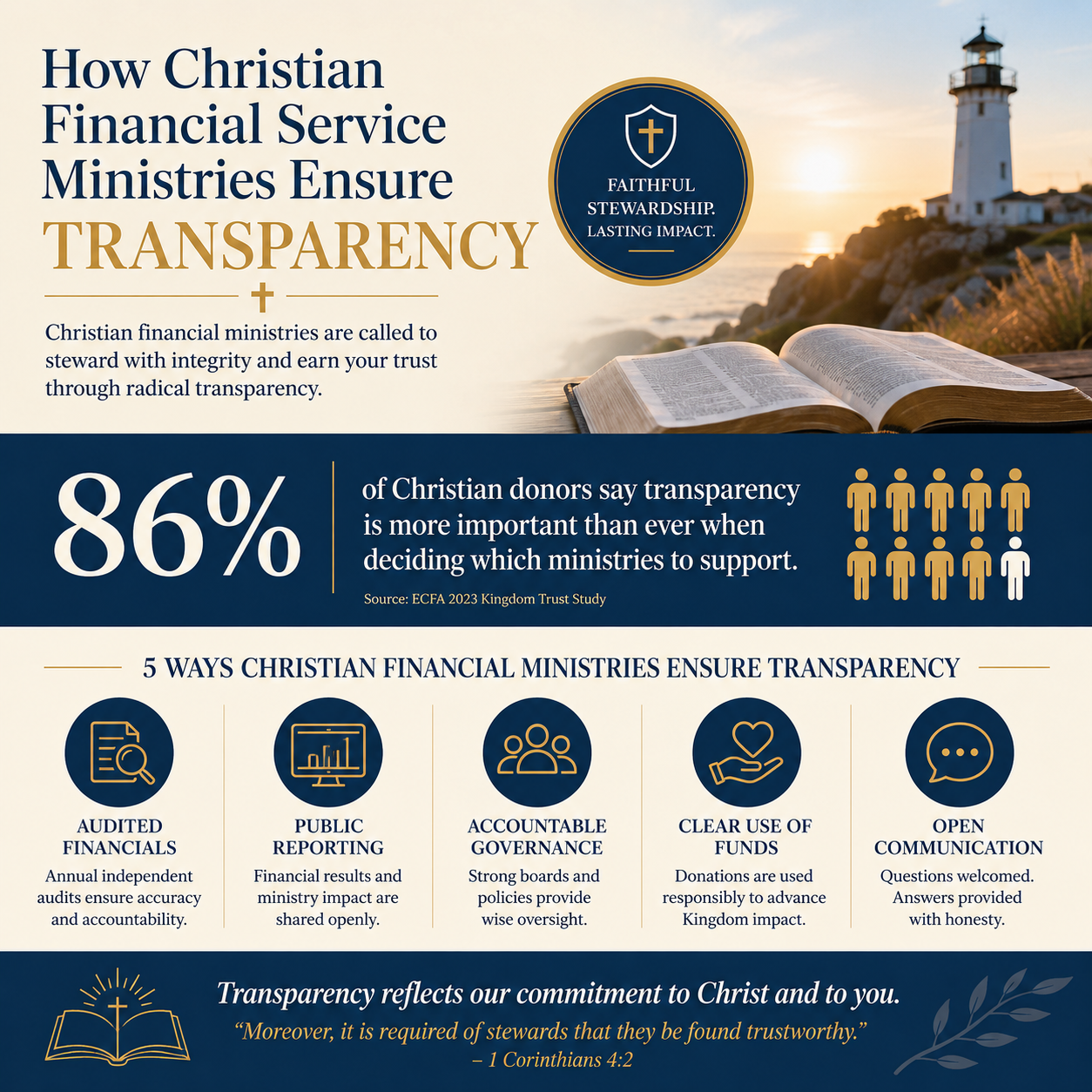
Transparency is fragile when it relies on the virtue of one founder or one charismatic leader. Boards exist so that accountability is not merely personal; it is institutional. Donors should look for a governing body with genuine independence, a documented process for evaluating executive performance, and clear conflict-of-interest policies that are more than boilerplate.
Christian financial service ministries are especially exposed to conflicts of interest because they may handle contracts with financial vendors, place funds with partner institutions, or compensate leaders who also speak or publish in ways that generate outside income. The transparent ministry does not pretend such conflicts never occur. It discloses related-party transactions, recusal practices, and the reasoning behind vendor selection.
Whistleblowers, incident response, and the courage to name failure
Donors often assume that transparency means “nothing has gone wrong.” In reality, the more meaningful test is whether a ministry can disclose what did go wrong and what changed as a result. A credible ministry has a whistleblower policy, a pathway for beneficiary complaints, and an incident-response plan for data breaches, fraud, or misallocation of funds.
The Christian tradition has words for this: confession, repentance, restitution, and repair. Not every operational failure is moral failure, but secrecy often turns a correctable mistake into an institutional wound. When transparency is governed—reviewed by a board committee, documented by policy, and executed consistently—it becomes resilient under pressure.
Program transparency requires outcome honesty, not marketing polish
Inputs, outputs, outcomes, and what is fair to claim
Financial service ministries can be tempted to tell impact stories that read like moral fables: one family is rescued; one entrepreneur flourishes; one community is transformed. Narratives have a place. But donors should also expect measurable definitions of success and restraint about causality.
Good reporting distinguishes inputs (money deployed), outputs (services delivered), and outcomes (changes in financial stability, debt reduction, savings behavior, employment, or resilience). Not every ministry can conduct randomized trials, and Christians should not treat complex human formation as a lab experiment. Still, transparent organizations avoid claims they cannot substantiate and acknowledge the limits of their data.
Protect dignity while publishing meaningful information
Some opacity is necessary. Ministries working with debt, poverty, immigration status, incarceration, or domestic crisis must protect confidentiality. Transparency is not the same as exposure. Donors should look for ministries that articulate how they protect client data, how they secure financial records, and how they anonymize case studies.
What this means in practice is that donor-facing reporting should disclose methodology without disclosing identities: what criteria qualify a household for assistance, what safeguards prevent favoritism, and how decisions are documented. The goal is to protect the vulnerable while still honoring donors with the truth.
Verification is strongest when it is independent and repeatable
Why third-party validation matters for donor confidence
A ministry can publish attractive reports and still hide material risks. Independent verification does not remove the need for trust, but it makes trust more informed. When donors rely solely on self-reported claims, they are placed in the position of either cynicism or naïveté. Neither posture serves the church well.
At Most Trusted, we evaluate Christian nonprofits against The Most Trusted Standard, a 15-criteria framework spanning faith foundation, financial integrity, governance and leadership, and transparency and effectiveness. The aim is not to create an elite class of ministries, but to clarify whether a donor can see and test what is claimed. Independent verification also helps ministries strengthen weak points before they become crises.
The practical questions mature donors should ask
The hardest question is not whether a ministry can answer a donor’s email. It is whether the ministry has built systems that make transparent answers normal. Donors should ask:
Does the ministry publish audited financials or a credible alternative? Does it explain reserves, fees, and risk? Is the board independent, engaged, and willing to discipline leadership? Are outcomes defined with restraint and measured with integrity? Are privacy and dignity protected without using confidentiality as a shield?
For donors focusing specifically on how ministries communicate and substantiate claims, our broader analysis within Accountability and Transparency in Christian Financial Service Ministries addresses recurring patterns that distinguish honest reporting from institutional storytelling.
FAQs for How Christian financial service ministries ensure transparency
What documents should Christian donors expect from a financial service ministry?
At minimum, donors should expect an IRS Form 990 when applicable, a current annual report, and clear explanations of how funds are received and used. For larger ministries, audited financial statements are a meaningful baseline. Donors should also look for board and conflict-of-interest disclosures, fee schedules when services are paid, and privacy policies that address sensitive financial data.
Is a low overhead ratio a reliable sign that a ministry is trustworthy?
No. Overhead can be manipulated, and underinvestment in finance, compliance, data security, and evaluation can increase risk. The more reliable question is whether administrative spending is appropriate to the ministry’s complexity and whether reporting is candid. The sector-wide “Overhead Myth” statement from Charity Navigator, GuideStar, and BBB Wise Giving Alliance explains why overhead alone is a poor proxy for impact (Charity Navigator).
Transparency is stewardship made visible
Christian donors are not buying a product; they are entrusting resources to the work of God in the world. That entrustment deserves more than inspiring language. It deserves transparent systems that honor the truth, protect the vulnerable, and constrain the temptations that accompany money. When Christian financial service ministries treat transparency as a moral obligation rather than a marketing tactic, they serve both their beneficiaries and the church with integrity.



