
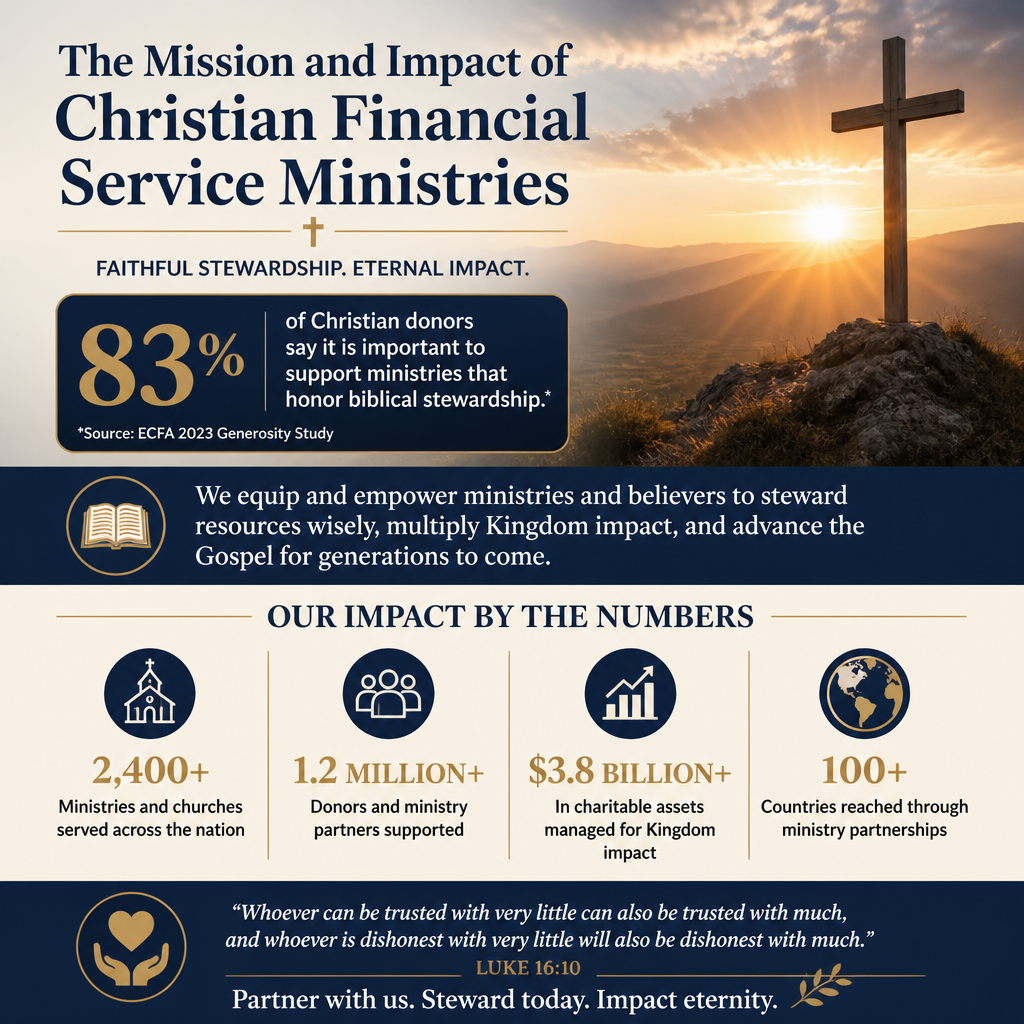
The mission and impact of Christian financial service ministries sit at an uneasy intersection of discipleship and practical necessity. Money is not a side theme in Scripture; it is a recurring test of trust, allegiance, and love of neighbor. Donors sense that tension. We want ministries that are biblically faithful, technically competent, and demonstrably effective without reducing the Christian life to a set of financial outcomes.
These ministries exist because financial distress is both a spiritual and material burden. Debt can trap families in anxiety and secrecy. Predatory lending can exploit the vulnerable. A lack of basic budgeting skill can compound generational instability. Yet Christians genuinely disagree about how much a ministry should emphasize behavior change, structural reform, emergency relief, or market participation. A serious donor approach begins by naming those disagreements and then asking which ministries show evidence of wisdom, accountability, and fruit consistent with the gospel.
Why these ministries exist and what they are actually trying to change
Christian financial service ministries typically aim at more than solvency. They pursue freedom from bondage, formation in stewardship, and the restoration of economic agency so households can provide for dependents and practice generosity. That mission draws from Scripture’s consistent teaching that wealth is spiritually dangerous and morally consequential, and that God’s people are responsible for honest work, just dealings, and care for the poor.
The best ministries also recognize that financial hardship is not morally uniform. Some financial crises are driven by choices that require repentance and new habits. Others are driven by illness, job loss, disability, exploitation, or long-term community disinvestment. Donors should be wary of ministries that flatten this complexity into either blame (“if you were faithful, you would prosper”) or sentimentality (“no responsibility is required”).
Common ministry models donors will encounter
Across our verification work, we see several models that recur:
- Stewardship education and coaching (church-based or para-church): budgeting, debt reduction plans, savings habits, and long-term financial planning.
- Debt relief and credit counseling: negotiated debt management, creditor advocacy, or structured relief paired with training.
- Microenterprise and job readiness: training, mentoring, and sometimes capital access for small business development.
- Emergency assistance with guardrails: rent, utilities, food, and transportation support designed to prevent crisis spirals while avoiding long-term dependency.
- Community development finance: loans or investments that strengthen housing, small businesses, or neighborhood institutions.
Each model carries trade-offs. Coaching models can reach many but may struggle to serve households whose primary challenge is income insufficiency. Relief models can stabilize families quickly but can drift into indefinite subsidization without a clear theory of change. Capital-based approaches can build durable assets but require underwriting discipline and may not serve the most fragile households without blended support.
What distinguishes Christian work from generic financial programming
Christian distinctiveness is not branding, nor is it merely quoting a verse over a budgeting worksheet. The deeper question is whether the ministry’s anthropology is biblical: human beings as image-bearers, not consumers; sin as real, not only structural; grace as formative, not permissive; and generosity as a fruit of discipleship, not a fundraising tactic. Christian financial service ministries should be able to explain how their work relates to worship, integrity, justice, and love of neighbor, and then show how that theology shapes actual program decisions.

How to evaluate impact without reducing it to a spreadsheet
Donors are right to ask for measurable outcomes, especially where finances are involved. At the same time, mature evaluation does not mistake what is countable for what is most important. Christian financial service ministries often pursue changes that take time: habits, family stability, restored trust between spouses, and the capacity to give. The question is not whether outcomes are reported, but whether the outcomes match the mission and whether the measurements are credible.
Outcome measures that tend to be meaningful
Verifiable evidence suggests that many financial outcomes are best interpreted as trajectories rather than immediate wins. Donors should look for indicators such as:
- Debt reduction or delinquency stabilization in a way that does not conceal harm (for example, moving debt from visible to invisible forms).
- Emergency savings formation and the ability to absorb shocks without cascading defaults.
- Income stability through job placement retention or improved hours and wage progression.
- Housing stability where emergency assistance prevents eviction and connects households to longer-term supports.
- Persistence (completion rates, coaching adherence, or sustained participation) reported honestly, not inflated.
When ministries report outcomes, the most credible ones define the baseline, specify the time horizon, and explain who was included and excluded. They resist selective reporting that highlights only the most successful participants.
Why donors should be cautious about simplistic metrics
Financial improvement can be genuine and still be achieved in ways that undermine discipleship or neighbor-love. A ministry can raise credit scores while normalizing consumerism. It can push aggressive debt payoff plans that ignore medical realities or caregiving burdens. It can emphasize “wealth-building” language that quietly echoes prosperity assumptions. Christians genuinely disagree about the use of certain tools—credit products, investment strategies, or debt instruments—and donors should not assume that technical sophistication implies spiritual wisdom.
There is also a known nonprofit evaluation tension: overhead ratios are often treated as a proxy for virtue, even though that logic has been publicly challenged by sector leaders. The joint “Overhead Myth” statement from Charity Navigator, GuideStar, and BBB Wise Giving Alliance explains why overhead alone is a poor measure of nonprofit performance and can create perverse incentives to underinvest in systems and evaluation (Charity Navigator). For donors, the implication is straightforward: ask whether the ministry’s spending supports effective, accountable service, not whether it can win a low-overhead contest.
What biblical faithfulness should look like in financial ministry practice
Christian financial service ministries often speak about stewardship, generosity, and freedom. Donors should ask how those words are defined. Scripture’s warnings about wealth are severe; its call to care for the poor is consistent; its demand for honest scales and just dealings is explicit. A biblically faithful ministry will not merely help individuals succeed within a system; it will also attend to the moral shape of financial life—truth-telling, justice, and neighbor-love.
Stewardship and generosity without manipulation
Because these ministries work in a domain of shame, fear, and secrecy, their posture matters. Some messaging produces short-term compliance and long-term disillusionment. Donors should listen for a tone that is both candid and compassionate: sin named without contempt, responsibility taught without moralism, grace offered without excusing deception. When a ministry asks participants to give, it should do so carefully, not as a performance measure or a fundraising pipeline, but as a dimension of formation. The widow’s mite is not a tactic; it is a rebuke to systems that devour widows’ houses.
Justice concerns donors should not ignore
Financial ministry is never only personal. Communities face predatory lending, wage theft, discriminatory housing practices, and the compounding effects of under-resourced schools and health disparities. A ministry does not need to become a policy shop to take justice seriously, but it should be able to describe how it avoids reinforcing exploitation. The ministries that meet The Most Trusted Standard tend to show clear ethical boundaries in partnerships and products, especially when financial services intersect with fees, interest, or referral relationships.
Protecting the vulnerable from spiritual and financial harm
Because money is a common site of spiritual abuse, donors should ask how a ministry guards against coercion and false promises. A Christian ministry should never imply that donations, participation, or “seed faith” purchases guarantee material return. Claims that obedience reliably produces wealth are not biblical discipleship; they are a distortion that turns God into a mechanism. A biblically faithful ministry will emphasize wisdom, diligence, and generosity while acknowledging that suffering and economic loss remain part of a fallen world and are not always traceable to individual moral failure.
What transparent reporting and accountable leadership require
The mission and impact of Christian financial service ministries become credible when transparency and governance are treated as spiritual responsibilities, not compliance chores. Financial work is high-trust work. Donors should expect ministries to show their work: what they do, who they serve, what they achieve, what they spend, and where they fall short.
What strong impact reporting tends to include
Most ministries now publish annual reports, but quality varies widely. Strong reporting usually includes:
- Clear program descriptions that distinguish education, relief, counseling, lending, and advocacy rather than blending them together.
- Outcome definitions with time horizons and denominators (how many participants began, completed, and were measured later).
- Risk acknowledgments such as relapse rates, incomplete coaching cycles, or the limitations of self-reported data.
- Audited financial statements and a coherent explanation of major revenue sources and restrictions.
Where ministries serve vulnerable clients, donors should also look for evidence of privacy protection, appropriate data handling, and trauma-informed practices that avoid shaming participants.
Why governance signals matter more in financial ministries
Programs that touch money—debt management, lending, fee-based services, or referral networks—create conflicts of interest that can quietly compromise integrity. Donors should ask basic but consequential questions: Who sets executive compensation, and how is it documented? Does the board have independent members with financial oversight competence? Are related-party transactions disclosed? Are fees and interest rates disclosed plainly and compared with market alternatives when relevant?
Most Trusted exists to help donors assess these questions with consistency. We evaluate ministries against The Most Trusted Standard, a 15-criteria framework spanning faith commitments, financial integrity, governance practices, and transparency in reporting. Donors who want to broaden their understanding of the broader landscape can start with Christian Financial Service Ministries, where we situate this category within the wider ecology of Christian work and donor responsibility.
Giving that strengthens real freedom
Christian donors are not merely funding a set of services; we are endorsing a moral vision of money, neighbor-love, and responsibility. The most credible Christian financial service ministries hold together what is often separated: compassion and candor, formation and skill, relief and accountability, measurable outcomes and long obedience. The task for donors is to reward that integrity—supporting ministries that can articulate a biblical mission, demonstrate prudent leadership, and report impact with humility and clarity.



