

Accountability and transparency in Christian financial service ministries are not administrative preferences; they are moral questions. Donors are not merely purchasing outcomes. We are entrusting resources that belong to the Lord, asking ministries to steward them in ways that can be tested, explained, and corrected when necessary.
That need has sharpened in recent years as Christian generosity has been shaped by online giving, donor-advised funds, and rapid-response campaigns. The speed can be a mercy in crisis, but it also increases the risk of confusion, overclaiming, and weak controls. Mature donors have learned to ask not only whether a ministry’s work is moving, but whether it is verifiable.
Why transparency is a theological obligation, not a marketing posture
Scripture treats money as spiritually diagnostic because it exposes what we love and what we trust. The New Testament does not assume that good intentions protect communities from misuse. Paul took up a collection for Jerusalem and then insisted on careful handling: “We want to avoid any criticism of the way we administer this liberal gift… for we are taking pains to do what is right” (2 Corinthians 8:20–21). The point is not suspicion as a lifestyle; it is credibility as a form of love.
Christian financial service ministries often operate where trust is already thin: debt, job loss, medical bills, housing instability, predatory lending, or the shame that keeps people from asking for help. The harder question is what transparency looks like when the ministry must protect confidentiality, negotiate with creditors, or address crises that unfold faster than annual reports. A ministry can be both discreet and accountable, but it cannot be neither.
Transparency should answer a donor’s concrete questions
Donors deserve clarity on what a ministry is and what it is not. Does it provide direct financial assistance? Does it offer coaching, education, or budgeting tools? Does it negotiate with lenders or counsel families through bankruptcy decisions? Each model has distinct risks and should be described plainly enough that a donor can understand what the ministry is promising and what it is actually able to deliver.
In practice, credible transparency is specific: the ministry’s revenue streams, major expense categories, fundraising costs, and reserve approach are described without euphemism. When a ministry uses restricted gifts, it should define what “restricted” means in its context and how restrictions are tracked. When the work involves financial products or fee-based services, the fee structure should be intelligible and consistently disclosed.
Some transparency must be structural, not narrative
Stories can illustrate mission, but they cannot replace evidence. Structural transparency includes audited financial statements when appropriate, a publicly accessible Form 990 for U.S. nonprofits, and governance disclosures that show who holds authority. For many donors, the Form 990 is the most practical starting point because it is standardized and comparable across organizations; it is available through the IRS Tax Exempt Organization Search at irs.gov.
That said, sophisticated donors also recognize the limits: the 990 is historical, often lagging by a year or more, and it cannot prove that today’s controls are functioning. Transparency, rightly understood, is a posture of being able to be examined, not merely a set of documents posted online.

What verifiable financial integrity looks like in practice
Financial transparency is frequently reduced to a single ratio, as though a donor can read moral integrity directly off a pie chart. The nonprofit field has rejected that simplification for good reason. Charity Navigator, Candid (GuideStar), and the BBB Wise Giving Alliance publicly argued against using overhead ratios as a proxy for effectiveness in what is commonly called the “Overhead Myth,” warning that it “can do more harm than good” by pressuring organizations to underinvest in capacity and controls charitynavigator.org.
For Christian financial service ministries, the better question is whether the financial system is designed to prevent foreseeable failure. Ministries handle donations, sometimes disburse funds to third parties, and often work with vulnerable clients whose needs can generate high emotional pressure on staff. A credible ministry assumes pressure and builds controls accordingly.

Independent audits and reviews should match the ministry’s risk profile
An independent audit is not a sacrament, but it is a meaningful accountability mechanism when it is done by a qualified firm and coupled with an active board. Some smaller ministries may pursue a financial review or compilation rather than a full audit, especially when revenue is modest. The principle is proportionality: the higher the volume of funds, the more complex the operations, and the more vulnerable the beneficiaries, the more the ministry should submit to external scrutiny.
Donors should look for a clear statement of what was performed (audit versus review), what period was covered, and whether any material weaknesses were identified. If findings exist, the ministry should be able to describe remediation steps in concrete terms rather than assurances.
Controls should be visible where misuse typically happens
Fraud and misuse rarely appear first in a line-item labeled “fraud.” They appear in ordinary processes: who can approve disbursements, who can change vendor information, who reconciles bank accounts, and who can override restrictions. Ministries that meet rigorous standards typically implement segregation of duties, formal expense policies, dual approvals for payments above set thresholds, and documented reconciliation procedures.
In financial service contexts, another pressure point is conflict of interest. If a ministry offers fee-based services, sells educational products, or partners with financial providers, donors should be able to see whether leadership receives commissions or referral fees. A ministry can engage partners ethically, but it must disclose relationships and govern them in ways that protect clients and donors from self-dealing.
Restricted giving must be tracked with discipline
Christian donors often give with specific intent: relief for families in crisis, scholarships for financial coaching, emergency rent assistance, or support for a defined region. A responsible ministry respects donor intent as a matter of truthfulness, not merely donor relations. That respect requires systems for tracking restrictions, documenting approvals, and reporting back in ways that can be reconciled to financial statements.
When needs change and restrictions become impractical, integrity is shown by how the ministry responds. The right path is not quiet repurposing; it is clear communication and, where necessary, donor consent consistent with legal and ethical obligations.
Governance that can correct course when leadership cannot
Transparency is sustained by governance, not by charisma. Christian ministries sometimes drift into an implicit theology of exceptionalism: because the mission is sacred, ordinary safeguards are treated as optional. Scripture does not permit that confusion. The New Testament’s qualifications for elders include being “not a lover of money” and being “above reproach” (1 Timothy 3:3, 7). Those are governance categories as much as they are personal virtues.
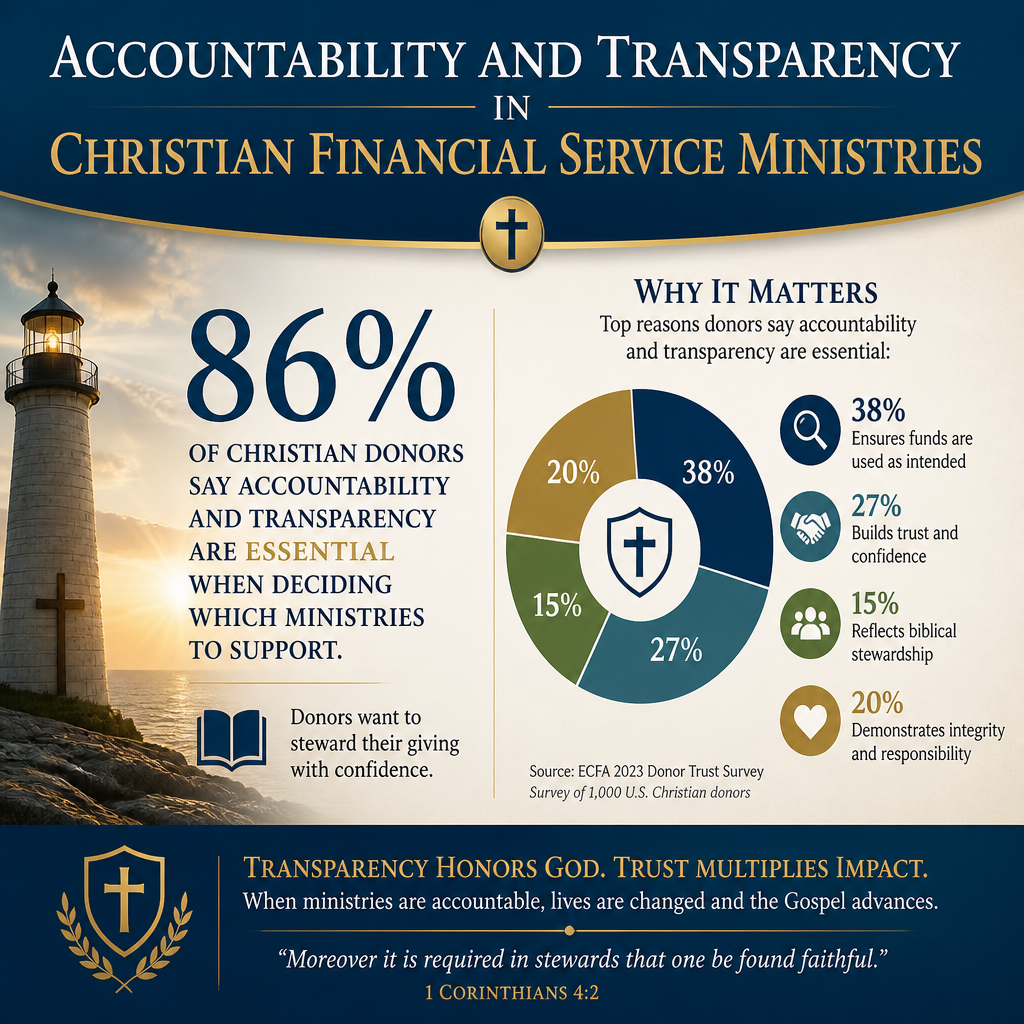
Donors should care about governance because it is the system that remains when founders retire, when a crisis hits, or when a strategic bet fails. A board’s job is not to applaud; it is to oversee, question, and, when necessary, restrain.
Board independence and competence are not luxuries
A board stacked with insiders, family members, or paid staff is typically a predictable weakness. Independence does not mean hostility; it means there are leaders in the room who can ask hard questions without fear of employment consequences or relational pressure. For financial service ministries, competence also matters: boards should include members who understand budgeting, risk, compliance, and program evaluation.
For donors, practical signals include a published board list, clear identification of officers, term limits or rotation practices, and evidence that the board meets regularly with documented minutes. If a ministry does not publish these basics, it may still be operating faithfully, but it is asking donors to trust what cannot easily be tested.
Policies are meaningful only if they are enforced
Many ministries can produce a conflict-of-interest policy, whistleblower policy, and document retention policy. The more revealing question is whether the organization has a culture and process that makes those policies real: annual conflict-of-interest disclosures, a reporting channel that does not route complaints back to the subject of the complaint, and evidence that issues are investigated with appropriate confidentiality.
Donors should not assume that a single internal report proves wrongdoing or that a lack of reports proves health. Healthy organizations can surface more concerns precisely because people believe reporting will be handled fairly.
Executive compensation should be explained in a way that honors both fairness and restraint
Christians genuinely disagree about what constitutes appropriate compensation for nonprofit executives, especially in high-cost regions or specialized financial work. The goal is not simplistic austerity; it is reasonableness supported by process. Ministries often document compensation decisions using comparability data and board approval procedures, as reflected in nonprofit governance best practices and IRS expectations around “reasonable compensation” irs.gov.
For donors, the key is whether compensation is set by disinterested board members, supported by data, and disclosed consistently. When compensation becomes opaque or personally negotiated without oversight, the risk is not merely financial; it is reputational and spiritual.
Donor questions that separate clarity from reassurance
Accountability and transparency ultimately serve relationship: donors, ministries, and beneficiaries aligned under truth. The aim is not to interrogate ministries into paralysis. It is to give in a way that is worthy of the gospel we profess—free from manipulation, grounded in reality, and resilient under scrutiny.
Questions donors should ask before giving
- What, exactly, does this ministry do? Ask for a plain description of services and the typical pathway for a client. If the answer is primarily inspirational, the operating model may not be clear even internally.
- How are funds safeguarded? Ask who approves disbursements, who reconciles accounts, and how the ministry handles restricted gifts.
- What external verification exists? Ask whether financial statements are audited or reviewed, and whether the ministry can share the latest report or a summary of findings and remediation.
- How does the board exercise oversight? Ask how often the board meets, whether it has an audit/finance committee, and how conflicts of interest are handled.
- How does the ministry measure outcomes without exaggeration? For financial coaching or debt relief, ask what outcomes are tracked, over what time horizon, and what limitations the ministry acknowledges.
Questions that matter after you have given
- Did the ministry report back in a way that can be reconciled to finances? Narrative updates are valuable, but donors should also look for numbers that connect to spending and program activity.
- Did the ministry correct errors publicly and promptly? No organization is error-free. The presence of correction is often a stronger indicator of maturity than the absence of disclosed problems.
Where Most Trusted fits for donors seeking verified confidence
Most Trusted exists because faithful donors often face a disproportionate research burden. Across our verification work, we find that ministries meeting The Most Trusted Standard tend to present fewer surprises over time: their disclosures are consistent, their governance is real, and their financial reporting can withstand informed questions. The Standard is a 15-criteria framework across Faith Foundation, Financial Integrity, Governance and Leadership, and Transparency and Effectiveness, designed to help donors distinguish between reassuring claims and verifiable practices.
Donors evaluating accountability and transparency in this category often benefit from reading the broader context for Christian Financial Service Ministries, since financial ministries vary widely in their operating models, regulatory exposure, and beneficiary safeguards.
Accountability that protects ministry, donor, and neighbor
Christian financial service ministries occupy a space where money, vulnerability, and moral credibility converge. Transparency is not a substitute for faithfulness, but it is one of the ways faithfulness is made legible in public. Donors should expect ministries to show their work: to disclose honestly, govern soberly, and handle funds as though every dollar will be examined—because one day it will.



