

What IRS rules apply to donor-advised funds is not a technical question reserved for accountants; it is a stewardship question with moral weight. A donor-advised fund can help a Christian household give with order and intention, but the IRS framework draws bright lines around what counts as a charitable gift, what control a donor may retain, and what benefits may not flow back to the donor.
Most donor confusion starts in a predictable place: a DAF feels personal because the donor names it, funds it, and recommends grants from it. Yet under federal tax law, the DAF is a component fund of a public charity, and the sponsoring organization is the legal steward of the assets. Understanding that distinction is the key to giving confidently without drifting into avoidable compliance risk.
Donor-advised funds exist under a specific IRS legal definition
The three-part definition that governs everything else
DAFs are defined in the Internal Revenue Code, and the definition matters because it triggers the set of restrictions and excise-tax rules discussed below. In general, a donor-advised fund is a fund or account that is separately identified by reference to contributions of a donor (or donors), is owned and controlled by a sponsoring organization, and with respect to which a donor (or donor advisor) has advisory privileges regarding distributions or investments. The statutory definition is found in Internal Revenue Code section 4966(d)(2). See Cornell Law School Legal Information Institute.
Two implications follow. First, the sponsoring organization must be a public charity (not a private foundation) and must have legal control over the fund. Second, the donor’s role is advisory, even when the sponsor follows recommendations as a matter of practice. When donors treat a DAF as if it were a personal checking account with a charitable label, problems usually follow.
What the donor receives and what the donor relinquishes
When a donor contributes to a DAF, the donor is making an irrevocable charitable contribution to the sponsoring organization. The donor generally receives a contemporaneous written acknowledgment from the sponsor for tax substantiation, and the donor may claim a charitable deduction if all other requirements are met. But the donor also relinquishes legal ownership and cannot “take back” the funds or redirect them to noncharitable uses.
This is a place where spiritual formation and legal form align. Christian giving is not merely a strategy for tax efficiency; it is an act of worship and trust. The DAF structure can reinforce that posture by formalizing the donor’s surrender of control while still allowing thoughtful recommendations over time.

The IRS cares deeply about benefits that flow back to donors
DAF grants cannot provide more than incidental benefits
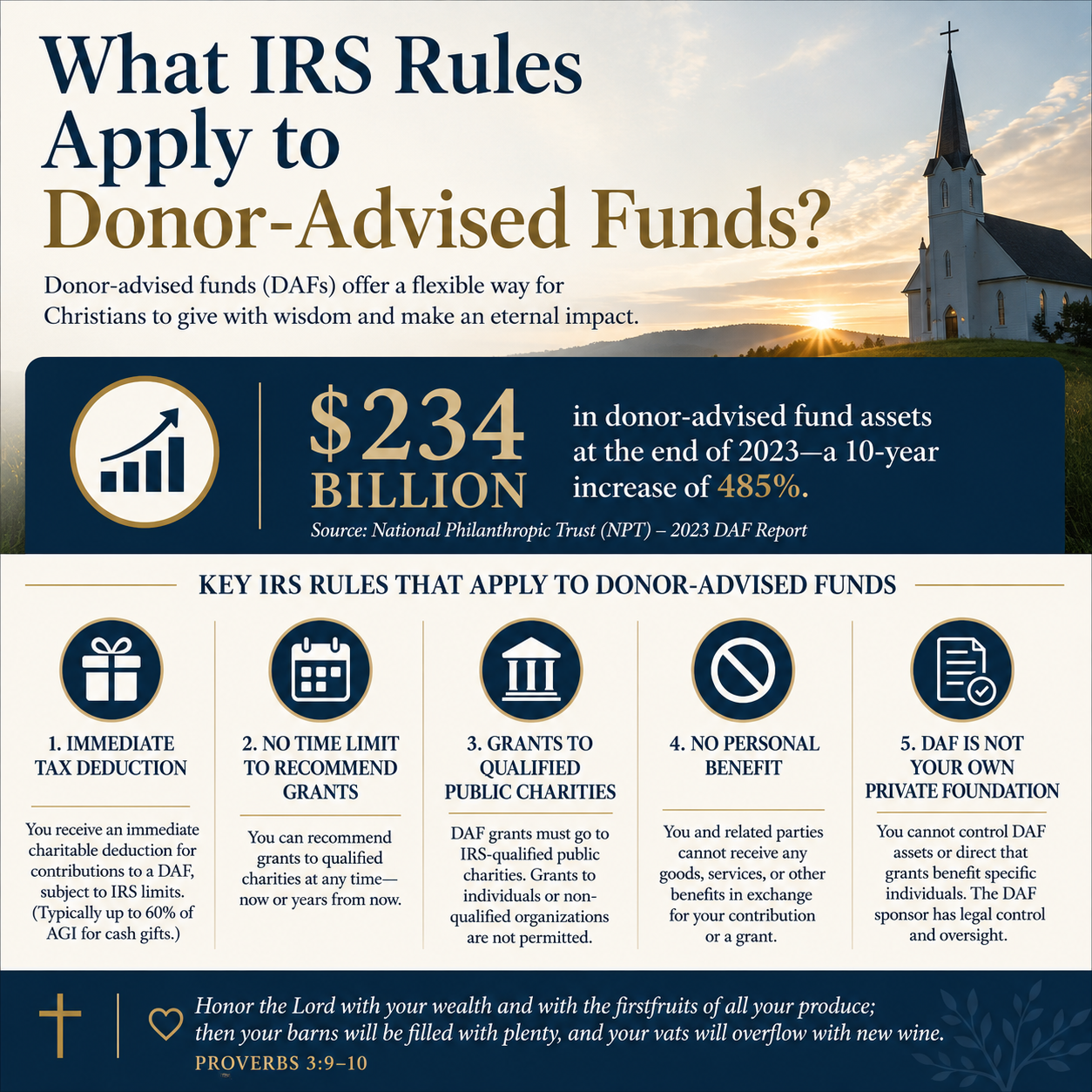
A central IRS concern is whether a DAF grant delivers impermissible benefits to a donor, donor-advisor, or related person. The Code uses the term “prohibited benefit” and backs it with excise taxes. These rules are complex, but the practical principle is straightforward: a DAF grant must be purely charitable, not a way to pay a personal obligation or obtain goods, services, or privileges in return.
Congress strengthened the DAF excise-tax framework in the Pension Protection Act of 2006, which is the major modern inflection point for DAF regulation. The legislative package is summarized by the Internal Revenue Service at IRS Charities and Nonprofits.
Common Christian giving scenarios where donors can misstep
Many Christians give through churches, schools, and ministry events where donor recognition and participation are culturally normal. A DAF does not automatically make those patterns unlawful, but it does require donors to separate personal benefit from charitable intent with greater care.
- Pledges: using a DAF to satisfy a legally binding personal pledge can create problems because it resembles paying a personal obligation rather than making a charitable gift.
- Tickets and tables: DAF grants should not be used to purchase gala tickets, golf entries, or other event benefits.
- Membership benefits: DAF grants should not be used where the donor receives membership perks in return.
- Tuition and tuition-like payments: DAF grants cannot be used to pay a child’s tuition or secure admission benefits.
- Mission trips: DAF grants generally cannot pay the donor’s own trip costs or those of family members.
These are not merely technical constraints. They protect the integrity of the charitable deduction by ensuring that tax-favored dollars are directed to public benefit rather than private advantage.
Excise taxes and penalties are designed to enforce the boundary
Tax law targets both donors and sponsoring organizations
The DAF rules include excise taxes that can apply to donors, donor-advisors, related persons, and the sponsoring organization, depending on the violation. For example, prohibited benefits connected to a DAF can trigger excise taxes under section 4967, and certain taxable distributions can trigger excise taxes under section 4966. The statutory framework is accessible through the U.S. Code at U.S. House Office of the Law Revision Counsel.
What this means in practice is that compliance is not only a donor’s problem. Well-governed sponsors build internal controls to prevent grants that create benefits to donors, pay personal obligations, or fail the basic charitable tests. Donors should welcome those controls as part of prudent stewardship, not treat them as obstruction.
Taxable distributions and the need for eligible recipients
DAF grants generally must be made to organizations eligible to receive tax-deductible charitable contributions—typically 501(c)(3) public charities in good standing. Grants to individuals are generally prohibited in the DAF context, and grants to noncharitable entities are likely to be treated as taxable distributions.
This is one reason sophisticated donors keep a working understanding of charity eligibility rather than relying on brand familiarity. For Christian donors, the question is often not whether a ministry is well-known, but whether it is properly organized, governed, and transparent enough to receive and steward charitable funds faithfully. That discernment is one place our work at Most Trusted often intersects with DAF decision-making.
DAF sponsors have discretion, and donors should expect due diligence
Advisory privileges are real, but they are not control
DAF sponsors typically honor donor recommendations, but they must retain variance power and final discretion to satisfy the legal requirement that the sponsor owns and controls the fund. Donors sometimes experience this as friction when a sponsor declines a recommended grant due to eligibility concerns, benefit concerns, or reputational and compliance risks.
The harder question is how a Christian donor should interpret that discretion. It is not an arbitrary intrusion; it is a safeguard that protects the charitable character of the fund and, in the long run, protects donors and ministries from scandal and loss of public trust.
Where verification and governance actually matter
Across our verification work, we observe that donors often over-index on a ministry’s public-facing story and under-index on governance quality, conflict-of-interest controls, and financial reporting clarity. Yet the IRS framework assumes those structures exist and function. When they do not, ministries become more vulnerable to self-dealing, weak documentation, and confusion about what donor funds were intended to accomplish.
The ministries that meet The Most Trusted Standard tend to treat compliance and transparency as part of discipleship rather than as a defensive posture. They also tend to welcome questions about board oversight, audited financials when appropriate, and clear articulation of restricted versus unrestricted funding. This is not about suspicion; it is about fidelity.
For readers making longer-term decisions about DAF-supported giving, it is often helpful to locate the DAF question within the wider landscape of Christian Donor-Advised Funds, including how DAFs shape planning, family formation, and ministry partnership over time.
Documentation and substantiation shape what is deductible and defensible
Receipts, acknowledgments, and the donor’s records
DAF sponsors typically provide receipts for contributions, and they may provide confirmations of grants. Donors should still maintain good records, especially for non-cash gifts such as appreciated securities or complex assets. The IRS sets specific substantiation requirements for charitable contributions, including contemporaneous written acknowledgments for gifts of $250 or more. See IRS Publication 1771.
This is also where Christian donors should name a genuine tension. The culture of giving in many churches is relational and informal, while the tax law governing charitable deductions is formal and documentary. Wise donors do not confuse relational warmth with adequate documentation. Both can coexist without diminishing the spiritual meaning of generosity.
When the IRS rules intersect with ministry integrity
Legal compliance does not guarantee spiritual health, and spiritual language does not excuse weak controls. Donors should be wary of ministries that pressure supporters to route personal expenses through “donations,” or that create ambiguous benefit arrangements dressed up as generosity. Those patterns can violate tax law, but even when they do not, they can erode trust and tempt leaders toward partiality and conflicted decision-making.
For donors seeking the broader context of governance, reporting, and donor protections, we address these issues in Tax and Legal Basics of Christian Donor-Advised Funds, where the legal mechanics are situated within a stewardship framework.
FAQs for What IRS rules apply to donor-advised funds
Can a donor-advised fund pay for a gala table or event tickets if the intent is to support the ministry?
In general, no. A DAF grant cannot be used to purchase goods or services or confer more than incidental benefits on the donor, which includes event tickets and similar benefits. If a donor wants to attend an event, the donor typically pays the ticket personally, and the DAF may be used only for the fully deductible portion if the sponsor can make a grant that does not provide a benefit to the donor—many sponsors will simply prohibit event-related grants to avoid violations.
Can a donor-advised fund be used to fulfill a church pledge?
It depends on how the pledge is structured and whether it is a legally binding obligation. Many DAF sponsors will not make grants that satisfy a binding pledge because that can resemble paying a personal debt, raising prohibited benefit concerns. Some sponsors will allow grants to a church where the donor has expressed an intent to give but has not created an enforceable obligation. Donors should consult their DAF sponsor’s policy and, when needed, qualified tax counsel for their specific facts.
Giving with confidence under the IRS framework
What IRS rules apply to donor-advised funds is ultimately a question about boundaries: what a donor may recommend, what a sponsor must control, and what benefits must never return to the giver. Christian donors do not need to fear these rules, but we should respect their purpose. Order in charitable giving protects the credibility of the church’s witness, preserves the integrity of tax-favored generosity, and helps donors partner with ministries whose governance and transparency can bear the weight of trust.



