
What questions to ask a Christian DAF sponsor is not an administrative detail; it is a spiritual and fiduciary act. A donor-advised fund can either strengthen a donor’s ability to give in faith, or quietly normalize a form of philanthropy untethered from the church’s moral imagination.
Christian donors often choose a DAF for legitimate reasons: to simplify recordkeeping, to give appreciated assets, to involve children in generosity, and to plan complex gifts with clarity. The harder question is whether the sponsor’s theology, governance, and grant practices actually serve Christian stewardship—or merely provide a Christian label over an otherwise generic financial product.
Begin with faith commitments that have operational consequences
Many organizations can write a statement of faith. Fewer are willing to make it costly. The first set of questions should test whether the sponsor’s Christian identity shapes policy, grantmaking boundaries, and accountability—not only marketing language.
What is your confessional center and who is accountable to it
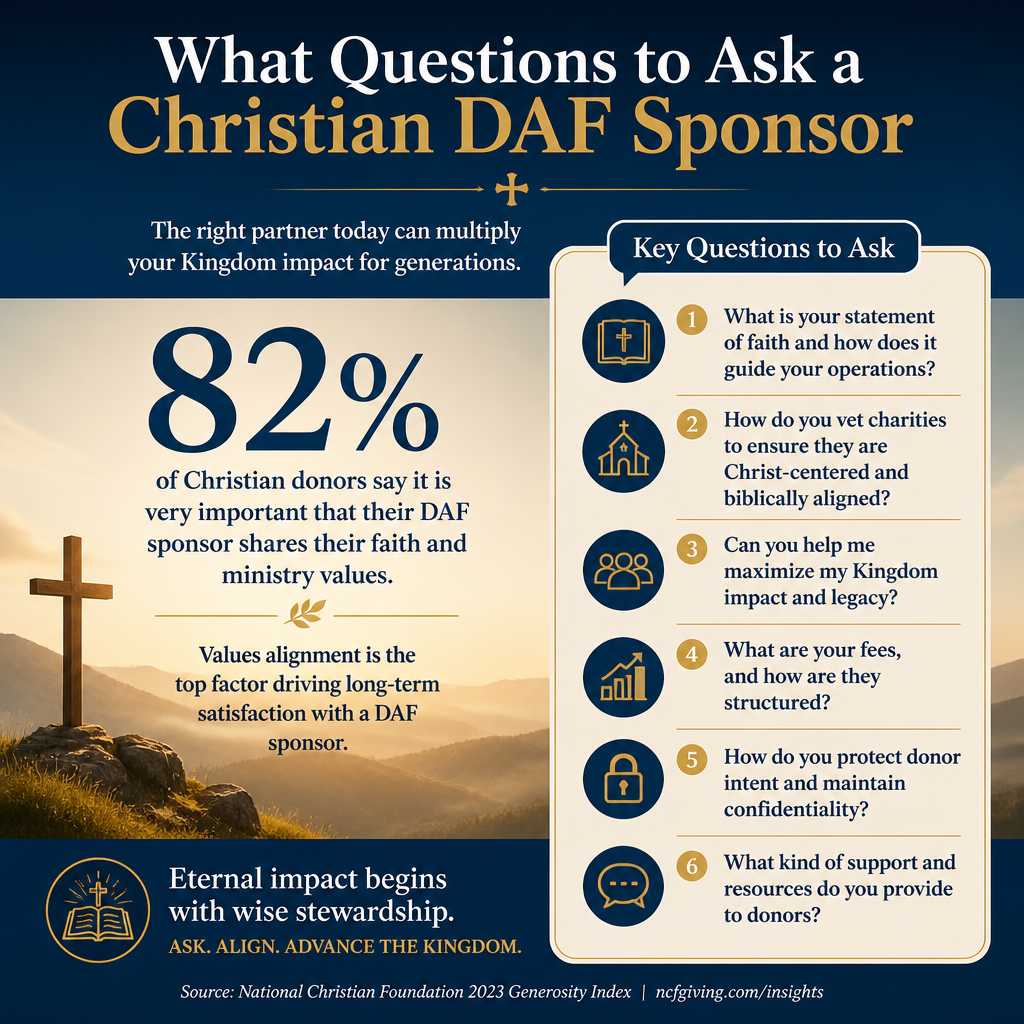
Ask for the sponsor’s statement of faith and the practical requirements attached to it: board affirmation, staff affirmation, and partner expectations. If the sponsor is part of a broader financial institution, ask how that institution’s values and policies interact with the DAF’s Christian commitments when tensions arise.
This is not sectarian nitpicking. Scripture treats money as a discipleship domain, and it treats leadership as morally weighty stewardship. “Moreover, it is required of stewards that they be found faithful” (1 Corinthians 4:2). Faithfulness is demonstrated in governance and decisions, not only in aspiration.
What grants will you restrict and why
Christian donors sometimes assume that a “Christian DAF” will automatically prevent grants to causes that contradict historic Christian moral teaching. Do not assume. Ask the sponsor to define its grant eligibility standards in writing. Specifically ask how it handles grants to organizations that affirm practices Christians genuinely disagree about, including abortion access, assisted suicide advocacy, and the redefinition of marriage.
In practice, this is where the sponsor’s theology becomes operational. A sponsor may say it serves “all donors” while also using Christian language; that may be workable for some donors, but it should be chosen with eyes open rather than discovered midstream.
Clarify who truly controls the account and how advice is weighed
A donor-advised fund is not a private foundation and it is not a personal checking account. The sponsor legally owns the assets, and the donor provides nonbinding recommendations. Mature stewardship asks how that legal reality is administered in practice, and whether the sponsor has policies that respect donor intent while maintaining legal compliance.
What are the legal and practical limits on donor recommendations
Ask the sponsor to describe, in concrete terms, what could cause it to decline a grant recommendation. Then ask for examples: international grantees, small churches without formal documentation, emerging ministries without 501(c)(3) status, and situations where a ministry is under public allegation. A sponsor that cannot articulate these boundaries clearly is unlikely to apply them consistently.
Also ask how quickly grants are processed, whether there are seasonal bottlenecks, and what documentation the sponsor requires from a recipient. The point is not speed for its own sake; it is reliability for the ministries you intend to support.
How will you protect donor intent across generations
If the DAF is part of estate planning, ask what happens when the primary advisor dies. Can the account name successor advisors? For how long? Can a church or ministry be named as a successor? Are there default policies that move dormant accounts into the sponsor’s discretionary grantmaking? These policies are common across the sector, but the specifics vary, and they matter.
For donors seeking a broader context on the category, we maintain ongoing coverage of Christian Donor-Advised Funds with an emphasis on the stewardship questions that tend to surface only after a DAF is funded.
Interrogate fees, investments, and the moral logic of your capital
DAF sponsors are not only grant processors. They are asset managers and, in many cases, partners with large financial firms. The donor’s capital will be invested, and both fees and investment philosophy shape what your generosity becomes over time.
What are all-in fees and who receives them
Ask for a complete fee schedule: administrative fees, investment management fees, and any additional charges for complex assets such as closely held stock or real estate. Ask where those fees go—into the sponsor’s operations, to third-party managers, or to affiliated entities.
Fee transparency is an ethical issue as much as a financial one. The sector has learned that donors often overemphasize overhead and underemphasize integrity. The “Overhead Myth” statement—signed by charity evaluators and accountability bodies—warns against using simplistic overhead ratios as the primary measure of nonprofit quality, because it can incentivize underinvestment in governance and effectiveness (BBB Wise Giving Alliance).
How are assets invested and what values screen is used
Ask whether the sponsor offers faith-consistent investment options, what screens are applied, and whether those screens are audited or independently verified. Christian donors disagree about the best approach to faith-based investing: some prioritize avoiding complicity in specific industries; others emphasize shareholder engagement; others prioritize mission-aligned community investing. The sponsor should be able to explain its philosophy without slogans.
Also ask who holds the investment authority. If a sponsor uses a large commercial platform, confirm whether the Christian screens are truly binding or merely optional. Capital formation is never morally neutral, and donors should know what their funds are supporting while they wait to be granted.
Test governance, risk controls, and the sponsor’s willingness to say no
DAF sponsors handle money that is tax-advantaged and, in many cases, intended for gospel work. That combination attracts both sincere generosity and predictable misuse. The sponsor’s governance, internal controls, and independence determine whether it can protect donors and recipients when pressures rise.
Who governs and what conflicts of interest exist
Ask for a list of board members, how they are selected, and what conflict-of-interest policies govern related-party transactions. If the sponsor is connected to a ministry, ask how it prevents the DAF from becoming a captive fundraising channel for the parent organization. There is nothing inherently wrong with a sponsor that also has its own ministry priorities, but donors deserve clarity about how discretionary grants are decided and whether donor assets are ever steered.
Across our verification work at Most Trusted, the organizations that align most consistently with The Most Trusted Standard tend to have two traits in common: documented governance practices that can be reviewed, and leadership that treats accountability as a theological commitment rather than a compliance burden.
How do you handle due diligence on grantees
Ask what the sponsor verifies before making a grant: IRS status, good standing, leadership identity, and public allegations. Then ask what happens when a supported ministry faces credible allegations of financial misuse or abuse. “Trust but verify” is not cynicism; it is prudence shaped by the biblical recognition that leaders can be tempted and institutions can drift.
For donors actively comparing sponsors, we have published decision criteria within How to Choose a Christian Donor-Advised Fund Sponsor to help donors evaluate policies that often remain in the fine print.
Confirm transparency, reporting, and what donors can measure
Christian donors often want two forms of clarity: personal reporting for stewardship and family formation, and organizational transparency about how the sponsor itself operates. Both can be tested with straightforward questions.
What reporting will we receive and how usable is it
Ask for samples of quarterly statements, tax receipts, and year-end summaries. Confirm whether the platform supports designating grants to specific projects, whether it tracks multi-year commitments, and whether it allows anonymous grants while still providing the donor with full documentation.
If the donor hopes to involve children or grandchildren, ask whether the sponsor provides permissions, multiple logins, or advisory roles that reflect family governance. Some platforms are built for single-user convenience and become unwieldy for multi-generational generosity.
What transparency do you provide about your own operations
Ask for the sponsor’s audited financial statements, Form 990, and policies for fundraising, privacy, and data security. Ask whether it publishes grant totals, payout rates, and discretionary grant priorities. DAF payout rates are debated in public policy and philanthropy circles, and donors should know whether the sponsor encourages timely generosity or quietly benefits from perpetual asset retention (The Chronicle of Philanthropy).
A practical way to keep questions focused is to ask the sponsor to answer a short set in writing:
- Which grants will you restrict as a matter of Christian conviction, and where is that policy published?
- Under what conditions will you decline a grant recommendation, and what is the appeals process?
- What are the all-in fees for our expected balance and asset types, including third-party charges?
- How are funds invested, and what faith-consistent screens or engagement practices are actually enforced?
- What due diligence is performed on recipient ministries, and what happens when credible allegations arise?
FAQs for What questions to ask a Christian DAF sponsor
Does a Christian DAF sponsor guarantee that every grant aligns with biblical values?
No sponsor can substitute for a donor’s moral responsibility, and policies vary widely. A sponsor can restrict categories of grants, require documentation, and maintain theological guardrails, but donors should request those guardrails in writing and test how they are applied in contested areas of Christian ethics.
Is the lowest-fee Christian DAF sponsor usually the wisest choice?
Not necessarily. Fees matter, but the larger question is whether the sponsor’s governance, due diligence, investment practices, and transparency protect the donor’s intent and the integrity of the ministries being funded. A sponsor that is slightly more expensive but materially stronger in accountability may be the more faithful steward over time.
A Christian DAF sponsor should be examined like a spiritual trustee
The questions to ask a Christian DAF sponsor are, at their core, questions about stewardship: who holds power, what moral boundaries are real, and whether accountability is strong enough to withstand pressure. Donors can approach this process without suspicion and without naïveté, recognizing that the stewardship of wealth is one of the arenas where discipleship becomes concrete.
Most Trusted exists to strengthen donor confidence through independent verification of ministries against The Most Trusted Standard. A DAF sponsor cannot replace that work, but it should make faithful giving easier rather than harder, clearer rather than more opaque, and more aligned with the purposes for which God entrusts resources to his people.



