
Minimums Christian donor-advised funds require are rarely about restricting generosity. They are usually a practical way a sponsor covers administration, compliance, investment management, and grant processing while still serving donors with integrity. For Christian givers, the question is not merely financial. It is a stewardship question: how to align a giving account with the purposes God has given us, without letting fee structures or convenience quietly govern our priorities.
Minimums also shape who a DAF is built to serve. Some sponsors are designed for large, complex giving portfolios. Others intentionally serve everyday donors who want a disciplined, tax-wise pattern of generosity without building a private foundation. The more clearly a sponsor discloses its minimums and how they function, the easier it is for donors to give “not reluctantly or under compulsion” but with clarity and freedom of conscience (2 Corinthians 9:7).
The three minimums that matter most
Most Christian DAF sponsors set minimums in three places: to open an account, to make grants, and to keep an account active. These are not uniform across the field, and Christian sponsors often add faith-based guardrails that can function like an additional “minimum” of alignment.
Minimum to open the DAF account
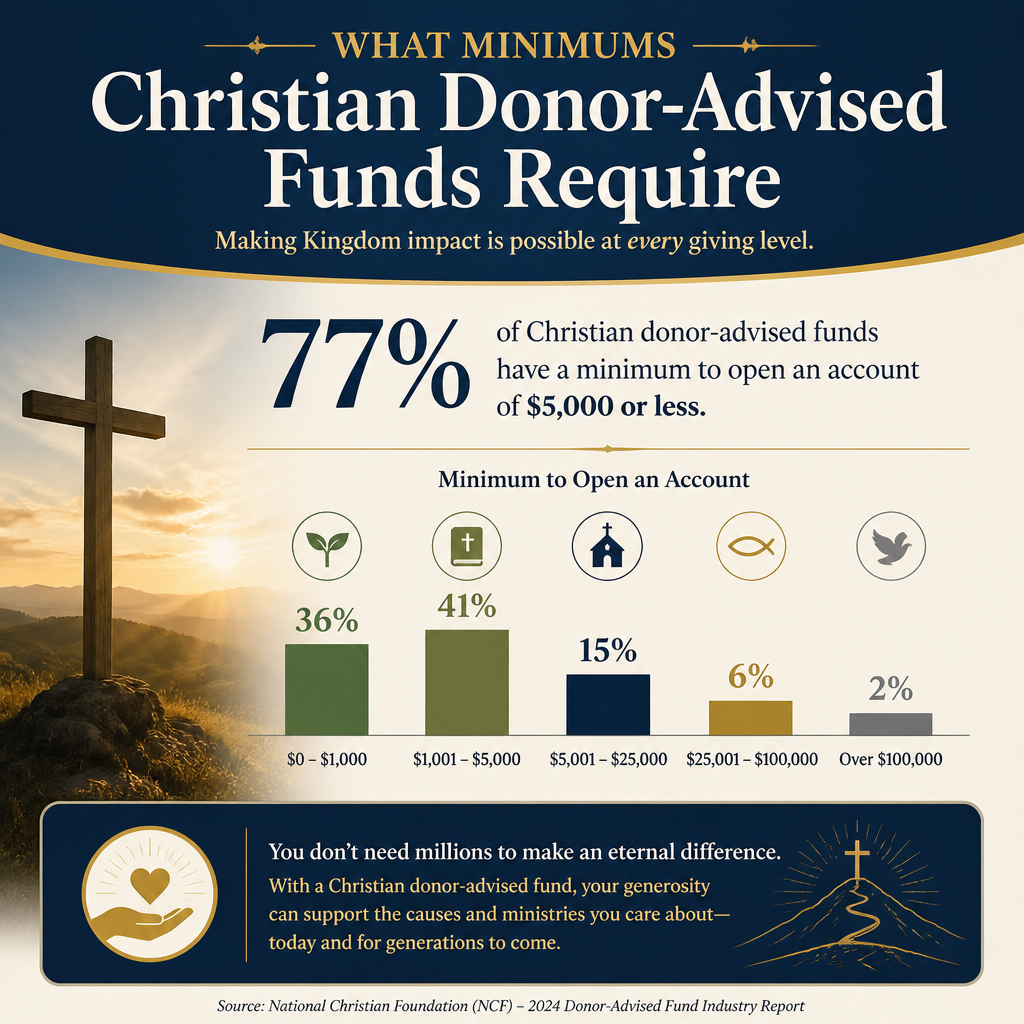
This is the initial contribution required to establish the account. It can be satisfied with cash, appreciated securities, or other eligible assets depending on the sponsor. A lower opening minimum typically signals a sponsor built for broad access; a higher one may indicate a sponsor whose model assumes more complex giving or investment management.
Minimum to keep the account active
Some sponsors require a minimum balance or a minimum annual contribution to justify ongoing administration. Others instead assess a modest annual fee regardless of balance. Donors should not assume that “no minimum” means “no cost.” It often means the cost is recovered differently, sometimes through higher fees on smaller balances.
For donors comparing options across the wider landscape of Christian Donor-Advised Funds, these three minimums are usually the most determinative, because they affect whether the account remains a reliable long-term tool for giving through seasons of varying income.

Grant minimums and the theology of small faithfulness
Many Christian donors want the freedom to make smaller, repeated grants to missionaries, church plants, pregnancy resource centers, and local mercy ministries. Some DAFs accommodate this readily; others set a per-grant minimum that subtly channels giving toward larger, less frequent gifts. Neither approach is automatically wrong, but the spiritual implications are real: minimums can unintentionally train donors away from patient, relational generosity.
Per-grant minimums and processing realities
A per-grant minimum is often justified by administrative cost per transaction: payment processing, due diligence, sanction screening, receipting, and donor support. Sponsors that permit very small grants sometimes recover that cost through higher administrative fees or by limiting the number of grants per year.
Recurring grants and support-raising integrity
Recurring grants matter for Christian workers who depend on steady, predictable support. If a DAF’s grant minimum prevents a donor from sending a monthly gift at a level they can sustain, the donor may be forced into an artificial pattern that does not fit their stewardship or the ministry’s cash-flow needs. When donors can structure a faithful cadence of support, they serve ministries with the kind of practical love Scripture commends (1 John 3:18).
Donors should ask direct questions about grant minimums and grant frequency limits before opening an account, especially if the intent is to support multiple smaller ministries, not only large institutions.
Minimum contribution types and what they imply
Minimums are not always just dollar figures. They often come bundled with requirements about what kinds of assets can be contributed, how quickly they can be liquidated, and whether the sponsor will accept complex gifts. These conditions can effectively become a “minimum sophistication” threshold for the donor.
Cash, appreciated securities, and complex assets
Most DAFs accept cash and publicly traded securities. Fewer accept complex assets such as closely held business interests, real estate, or cryptocurrency. When a sponsor does accept complex assets, the minimums are typically higher because valuation, legal review, and liquidation introduce risk and cost. A donor considering a non-cash gift should confirm whether the sponsor’s minimum is tied to the asset type rather than merely the account balance.
Timing minimums and liquidity constraints
Some sponsors require that an initial contribution be received and cleared before any grant recommendations can be processed. Others permit grant recommendations once the contribution is initiated but not yet settled. This is not mere bureaucracy; it is part of the sponsor’s fiduciary and compliance posture. Donors planning year-end giving should clarify cutoffs and settlement timelines so that generosity is not distorted by avoidable delays.
For donors evaluating sponsors through the lens of How to Choose a Christian Donor-Advised Fund Sponsor, these “hidden minimums” often explain why two sponsors with identical published opening minimums can feel very different in practice.
The tradeoffs minimums create for fees, access, and accountability
Minimums inevitably create tradeoffs. Lower minimums increase access, but they can pressure a sponsor to simplify service, standardize investment options, or recover costs through higher fees on smaller accounts. Higher minimums can support more customization and deeper due diligence, but they can also concentrate service among wealthier donors and reduce broad participation in structured generosity.
How minimums relate to administrative fees
DAF fee schedules are typically a percentage of assets under management, often with tiers. Sponsors with low opening minimums sometimes have higher effective fees for small balances because fixed costs must be covered. Conversely, a sponsor with a higher opening minimum may be able to offer lower marginal fees at larger balances. The donor’s task is to compare the all-in cost structure over time, not only the entry price.
Accountability and the temptation to treat minimums as a proxy for quality
Some donors assume that a higher minimum implies a more rigorous sponsor or a more faithful approach. That may be true in a given case, but it is not reliable. The more meaningful question is whether the sponsor can demonstrate governance strength, financial integrity, theological clarity, and transparent reporting. At Most Trusted, our verification work exists because donors need more than signals. They need verifiable evidence that a ministry or giving vehicle meets clear standards of faith and practice.
Minimums should be evaluated alongside the sponsor’s transparency: clear disclosures of fees, grant policies, conflict-of-interest controls, and the criteria used to approve or deny grants. When policies are vague, donors can be left with preventable uncertainty at precisely the moment they are trying to act in good faith.
Questions mature donors ask before opening a Christian DAF
Minimums are easiest to assess when donors ask for policies in writing and read them as carefully as they would read a ministry’s annual report. A thoughtful sponsor will welcome the questions. A sponsor that cannot answer them clearly is signaling something important, even if unintentionally.
A short due diligence checklist
- What is the minimum to open an account, and does it vary by asset type?
- Is there a minimum annual balance or a minimum annual contribution to keep the account active?
- What is the minimum per grant, and are there limits on the number of grants per year?
- Are there restrictions on grants to churches, missionaries, or international work, and what documentation is required?
- How does the sponsor handle grantee vetting, and what causes a grant to be denied?
- What are the total fees a donor should expect at common balance levels over time?
Where minimums intersect with faith commitments
Christian DAFs often carry convictions about what kinds of organizations may receive grants. Some require a statement of faith alignment for grantees. Others permit grants more broadly while screening out entities that clearly conflict with Christian moral teaching. Christians genuinely disagree about where lines should be drawn, especially when giving to nonsectarian charities for disaster relief, poverty alleviation, or education. The sponsor’s policies should be explicit enough that donors can make informed decisions without discovering limits after they have already committed funds.
A final tension is worth naming: a DAF is a tool, not a substitute for discipleship. The administrative minimums should serve generosity, not define it. Mature stewardship uses tools well without letting them become ultimate.
FAQs for What minimums Christian donor-advised funds require
Do Christian donor-advised funds usually have higher minimums than mainstream DAFs?
Not necessarily. Some Christian sponsors set low opening minimums to serve broad participation, while some mainstream sponsors do the same. Minimums tend to reflect the sponsor’s service model, fee structure, and intended donor profile more than whether the sponsor is explicitly Christian. The more useful comparison is the complete package: opening minimum, grant minimum, ongoing fees, and clarity of faith-based grant policies.
What if our giving is modest but we still want a DAF for disciplined, tax-wise generosity?
A modest giving level can still justify a DAF when it supports disciplined generosity, appreciated-asset giving, or bunching deductions for years with higher tax impact. The practical constraint is whether the sponsor’s opening minimum, annual fees, and grant minimums allow faithful patterns of giving without turning small grants into an administrative struggle. When the numbers do not fit, donors may be better served by direct giving paired with careful ministry verification, including evaluations aligned with The Most Trusted Standard.
Minimums should serve mission, not master it
The minimums Christian donor-advised funds require can either support generosity with clarity or quietly steer giving away from a donor’s convictions and relationships. The best sponsors state their minimums plainly, connect them to real administrative costs, and pair them with transparent policies that respect donor intent while honoring legal and moral constraints. Wise donors treat minimums as one dimension of stewardship, then weigh the deeper question: whether the sponsor’s governance, faith commitments, and accountability practices are worthy of trust.



