
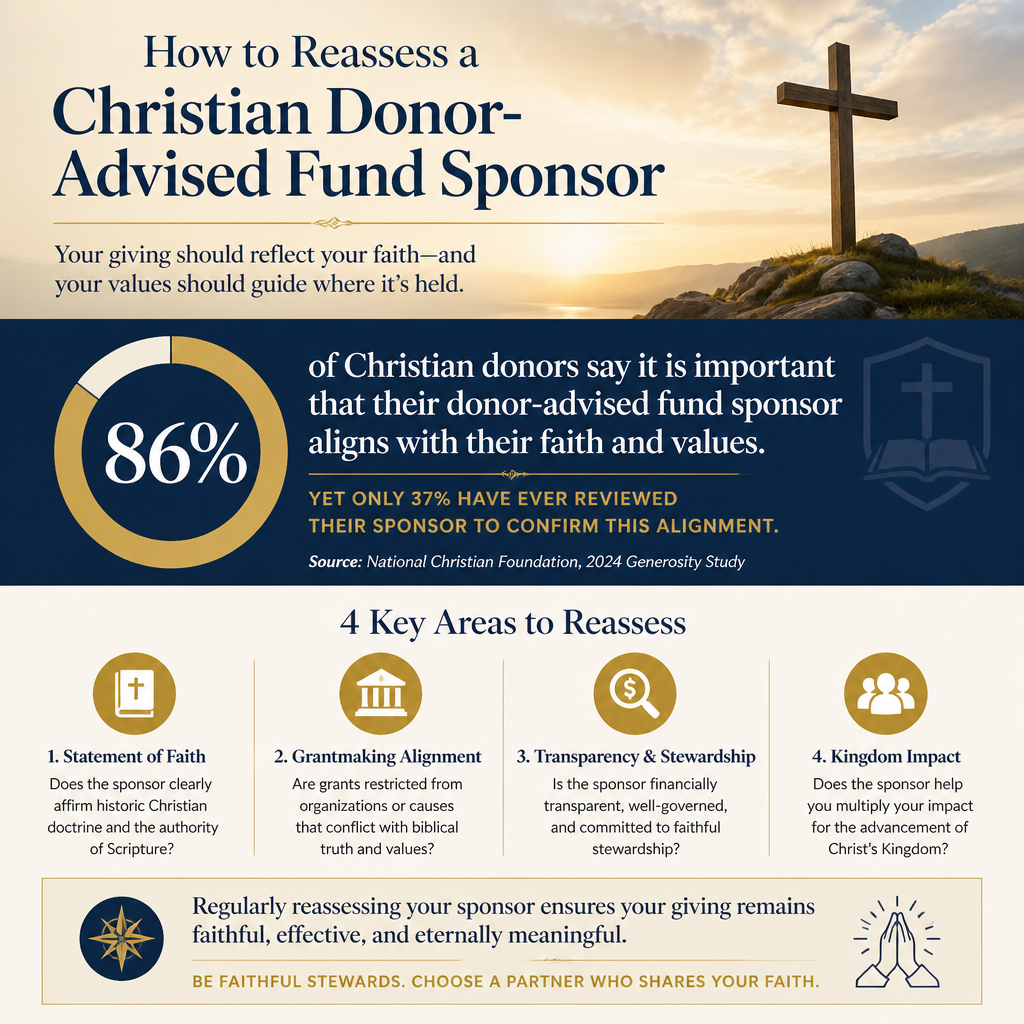
Reassessing a Christian donor-advised fund sponsor is not a matter of personal preference. It is a stewardship decision with moral weight, because a sponsor quietly shapes what kind of giving is easy, what kind is difficult, and what kind is impossible. For Christian donors who want generosity to remain accountable to Scripture and to the church’s historic moral reasoning, periodic reassessment is part of faithfulness, not a sign of distrust.
Jesus’ teaching makes money a discipleship arena, not a neutral tool. “Where your treasure is, there your heart will be also” (Matthew 6:21) is not a sentiment about emotions; it is a diagnostic about allegiance. A Christian DAF sponsor can either support that alignment or slowly erode it through incentives, ambiguity, or silence on contested moral questions.
Start with the sponsor’s theological and moral boundaries
The first task is to clarify what the sponsor is actually sponsoring. Many Christian DAF providers describe themselves in broad language about “values” or “biblical principles,” but donors need operational clarity: What qualifies as “Christian”? What disqualifies a grantee? How are contested moral issues handled when institutions disagree?
Ask for the sponsor’s written standards and decision rights
A sponsor’s commitments need to be visible in writing, not assumed. Request the grantmaking guidelines, the statement of faith, and any policies on human sexuality, sanctity of life, religious liberty, and partnership with organizations whose work mixes mercy with advocacy. Some sponsors treat these questions as mostly donor-directed. Others reserve meaningful discretion to approve or deny grants based on their standards.
That discretion is not automatically a problem. It can be a form of moral protection. The concern is undisclosed discretion or shifting discretion. If the sponsor can override donor intent, donors should know when and why, and whether the standard is stable over time.
Test whether the sponsor’s posture is ecclesial or merely cultural
Christian donors often want their giving to reflect the church’s deepest moral commitments, not the instincts of a subculture. A sponsor’s language can sound orthodox while functioning like a brand. Examine whether the sponsor shows evidence of submission to Scripture and the historic Christian moral tradition, including a willingness to name real trade-offs rather than promising “wins” in every direction.
For readers weighing options across the broader landscape, our coverage of Christian Donor-Advised Funds frames the central questions donors should keep in view as they evaluate tools, providers, and governance models.

Reevaluate governance and accountability as if donor intent depends on it
Governance is where a sponsor’s convictions become enforceable. A sponsor can publish admirable statements and still operate without real accountability. For DAF donors, governance matters because the sponsor is the legal owner of the assets, and donors are providing recommendations under the sponsor’s control.
Look for independent oversight and conflict management
Request the board list and study it. Independence is not a box to check; it is a question of whether any one personality, family, or internal leadership group can dominate decisions. Donors should also ask whether the sponsor has written conflict-of-interest policies and how they are enforced.
Across our verification work at Most Trusted, we observe that organizations willing to publish governance safeguards tend to handle pressure more faithfully when controversial decisions arise. The ministries that meet The Most Trusted Standard typically treat board independence and documented conflicts as spiritual disciplines, not administrative details.
Confirm donor intent protections and variance power
Every DAF sponsor has “variance power,” the legal authority to redirect funds if a recommendation is not permissible or a grantee is no longer qualified. The question is how that power is framed and constrained. Donors should ask:
- Under what conditions will the sponsor decline a donor recommendation?
- If a grant is declined, what options does the donor have for an alternative recommendation?
- If funds are redirected, can the donor see the reasoning and the destination?
- How are disputes handled, and who makes the final decision?
- Is there an appeals process with documented timelines?
A sponsor that treats variance power as a last resort, explains it clearly, and documents its use signals maturity. A sponsor that minimizes the topic or treats it as purely theoretical may not be prepared for real-world complexity.
Scrutinize financial integrity and fee practices without suspicion or naivety
Christian donors can fall into two errors: cynicism that assumes every fee hides compromise, or naivety that equates Christian branding with financial prudence. A mature reassessment refuses both. Financial integrity is a question of transparency, reasonableness, and alignment with mission.
Separate the sponsor’s administrative costs from investment costs
DAF costs often appear simple but are not. Sponsors may charge an administrative fee, and the underlying investment options may carry their own expense ratios. Donors should ask for an all-in cost view in writing, including tiered fee schedules, minimums, and any additional charges for complex grants, international giving, or scholarship-like recommendations.
Fee comparisons are not purely about finding the lowest number. They are about paying for what is necessary and refusing what is unnecessary. The “Overhead Myth” statement—signed by GuideStar, BBB Wise Giving Alliance, and Charity Navigator—helpfully explains why overhead ratios alone are a poor proxy for effectiveness, while still affirming the importance of transparency and appropriate spending GuideStar.
Ask whether investment options match your convictions and risk posture
Some Christian sponsors offer faith-based screened funds. Others allow donor-directed accounts with advisors. Others limit choices to a small menu. The reassessment question is not only “Are the options Christian?” but “Are the options prudent for our aims?” A sponsor that encourages undisciplined risk-taking, or that offers opaque products without clear benchmarks, may be eroding stewardship even if the marketing is Christian.
Donors should request the investment policy statement, the list of managers, and the benchmarks used to judge performance. Responsible sponsors can explain their approach without defensiveness and without turning investment talk into sales language.
Examine operational transparency and grantmaking practice where misuse can hide
DAFs are designed to simplify giving. That simplicity can also conceal problems: slow grant processing, unclear restrictions, weak compliance, or inconsistent treatment of ministries. Reassessment should attend to the mundane, because faithfulness is often tested there.
Confirm compliance and grantee vetting without overpromising
A sponsor should be able to describe how it verifies a grantee’s eligibility and prevents grants that provide impermissible private benefit. The Internal Revenue Service provides guidance on donor-advised funds and the legal framework governing them, and donors should expect sponsors to operate within those contours Internal Revenue Service.
At the same time, a sponsor’s compliance checks are not the same as ministry verification. A 501(c)(3) determination letter does not tell donors whether a ministry is governed well, teaches faithfully, or reports outcomes credibly. That is one reason independent verification exists. Most Trusted evaluates ministries against The Most Trusted Standard, a 15-criteria framework that attends to faith commitments, financial integrity, governance and leadership, and transparency and effectiveness.
Measure service quality as a stewardship issue
Service problems are not merely inconvenient. They can distort generosity. If grants take weeks to process, if international giving is consistently delayed, or if the sponsor cannot handle complex gifts without confusion, donors may change where and when they give. Over time, the sponsor’s operational limits become the donor’s moral limits.
Request hard details: average grant processing times, cutoffs for year-end granting, error rates, and how the sponsor handles fraud prevention. Mature organizations can offer measurable answers, not only assurances.
Reassess effectiveness through the ministries you can reach and the stories you can verify
The deepest question is whether the sponsor is helping Christian donors give with both conviction and clarity. A sponsor can be administratively competent and still leave donors isolated, with little help discerning which ministries are trustworthy, which claims are inflated, and which outcomes are plausible.
Ask what the sponsor does when a ministry is controversial or implausible
Some ministries make large promises: dramatic conversion statistics, sweeping claims about human trafficking rescues, or unusually low cost-per-outcome numbers. Christian donors should be neither credulous nor reflexively dismissive. A serious sponsor should have a posture toward evidence: What documentation is required? How are exaggerated claims challenged? Does the sponsor ever suspend relationships or limit access based on credible concerns?
Christians genuinely disagree about how much due diligence belongs with donors versus intermediaries. But donors should be wary of a sponsor that treats verification as someone else’s problem while simultaneously presenting itself as a trusted Christian gatekeeper.
Evaluate the sponsor’s reporting and donor formation
Donor formation is not about producing inspirational content. It is about helping donors think truthfully about impact, integrity, and unintended consequences. Mature sponsors educate donors on issues like restricted gifts, dependence creation, and the difference between activity metrics and outcomes.
For donors who want a structured way to compare providers, our work in How to Choose a Christian Donor-Advised Fund Sponsor maps the evaluation questions that tend to matter most once the initial enthusiasm for convenience has passed.
FAQs for How to reassess a Christian donor-advised fund sponsor
How often should we reassess a Christian DAF sponsor?
We recommend a formal reassessment at least every two to three years, and sooner if any of the following occurs: a leadership transition, a material change in policies, a shift in theological positioning, or repeated operational failures that affect grantmaking. A DAF is a long-term vehicle; periodic review is part of protecting donor intent.
What are the clearest warning signs that a sponsor no longer fits Christian donor priorities?
The most consistent warning signs are evasiveness about written standards, unclear use of variance power, opaque all-in fees, unwillingness to answer governance questions, and a pattern of public messaging that substitutes cultural signaling for doctrinal clarity. No sponsor is perfect, but a sponsor that cannot explain how it makes hard decisions is unlikely to make them well.
Reassessment as a discipline of stewardship
Reassessing a Christian donor-advised fund sponsor is a way of refusing drift. It keeps convenience from becoming control, and it keeps donor intent from dissolving into vague goodwill. The aim is not suspicion; it is faithfulness—giving in ways that honor Christ, protect the vulnerable, and withstand scrutiny when claims are tested by evidence.



