

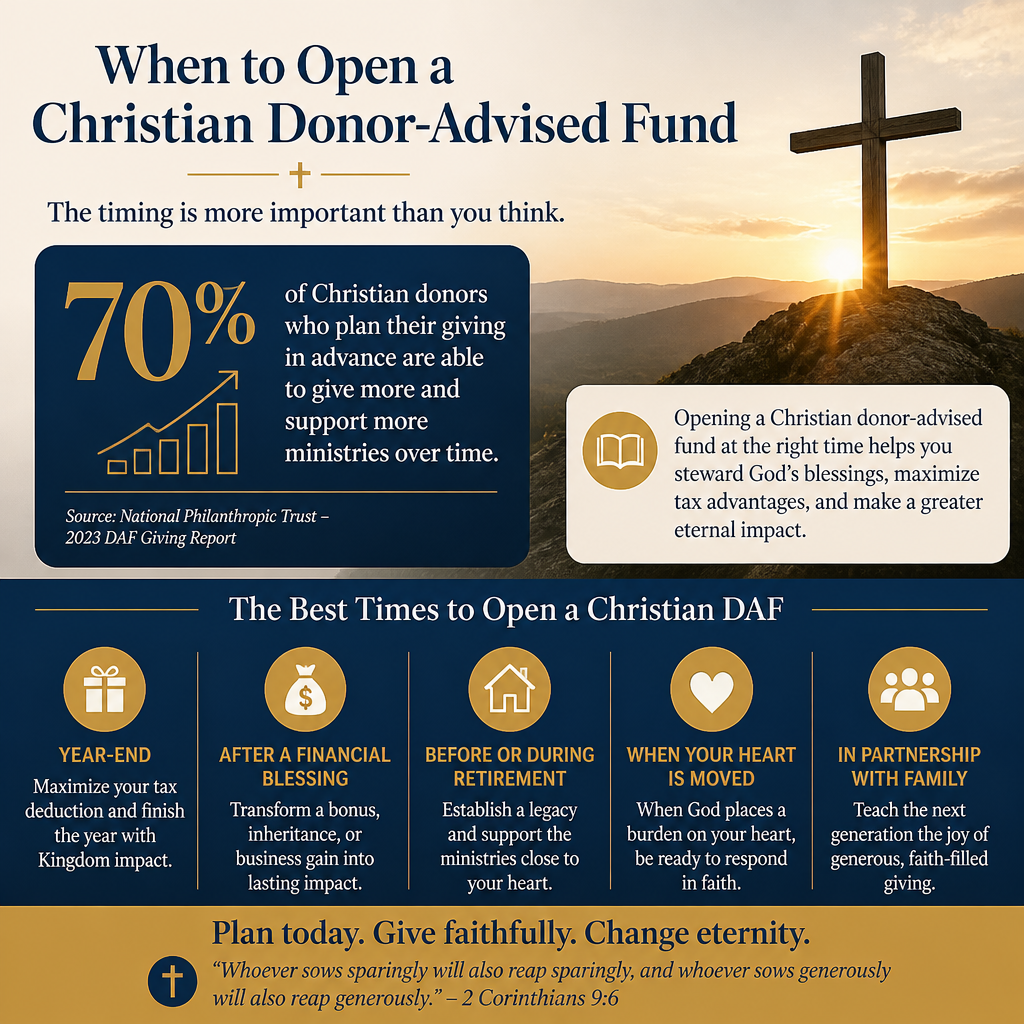
Knowing when to open a Christian donor-advised fund is less about finding the perfect tax moment and more about clarifying the kind of stewardship you intend to practice over decades. A donor-advised fund can be a disciplined tool for Christians who want to give thoughtfully, avoid hurried decisions, and align their generosity with durable convictions rather than headlines.
The harder question is whether a DAF will deepen obedience or merely add complexity. Scripture commends purposeful generosity that is both freehearted and wise: “Each of you should give what you have decided in your heart to give… for God loves a cheerful giver” (2 Corinthians 9:7). A DAF can support that “decided in the heart” posture when it strengthens planning, prayer, and accountability.
Open a Christian donor-advised fund when your giving needs a stable, long-term structure
When your giving is growing beyond ad hoc decisions
A DAF becomes compelling when annual giving has moved from occasional gifts to sustained, significant generosity. Many Christian households reach a point where the question is no longer whether to give, but how to give with consistency across seasons of life, market cycles, and ministry needs.
For donors who already support a church and a set of ministries, a DAF can function as a deliberate “giving reservoir.” You can contribute when income is high or when an asset event occurs, then recommend grants over time as needs and discernment mature.
When you want to separate generosity from volatility
Business owners, commission-based professionals, and donors with concentrated equity often experience uneven cash flow. A DAF can reduce the spiritual and practical strain of tying grantmaking to the month-to-month fluctuations of income. It also makes it easier to sustain commitments to ministries whose work does not pause when the economy tightens.
That stability matters because Christian giving in the United States is not immune to broader philanthropic shifts. Total charitable giving in the U.S. has shown sensitivity to inflation and market conditions in recent years, which affects many nonprofits’ planning and staffing decisions (Giving USA).

Open a Christian donor-advised fund when you anticipate a major tax year or liquidity event
When you can fund the DAF in a high-income year
In practical terms, many donors open and fund a DAF in the same year they have unusually high taxable income: a business sale, a large bonus, an exercised equity position, or an exceptionally strong year for capital gains. The DAF can allow you to make a charitable contribution in that tax year while taking time to decide which ministries should receive grants over the coming months or years.
This is not merely a technical advantage. It can also help prevent a common spiritual misstep: allowing tax planning to become the real driver of giving rather than a servant of obedient generosity. The tax year can be the occasion, but it should not become the motive.
When appreciated assets are part of your stewardship plan
Many DAF sponsors accept contributions of appreciated securities, and some accept more complex assets. For donors with long-held stock, this can be a meaningful way to give without liquidating first. The Christian wisdom question is whether that asset-based strategy will actually increase faithful giving or simply preserve optionality.
Christians genuinely disagree about how much tax strategy should shape generosity. Some emphasize simplicity and immediacy; others see careful planning as a way to free more resources for Kingdom purposes. The most mature posture is to treat tax considerations as one factor among many: prayerful discernment, household obligations, the needs of the poor, and the credibility of the ministries being supported.
Open a Christian donor-advised fund when you need time to verify ministries and reduce avoidable risk
When discernment must catch up to urgency
Crises generate both legitimate need and elevated fraud risk. The Federal Trade Commission regularly warns donors about impostor charities and emergency-related giving scams (Federal Trade Commission Consumer Advice). In those moments, a DAF can slow the transaction without slowing compassion: you can set aside a charitable gift and then take the time required to verify where it should go.
This is where Christian donors often feel an internal tension. Scripture commends urgency in mercy, yet Scripture also commends discernment. The Book of Proverbs repeatedly honors prudence, and the New Testament calls believers to test what is true. A DAF can create space for both prompt generosity and careful validation.
When your giving strategy depends on credible accountability
Across our verification work at Most Trusted, we see that donors do not merely ask whether a ministry is doctrinally orthodox. They also ask whether it is financially sound, responsibly governed, and honest about outcomes. Those are not secular concerns imported into Christian giving; they are stewardship concerns rooted in truth-telling and neighbor-love.
Most Trusted exists to help donors give with confidence by evaluating Christian nonprofits against The Most Trusted Standard, a 15-criteria framework spanning Faith Foundation, financial integrity, governance and leadership, and transparency and effectiveness. A DAF is not a substitute for that kind of evaluation, but it can support it by allowing time to do the work well before grants are recommended.
For donors looking to situate DAF decisions within a broader understanding of this tool, the most useful place to begin is the larger landscape of Christian Donor-Advised Funds.
Open a Christian donor-advised fund when you want family formation without confusing roles
When you want to disciple children and heirs in generosity
Many donors consider a DAF when they realize that the formation of heirs is not primarily about wealth transfer. It is about worship, responsibility, and a truthful understanding of money’s limits. A DAF can be a structured way to involve children or extended family in researching ministries, discussing theological priorities, and recommending grants together.
That said, a DAF is not automatically formative. It can also become a venue for preferences untethered from the church, from lived relationships, or from serious evaluation. Family involvement is strongest when it is paired with clear criteria, pastoral connection, and a willingness to say no to emotionally compelling but unaccountable appeals.
When you need a clear policy for what qualifies as Christian giving
DAFs can introduce definitional questions: What counts as a ministry we will support? How do we weigh evangelism, mercy, education, and public theology? How do we treat institutions that do good work but lack clear confessional commitments?
Many families benefit from writing down a simple set of convictions and constraints before the first grant is recommended. A short policy can prevent future conflict and can honor conscience where Christians may disagree.
- A statement of theological commitments that guide giving decisions
- Non-negotiables for financial integrity and governance
- Minimum expectations for transparency and reporting
- A posture toward restricted gifts and project funding
- A plan for responding to crises without abandoning diligence
Open a Christian donor-advised fund when the trade-offs are acceptable and you are ready to govern the tool
When you understand the limits and are at peace with them
A DAF is not the same as a private foundation, and it is not the same as direct giving. In exchange for administrative simplicity, you generally give up certain forms of control. You can recommend grants, but the sponsoring organization retains legal authority over distributions. Most donors find this reasonable; some do not.
There are also moral questions that careful Christians should not ignore. Critics have raised concerns about funds sitting idle and the absence of a legal payout requirement for DAFs. The National Philanthropic Trust has reported that many DAFs do pay out substantial percentages annually, but the debate persists because “average payout” does not address every individual account (National Philanthropic Trust).
When you can commit to active stewardship rather than passive accumulation
For Christian donors, the most decisive readiness signal is not account size but intention. A DAF becomes spiritually hazardous when it turns giving into a deferred plan that never becomes a gift. It becomes spiritually fruitful when it strengthens habits of decisive generosity, wise evaluation, and faithful follow-through.
Operationally, it is also wise to understand fees, investment options, grant processing timelines, and the sponsor’s policies for international giving or complex grantees. These details are not distractions from spiritual stewardship; they are part of it. A Christian donor’s responsibility is not only to give, but to give in ways that honor truth, avoid unnecessary scandal, and serve real people.
For readers who want to understand the mechanics and decision points in greater detail, we address the underlying operational questions in How Christian Donor-Advised Funds Work.
FAQs for When to open a Christian donor-advised fund
Should Christians open a donor-advised fund only for tax benefits?
Tax benefits can be a legitimate secondary factor, especially in high-income years or when contributing appreciated assets. But a Christian case for opening a DAF should be anchored in stewardship and discernment: the ability to give generously without haste, verify ministries carefully, and sustain support across seasons. If tax strategy becomes the primary driver, the tool can quietly reshape the heart in the wrong direction.
Is it better to give directly to ministries instead of using a DAF?
Direct giving is often best when you already have high confidence in a ministry’s faithfulness and integrity and when timing matters for the work. A DAF is often best when you need time to evaluate, when a liquidity event creates an unusual giving opportunity, or when you want a stable structure for long-term grantmaking. Many mature donors do both: direct gifts to core ministries, and a DAF for planned, researched, and occasionally time-sensitive giving.
A disciplined answer to a pastoral question
The question of when to open a Christian donor-advised fund is ultimately a question of governance: how we will order money under the lordship of Christ rather than under impulse, fear, or vanity. The right time is when the structure will serve generosity that is both cheerful and truthful—prompt in compassion, careful in discernment, and committed to supporting ministries whose doctrine and practices can bear weight.



