

How Christian donor-advised funds handle anonymous gifts is ultimately a stewardship question before it is a privacy question. Many Christian donors want to give quietly for biblical reasons, yet they also want to ensure that the ministries they support are worthy of trust and capable of receiving restricted or sensitive gifts responsibly.
Anonymous giving can be a form of obedience to Jesus’ warning against performing righteousness “to be seen by others” (Matthew 6:1–4). At the same time, anonymity can complicate accountability for both the donor and the recipient. A mature approach treats anonymity neither as a virtue in itself nor as a red flag in itself, but as a tool that must serve truth, integrity, and the good of the people impacted by the gift.
Anonymous giving has a biblical logic and a practical cost
Christian donors seek secrecy for principled reasons
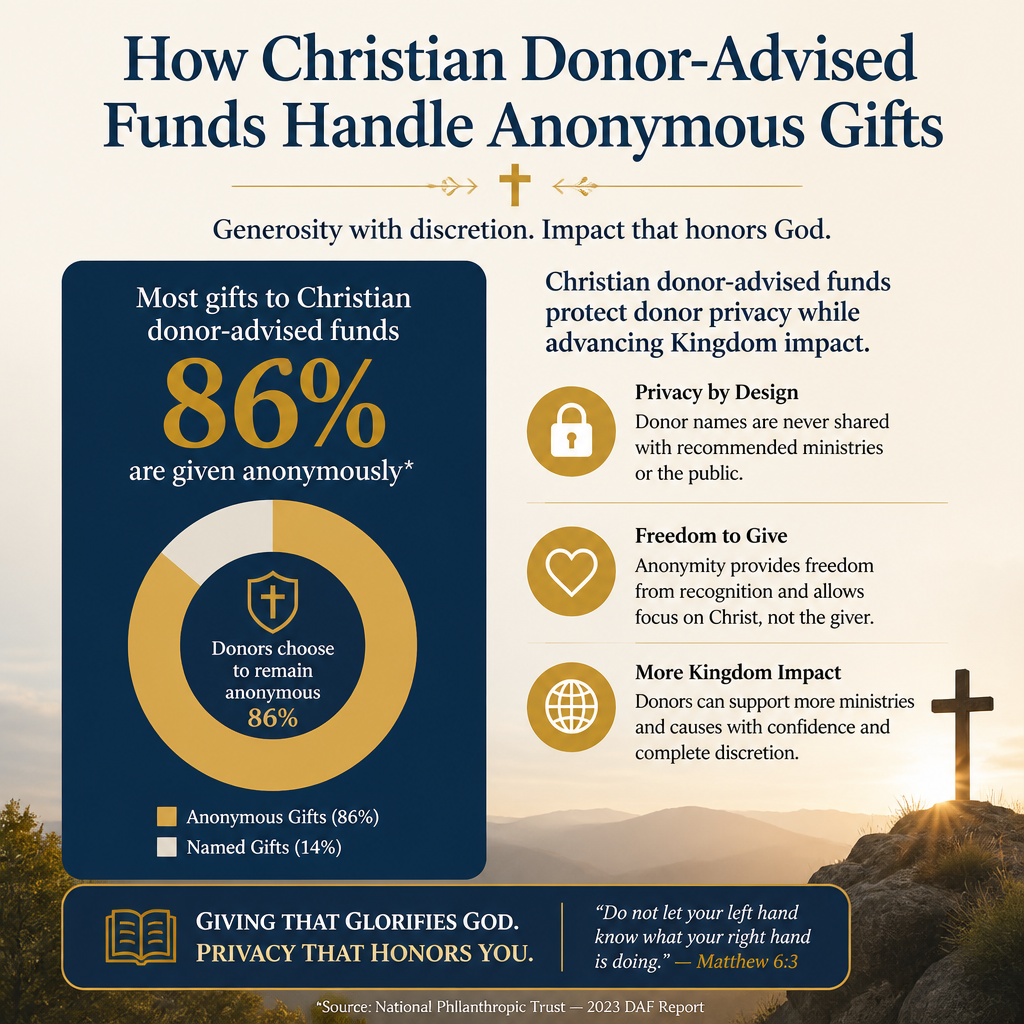
Jesus explicitly commends giving that refuses public recognition. The point is not that public generosity is always wrong, but that the donor’s heart must not be formed by applause. Christian donors also have prudential reasons: preventing relational pressure, avoiding “naming rights” dynamics, and protecting a family’s security in an era of data exposure.
Donor-advised funds often feel like the right fit because they can create separation between a donor’s identity and the recipient ministry. That separation can help donors give without entanglements, especially when the gift is sizable, when the recipient serves politically sensitive populations, or when the donor’s employment requires discretion.
Anonymity can also weaken relationship and oversight
The harder question is what anonymity does to the moral ecology of giving. Relationship is not a sentimental add-on; it is frequently the pathway through which clarity, appropriate restrictions, and honest reporting travel. When a ministry cannot connect a gift to a donor, it may be unable to clarify intent, confirm compliance with restrictions, or invite the donor into more informed partnership.
For donors, anonymity can become a way of avoiding the ordinary disciplines of due diligence. Scripture’s warnings about money are not only warnings against greed; they are also warnings against self-deception. A donor can keep distance not for humility but for control, or for the comfort of not asking hard questions about governance, theology, and outcomes.

What anonymity means inside a Christian donor-advised fund
Who knows the donor’s identity
In most donor-advised fund arrangements, “anonymous to the charity” does not mean “unknown to the sponsor.” The sponsoring organization typically maintains the donor’s identity for legal, tax, and compliance purposes. That is part of how the sponsor documents that the donor made an irrevocable charitable contribution and that grants were made to qualified organizations.
Donors should also understand that internal visibility can be broader than expected. The sponsor’s finance team, compliance staff, and sometimes donor services personnel may have access to identifying information. If anonymity is tied to safety concerns, it is appropriate to ask the sponsor detailed questions about data handling, internal access, and incident response.
How grants are labeled and delivered
Most donor-advised funds allow a grant to be sent with identifying information, with partial information (for example, a family foundation name), or with no donor identity disclosed. Many also allow a donor note to be included, which can be crucial if the gift is intended for a program, a geographic region, or a specific need.
What this means in practice is that anonymity is often a spectrum. A donor can be fully anonymous, “quietly known” to a development director, or publicly acknowledged in a way that still avoids performative recognition. The faithful choice depends on motive, context, and the downstream risks carried by the ministry and its beneficiaries.
How recipient ministries experience anonymous DAF gifts
Finance and development workflows are affected
Anonymous DAF grants can create genuine operational friction. A ministry must record the gift properly, issue any required acknowledgments to the sponsor, and ensure that the gift is not treated as a quid pro quo benefit. If a donor expects a receipt or recognition from the ministry while remaining anonymous, expectations can collide with compliance reality.
Another tension is budgeting. Unrestricted anonymous gifts can be a quiet blessing. But restricted anonymous gifts—especially those aimed at specific families, staff members, or projects—can create governance questions the ministry cannot resolve without speaking to the donor. Mature ministries will often decline or renegotiate a restricted gift if they cannot confirm intent, feasibility, and reporting expectations.
Restricted grants and sensitive programs require extra clarity
Some of the most urgent Christian work happens in places where discretion is not merely tasteful but necessary: missions work in closed countries, ministry to people fleeing domestic violence, and pastoral care in politically volatile settings. In those contexts, donor anonymity may be protective, yet the ministry still needs clear written intent and a realistic reporting plan that does not expose vulnerable people.
Across our verification work at Most Trusted, we find that ministries that meet The Most Trusted Standard tend to have clear gift acceptance policies and a willingness to say no to funding that would compromise their integrity or their duty of care. That posture is not donor-hostile; it is governance maturity.
When anonymity helps and when it harms Christian stewardship
Healthy reasons to give anonymously
Anonymity can serve Christian faithfulness when it protects humility, prevents unhealthy influence, or shields vulnerable people from attention. It can also help avoid subtle coercion in church and ministry settings where power dynamics are real and donors may be treated differently.
Some donors use anonymity as a way to resist the temptation to “purchase” spiritual authority. That restraint deserves respect, particularly in a giving culture that can confuse generosity with entitlement.
Warning signs donors should not ignore
Anonymity becomes spiritually and practically dangerous when it functions as a substitute for due diligence or as a mechanism of control. A donor who insists on secrecy while also requiring bespoke reporting, special access, or informal influence is placing the ministry in a compromised position. The same is true when a donor uses anonymity to fund activity that bypasses a ministry’s governance, theological oversight, or safeguarding practices.
Responsible stewardship asks a more searching question: does anonymity serve the truth, or does it obscure the truth? Scripture calls Christians to walk “in the light” (1 John 1:7), not by making everything public, but by refusing deception and evasion.
- If the gift is restricted, provide written purpose and reporting expectations that the ministry can realistically meet.
- If safety is a concern, ask the DAF sponsor about internal data access and security protocols.
- If influence is the temptation, choose anonymity but also relinquish back-channel control.
- If accountability is the concern, verify the ministry’s governance and financial integrity before giving.
- If relationship matters, consider being known to one appropriate leader while remaining anonymous publicly.
How to practice due diligence when the gift is anonymous
Verification matters more, not less
When a donor is anonymous to a ministry, the usual relational signals that build trust are weaker. That makes independent verification more important. The question is not whether a ministry has compelling stories; it is whether the ministry can demonstrate faithful doctrine, financial integrity, competent governance, and transparent reporting.
Most Trusted exists to serve precisely that need for donors who want to give with confidence. Our evaluations measure ministries against The Most Trusted Standard, a 15-criteria framework across Faith Foundation, Financial Integrity, Governance and Leadership, and Transparency and Effectiveness. Donors can be discreet without being naïve.
Ask the DAF sponsor the questions that protect integrity
Christian donor-advised funds vary in how they handle grantee vetting, sanctions screening, grant documentation, and the timing of grant processing. Some donors assume every sponsor performs the same level of review. They do not.
Before using anonymity, donors should ask the sponsor for clarity on due diligence practices and grant controls. For background context on structures and choices within this field, see Christian Donor-Advised Funds. For practical applications and decision points that arise as donors make grants, see Giving Strategies Using Christian Donor-Advised Funds.
FAQs for How Christian donor-advised funds handle anonymous gifts
Are anonymous gifts through a donor-advised fund still tax-deductible?
Yes, in the ordinary case. The tax deduction generally relates to the donor’s contribution to the donor-advised fund sponsor, not to the subsequent grant to a ministry. The donor’s identity is still known to the sponsor for documentation and compliance. Because tax situations vary and rules change, donors should confirm details with the sponsoring organization and their tax advisor.
Can a ministry refuse an anonymous donor-advised fund grant?
Yes. A responsible ministry may decline a grant if restrictions are unclear, if reporting demands are unrealistic, if accepting the gift would compromise governance, or if the funds appear connected to activity inconsistent with the ministry’s mission or safeguarding standards. A willingness to refuse problematic money is often a sign of mature leadership rather than ingratitude.
Anonymous giving should serve truth, not obscure it
Christian donor-advised funds handle anonymous gifts by creating a lawful, documented pathway for donors to give without public recognition, while still preserving compliance oversight at the sponsor level. The moral task is to ensure that anonymity remains an instrument of humility and prudence rather than a shelter from accountability. When donors pair discretion with serious verification and clear intent, anonymous giving can honor Christ and protect the people our generosity is meant to serve.



