

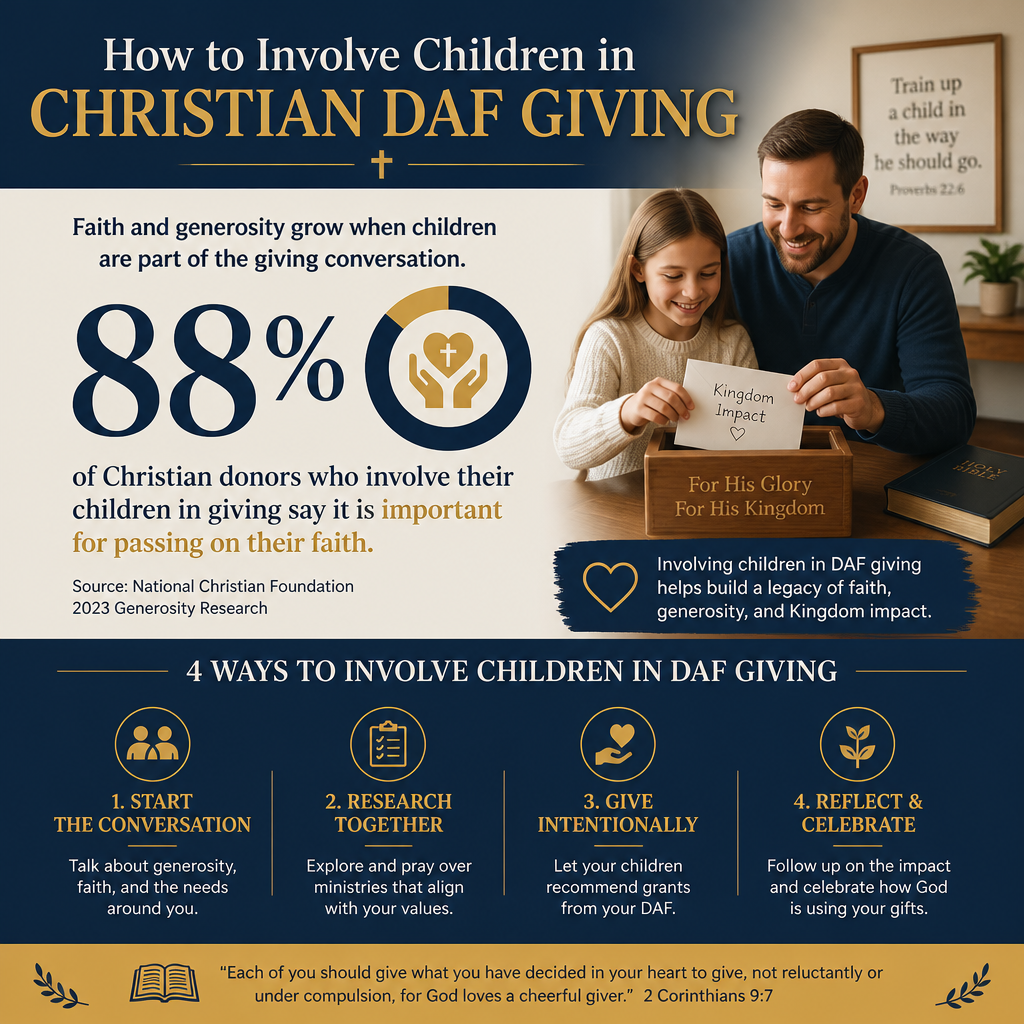
How to involve children in Christian DAF giving is not primarily a question of tactics. It is a question of formation: whether our children will learn to see wealth as stewardship under Christ, and whether they will learn to love their neighbors with discernment rather than sentiment. A donor-advised fund can become a practical classroom for that formation because it holds together prayer, planning, and accountable action.
Many Christian households want their children to participate in giving, yet feel the tension between two errors. One is performance-based generosity that trains children to give for approval. The other is unexamined generosity that bypasses wisdom, leaving children with the impression that sincerity is the same as faithfulness. Scripture commends neither. Jesus calls for secrecy in giving, but he also calls for careful obedience, including sober warnings about money’s power to deform the heart.
Begin with theology and the habits of stewardship
Teach that giving is worship, not merely philanthropy
Christian giving begins with God’s prior generosity. “Where your treasure is, there your heart will be also” (Matthew 6:21) is not a fundraising slogan; it is a diagnosis of spiritual direction. When children participate in DAF giving, they are not learning a technique for being kind. They are being apprenticed into a way of ordering life under the reign of Christ.
What this means in practice is that the first conversations should be about ownership and trust. “The earth is the LORD’s and everything in it” (Psalm 24:1) establishes that our family assets are not autonomous property. They are entrusted goods. A DAF can reinforce that truth because it formalizes the idea that certain resources have been set apart for giving and will not be consumed for family comfort.
Clarify what a DAF can and cannot do
A donor-advised fund is a charitable vehicle, not a replacement for discipleship. It can facilitate grants, track giving, and invite children into a consistent pattern of decision-making. It cannot teach repentance, produce compassion, or sanctify motives. The DAF serves best when it is clearly placed under the broader catechesis of the home and the church.
Christians genuinely disagree about how much structure to place around children’s giving decisions. Some families emphasize freedom early; others emphasize guidance longer. Both approaches can be faithful, but both can fail if they ignore the formation of conscience. The measure is not whether a child “likes” the process, but whether the process steadily trains love of God and neighbor with truthfulness.

Choose an age-appropriate decision framework
Move from observation to participation to responsibility
Children generally need giving responsibilities that grow with their capacity. A helpful progression is to begin with observation, move to meaningful participation, and eventually move to real responsibility. That sequence respects the fact that discernment is learned over time, and that children are not miniature adults.
Across our verification work at Most Trusted, we observe that mature ministries tend to have clearly articulated programs, measurable activity, and accountable leadership. Children can understand more of this than adults often assume, especially when it is explained in concrete terms: what the ministry does each week, who is served, how decisions are made, and how money is handled.
Give children real influence, not ceremonial input
Children learn integrity when they see that their counsel matters. If the family invites a child to recommend a grant but routinely ignores the recommendation, the child is being trained in cynicism. A wiser approach is to allocate a defined portion of annual DAF grants for children to recommend, and then honor those recommendations within clear boundaries.
Those boundaries can be explicit: grants must go to recognized charitable organizations; the ministry’s doctrinal commitments must not contradict the family’s confessional convictions; and the organization must show evidence of financial integrity and accountable governance. This is not suspicion; it is love of neighbor expressed through stewardship.
- Set a defined “children’s giving” amount each year within the DAF.
- Require each child to name a cause and a ministry working in that area.
- Ask for one paragraph of rationale: need, approach, and expected impact.
- Hold a family conversation where each child presents and answers questions.
- Make the grant and then follow up with a letter or update request.
Teach discernment by evaluating ministries, not just causes
Explain why verification matters for Christian love
Christian compassion is not opposed to careful evaluation; it requires it. When Paul organized relief for Jerusalem, he took pains to ensure accountable handling of funds “so that no one should blame us about this generous gift” (2 Corinthians 8:20–21). That instinct is profoundly relevant in modern charitable giving, where donors face information asymmetry and ministries can drift in mission, theology, or financial practice.
Most Trusted exists because serious Christian donors want to give with confidence. We evaluate ministries against The Most Trusted Standard, a 15-criteria framework spanning Faith Foundation, Financial Integrity, Governance and Leadership, and Transparency and Effectiveness. For families, the value is not only in making safer grants. It is in giving children a vocabulary for integrity: doctrinal clarity, board oversight, audited financials where appropriate, clear outcomes, and honest communication.
Model both conviction and humility
The harder question is how to talk about ministry failures without breeding suspicion. Children can easily conclude that “most charities are scams,” or that discernment is merely finding faults. A healthier posture is to name what is at stake: real needs, real people, and real stewardship. The goal is not to win an argument. The goal is faithful love expressed through careful action.
When field debates arise, we should name them. For example, Christians disagree about how to weigh administrative costs, and the broader nonprofit sector has argued against simplistic “overhead ratios” for years. The widely cited “Overhead Myth” letter—signed by major evaluators—warned that minimizing overhead as a primary metric can harm organizational effectiveness and distort donor expectations. Donors can review the statement through BBB Wise Giving Alliance.
Connect DAF giving to family discipleship and church life
Keep the local church central
A DAF can widen a family’s giving beyond the local congregation, but it should not train children to treat the church as optional. The New Testament assumes material support for the ministry of the Word and for mercy within the body (Galatians 6:6–10). Many families will rightly prioritize regular giving to their church outside the DAF, keeping the DAF as a distinct tool for additional grants. The key is consistency and clarity in the child’s mind: the church is not one nonprofit among many.
For families seeking a coherent approach, it often helps to situate children’s DAF participation within broader Family and Legacy Giving Through Christian Donor-Advised Funds. The point is not complexity; it is continuity across generations, where generosity is taught as a normal Christian obligation and privilege.
Protect against performative giving
Jesus explicitly warns against public displays of generosity (Matthew 6:1–4). Children are especially vulnerable to this temptation because adults praise generosity easily and because social media treats giving as identity. A family DAF process should therefore include quietness: private discussion, unpublicized grants, and gratitude expressed without spectacle.
There is also a subtler form of performance: giving only to projects that feel exciting. Some of the most faithful work in Christian ministry is unglamorous—consistent pastoral care, long-term counseling, patient discipleship, or slow community development. Children should learn that faithfulness is often ordinary and sustained.
Use the DAF to teach long-term thinking and moral trade-offs
Introduce the idea of time horizons and sustainability
A donor-advised fund naturally encourages longer time horizons. Grants do not have to be reactive. They can be planned, revisited, and adjusted as evidence accumulates. Children benefit from seeing that some needs are acute and immediate, while others require steady support over years.
The nonprofit field has had to reckon with the “starvation cycle,” a dynamic in which funders’ preference for low overhead can push organizations to underinvest in staff, systems, and evaluation, leading to weaker outcomes and eroded trust. The concept is widely discussed in the sector, including in Stanford Social Innovation Review; donors can consult Stanford Social Innovation Review for background. For children, this becomes a concrete lesson: sometimes the faithful grant is not the most emotionally compelling one, but the one that strengthens durable capacity to serve.
Teach that outcomes matter and dignity matters
Christians should not reduce ministry to metrics, yet we also cannot treat effectiveness as irrelevant. When a program claims to serve vulnerable people, we should ask whether it truly helps. The When Helping Hurts framework, articulated by Steve Corbett and Brian Fikkert, has shaped many Christian discussions by warning that aid can unintentionally harm when it undermines local agency or reinforces dependency. Children can grasp the core insight: help should strengthen people, not replace them.
In practice, this means asking ministries questions children can understand. Who is making decisions on the ground? How are local churches involved? How does the ministry know whether it is helping? What safeguards exist for vulnerable people? These questions do not require cynicism. They require love ordered by truth.
FAQs for How to involve children in Christian DAF giving
Should children be allowed to recommend any ministry they feel passionate about?
Children should be allowed meaningful influence, but within boundaries that reflect Christian responsibility. A workable approach is to limit recommendations to recognized charitable organizations whose mission and doctrine do not contradict the family’s convictions, and whose leadership and financial practices show basic accountability. That approach honors a child’s developing conscience while protecting the household from avoidable harm and confusion.
How can we keep discernment from turning into suspicion?
Discernment becomes suspicion when it is driven by fear or contempt. It remains discernment when it is driven by love of neighbor, humility about our own blind spots, and a commitment to truthful stewardship. Families can reinforce this by praying for ministries, speaking charitably about leaders, and treating accountability questions as normal Christian prudence rather than as accusations.
Forming generosity that will endure
Involving children in Christian DAF giving is a long obedience in the same direction. The aim is not to produce young grantmakers with adult vocabulary, but to form future disciples who understand that money is a spiritual matter, that love must be truthful, and that stewardship requires accountability. As families apply these practices within Christian Donor-Advised Funds, the DAF can become more than a convenient tool; it can become a durable instrument of Christian formation and intergenerational faithfulness.



