

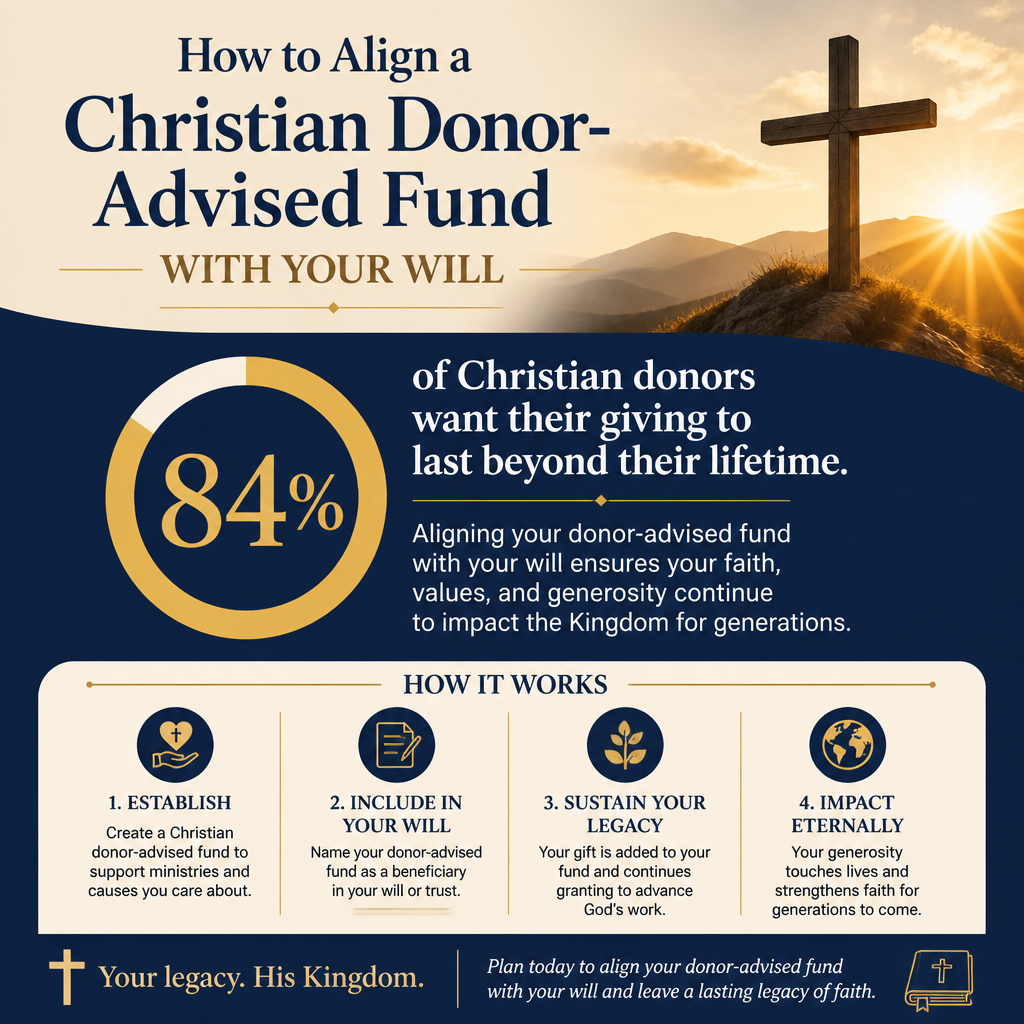
To align a Christian donor-advised fund with your will is to decide, in advance, how the resources God entrusted to you will continue to serve his purposes after your death. For many Christian donors, the practical question is not whether to give, but how to give in a way that is both spiritually coherent and legally durable. A donor-advised fund can be a disciplined instrument of stewardship, but only if it is coordinated carefully with your estate plan, your family responsibilities, and your convictions about ministry fruitfulness.
The harder question is that a DAF sits at the intersection of two different worlds. Your will controls what happens to your probate assets when you die. Your donor-advised fund is typically a separate charitable account administered by a sponsoring organization under its own policies. Alignment requires more than good intentions; it requires clear designations, credible oversight, and a plan that reduces ambiguity for heirs and honors the charitable purposes you intend.
Start with the theological and fiduciary purpose of the gift
Stewardship after death is still stewardship
Scripture speaks plainly about the moral weight of wealth and the responsibility of stewardship. Jesus’ teaching in Luke 12 warns against storing up treasure “for himself” while not being “rich toward God.” That text is not an argument against prudent planning; it is an argument against treating possessions as an end in themselves. Estate planning becomes spiritually significant when it is ordered toward love of God and neighbor, rather than driven by anxiety, control, or the desire to secure a legacy as self-justification.
For many donors, the donor-advised fund has become a way to hold charitable capital with discipline while making grants over time. Fidelity Charitable reported that its donors recommended $11.2 billion in grants in 2023, a reminder that DAFs are now a major channel in American philanthropy (Fidelity Charitable). That scale matters because it means DAFs are not a niche tool; they are increasingly part of how Christian families organize generosity.
What a DAF can and cannot do for your estate plan
A DAF can be excellent at some tasks and weak at others. It can simplify multi-ministry giving, reduce administrative burdens, and support long-term grantmaking. It cannot, however, replace the role of a will or trust in providing for dependents, naming guardians, paying taxes and debts, or resolving conflicts among heirs. Christians genuinely disagree about how much control a donor should exercise over charitable dollars beyond the grave. The more complex and prescriptive the plan becomes, the more it must be tested for practical enforceability and relational wisdom.

Coordinate the legal mechanics so the will and the DAF are not competing documents
Decide whether the DAF is a beneficiary or a companion tool
Most DAF alignment begins with a straightforward choice: will the donor-advised fund receive assets at death, or will it simply continue as the vehicle through which an already-funded account makes grants? If you intend to transfer assets into the DAF at death, you typically do that by naming the DAF sponsoring organization as a beneficiary of particular accounts or as a recipient under your will or trust. If you intend only for the DAF to continue distributing existing funds, then the estate plan must name successor advisors or establish the sponsoring organization’s default succession policy as acceptable.
What this means in practice is that your attorney should not draft your will in a vacuum. The DAF sponsoring organization’s beneficiary language and succession forms need to be reviewed alongside the will. A common failure is leaving a general bequest “to my donor-advised fund” without specifying the legal entity of the sponsoring organization and the exact fund name or account number. Clarity protects both your intent and your heirs.
Use beneficiary designations where possible
Many significant assets pass outside the will through beneficiary designations, including IRAs, life insurance policies, and certain brokerage accounts. If the DAF sponsoring organization can be named as a beneficiary, that can be simpler and faster than routing the gift through probate. It can also reduce administrative friction for your executor.
For retirement accounts in particular, charitable beneficiaries can be tax-efficient because charities generally do not pay income tax on distributions. That does not make the decision automatic, because families may have legitimate needs, and tax law is only one consideration among several. The correct ordering is theological and fiduciary: first decide what faithfulness requires, then ask how to execute it with prudence.
Plan for succession so the fund continues with integrity, not drift
Name successor advisors with real formation, not only good intentions
After your death, someone may have the ability to recommend grants from the donor-advised fund. Many sponsors allow you to name successor advisors, sometimes for one or more generations. That decision should be made with spiritual realism. Not every adult child shares the same ecclesial commitments, and not every heir has the competence to evaluate ministries responsibly. A DAF can create a meaningful intergenerational culture of generosity, but it can also become a mechanism for diffuse giving that no longer reflects your convictions.
Across our verification work at Most Trusted, we observe that donors are often surprised by how quickly “good causes” multiply while discernment capacity stays fixed. The ministries that meet The Most Trusted Standard tend to show consistency over time in governance practices, financial integrity, and truthful reporting, which makes them more dependable partners for long-term grantmaking. That is not a guarantee of spiritual fruit, but it is a disciplined way to reduce preventable risk in Christian giving.
Give guardrails without building a cage
Many donors want to set boundaries: the DAF should support gospel-centered work, avoid certain theological commitments, or prioritize specific regions or causes. Guardrails can be wise. Over-specification can be unworkable, especially when ministry landscapes change over decades. Mission agencies merge, local churches plant and dissolve, and the needs of the poor shift with migration and conflict. A plan that assumes the future will look like the present often fails its own aims.
A balanced approach typically includes (1) a clear statement of charitable priorities, (2) permission to adapt within those priorities, and (3) a process for discernment that is grounded in Scripture and accountable to the church. In many cases, it is better to articulate principles and trusted categories of recipients than to lock in a brittle list of organizations.
Ensure your giving reflects both family obligations and charitable convictions
Address the pastoral reality of heirs and expectations
Christians do not have a single mandated formula for what portion of an estate should go to family versus ministry. Scripture commands care for one’s household and warns against neglecting family obligations. It also warns against the spiritual danger of wealth and commends radical generosity. Wise estate planning treats heirs neither as idols nor as afterthoughts. It aims for justice, clarity, and peace.
Family dynamics can complicate otherwise sound plans. A donor-advised fund can be emotionally charged if heirs interpret it as money “taken away” from them, especially when the DAF balance is large. The solution is not primarily technical. It is often a matter of transparent communication in advance, anchored in a shared understanding of stewardship. When the giving plan is explained as discipleship rather than self-expression, heirs are more likely to receive it with maturity even if they would have chosen differently.
Create a short written statement of intent that can outlast your voice
We recommend drafting a concise letter of charitable intent to be kept with your estate documents and DAF records. This is not the same as inserting complex instructions into a will. It is a pastoral and interpretive document that helps successor advisors and family members understand the “why” behind the plan.
For many households, the most helpful statement includes:
- A brief theological rationale for generosity and mission
- The ministry priorities you intend to emphasize and why
- The role you want the donor-advised fund to play after your death
- Any boundaries you consider necessary for faithfulness
- A process for evaluating grantees, including accountability expectations
This is also a natural place to point heirs to careful Christian discernment about ministries, including the kind of verification work Most Trusted conducts. When donors and heirs share a common standard of evidence and integrity, the conversation becomes less about personalities and more about faithfulness.
Align grantmaking with verifiable trust, not only compelling stories
Distinguish between charity as sentiment and charity as responsibility
Christian compassion is not optional. Yet compassion without truth can be manipulated. Mature donors learn to ask not only “Is this moving?” but “Is this true, and is it good?” That is one reason the broader nonprofit sector has pushed back against simplistic measures like overhead ratios. The “Overhead Myth” letter, signed by GuideStar, Charity Navigator, and the BBB Wise Giving Alliance, argued that donors should consider governance, impact, and transparency rather than treating low overhead as a proxy for effectiveness (Candid GuideStar).
In Christian ministry, the stakes are higher than financial efficiency. Theology, accountability, and honest reporting matter because they shape the witness of the church and the protection of vulnerable people. A DAF plan connected to your will is only as strong as the integrity of the ministries it ultimately supports.
Build a verification habit into the posthumous plan
What this means in practice is that successor advisors should have a clear expectation to investigate before granting. That includes reviewing audited financials when available, confirming board independence and conflict-of-interest policies, and assessing whether the ministry communicates with candor rather than promotional exaggeration. Our work at Most Trusted is designed for precisely this: to help donors give with confidence by evaluating ministries against The Most Trusted Standard, including criteria that touch faith foundation, governance, financial integrity, and transparent reporting.
Donors who want their DAF to remain aligned over time often set a simple rule: grants should be made primarily to ministries that can demonstrate credible governance and truthful outcomes, and secondarily to experimental work where the uncertainty is acknowledged and appropriately constrained. That approach respects both prudence and the biblical call to faith.
For further context on how DAFs function in Christian stewardship, many donors benefit from reviewing Christian Donor-Advised Funds as part of their broader giving framework. Family considerations and estate-planning implications are treated more fully within Family and Legacy Giving Through Christian Donor-Advised Funds, which addresses the relational and intergenerational realities that documents alone cannot solve.
FAQs for How to align a Christian donor-advised fund with your will
Should we name our donor-advised fund in the will, or name the sponsor as a beneficiary?
In most cases, the sponsoring organization is the legal entity that must receive the gift, so beneficiary designations and bequests should name the sponsor using its exact legal name, with identifying information for the specific fund when the sponsor requires it. Whether to use the will or a beneficiary designation depends on the asset type and your broader estate plan. Many donors use beneficiary designations for retirement accounts or life insurance and use the will or trust for assets that require more detailed administration. Your attorney should confirm the sponsor’s required language and ensure the documents do not create ambiguity.
How do we keep our DAF aligned with our convictions if our children do not share them?
The first step is sober clarity about authority: who will be able to recommend grants, and under what constraints? Many sponsors allow you to name successor advisors or successor charitable beneficiaries; some allow advisory privileges to be time-limited. The second step is relational: explain the plan while you are living, and provide a written statement of intent grounded in Scripture and in the responsibilities of stewardship. Where convictional continuity is unlikely, some donors choose to direct remaining DAF assets to specified ministries or to the sponsor’s charitable programs rather than extending family advisory control indefinitely.
A durable plan honors God and reduces burden for those who come after
Aligning a Christian donor-advised fund with your will is an act of stewardship that takes both faith and foresight seriously. The goal is not control for its own sake, but clarity that serves peace: for heirs who must administer your estate, and for ministries that will rely on your support. When the legal mechanics, succession plan, and ministry discernment are integrated, your generosity can continue with integrity, bearing witness that the Giver is more precious than the gift.



