
Using Christian donor-advised funds together can turn family giving from a series of disconnected checks into a disciplined practice of stewardship, discernment, and shared formation. The central question is not whether a family can give together, but whether the structure of a donor-advised fund can serve the family’s spiritual aims without turning generosity into a financial exercise.
Scripture frames wealth as entrusted, not owned. “As each has received a gift, use it to serve one another, as good stewards of God’s varied grace” (1 Peter 4:10). A family DAF can reinforce that stewardship by making giving visible, accountable, and teachable across generations. It can also introduce new tensions: whose convictions guide the grants, how disagreements are handled, and how the family avoids confusing control with faithfulness.
Begin with a theology of shared stewardship
Stewardship is formation before it is strategy
Families often start DAF conversations with tax questions and end them with relational questions. That is usually the right order. A Christian family’s giving should be more than efficient; it should be faithful. The DAF becomes a tool, not a teacher.
Jesus’ warnings about money are direct because money quietly catechizes. It forms our instincts about security, status, and control. A shared DAF can counter that formation by placing decisions in the open, requiring deliberation, and inviting prayerful restraint. What this means in practice is that families should name the spiritual purpose of giving before discussing contribution amounts, investment options, or grant schedules.
Agree on what unity requires and what it does not
Christian families are not uniform. Some will prioritize local church and direct mercy; others will emphasize missions, education, or public witness. Unity does not require identical preferences, but it does require a shared commitment to love, truthfulness, and fair process.
A helpful discipline is to distinguish between core commitments (what the family will always support) and discretionary convictions (where members may differ). Many families treat every grant as a referendum on the family’s theology. A more mature approach acknowledges that conscience and calling vary while still holding the line on basic Christian integrity.

Choose a structure that fits your family and protects trust
Clarify who holds authority and how successors are formed
Donor-advised funds are governed by sponsoring organizations, and donors typically retain advisory privileges rather than legal control. Within that reality, families still need clarity: who is the primary advisor, who can recommend grants, and how successor advisors are appointed. These details do not diminish generosity; they protect it from ambiguity and quiet resentment.
We recommend writing a short family giving charter that is specific enough to prevent confusion but simple enough to use. It should address decision rights, conflict resolution, timelines for review, and how younger members will be included. A family that refuses to discuss authority usually ends up practicing authority without accountability.
Use shared rhythms rather than constant negotiation
Many families underestimate how exhausting it is to evaluate ministries ad hoc. A shared DAF works best when giving is organized around predictable rhythms: quarterly meetings, a yearly “portfolio” review of ministry partners, and pre-agreed budgets for categories such as local mercy, global missions, and congregational priorities.
When the process is stable, the family can focus on the substance: what is faithful giving, what is effective giving, and what kind of risk is appropriate when supporting newer works. The goal is not to eliminate disagreement but to ensure that disagreement is handled with order and charity.
Evaluate ministries with more than warmth and reputation
Discernment is part of Christian love
Families often assume that because a ministry appears sincere, it is necessarily trustworthy. The Christian tradition is more realistic. Scripture repeatedly warns against misuse of power and money among God’s people, and the history of the church includes both profound faithfulness and grievous failure.
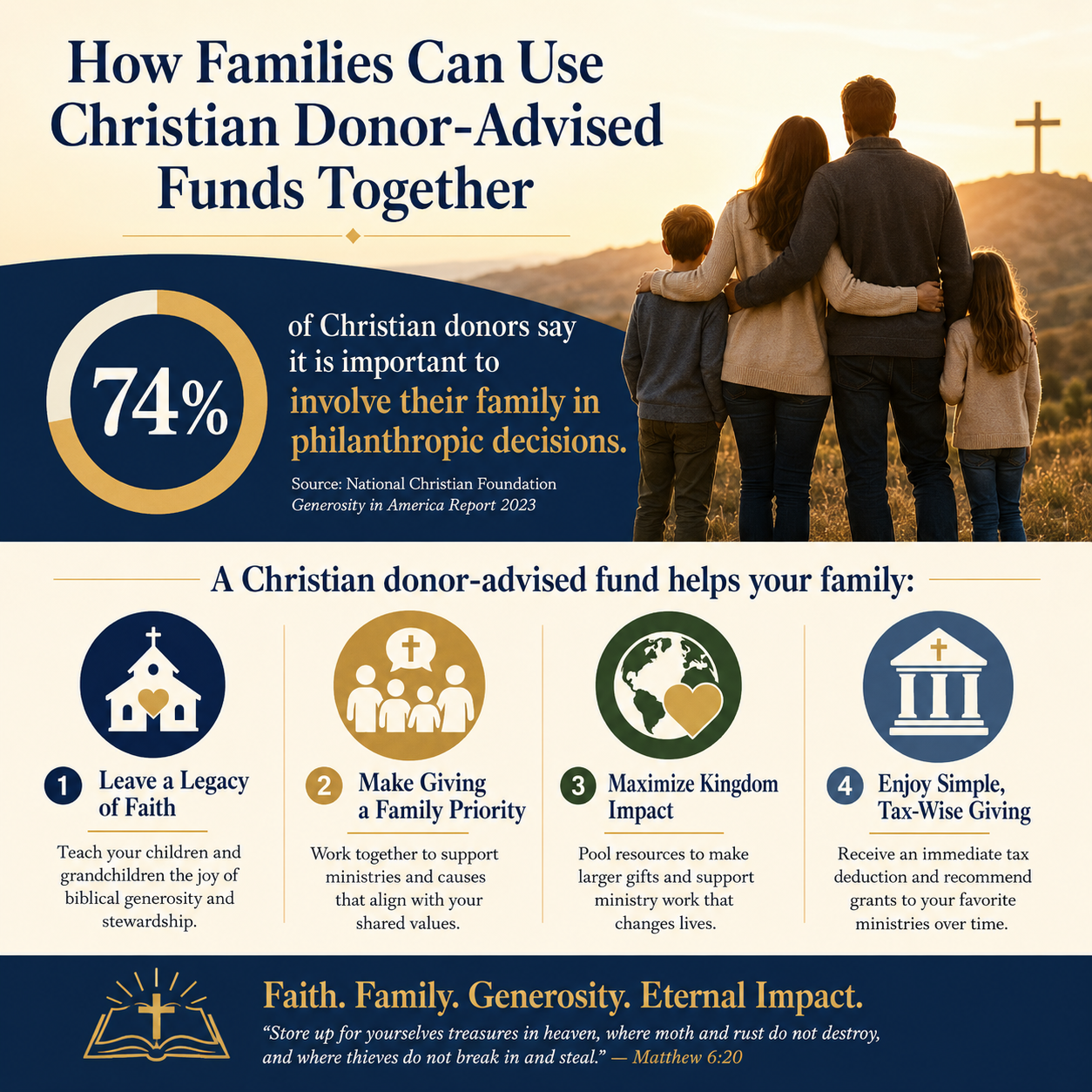
In the contemporary nonprofit world, donors also face a documented trust deficit. A majority of Americans say they have only “some” or “hardly any” confidence in charities, according to Gallup’s confidence polling Gallup. Christian donors are not immune to that broader environment, even when they rightly desire to assume the best of fellow believers.
Bring verification into the family conversation
Across our verification work at Most Trusted, we observe that mature donors do not treat due diligence as a lack of faith. They treat it as a way of honoring both donors and beneficiaries. This is where an external framework can help families remain united: disagreements become less personal when the family evaluates ministries against shared criteria.
The Most Trusted Standard assesses ministries across four areas: Faith Foundation, Financial Integrity, Governance and Leadership, and Transparency and Effectiveness. Families do not need to become auditors, but they do need to ask adult questions: Is there independent board oversight? Are finances clear and current? Does the ministry make verifiable claims? Does it handle restricted gifts with integrity? Does its theology meaningfully shape its practice rather than functioning as branding?
For families building a long-term approach, it can be helpful to ground your shared discernment in broader Christian reflection on helping. The When Helping Hurts framework, articulated by Steve Corbett and Brian Fikkert, has shaped many responsible mercy efforts by clarifying how misdiagnosing poverty can reinforce dependency and harm relationships When Helping Hurts. Even when a family’s giving is not focused on poverty alleviation, the principle holds: good intentions do not guarantee good outcomes.
Practice multigenerational participation without tokenizing younger voices
Give children real responsibility, not performative choices
If a family wants a DAF to serve legacy aims, children and grandchildren need meaningful participation. But participation should match maturity. A common error is to offer young members “fun” giving decisions while adults keep all substantive discernment to themselves. Another error is to treat youthful passion as sufficient reason to fund a ministry without adequate evaluation.
A better approach is apprenticeship. Older members model how to read a Form 990, how to ask a ministry for a clear outcomes report, how to assess leadership accountability, and how to test theological clarity. Younger members can then bring their questions and convictions into a process that is rigorous, not dismissive.
Create a shared grant docket with clear categories
Families often find that a small set of categories reduces conflict and improves clarity. These categories can reflect callings and commitments without forcing a single uniform priority. A shared docket also gives younger members a visible map of how the family thinks about the Kingdom of God and the needs of the world.
- Core commitments that recur annually, such as local church support and trusted long-term partners
- Mercy and relief for urgent needs with clear guardrails on verification
- Missions and church planting with attention to accountability and local leadership
- Formation and education that strengthens Christian institutions and discipleship
- Exploratory grants for newer ministries, capped at a modest portion of annual giving
For readers who want a broader context on how DAFs function in Christian giving, we address key considerations in Christian Donor-Advised Funds. Families typically benefit from understanding the mechanics well enough to avoid either cynicism or naivete.
Handle disagreement with seriousness and pastoral realism
Expect tensions and decide in advance how to resolve them
Even spiritually mature families will disagree about giving. Some disagreements are prudential: how much to allocate to immediate relief versus long-term development, or how to weigh measurable outcomes against less quantifiable spiritual fruit. Other disagreements are theological: what kinds of public engagement are faithful, or how to interpret contested cultural questions.
What this means in practice is that families should not wait for a conflict to decide how decisions will be made. Some families require unanimity for grants from the shared pool and create a separate discretionary pool for individual recommendations. Others use supermajority thresholds. Either can be faithful if it protects conscience, preserves relationships, and avoids coercion.
Guard against the moral hazards of family philanthropy
Family giving can drift toward control, image management, or the subtle purchase of influence. A DAF’s structure can amplify these risks because it gathers resources and formalizes decision-making. The discipline is to keep giving oriented toward service rather than status.
One practical guardrail is to require clear documentation for grants to any ministry where a family member has a leadership role or receives compensation. Another is to insist on the same verification standards for “friends’ ministries” that would be applied to an unknown organization. Christian integrity is consistent when it costs something.
Families who want to think carefully about long-term dynamics often benefit from the wider conversation in Family and Legacy Giving Through Christian Donor-Advised Funds. Legacy is not only about the size of the fund. It is about the habits of truthfulness, humility, and discernment that are handed down.
FAQs for How families can use Christian donor-advised funds together
Can multiple family members legally control a donor-advised fund together?
A donor-advised fund is owned and administered by the sponsoring organization, and family members typically have advisory privileges defined by that sponsor’s policies. Many sponsors allow multiple advisors and successor advisors, but the details vary. Families should confirm, in writing, who can recommend grants, who can access statements, and how successor roles are transferred.
How can a family keep DAF giving from becoming divisive?
Divisiveness usually comes from unclear authority and unclear criteria. A short family giving charter, predictable decision rhythms, and shared standards for ministry evaluation reduce conflict without suppressing conviction. When disagreements remain, a two-pool approach often helps: a shared pool for consensus priorities and a discretionary pool for individual convictions, both governed by the same integrity expectations.
A shared DAF can serve both generosity and discipleship
Christian donor-advised funds can help families give together with order, patience, and seriousness, but they cannot manufacture unity or maturity. The most enduring family giving cultures join clear structures to clear spiritual purpose: stewarding resources as a trust from God, loving neighbors with wisdom, and supporting ministries whose faith and practices can bear scrutiny. When those commitments are in place, a family DAF becomes less a financial vehicle and more a disciplined practice of shared stewardship.



