

Teaching members about donor-advised funds requires more than describing a tax-efficient account. Donor-advised funds sit at the intersection of worship, stewardship, and discernment, and pastors are uniquely positioned to frame them as a means of ordered generosity rather than a substitute for it.
The pastoral opportunity is real because the pastoral risk is also real. A donor-advised fund can encourage disciplined giving, thoughtful support of effective ministries, and generosity during seasons of unusual income. It can also become a place where good intentions stall, where generosity becomes abstract, and where the local church is unintentionally displaced from a member’s giving life. Clear teaching can hold the tool in its proper place.
Teach donor-advised funds as stewardship under the Lordship of Christ
Begin with Scripture that addresses ownership and accountability
Christian teaching on money begins with the conviction that God owns what we manage. “The earth is the LORD’s and everything in it” (Psalm 24:1). Jesus’ parables assume stewardship and accountability, not mere preference. When pastors teach donor-advised funds within that frame, the conversation becomes less about “smart giving” and more about faithful administration of resources entrusted for love of God and neighbor.
That framing also protects against a subtle moral inversion: treating “impact” as if it were the ultimate good, detached from obedience, humility, and justice. Members do not need a sermon that baptizes financial technique. They need guidance that makes space for prudence while insisting that generosity remains a spiritual discipline with eternal stakes (Matthew 6:19–21).
Name the difference between giving and parking funds
A donor-advised fund is not, in itself, a charitable gift to operating ministries. In most cases, it is a charitable contribution to a sponsoring organization with advisory privileges about future grants. That distinction matters pastorally, because Scripture’s emphasis falls on love enacted, not merely resources allocated.
The harder question is not whether a donor-advised fund is permissible. The harder question is whether it helps a household become more faithful in generosity over time. Pastors can teach members to examine the heart-level temptations: procrastination disguised as prudence, control disguised as discernment, and tax planning disguised as sacrifice.

Explain the mechanics clearly without turning the pulpit into a seminar
Use plain definitions and one or two concrete scenarios
Most members will not act on what they cannot repeat in ordinary conversation. A simple definition is usually sufficient: a donor-advised fund is a charitable account where a donor contributes assets, receives a charitable deduction (subject to IRS rules), and then recommends grants to nonprofits over time. Pastors do not need to recite every technical detail to teach faithfully; they need to remove confusion that leads to poor decisions.
Two scenarios tend to resonate in church life. First, a member has an unusually high-income year and wants to set aside funds for multi-year giving. Second, a member wants to donate appreciated stock rather than cash. The IRS itself notes that long-term capital gains are taxed at different rates than ordinary income, which is one reason appreciated assets often appear in charitable planning discussions Internal Revenue Service.
Clarify what donor-advised funds can and cannot do
Pastors serve members well by naming a few boundaries that prevent accidental misuse. A donor-advised fund generally cannot pay for a legally binding pledge, cannot provide personal benefit, and cannot replace ordinary budgeting discipline. Some sponsors also limit grants to certain kinds of entities.
What this means in practice is that donor-advised funds fit best as a complement to faithful baseline giving, not a workaround for indecision. Members who struggle to give consistently are rarely helped by adding a more complex vehicle.
- When donor-advised funds tend to fit: irregular income, large one-time events, appreciated assets, multi-year commitments, and family giving decisions.
- When they tend not to fit: chronic under-giving, confusion about priorities, or a desire to keep giving opaque to any accountability.
- Key pastoral question: does this tool strengthen generosity and clarity, or multiply delay and control?
- Key discipleship question: who will help the member remain faithful once the money is “set aside”?
Guard against spiritual and ethical pitfalls that sophisticated donors recognize
Address the problem of dormant funds without demonizing the tool
One widely discussed concern is that donor-advised funds can accumulate assets while pressing needs remain unmet. That is not a reason to condemn donor-advised funds; it is a reason to teach members to set a personal granting rhythm. When pastors raise this concern carefully, thoughtful donors usually respect the candor because it acknowledges a real tension: charitable resources can be “earmarked for good” without being deployed for good.
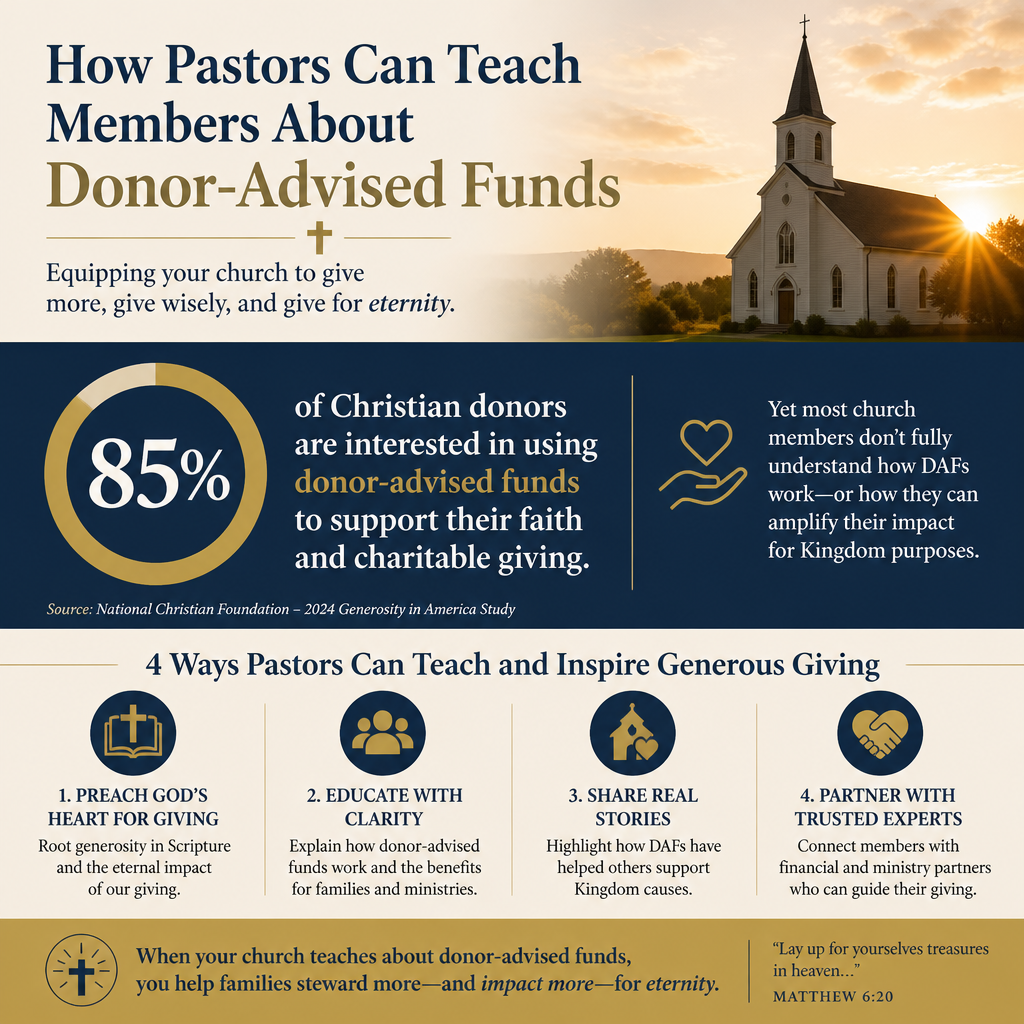
National reporting has drawn attention to the scale of donor-advised funds in American philanthropy and the debate about payout expectations The Chronicle of Philanthropy. A pastor does not need to adjudicate every policy argument to offer wise guidance. It is enough to say, plainly, that Christians should not confuse account balances with obedience.
Hold together church support and broader charitable giving
Christians genuinely disagree about how to relate tithing language to the New Testament, and pastors should acknowledge that rather than forcing a simplistic rule. Yet the New Testament is clear that local churches have real needs and real claims: the support of elders who labor in preaching and teaching (1 Timothy 5:17–18), the care of the poor, and the sending of the gospel (Philippians 4:15–18).
Pastors can teach members to avoid the false choice between giving through the church and giving to ministries beyond the church. Donor-advised funds may help some households support a range of ministries, but they should not become a mechanism for drifting away from covenantal responsibility and embodied community.
Teach members to give with confidence by verifying ministries, not merely admiring them
Encourage due diligence as a form of neighbor-love
Many members assume that Christian branding is sufficient evidence of faithfulness. Pastors know better. Ministries vary widely in governance, financial integrity, theological clarity, and truthfulness in communications. Donor-advised funds can intensify this issue because they make it easier to support many organizations with a few clicks, sometimes without real scrutiny.
Verifiable evidence suggests donors are increasingly attentive to trust and transparency in the nonprofit sector. Independent evaluators and watchdogs have documented how difficult it can be for donors to assess effectiveness without clear reporting and governance practices GiveWell. The Christian donor’s task is not merely to find “good causes,” but to support organizations that handle resources with integrity before God and people.
Place verification tools in the service of discipleship
Most Trusted exists to help donors give with confidence by evaluating Christian nonprofits against The Most Trusted Standard, a 15-criteria framework spanning Faith Foundation, Financial Integrity, Governance and Leadership, and Transparency and Effectiveness. Pastors do not need to outsource pastoral care to an evaluator. But pastors can commend verification as a practical expression of wisdom.
Across our verification work, we observe that ministries that are strongest in outward impact usually have strong internal disciplines as well: clear doctrinal accountability, documented financial controls, a functioning board, and reporting that can be tested rather than merely celebrated. Teaching members to ask for this kind of evidence is not cynicism. It is stewardship.
For members who want to situate donor-advised funds within a distinctly Christian approach, Christian Donor-Advised Funds is a useful starting point because it keeps theological commitments and practical decisions in the same conversation.
Equip pastors with a workable teaching plan for real congregational life
Teach in layers rather than a single announcement
Most churches will not form a congregation’s giving habits through one Sunday or one class. Donor-advised funds are best taught in layers: a sermon-level theological frame, a short educational forum with basic mechanics, and then personal counsel for members facing complex decisions. Pastors can also enlist trusted financial professionals in the congregation, with clear boundaries: education is not endorsement, and the church is not selling products.
What this means in practice is that pastors should prepare language that is consistent across settings. If a donor-advised fund is presented as “a way to give later,” members will use it to delay. If it is presented as “a way to plan giving faithfully and release resources on a deliberate schedule,” members are more likely to treat it as a discipline.
Offer guardrails members can adopt immediately
Mature donors often welcome guardrails because they know money can become a spiritual blind spot even for sincere believers. Pastors can suggest a few commitments without making them into law: maintain regular giving to the local church; set a written plan for grants; review grants annually in prayer; and prioritize ministries with verified governance and financial integrity.
Many churches will also want a clear internal policy for how members may use donor-advised funds in relation to church giving, especially when members want to “fulfill” pledges or commitments. Pastors should consult counsel familiar with charitable compliance and encourage members to check with their donor-advised fund sponsor. A short, written church policy prevents confusion and protects unity.
Because donor-advised funds easily touch questions of motive, transparency, and accountability, Faith-Based Stewardship in Christian Donor-Advised Funds is an appropriate category for deeper reflection that keeps financial practice tied to formation.
FAQs for How pastors can teach members about donor-advised funds
Should pastors encourage donor-advised funds from the pulpit?
Pastors can teach about donor-advised funds as one legitimate tool of stewardship, but the pulpit is best used to form the theology of money rather than to promote a particular vehicle. The most faithful approach is to describe what donor-advised funds are, when they may serve generosity, and where they can tempt Christians toward delay or control. Members with complex situations can then be served through classes or pastoral counsel.
Can a donor-advised fund be used to give to the local church?
In many cases, a donor-advised fund can recommend grants to a church that qualifies as a charitable organization under IRS categories. However, donor-advised funds typically cannot be used to satisfy a legally binding pledge, and they cannot provide personal benefit. Members should confirm the church’s eligibility and the sponsor’s rules, and churches should adopt a clear policy so members are not pressured or confused.
A faithful teaching posture for a useful but imperfect tool
Donor-advised funds can serve Christian generosity when they are treated as a means of disciplined release rather than deferred obedience. Pastors serve members well by teaching the tool within a full theology of stewardship, by naming the moral risks without alarmism, and by encouraging verification of ministries as an act of integrity. The goal is not sophisticated giving for its own sake, but faithful giving ordered toward love of God and neighbor.



