
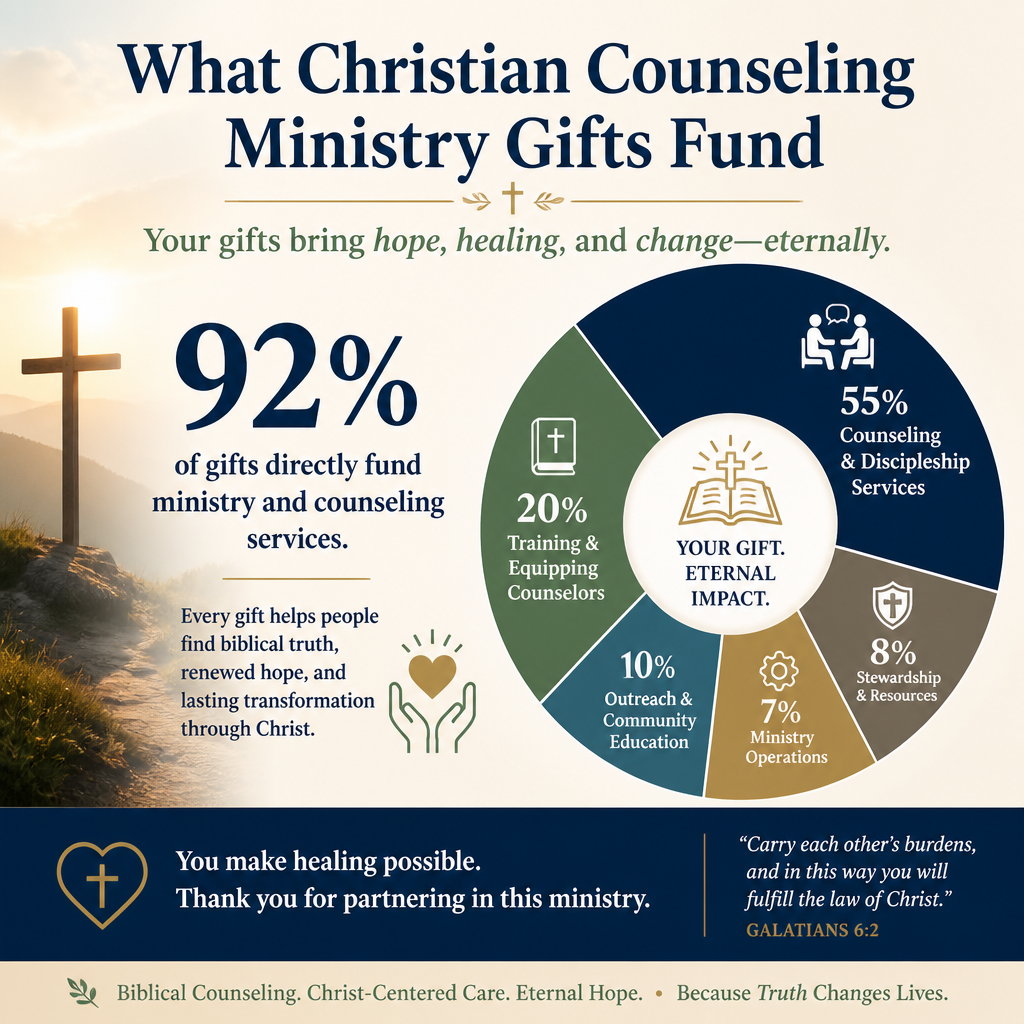
What Christian counseling ministry gifts fund is not a vague set of “general operations.” In faithful ministries, donor dollars underwrite a careful blend of pastoral care, clinical competence, and practical mercy for people whose lives have been strained by trauma, addiction, marital conflict, anxiety, depression, and grief. Christians give to counseling ministries because the Church is commanded to bear one another’s burdens, and because suffering is not only a private problem but a discipleship concern (Galatians 6:2).
The harder question is not whether counseling matters, but what exactly a donor is paying for when a ministry says “counseling,” and whether that work is credibly governed, financially clean, and spiritually grounded. Across our verification work at Most Trusted, the ministries that meet The Most Trusted Standard tend to describe funding uses with uncommon specificity: who is served, what model is used, how outcomes are tracked, how counselors are supervised, and what safeguards protect counselees and the donor’s trust.
Clinical care and pastoral care are both real costs
Session-based counseling is labor-intensive by design
High-quality counseling is time-bound, relational work. A single clinical hour typically includes preparation, documentation, care coordination, and supervision, even when a ministry does not bill those activities separately. Donor gifts often cover the gap between what counselees can pay and what it costs to deliver competent care, particularly when a ministry serves families facing unemployment, medical bills, or long-term caregiving burdens.
When a ministry employs licensed clinicians, gifts can fund salaries and benefits that keep counselors stable and available. When a ministry uses a referral network of licensed providers, gifts can fund intake staff, case management, and subsidized referral vouchers that make services reachable for those who would otherwise forgo care.
Spiritual integration requires training and accountability
Many donors are drawn to Christian counseling because it refuses the false choice between spiritual counsel and psychological insight. That integration is not automatic. It requires a clear theological statement, training in spiritually informed care, and boundaries that protect counselees from being treated as a project rather than a person. Some ministries use established frameworks such as trauma-informed care and evidence-based modalities while remaining explicit that hope, repentance, forgiveness, and reconciliation are not merely therapeutic tools but theological realities.
This is also where Christians genuinely disagree. Some prioritize “biblical counseling” models that limit the role of secular psychology; others prioritize clinical licensure as the primary safeguard. Donors should not assume uniformity. A credible ministry will state its model plainly and show how it trains counselors to apply it responsibly.

Access is often the primary financial purpose of donor gifts
Scholarships and sliding-scale fees are a form of mercy
Most counseling need is concentrated where money is tight. Gifts frequently fund scholarships, reduced fees, or a sliding-scale structure that allows a ministry to say “yes” to the counselee who cannot pay market rates. In practice, these subsidies are often the single largest donor-funded line item, because demand is high and insurance coverage is inconsistent.
Nationally, cost remains a documented barrier to mental health care. The National Alliance on Mental Illness reports that in 2023, 27% of adults with mental illness said they were unable to receive needed treatment due to cost, and 11% said cost caused them to stop treatment or medication (NAMI).
Infrastructure that lowers friction for suffering people matters
Donors sometimes undervalue “administration” because it feels indirect. But for counseling ministries, the front door is part of the care. Gifts may fund intake lines, scheduling systems, secure record-keeping, and triage protocols that keep a person from being bounced between voicemail boxes during a crisis.
What this means in practice is that a ministry may spend meaningfully on client management software, secure telehealth platforms, and training in privacy practices. Those are not luxuries; they are part of treating people with dignity and protecting them from avoidable harm.
Healthy ministries invest in standards, supervision, and safeguarding
Supervision protects counselees and counselors
Counseling is a profession with real power dynamics. A ministry’s budget should reflect that reality. Donor gifts can fund clinical supervision, case consultation, and continuing education—especially in areas that are common in ministry settings: sexual abuse and exploitation, domestic violence, suicidal ideation, addiction, and complicated grief. Competent care is rarely the work of isolated counselors; it is the work of supervised teams.
For donors, one of the most telling indicators is whether a ministry can explain its supervision structure without defensiveness. Who reviews cases? How are high-risk situations escalated? What credentials are required for supervisors? The answers should be concrete.
Safeguarding includes policies, audits, and reporting pathways
Christian counseling settings can be vulnerable to spiritual manipulation and to ordinary forms of misconduct. Gifts may fund background checks, ethics training, mandatory reporting training, and outside legal review of policies. In some organizations, donor dollars support third-party hotlines or independent reporting mechanisms that allow counselees and staff to raise concerns without fear of retaliation.
This is also where governance shows. Ministries that treat safeguarding as a moral obligation, not a public-relations risk, typically have board oversight of policies and a disciplined approach to incidents. Donors can rightly expect that a ministry’s leadership has done the unglamorous work of preparing for the hard cases.
Many counseling ministries serve the whole household, not only the individual
Marriage, parenting, and family systems work is common
While the presenting issue may be an individual’s anxiety or depression, the actual strain often runs through marriages, parent-child relationships, and extended family conflict. Gifts can fund marriage intensives, parenting groups, and family therapy capacity, especially when a ministry serves pastors and ministry families whose pressures are distinctive.
Donors should also recognize that family-based work frequently requires more coordination and longer care plans. It can be slower, more expensive, and more fruitful when done well.
Groups, classes, and prevention reduce downstream harm
Many ministries use donor support to move upstream: trauma support groups, addiction recovery support, grief groups, and psychoeducational classes on communication, boundaries, and spiritual practices. These programs are not substitutes for individual counseling, but they can extend reach and create community-based support that individual sessions cannot provide.
Research on loneliness underscores why relationally grounded interventions matter. In 2023, the U.S. Surgeon General issued an advisory describing loneliness and isolation as significant public health concerns, with associated risks for health and well-being (U.S. Department of Health and Human Services).
- Subsidized counseling sessions for low-income individuals and families
- Intake, triage, and case management for timely, appropriate referrals
- Clinical supervision, consultation, and continuing education
- Safeguarding systems including training, screening, and reporting pathways
- Groups and classes that extend care through community
What donor confidence requires is more than compassionate intent
Transparency about theology, outcomes, and money is a ministry discipline
Christian compassion does not remove the need for verification. Donors should expect clear reporting: how many people were served, what services were delivered, what the average subsidy was, and what the ministry learned about effectiveness. Counseling outcomes are not always easily reduced to numbers, and confidentiality must be honored, but responsible ministries can still report aggregates, retention rates, wait times, and client satisfaction patterns without compromising privacy.
They should also be transparent about theological commitments. A ministry can be explicitly Christian without treating Scripture as a slogan. Serious counseling ministries articulate how they understand human personhood, sin and suffering, sanctification, and hope, and how those convictions shape care for trauma survivors, those with psychiatric diagnoses, and those in complex family situations.
Verification frameworks help donors distinguish maturity from marketing
Because counseling work is intimate and emotionally charged, donors can be vulnerable to persuasive stories that are difficult to evaluate. This is one reason Most Trusted exists. Our evaluations against The Most Trusted Standard examine faith foundation, financial integrity, governance and leadership, and transparency and effectiveness—precisely the areas where a compassionate mission can still fail its people.
Donors who want a broader view of this field can engage our coverage of Christian Counseling Ministries. For those focusing on the practical question of how gifts translate into ministry activity, we also publish analysis within How Christian Counseling Ministries Use Donations, where accountability and donor intent remain central.
A final tension deserves to be named. Some donors are taught to evaluate ministries primarily by “low overhead,” as if administration were inherently suspect. Yet leaders across the nonprofit sector have argued that overhead ratios can mislead donors and distort organizational health. Charity Navigator, Candid (GuideStar), and the BBB Wise Giving Alliance jointly urged donors to move beyond overhead as a primary measure, emphasizing results, transparency, and governance (Charity Navigator).
FAQs for What Christian counseling ministry gifts fund
Do Christian counseling ministry gifts mainly pay for counseling sessions?
Often they do, especially through scholarships and sliding-scale subsidies. But gifts also fund the systems that make sessions safe and effective: intake and triage, clinical supervision, continuing education, safeguarding policies, secure records, and appropriate referral pathways. For donors, the relevant question is whether the ministry can show how each cost serves faithful care and protects counselees.
How can donors tell whether a counseling ministry is responsible with gifts?
Responsible ministries state their counseling model and theological commitments clearly, show credentialing and supervision practices, publish financial statements and governance information, and report credible indicators of reach and effectiveness without violating confidentiality. Donors can also rely on independent verification. Most Trusted evaluates ministries against The Most Trusted Standard so giving decisions can rest on verifiable practices, not only compelling stories.
Giving that strengthens the Church’s care
Christian counseling ministry gifts fund work that is both tender and technically demanding: wise presence with suffering people, disciplined safeguards, and accessible care for those priced out of help. When donors give with discernment, they participate in a form of stewardship that honors Christ’s concern for the wounded and the Church’s obligation to serve with integrity, not sentimentality.



