

Christian counseling ministries track spiritual growth outcomes because donors, counselees, and church partners are not merely funding services; they are seeking evidence of genuine discipleship and healing. The work is spiritual by nature, and Christian stewardship requires more than good intentions—it requires truthfulness about what is actually forming in people over time.
That claim invites immediate tension. Spiritual growth is not reducible to a dashboard, and Scripture does not treat sanctification as a linear metric. Yet the New Testament does expect discernible fruit (John 15:8), measurable integrity in leadership (1 Timothy 3), and accountable stewardship (Luke 16:10–12). Tracking outcomes is not a concession to secular measurement culture; it is often a practical way to obey biblical accountability without pretending we can quantify the Holy Spirit.
Spiritual growth is a ministry aim, not a marketing claim
Counseling that names Christ should not be outcome-agnostic
Many counseling ministries describe their distinctiveness in explicitly Christian terms: repentance, renewed mind, reconciliation, freedom from enslaving patterns, restored worship, and vocational faithfulness. If those are the ministry’s stated ends, the ministry has an obligation to test whether its work plausibly contributes to those ends. Otherwise, “Christian” becomes branding rather than a truthful description of formation.
The harder question is not whether spiritual growth can be measured in a laboratory sense. The harder question is whether a ministry can honestly report what it is seeing, what it is not seeing, and what it is still learning. Mature reporting often includes both encouragement and restraint: evidence of change alongside acknowledgment of relapse, attrition, unresolved trauma, and the slow pace of growth for some counselees.
Scripture assumes fruit is observable, even when motives are hidden
Scripture distinguishes between what only God can see and what the church is responsible to recognize. “The Lord sees not as man sees” (1 Samuel 16:7) is not a license for leaders to avoid evaluation. Jesus’ teaching repeatedly returns to fruit as a public reality: “You will recognize them by their fruits” (Matthew 7:16). Paul expects churches to evaluate character and conduct in leaders and to practice meaningful discipline when necessary (1 Corinthians 5). Those are not sterile exercises; they are spiritual acts of fidelity.

Donors give as stewards, and stewardship requires evidence
Giving is discipleship, so donors ask better questions
Christian donors are not only transferring resources; they are practicing stewardship before God. That is why the most serious donors increasingly ask about outcomes rather than only activities. A ministry can be busy and still be ineffective, or worse, subtly harmful. The point is not to demand perfection. The point is to refuse the false comfort of activity as a substitute for impact.
Within charitable giving more broadly, expectations for evidence have risen across the sector. One reason is that trust has been damaged by preventable failures—financial mismanagement, leadership scandals, and inflated claims. Donors who want to honor Christ with their giving cannot treat these as merely “administrative” issues; they are matters of truth-telling.
The credibility crisis makes transparency more than a preference
Public confidence in institutions has weakened markedly in recent years, including in the nonprofit world. The significance for Christian counseling is direct: when trust is thin, donors rely more heavily on verifiable transparency. The Pew Research Center has documented long-term declines in Americans’ trust in government and other major institutions, a broader cultural backdrop that shapes donor behavior even when donors remain committed to biblical generosity (Pew Research Center).
What this means in practice is that ministries that can clearly describe their outcomes—how they define them, how they track them, and what they do when results are weak—tend to earn deeper, more durable trust. That trust is not a marketing asset; it is a stewardship responsibility.

What can be tracked without reducing sanctification to numbers
Outcomes should reflect theology, not borrow a secular template
Christians genuinely disagree about the best way to describe growth: habits of grace, spiritual disciplines, virtue formation, affective maturity, obedience, union with Christ, or participation in the life of the church. Good measurement begins by naming a theological account of change and then choosing indicators that fit that account. Poor measurement begins by importing generic wellness indicators and then baptizing the language.
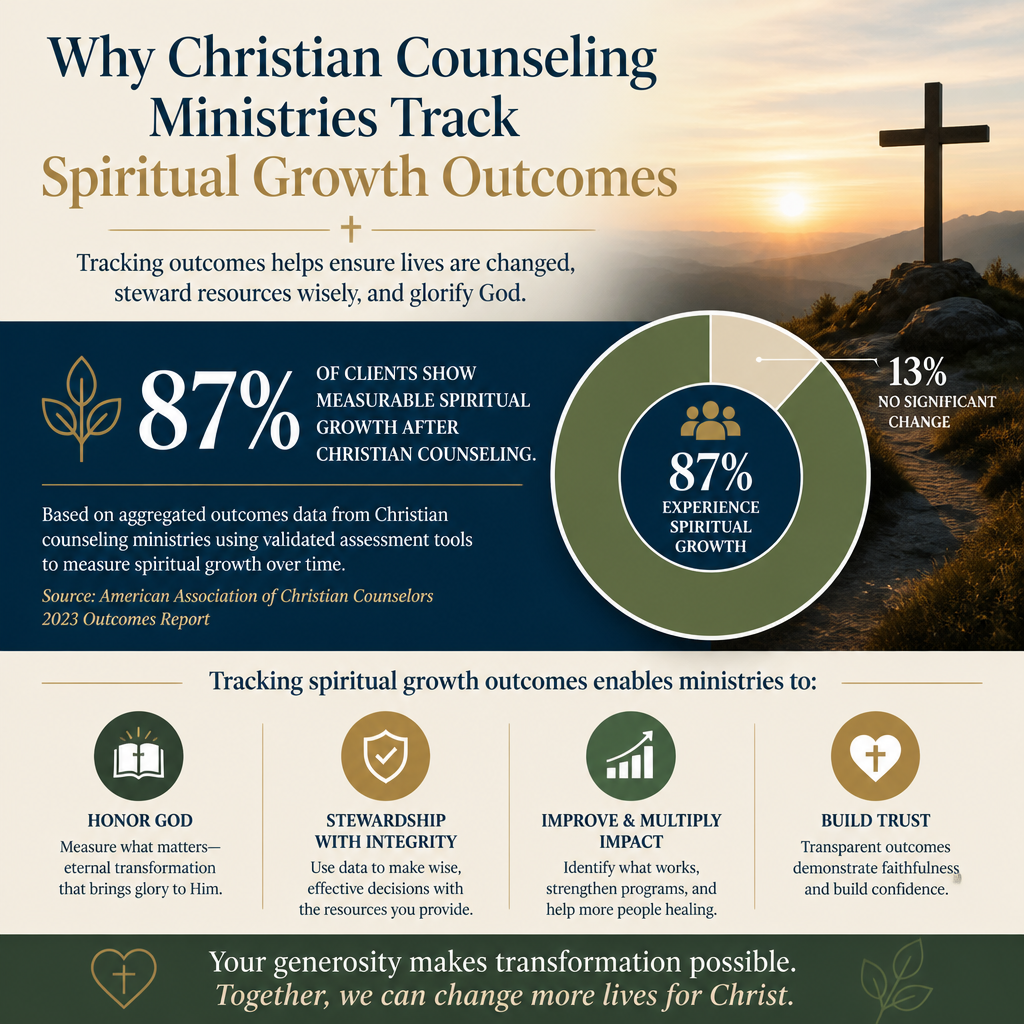
Serious ministries often track a mix of spiritual, relational, and functional outcomes, because Scripture speaks to the whole person. Depression scores may matter, but so may reconciliation with family, resumption of church fellowship, confession of sin, development of stable rhythms, and faithful endurance in suffering. None of these are easily collapsed into a single score, and that is a feature, not a bug.
Practical examples of outcome indicators that respect complexity
Across our verification work at Most Trusted, we observe that the healthiest counseling ministries avoid two extremes: vague claims of “lives changed” with no definition, and overly technical metrics that pretend to capture spiritual realities exhaustively. The ministries that meet The Most Trusted Standard tend to articulate outcomes that can be credibly observed and ethically gathered.
Examples of outcome indicators that many ministries can track without distortion include:
- Counselee retention and completion rates with clear definitions and honest reporting of attrition
- Pre and post self-report measures of hope, despair, or perceived closeness to God, used with pastoral humility
- Church re-engagement where appropriate, such as returning to corporate worship or small-group participation
- Relational repair milestones, such as reconciliation efforts, boundary-setting, or reduced conflict
- Referral patterns and follow-up outcomes from pastors, physicians, or partner churches
Some ministries also use established clinical instruments for anxiety or depression when licensed professionals oversee their use. That can be appropriate, but it raises additional questions about training, scope of practice, privacy, and the ministry’s theology of care.
Outcomes protect counselees and strengthen churches
Measurement can surface harm, not merely confirm success
The field has had to reckon with a sobering reality: counseling can unintentionally harm. Harm is not always dramatic; it can take the form of spiritual bypassing, coercive discipleship, mishandled trauma disclosure, or simplistic attributions of suffering to personal sin. Tracking outcomes and collecting structured feedback can help leadership detect patterns that otherwise remain hidden—especially when counselees feel intimidated or grateful and therefore reluctant to criticize.
In other words, outcome tracking is not only about proving effectiveness. It is also about guarding the flock. Ministries that counsel in Christ’s name bear a weighty responsibility to receive correction. “Not many of you should become teachers… for you know that we who teach will be judged with greater strictness” (James 3:1). Counseling ministries are not identical to the teaching office, but the warning about spiritual influence is relevant.
Good outcomes data helps pastors shepherd more wisely
Christian counseling ministries frequently serve as an extension of local church care. When outcomes are tracked well, pastors can better understand what kinds of cases are being served, where counselees commonly get stuck, and what kinds of support from the church correlate with sustained change. This strengthens the relationship between counseling ministries and church leaders, replacing vague endorsements with concrete collaboration.
Done poorly, data can undermine that trust. If a ministry presents inflated success rates or selectively reports only favorable stories, pastors eventually notice the mismatch between the narrative and what their people experience. Honest outcomes reporting, including limits and learning, tends to mature partnerships rather than strain them.
How donors should evaluate spiritual growth claims
Donors should look for clarity, humility, and verifiability
Donors do not need to become clinicians to ask discerning questions. The goal is to see whether a ministry’s claims are proportionate to its evidence, and whether its leadership is willing to be accountable. A ministry that speaks with theological seriousness about transformation should also be willing to describe how it listens, learns, and corrects course.
Questions that often clarify whether outcomes language is trustworthy include: What outcomes do you define as central, and why? How do you gather data without coercion? How do you protect confidentiality? What do you do when outcomes are weak? How do you involve local churches?
Verification adds a second layer of accountability
Self-reporting is necessary, but it is not sufficient for donor confidence. Independent verification can test whether an organization’s public claims align with its governance practices, financial integrity, and program reality. That is the work Most Trusted exists to do: we evaluate Christian nonprofits against The Most Trusted Standard, a 15-criteria framework spanning faith foundation, financial integrity, governance and leadership, and transparency and effectiveness.
Donors who want to assess the broader landscape of Christian Counseling Ministries should expect clear evidence that a ministry can describe impact without distortion and can receive accountability without defensiveness. For donors comparing approaches and expectations, How Christian Counseling Ministries Measure Impact is often the practical place to begin.
FAQs for Why Christian counseling ministries track spiritual growth outcomes
Does tracking spiritual growth outcomes contradict the doctrine of grace?
No. Grace is not opposed to effort or assessment; it is opposed to earning (Ephesians 2:8–10). Tracking outcomes does not claim that sanctification can be manufactured, purchased, or guaranteed. It simply acknowledges that ministries make choices—curriculum, counselor training, supervision, referral policies, safeguarding practices—and those choices have consequences that can often be observed. Under grace, Christians still examine fruit and practice accountability.
What if a counseling ministry serves complex trauma and progress is slow?
Slow progress can be faithful progress, particularly in long-standing trauma, addiction, or severe relational breakdown. In those contexts, wise outcomes reporting often emphasizes realistic indicators: stability, safety planning, reduced self-harm, consistent church support, strengthened coping skills, and sustained engagement over time. The question is not whether every story resolves quickly; it is whether the ministry can describe what faithful care looks like in hard cases and can show credible patterns of help rather than relying on exceptional testimonies.
Accountability is part of Christian love
Christian counseling ministries exist to serve people in some of their most vulnerable moments. That reality calls for compassion, but it also calls for rigor. Tracking spiritual growth outcomes—carefully defined, ethically gathered, and humbly interpreted—is one way ministries honor the truth, protect counselees, and give donors the confidence that generosity is supporting genuine, lasting formation.



