
How Christian counseling ministries measure outcomes is not a technical question reserved for clinicians and boards. It is a stewardship question, because donors are not only funding sessions; they are funding the ministry’s claim that the gospel brings light into places of despair, confusion, addiction, and grief.
Measuring outcomes in Christian counseling requires moral seriousness. Scripture refuses both cynicism and credulity. We are commanded to “test everything; hold fast what is good” (1 Thess. 5:21), and we are warned that “unequal weights are an abomination to the Lord” (Prov. 20:23). The counseling field itself has learned that sincere intentions do not guarantee lasting change. Donors deserve more than anecdotes, and ministries deserve better than simplistic scorecards.
Outcomes are not the same as activity
Counting sessions is easy. Assessing change is harder.
Many ministries can report the number of counseling sessions delivered, clients served, or volunteer hours contributed. Those are activity measures. They matter for capacity planning, but they do not answer the donor’s primary question: did people actually get help?
Outcome measurement asks whether a counselee’s functioning changed in meaningful ways. That can include reductions in symptom severity, improved relational stability, decreased substance use, or increased ability to work and care for family. In pastoral contexts, it can also include growth in spiritual resilience and re-engagement with the life of the church—though responsible ministries are careful not to confuse external religious compliance with internal healing.
Christian ministries have distinctive aims, but not a separate reality
Christians genuinely disagree about how to speak of “success” in counseling without slipping into a prosperity logic. Sanctification is not a spreadsheet. Yet Christian counseling ministries operate in the same embodied world as everyone else. Trauma affects sleep, concentration, and relationships. Depression and anxiety influence work and family life. If a ministry claims to help, it should be willing to describe, in observable terms, what “help” looks like and what evidence would count against its claims.

Good measurement begins with a clear theory of change
The ministry must state what it believes causes change
Outcome measurement is only as coherent as the underlying theory of change: a ministry’s articulated belief about how inputs and activities lead to results. In counseling, this includes the ministry’s model of care (licensed clinicians, pastoral counselors, peer support), its approach to spiritual integration, and its referral pathways for medical or psychiatric needs.
A coherent theory of change also makes room for biblical anthropology: people are moral agents made in God’s image, not machines to be tuned. Wise ministries name both personal responsibility and the reality of suffering, including harm done to people by others. Donors should expect ministries to show how their counseling practice attends to sin, suffering, and the ordinary means God uses to heal—truth, community, confession, prayer, and sometimes medicine.
Clarifying boundaries is part of integrity
Some ministries serve mild to moderate distress with short-term counseling and refer out higher-acuity cases. Others provide long-term clinical care under licensed supervision. Both can be faithful, but measurement must match the program. A ministry that primarily offers six sessions of short-term counseling should not promise outcomes that require sustained care, stable housing, or intensive psychiatric treatment.
Across our verification work, we observe that ministries that meet The Most Trusted Standard tend to define their client population and services precisely. Clarity protects counselees, staff, and donors alike.

What credible outcome measurement looks like in counseling
Use validated tools, not self-made scorecards
The counseling field has developed widely used, validated instruments for tracking mental health symptoms and functioning over time. Ministries do not need to invent their own measurement systems to be faithful; they need to be disciplined. Many credible programs use standardized screening and progress tools at intake and at regular intervals, then use those results to adjust care and supervision.
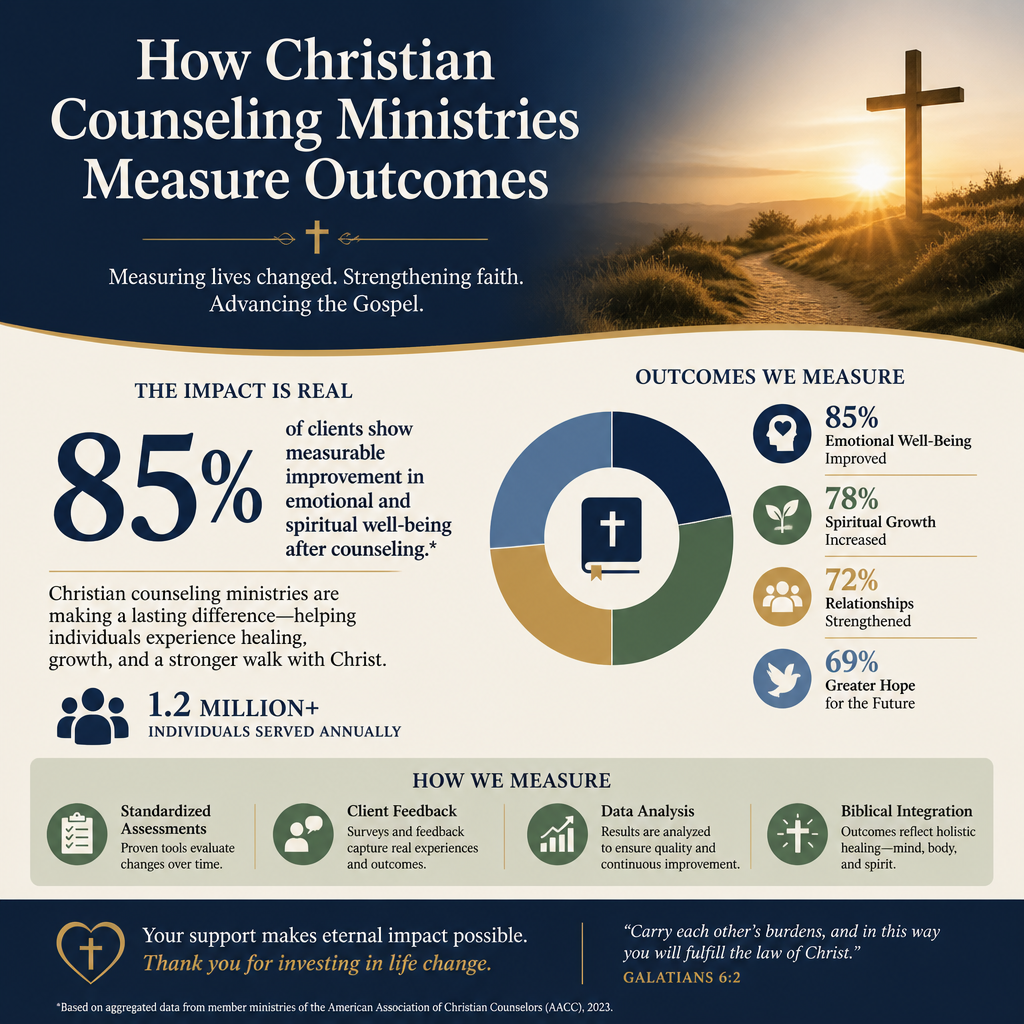
Donors should recognize a difference between “we asked people if they felt better” and “we used validated measures, tracked change over time, and reviewed results in clinical supervision.” The former may be sincere. The latter is more accountable.
It is also reasonable to expect ministries to acknowledge what measurement can and cannot prove. In real-world counseling, improvements can be influenced by life events, medication changes, church support, or concurrent services. Outcome measurement is rarely a clean experiment. The goal is not perfect attribution; it is honest learning and responsible reporting.
Include both quantitative and qualitative evidence
Quantitative tools can show patterns across many counselees. Qualitative feedback can reveal whether the ministry’s approach is experienced as safe, respectful, and spiritually appropriate. Both matter, and both can be misused if they are curated only to reassure donors.
When ministries report outcomes, we recommend they include enough detail for a donor to interpret the claim: how many people were measured, which tools were used, what the time frame was, and what proportion completed follow-up. A strong report is specific about limitations, not defensive.
- Baseline and follow-up: measurement at intake and at defined checkpoints, not only at discharge
- Completion rates: how many clients drop out, and why
- Clinical oversight: supervision structures and escalation protocols
- Safety indicators: crisis response, mandated reporting, and referral networks
- Equity of access: wait times and barriers for low-income or rural counselees
Effectiveness must be paired with transparency and safeguards
Measurement can be manipulated. Governance matters.
Outcomes are easy to market and easy to distort. Ministries can unintentionally bias results by only surveying those who finish counseling, by excluding complex cases, or by redefining success after the fact. Donors should care not only about numbers, but about whether an organization has governance structures that reduce pressure to produce flattering reports.
This is one reason Most Trusted evaluates ministries against The Most Trusted Standard. When boards ask hard questions, when financial reporting is disciplined, and when program claims are documented, ministries are less likely to drift into exaggerated impact narratives. Transparency is not an accessory to effectiveness; it is part of what makes effectiveness credible.
Guardrails for spiritual integration are also outcome safeguards
Because these are Christian counseling ministries, donors should also ask how spiritual practices are integrated. Are Scripture and prayer used as care, or as shortcuts? Are counselees pressured into premature forgiveness or reconciliation? Are complex mental health conditions treated as primarily spiritual failures?
These are not theoretical concerns. Misapplied spiritual counsel can increase shame, deepen trauma, and deter people from seeking appropriate care. A ministry’s outcome story should therefore include safeguards: referral relationships, staff training, clear ethical standards, and a posture of humility before the complexity of human suffering.
How donors can evaluate outcome claims responsibly
Ask for evidence that is proportionate to the ministry’s size
A local counseling center with a small staff may not have the resources of a university clinic. Donors can still expect discipline: clear definitions, consistent measurement, and candid reporting. The question is not whether a ministry has a research department. The question is whether it can show that it learns, improves, and tells the truth about results.
When reviewing outcome claims, we recommend donors ask for the ministry’s own written definitions of success, the tools used, and what the data has prompted them to change. Ministries that are genuinely attentive to outcomes can usually name the adjustments they have made because measurement exposed weaknesses.
Interpret results through a theological lens of stewardship
Christian donors often feel a tension: the desire for accountability can sound like distrust, yet careless giving can enable harm. Scripture holds both realism and charity together. We give as worship, but we also give as stewards who will answer for how resources were directed.
For donors seeking context across the field, it is often helpful to compare how different ministries define and report impact within How Christian Counseling Ministries Measure Impact. Seeing the range of practice can clarify what is mature and what is merely promotional.
Donors who want a broader view of the space—how counseling ministries are structured, governed, and funded—can also review Christian Counseling Ministries as a category. Outcomes make more sense when paired with an understanding of clinical models, church partnerships, and the realities of access to care.
FAQs for How Christian counseling ministries measure outcomes
Should Christian counseling ministries use the same outcome measures as secular clinics?
When ministries are addressing mental health symptoms and functioning, using widely accepted clinical measures is often appropriate, because anxiety, depression, and trauma have observable effects regardless of worldview. Ministries may also include spiritual and relational indicators, but those should be defined carefully and handled ethically. A credible approach distinguishes between clinical change, spiritual formation, and church engagement rather than collapsing them into a single metric.
What if a ministry cannot show strong outcome data yet?
Early-stage measurement is not disqualifying if the ministry is candid about its limits and is building a disciplined system. Donors should look for evidence of integrity: clear definitions, consistent data collection, appropriate privacy protections, and governance that welcomes unfavorable findings. Claims should remain proportionate to the evidence, and ministries should be willing to report what is not improving alongside what is.
A faithful outcome story tells the truth
Christian counseling ministries serve people in some of the most vulnerable moments of their lives. Outcome measurement, done well, honors those counselees by refusing to turn their pain into marketing and by insisting that care be tested, improved, and supervised. Donors can give with deeper confidence when ministries define success clearly, measure change with discipline, and speak with the honesty Scripture requires of every steward.



