
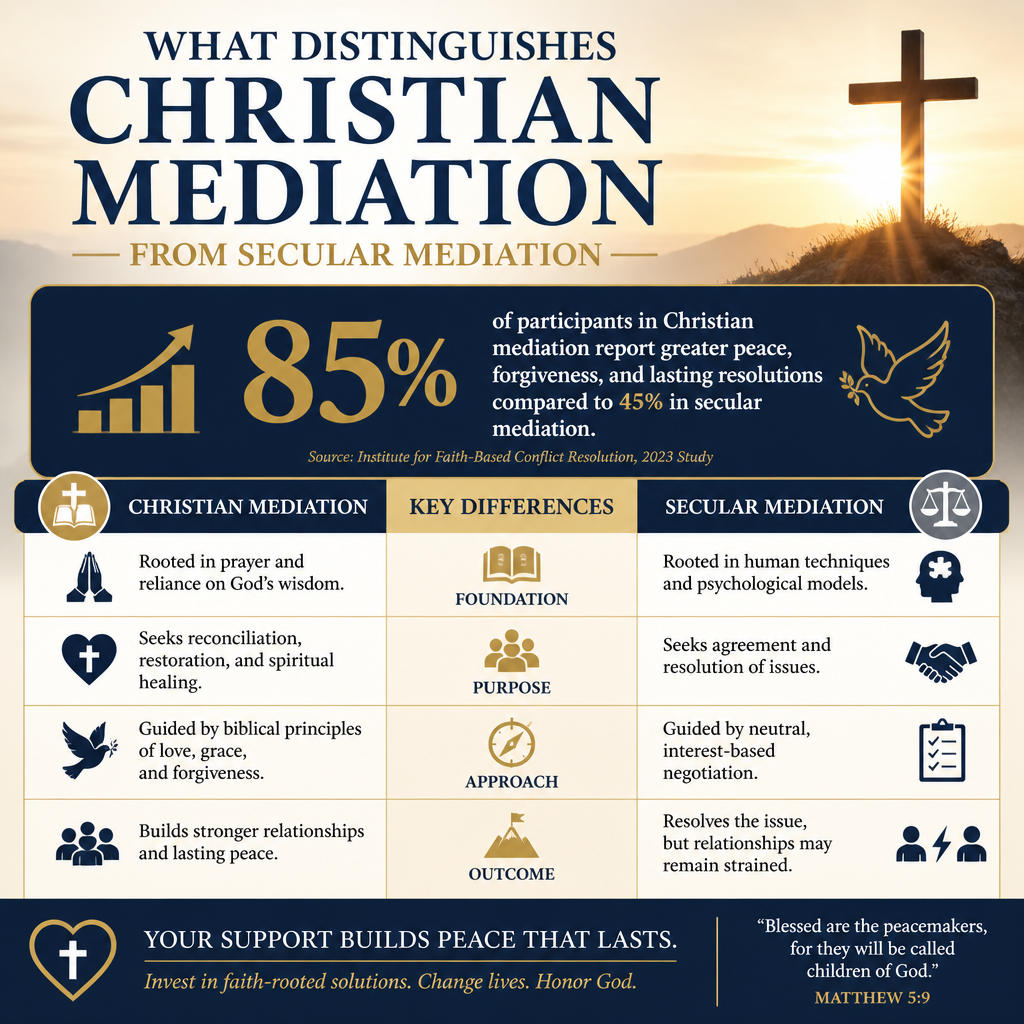
What distinguishes Christian mediation from secular mediation is not merely the presence of prayer or Bible verses, but the ultimate aim of the process: reconciliation under the lordship of Christ. Secular mediation typically seeks a workable agreement that reduces conflict and clarifies terms. Christian mediation, at its best, seeks a just and durable peace that tells the truth about sin, repairs relational breach where possible, and honors the authority of God over both the process and the outcome.
For Christian donors, this distinction matters because conflict resolution ministries often work in high-stakes environments—churches in crisis, marriage breakdown, workplace disputes inside Christian organizations, and fractured relationships that spill into litigation. Funding this work is not funding generic problem-solving. It is funding a ministry of peacemaking that can either embody the gospel with integrity or, if poorly governed, baptize coercion and call it “reconciliation.” Mature giving requires more than sympathy for broken relationships; it requires discernment.
Different goals shape different definitions of success
Agreement is not the same as reconciliation
Most secular mediation models are value-neutral by design. They prioritize party autonomy, confidentiality, and negotiated settlement. Those are not trivial goods. In many settings they protect the vulnerable, prevent escalation, and save time and expense. But the metric of success is commonly an agreement the parties can live with, whether or not the agreement reflects moral truth or relational repair.
Christian mediation has a more demanding horizon. Scripture presents peace not as mere absence of conflict but as a form of wholeness ordered toward God and neighbor. “If possible, so far as it depends on you, live peaceably with all” (Romans 12:18). That command assumes limits—sometimes peace is not possible, sometimes it does not depend on us—yet it also assumes that peacemaking is a Christian obligation rather than a personal preference.
Justice and truth are not optional add-ons
The harder question is whether “getting to yes” can become a subtle way of avoiding truth. Christian mediation is not free to treat right and wrong as merely competing narratives. It must take seriously that certain actions—deceit, exploitation, coercion, abuse—are not simply “issues to negotiate” but sins to be named and, where possible, repaired. This does not mean mediators play judge. It means the process cannot be structured to reward manipulation or to silence the harmed for the comfort of the powerful.
This is where donors should press for clarity. Ministries doing Christian mediation should be explicit about what they mean by reconciliation, when it is appropriate, and when safety and justice require separation, reporting, or formal discipline. In church contexts especially, the line between “peace” and “pressure” can be thin when leadership accountability is weak.

Authority and anthropology are different at the root
Secular frameworks rely on autonomy
Secular mediation generally begins with a modern assumption: individuals are autonomous agents who define their own interests and negotiate their own terms. The mediator’s role is to facilitate communication, surface interests, and help the parties reach a voluntary agreement. Many Christian mediators also use these tools because they work; careful listening and reframing can lower defensiveness and clarify what is actually being disputed.
Yet Christian faith begins elsewhere. We are not self-created. We belong to God, and we are accountable to his moral order. That accountability places real constraints on what a Christian can rightly agree to, and it also places obligations on how a Christian pursues resolution: truthfulness, mercy, restitution, and a refusal to bear false witness even when doing so would “win.”
Christian mediation assumes sin and the need for repentance
Christian mediation is distinguished by its anthropology. Scripture does not treat conflict primarily as misunderstanding among basically good people; it treats conflict as flowing from disordered desires and rival kingdoms of the heart. “What causes quarrels and what causes fights among you? Is it not this, that your passions are at war within you?” (James 4:1). A process that never asks about repentance, forgiveness, restitution, or the fear of the Lord will tend to stay at the level of tactics rather than transformation.
Christians genuinely disagree about how overtly theological the mediation room should be. Some contexts—especially when one party is not a believer—require a careful and respectful posture. But Christian mediation, if it is Christian in substance, cannot function as though sin is merely a misunderstanding and grace is merely goodwill.
Process differences reveal what a ministry truly believes
The role of Scripture and prayer is real and disciplined
In Christian mediation, Scripture is not used as a rhetorical weapon. It functions as moral ballast and shared authority for those who receive it, and as a boundary against sentimental peacemaking. A mediator may pray, may remind parties of biblical obligations, and may frame the dispute in terms of stewardship and neighbor-love. But a disciplined Christian practice refuses to use spiritual language to rush lament, bypass accountability, or produce superficial harmony.
When donors evaluate peacemaking ministries, our team recommends asking whether the ministry has written standards for how Scripture is applied, how confidentiality is handled, and how power imbalances are addressed. “Christian” language can conceal poor practice unless the organization is willing to be evaluated.
Confidentiality has limits when harm is present
Most mediation models elevate confidentiality because it enables candor. Christian mediation should value that candor while also being clear-eyed about circumstances where confidentiality cannot be absolute. Allegations of child abuse, credible threats of violence, and certain forms of fraud require reporting and protective action. This is not a concession to “secular requirements” but an application of neighbor-love and justice.
Donors have watched too many institutions protect reputations at the expense of the vulnerable. A faithful mediation ministry does not promise secrecy that it cannot morally or legally keep. It explains boundaries in writing, ensures informed consent, and does not place the burden of institutional peace on those who are already harmed.
Church and ministry disputes require ecclesial competence
Christian mediation understands spiritual and organizational dynamics
Conflicts inside churches and Christian nonprofits have layers: theology, personality, governance, and spiritual formation. A secular mediator can be highly skilled and still miss the significance of covenant language, membership vows, church discipline, or the authority structures of elders and boards. Christian mediation in these settings requires not only conflict-resolution skill but also ecclesial competence—an understanding of how authority should function and how it can be distorted.
This is one reason donors often support ministries with specialized focus, such as church conciliation organizations, reconciliation ministries serving pastors, or peacemaking groups trained in both mediation and church polity. The work is not interchangeable with generic mediation services.
Reconciliation is never a mandate to endure abuse
The field has had to reckon with a grievous pattern: “forgiveness” language used to pressure victims into unsafe proximity with unrepentant offenders. Christian mediation must be able to say plainly that forgiveness and reconciliation are not identical. Scripture commands forgiveness; it also commands justice, protection of the vulnerable, and wise boundaries. Repentance is not a script, and reconciliation is not owed to the unaccountable.
Donors can honor both mercy and truth by supporting ministries that demonstrate competence in safeguarding, referrals to licensed counselors when needed, and coordination with appropriate authorities. A ministry that treats every dispute as morally symmetrical is not practicing biblical discernment.
What donor due diligence should look for in peacemaking ministries
Outcomes are spiritual and practical, so accountability must be both
Christian donors are often willing to fund intangible outcomes—restored relationships, reconciled leadership teams, congregations that avoid schism—because these outcomes are genuinely valuable. The risk is that intangible outcomes are also easy to claim without evidence. That is why governance, financial integrity, and transparency matter in this category as much as theological fidelity.
At Most Trusted, we evaluate Christian nonprofits against The Most Trusted Standard, a 15-criteria framework across Faith Foundation, Financial Integrity, Governance and Leadership, and Transparency and Effectiveness. In conflict resolution ministries, these areas are not abstract checkboxes. They are protective structures. Weak governance can turn mediation into brand management. Weak financial practices can create perverse incentives to promise quick peace. Weak transparency can conceal patterns of harm.
Practical markers donors can reasonably request
Before funding a Christian mediation ministry, donors can request concrete information that indicates maturity and restraint:
- Written policies on confidentiality, mandatory reporting, and safeguarding when harm is alleged
- Clear statements about the difference between forgiveness, reconciliation, and restoration to leadership
- Training standards for mediators, including supervision and continuing education
- Governance practices that prevent conflicts of interest when disputes involve senior leaders
- Evidence of transparent financial reporting and appropriate use of restricted gifts
What this means in practice is that donors should treat peacemaking ministries as both spiritual and institutional endeavors. The church is not served when mediation is framed as a purely private matter. Nor is it served when ministry leaders are permitted to redefine “peace” as the absence of scrutiny.
For donors looking to support this work across a broader landscape, the most reliable first step is to understand the wider field of Christian Conflict Resolution Ministries and how different organizations define their scope, their safeguards, and their theology of reconciliation.
FAQs for What distinguishes Christian mediation from secular mediation
Is Christian mediation only for disputes between believers?
No. Christian mediation can serve mixed-faith or even non-faith contexts, especially when the ministry’s service is requested and the process is transparent about its commitments. In practice, the more explicitly theological the framework becomes—shared submission to Scripture, repentance, forgiveness—the more important it is that participants understand what they are consenting to. When only one party is Christian, a wise mediator will avoid using Scripture as a pressure tactic while still embodying Christian virtues: truthfulness, patience, and a commitment to justice.
Does Christian mediation mean parties should avoid courts at all costs?
Scripture commends reconciliation and warns against litigiousness among believers (1 Corinthians 6:1–8), but it does not require Christians to forgo lawful protection when serious harm is present. Certain matters—criminal abuse, credible threats, significant fraud—properly involve civil authorities. Christian mediation is not an alternative justice system. It is a ministry that can help parties pursue confession, restitution, and durable agreements where appropriate, without using “keeping it in-house” to shield wrongdoing.
Why the distinction matters for faithful giving
Christian mediation differs from secular mediation because it answers to a different authority and pursues a thicker peace—one that can name sin, protect the vulnerable, and seek reconciliation without denying justice. For donors, the question is not only whether a ministry can reduce conflict, but whether it can do so without trading truth for quiet. The ministries most worthy of support tend to pair theological seriousness with institutional safeguards, because peacemaking without accountability is not a ministry of reconciliation; it is a mechanism of control.
As donors consider where to invest, the category of The Mission and Impact of Christian Peacemaking Ministries deserves careful attention. Healthy peacemaking organizations strengthen churches and Christian nonprofits for the long term, not by avoiding hard truths, but by insisting that the path to peace runs through them.



