
What liability insurance Christian mediation ministries should carry is not a clerical detail. It is a stewardship question that touches the credibility of the ministry, the protection of vulnerable people, and the integrity of the reconciliation work itself. Donors have a legitimate interest in whether a ministry has the financial capacity to absorb a claim without collapsing, retaliating against whistleblowers, or quietly shifting harm onto those it was called to serve.
Christian conciliation operates in a high-trust environment: pastors, peacemakers, and counselees often share prayer, confession, and sensitive personal history in the same room. That spiritual texture is a strength, but it also magnifies risk. When a dispute later turns adversarial, the ministry’s records, decisions, and communications can become evidence, and the ministry can become a target—sometimes fairly, sometimes opportunistically. Wise insurance coverage does not replace godly governance, but it does keep a ministry from being one lawsuit away from insolvency.
Why insurance is not a lack of faith
Stewardship requires foresight
Scripture commends prudent preparation alongside dependence on God. The ant’s diligence is praised not because it removes God from the picture, but because it honors the moral reality that tomorrow will come with real needs (Proverbs 6:6–8). For mediation ministries, the question is not whether conflict will arise—conflict is the ministry context—but whether the organization has planned for predictable forms of financial exposure that can accompany conflict work.
Insurance is one way a board acknowledges its duty of care. It is also a way to keep the ministry’s mission from being derailed by a single incident: an allegation of mishandled confidentiality, a claim of negligent referral, or an accident at an on-site training. The better-run ministries we observe across our verification work treat insurance as part of an integrated risk posture: clear policies, trained staff, documented processes, and coverage that matches the organization’s actual activities.
Mediation ministries can be sued even when they act responsibly
American civil litigation is expensive even when a claim lacks merit. Defense costs alone can pressure small ministries into unfavorable settlements simply to stop the bleeding. The American Bar Association has documented how litigation expenses can shape outcomes independent of the underlying facts, particularly where discovery is intensive and document production is costly; the dynamics are well summarized in the ABA’s resources on civil litigation and access to justice (American Bar Association).
That reality is not an argument for fear. It is an argument for ensuring that a ministry’s reconciliation work is not held hostage to the financial asymmetry of a lawsuit.

Core liability coverages most mediation ministries should not treat as optional
General liability and premises exposure
Commercial general liability covers the ordinary but consequential risks of operating in the physical world: a participant trips at a training, a venue alleges property damage, or someone claims a ministry volunteer’s actions caused bodily injury. Even ministries that “only do mediation” often host meetings, trainings, or conferences. If the ministry meets at churches, the church’s policy may cover the church, not the ministry, and not necessarily the ministry’s volunteers acting under the ministry’s direction.
Donors should ask whether the ministry has general liability sized to its actual footprint: number of events, average attendance, and whether the ministry uses volunteers for logistics or hospitality. A minimal policy purchased to satisfy a venue contract is not the same as coverage shaped to the ministry’s risk.
Professional liability for mediation and conciliation services
For Christian mediation ministries, professional liability—often called errors and omissions—matters as much as general liability. It is the coverage category most likely to respond when a claimant alleges harm from the ministry’s professional services: negligent advice, failure to follow established protocols, mishandling of a process, or breach of confidentiality. Even when the ministry carefully distinguishes mediation from counseling and avoids legal advice, participants may still allege reliance.
Because many ministries operate under pastoral authority or within a church network, there is sometimes confusion about whether “pastoral counseling” coverage applies to mediation. The harder truth is that policy language and exclusions govern, not the ministry’s self-description. Ministries should work with a broker who can name, in writing, whether mediation, arbitration, conciliation, coaching, training, and case management are covered activities.
Coverage areas donors should watch closely in Christian conflict work
Sexual misconduct and abuse liability
It is painful to name, but Christian organizations have learned that misconduct claims can arise in contexts where one party holds perceived spiritual authority, where confidentiality is expected, and where vulnerable people seek help. Mediation ministries do not exist to provide abuse response, but they can still become entangled in allegations if they facilitated a process involving an abusive dynamic, failed to report when required, or placed a victim back into proximity with harm.
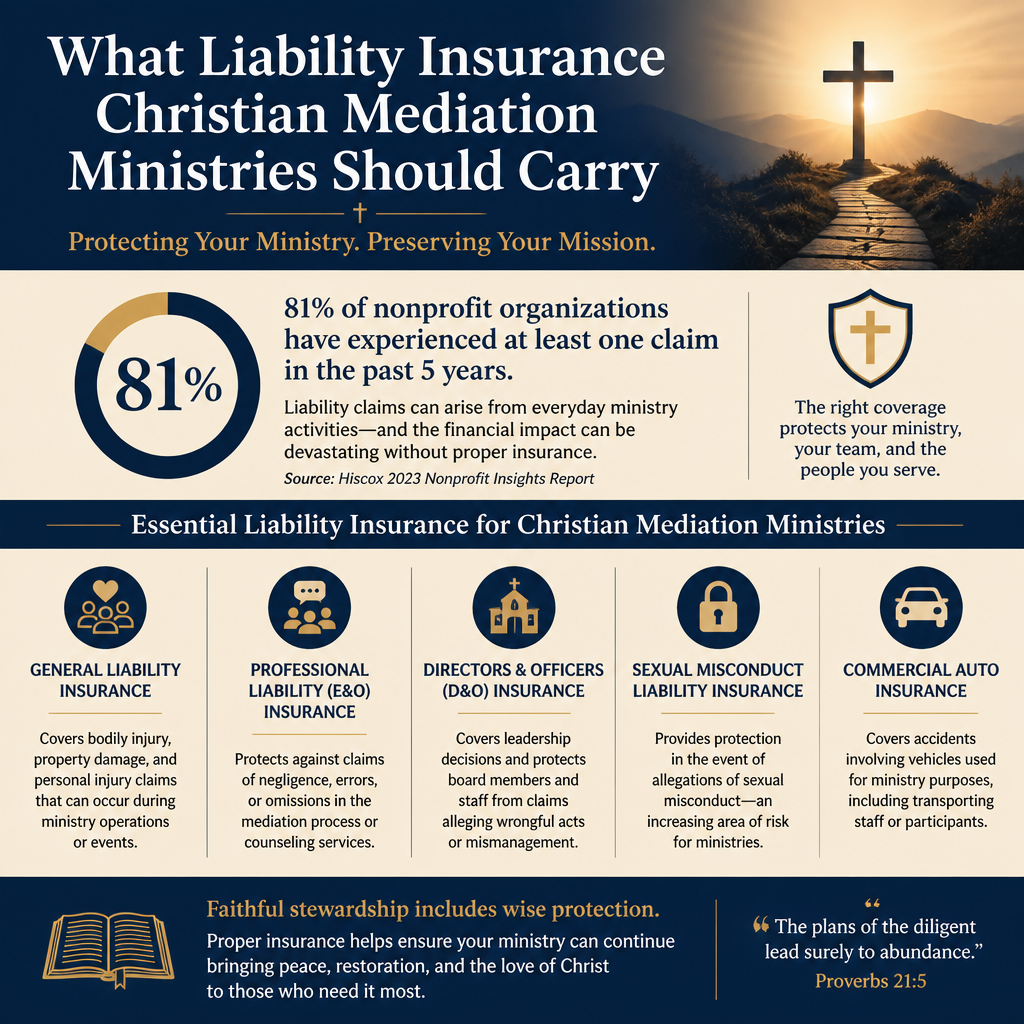
Many general and professional liability policies exclude sexual misconduct or severely limit it. A separate sexual misconduct and abuse liability endorsement or policy may be necessary. This is not only about worst-case scenarios; it is about whether the ministry has taken seriously the duty to protect. Donors should also look for alignment between coverage and practice: screening, two-adult rules where appropriate, boundaries for one-on-one meetings, and clear pathways for reporting.
Employment practices liability for internal conflict
It is not unusual for organizations devoted to reconciliation to face conflict inside their own walls. Employment practices liability insurance, often called EPLI, helps cover claims such as wrongful termination, retaliation, discrimination, and harassment. This matters for mediation ministries because staff and contractors may be exposed to intense emotional dynamics, and because confidentiality and discretion—good in the mediation room—can become unhealthy opacity in HR matters.
The U.S. Equal Employment Opportunity Commission continues to report tens of thousands of workplace discrimination charges each year (U.S. Equal Employment Opportunity Commission). A ministry’s faithful intent does not immunize it from HR exposure, and small organizations can be particularly strained by the costs of responding to a claim.
Governance protection and modern operating risks
Directors and officers liability for board-level decisions
Directors and officers coverage, or D&O, protects the organization and its leaders when claims arise from governance decisions: allegations of mismanagement, breach of fiduciary duty, improper handling of conflicts of interest, or failure to supervise. For ministries working with disputes, allegations sometimes include “you should have known” theories—especially when a case involves a leader’s misconduct, a disputed church discipline process, or a contested outcome.
Many donors assume a board is safe if it is composed of respected pastors and professionals. The legal exposure is not reduced by reputation. D&O coverage signals that the board understands that spiritual authority does not replace legal responsibility, and that the ministry is committed to accountability structures that can withstand scrutiny.
Cyber liability and the duty to protect confidences
Mediation ministries hold sensitive data: intake forms, allegations, audio or video recordings, email chains, and sometimes counseling referrals. Even modest organizations can face phishing, ransomware, and accidental disclosure. Cyber liability coverage can help with breach response costs, forensic investigation, notification, credit monitoring, and in some cases extortion demands. It can also address third-party claims alleging failure to protect information.
The Federal Bureau of Investigation has repeatedly emphasized that ransomware and business email compromise affect organizations of all sizes, including nonprofits (Federal Bureau of Investigation). Donors should treat information security as a moral issue: the confidentiality that makes mediation possible is also a promise that can be violated through negligence.
How donors can assess insurance without becoming underwriters
Ask for evidence of coverage that matches real activities
Most donors do not need policy schedules. But donors can reasonably ask whether the ministry carries the major liability lines relevant to its work and whether limits are reviewed annually by the board. Within Christian Conflict Resolution Ministries, the pattern is consistent: organizations that are serious about protection can explain their coverage plainly and can name who oversees risk management at the governance level.
A concise donor-facing answer should include the types of coverage carried, whether the ministry uses an experienced nonprofit broker, and whether there are known exclusions that shape how the ministry operates. If a ministry says, “We rely on God, not insurance,” donors should understand that as a warning signal about governance maturity, not as a mark of spiritual depth.
Look for risk alignment, not just a list of policies
Insurance can become a performative checklist if it is not integrated with the ministry’s practices. Donors should consider whether the ministry has policies that reduce predictable risk and whether its insurance is built to support those policies. A short set of indicators can guide donor conversations:
- Written confidentiality policy and clear limits for mandated reporting and safety concerns
- Documented intake and screening that identifies power imbalances and potential abuse dynamics
- Role clarity that prevents mediators from drifting into legal advice or clinical counseling
- Board review of insurance coverages and limits at least annually
- Secure data practices for case files, email, and recordings, supported by cyber coverage
These are not merely operational details. They are expressions of love of neighbor in organizational form: minimizing foreseeable harm, telling the truth about risk, and refusing to trade vulnerable people’s safety for institutional convenience. This is also where donors benefit from verification. At Most Trusted, we evaluate ministries against The Most Trusted Standard, including governance, financial integrity, and transparency indicators that often correlate with responsible risk management. Within Legal and Ethical Standards in Christian Conflict Resolution, mature organizations typically treat insurance as one component of a larger commitment to accountability.
FAQs for What liability insurance Christian mediation ministries should carry
Should a Christian mediation ministry carry professional liability even if it never gives legal advice?
Yes. Claims often hinge on what a participant believed they were receiving, not on what the ministry intended to provide. Professional liability is designed to respond to allegations tied to the performance of services—such as negligent process, mishandled confidentiality, or failure to follow stated protocols—even when no legal advice was given.
Does meeting at a church mean the church insurance covers the mediation ministry?
Not necessarily. A church policy generally protects the church and its activities, and coverage for third-party ministries varies widely. A mediation ministry should carry its own general liability and confirm in writing how additional insured endorsements and venue agreements are handled.
What faithful insurance coverage signals to donors
Christian mediation ministries exist to bear witness to the reconciling work of Christ in human conflict. That calling deserves structures strong enough to endure pressure. Adequate liability coverage does not sanctify a ministry, and inadequate coverage does not automatically condemn one, but insurance decisions do reveal whether leaders are prepared to carry the costs of accountability. Donors should favor ministries that can name their risks, govern them transparently, and protect the people they serve without compromising their mission when conflict inevitably intensifies.



